
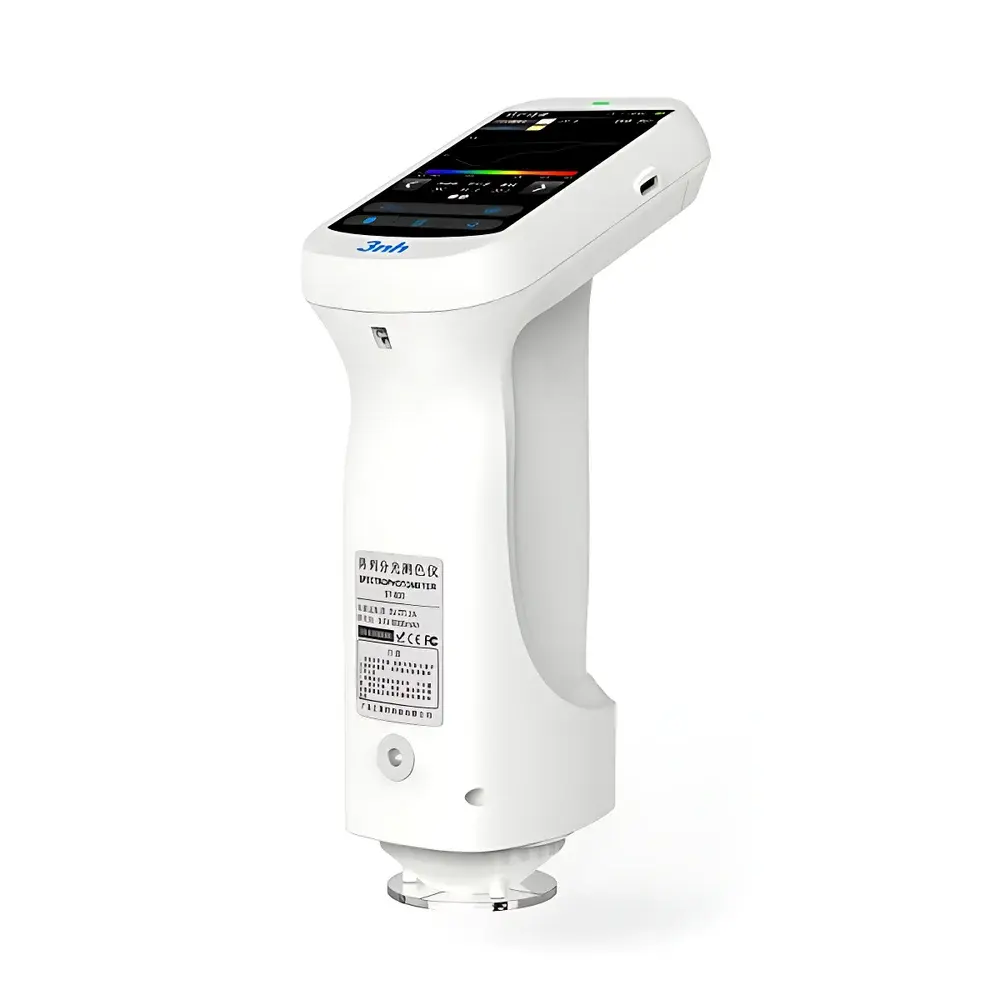
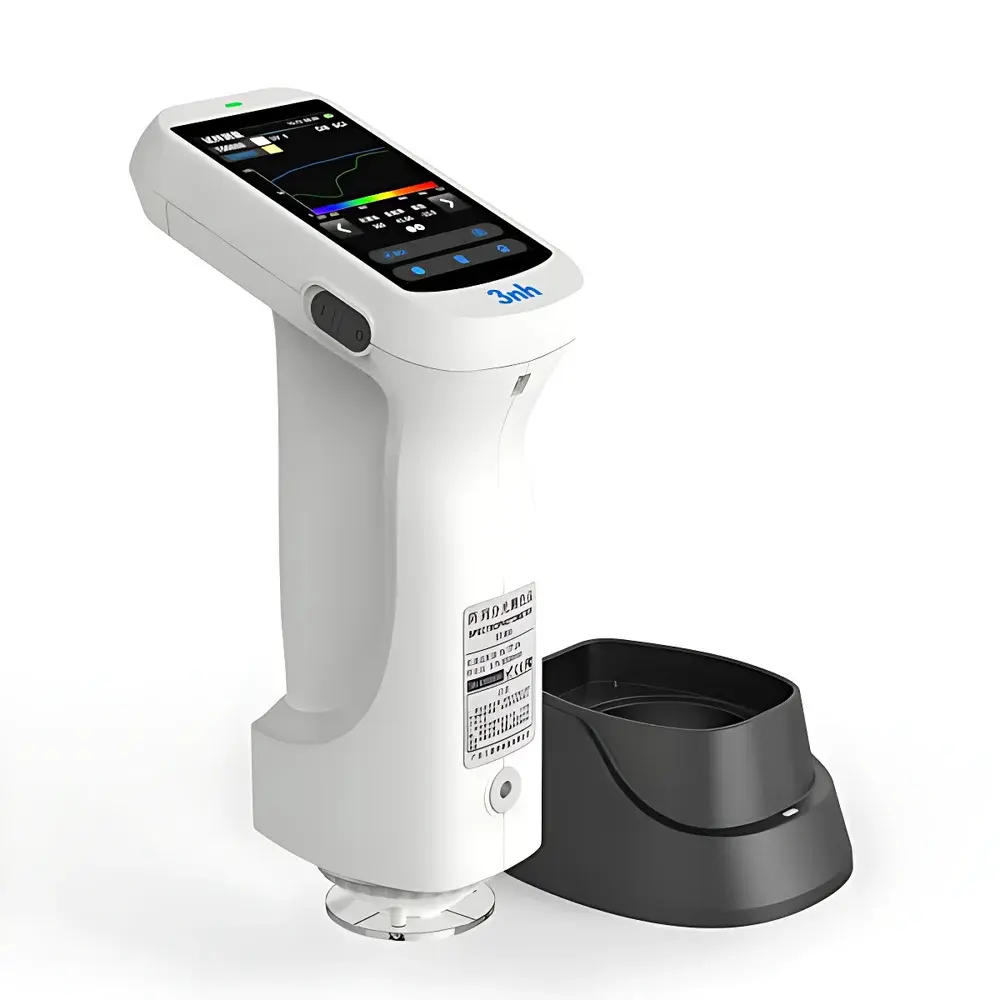
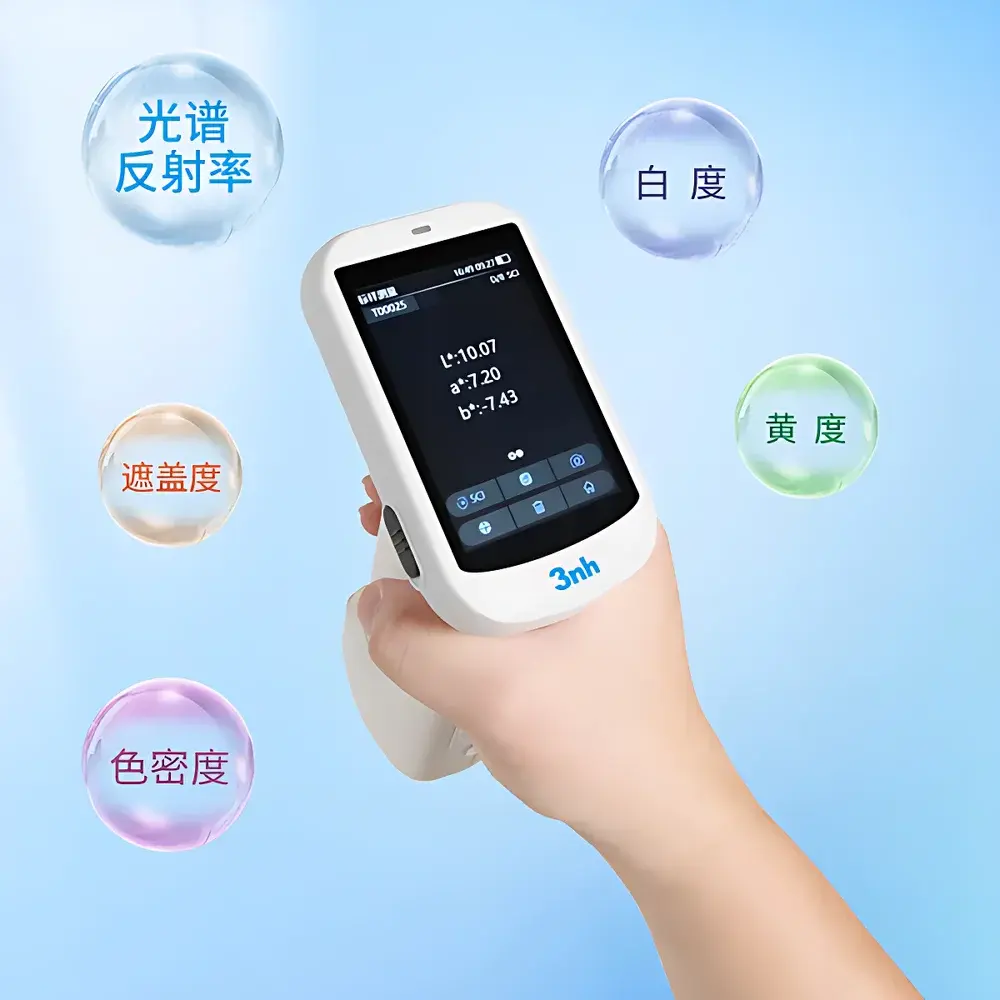
3nh ST-800 Handheld Spectrophotometer
| Brand | 3nh |
|---|---|
| Origin | Guangdong, China |
| Manufacturer Type | Original Equipment Manufacturer (OEM/ODM) |
| Product Category | Spectrophotometric Colorimeter |
| Instrument Type | Portable |
| Optical Geometry | d/8° integrating sphere (SCI/SCE modes) |
| Light Source | Full-spectrum LED array + UV-emitting LED |
| Spectral Range | 400–700 nm |
| Wavelength Interval | 10 nm |
| Repeatability | ΔE*ab ≤ 0.015 (MAV/SCI, after warm-up and 30 measurements of white tile at 5 s intervals) |
| Reflectance Standard Deviation | ≤ 0.07% (MAV/SCI) |
| Inter-instrument Agreement | ΔE*ab ≤ 0.18 (BCRA Series II 12 tiles, MAV/SCI) |
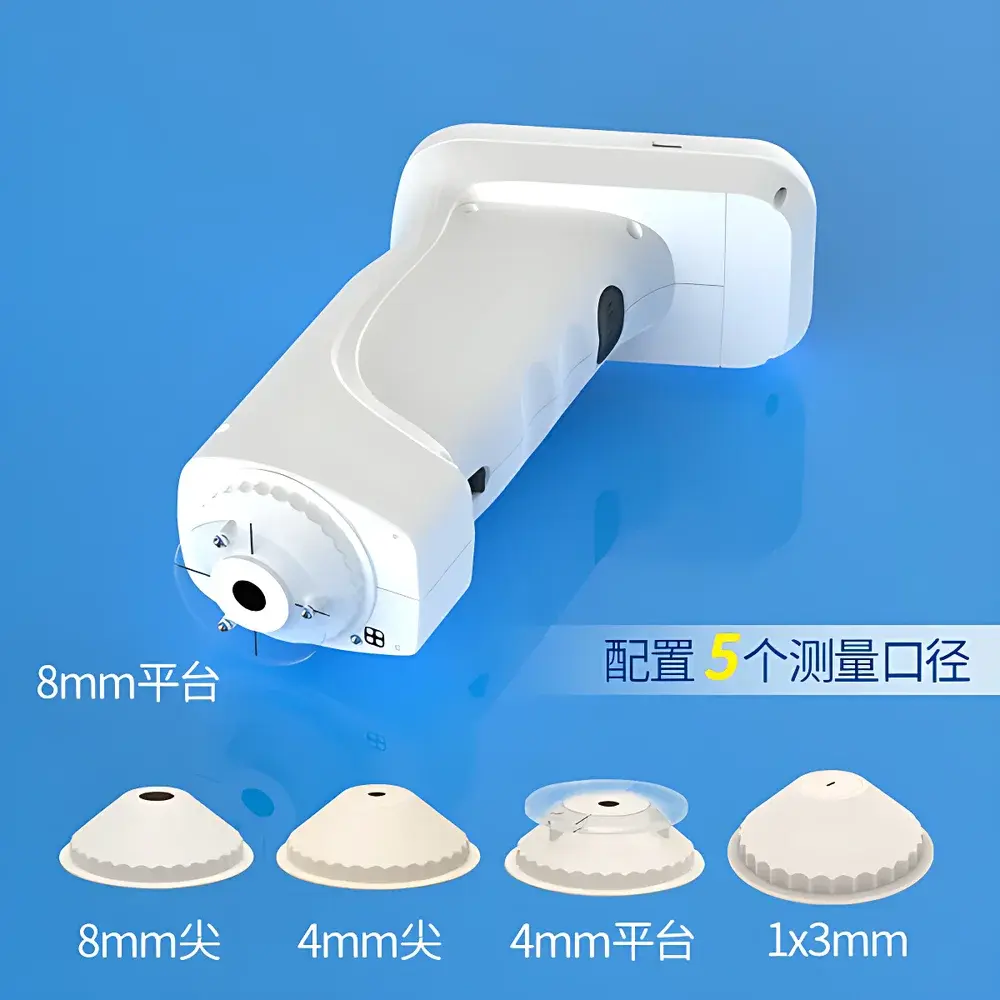
| Aperture Options | Five interchangeable ports — 8 mm flat, 8 mm tip, 4 mm flat, 4 mm tip, 1×3 mm rectangular |
| Viewing System | Integrated CMOS camera with real-time preview |
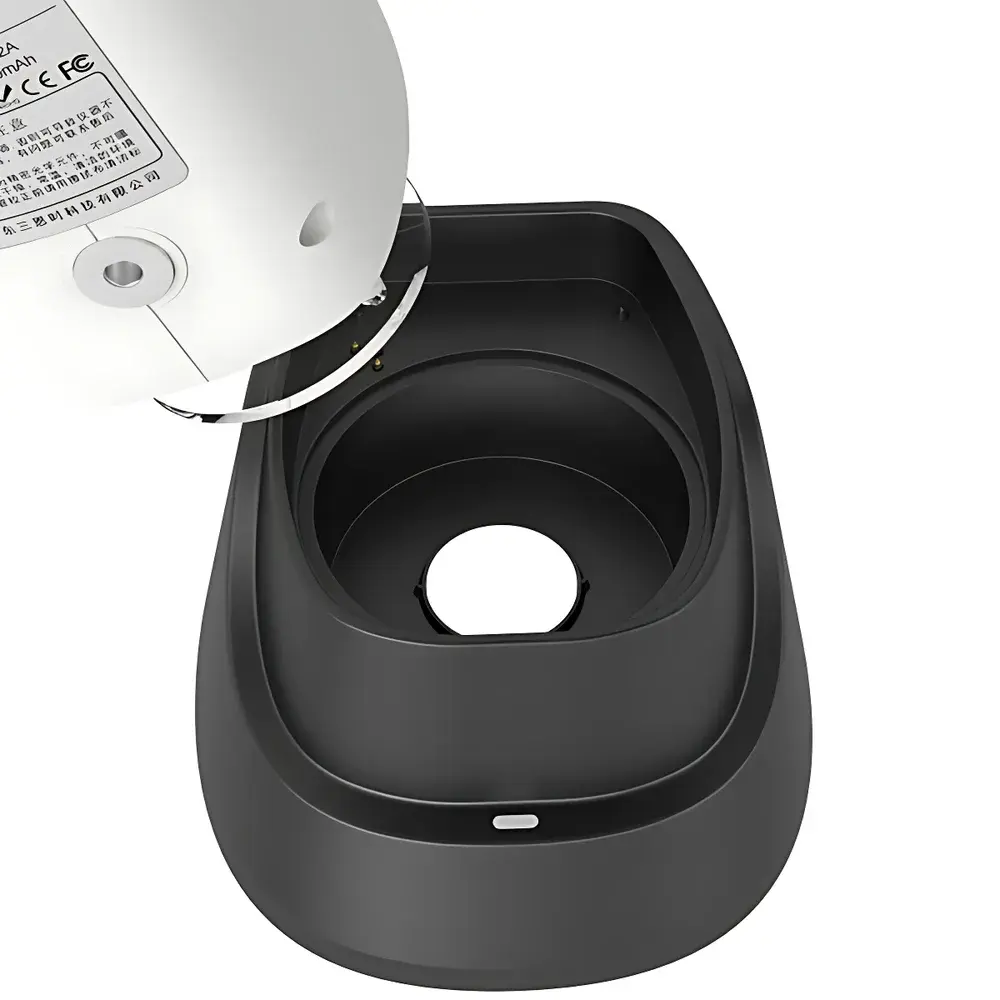
| Calibration | Non-contact automatic white calibration via smart base |
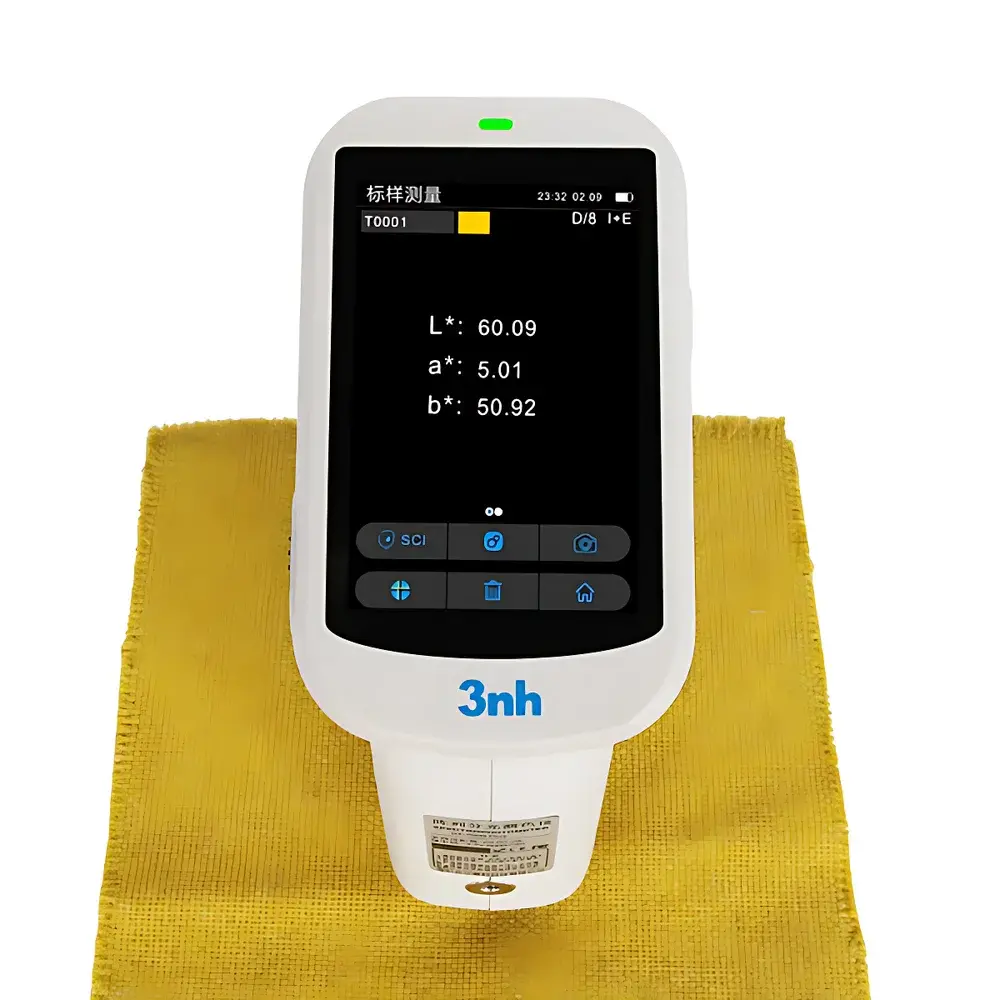
| Display | 3.5″ capacitive TFT touchscreen |
| Connectivity | USB 2.0, Bluetooth® 5.0 |
| Battery | Rechargeable Li-ion, 3.7 V / 5000 mAh |
| Operating Temperature | 0–40 °C, ≤85% RH (non-condensing), altitude <2000 m |
| Storage Temperature | −20–50 °C, ≤85% RH |
| Compliance | CIE No. 15:2018, ISO 7724-1:1984, ASTM E1164-22, DIN 5033-7:2018, GB/T 3978–2008, GB/T 18833–2020 |
Overview
The 3nh ST-800 Handheld Spectrophotometer is a precision optical instrument engineered for high-fidelity color measurement in industrial quality control environments. It operates on the principle of diffuse illumination and 8° viewing geometry (d/8°), compliant with CIE No. 15 and ISO 7724-1 standards, enabling simultaneous measurement in both Specular Component Included (SCI) and Specular Component Excluded (SCE) modes. Its core optical architecture integrates a 40-mm diameter integrating sphere with dual-array silicon photodiode sensors (40-element × 2), ensuring robust signal capture across the visible spectrum (400–700 nm) at 10-nm resolution. The inclusion of a dedicated UV-emitting LED—combined with full-spectrum white LEDs—enables accurate assessment of fluorescent whitening agents (FWAs), optical brighteners, and UV-reactive pigments commonly found in textiles, paper, plastics, and coatings. Designed for field-deployable metrology, the ST-800 delivers laboratory-grade spectral reflectance data without requiring fixed benchtop infrastructure.
Key Features
- Full-spectrum + UV illumination system: Dual-source optical design eliminates spectral gaps between 360–400 nm and 400–700 nm, supporting quantitative evaluation of UV-dependent colorants per ASTM D1925 and ISO 105-J03.
- Dual 40-channel photodiode array: Provides enhanced dynamic range to mitigate saturation under high-reflectance conditions and improve signal-to-noise ratio in low-reflectance or textured surfaces.
- Five interchangeable apertures: Includes 8 mm flat, 8 mm conical, 4 mm flat, 4 mm conical, and 1×3 mm rectangular ports—enabling precise targeting of heterogeneous samples such as printed halftones, woven fabrics, or small electronic components.
- Real-time optical preview: Integrated CMOS camera overlays measurement crosshairs onto live video feed, ensuring spatial accuracy and eliminating misalignment errors during handheld operation.
- Non-contact auto-calibration: Smart base enables repeatable, operator-independent white calibration without physical contact—reducing drift and maintaining traceability per ISO/IEC 17025 requirements.
- Multi-standard colorimetric engine: Computes CIE LAB, LCH, XYZ, Yxy, CIE LUV, Hunter Lab, DIN 99, and Munsell (C/2) coordinates; supports ΔE*ab, ΔE00, ΔE94, ΔEcmc (1:1 & 2:1), DIN ΔE99, and ASTM D2244-compliant tolerancing.
- Comprehensive spectral metrics: Outputs spectral reflectance curves, whiteness (ASTM E313, CIE/ISO), yellowness (ASTM D1925), metamerism index (Mt), color strength (dye yield), opacity, gloss (8°), and CMYK density—facilitating cross-functional QA workflows.
Sample Compatibility & Compliance
The ST-800 accommodates diverse sample morphologies—including flat, curved, textured, granular, and translucent materials—via its modular aperture system and stable contact plate. It meets regulatory expectations for color-critical industries: compliance with ASTM E1164 (instrumental color measurement), ISO 7724-1 (geometry and illuminant specifications), and GB/T 18833 (traffic sign retroreflectivity) ensures interoperability with global supply chain protocols. For pharmaceutical packaging and medical device labeling, its traceable calibration path and audit-ready data export support GLP/GMP alignment. While not FDA 21 CFR Part 11–certified out-of-the-box, raw spectral data files (.spc, .csv) retain full metadata (timestamp, operator ID, aperture, illuminant, observer angle), enabling integration into validated LIMS or ELN systems.
Software & Data Management
The ST-800 interfaces natively with 3nh’s QC software suite (Windows/macOS), mobile apps (iOS/Android/HarmonyOS), and cloud-enabled web platforms. All firmware and application layers support Unicode UTF-8 encoding for multilingual label generation and report localization. Measurement data—including full spectral curves, color difference matrices, pass/fail flags, and image annotations—is stored locally (500 standards + 20,000 samples) and synchronized via encrypted Bluetooth 5.0 or USB mass storage. Export formats include CSV (for Excel/Python analysis), PDF (ISO-compliant test reports), and XML (for ERP/MES integration). Audit trails log every calibration event, user login, and parameter change—meeting ISO 9001 clause 7.1.5.2 requirements for monitoring and measurement resource control.
Applications
This spectrophotometer serves as a primary color verification tool across regulated and high-volume manufacturing sectors. In plastics and electronics, it validates batch-to-batch consistency of injection-molded housings against Pantone or RAL standards. Within textile dyeing facilities, it quantifies shade deviation across dye lots while calculating metamerism risk under retail lighting (e.g., F11 TL84, LED-B2). Printing operations leverage its 1×3 mm aperture to assess dot gain and ink trapping on halftone patches per ISO 12647-2. Paint and coating labs use UV-enabled measurements to monitor FWA degradation during weathering tests (ASTM G154). Ceramic tile producers apply SCE mode to separate surface gloss effects from intrinsic pigment performance—critical for ISO 105-J03-compliant whiteness certification.
FAQ
Does the ST-800 support third-party spectral database integration?
Yes—raw .spc files contain wavelength-intensity pairs with embedded CIE illuminant/observer metadata, compatible with industry-standard tools including BYK-Gardner labVIEW modules, Datacolor SpectraMagic, and open-source Python libraries (e.g., colour-science).
What is the recommended recalibration frequency for production-line use?
For continuous operation in controlled environments (23 ± 2 °C, 50 ± 5% RH), daily white calibration using the supplied ceramic tile is sufficient. In variable ambient conditions or after transport, perform calibration before each shift and log results for ISO 9001 internal audits.
Can the device measure transparent or translucent films?
Yes—when used with the optional transmission adapter (sold separately), the ST-800 supports transmittance mode per ISO 13655:2017, enabling haze-corrected color evaluation of PET, polycarbonate, and coated glass substrates.
Is firmware update capability available over-the-air?
Firmware updates require connection to a host PC running the official 3nh QC software; no OTA or cloud-based remote update functionality is implemented to maintain measurement integrity and prevent unauthorized modification.
How does the ST-800 handle inter-instrument agreement in multi-site deployments?
With ΔE*ab ≤ 0.18 across BCRA Series II tiles, the ST-800 meets ISO 13655 Class II tolerance for portable instruments. For tighter synchronization, users may perform cross-calibration using shared master standards traceable to NIM (China National Institute of Metrology) or PTB-certified artifacts.




