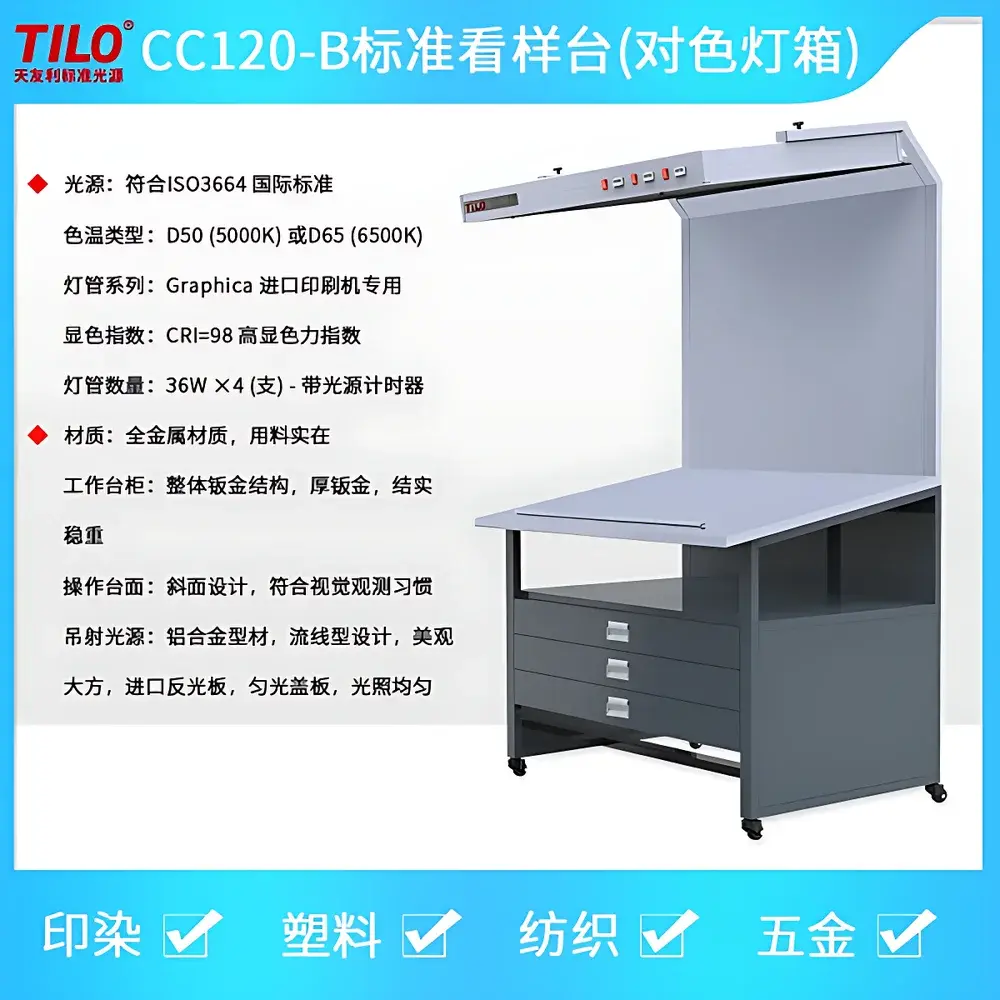
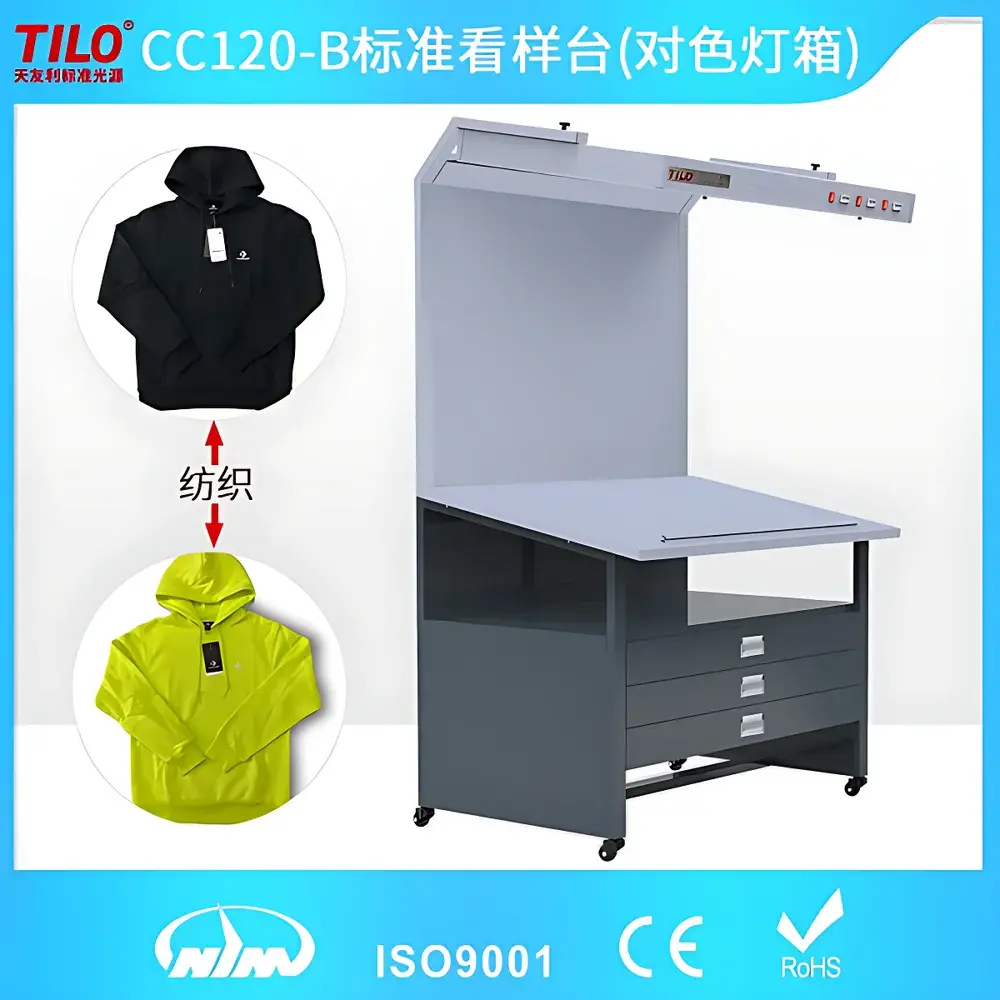
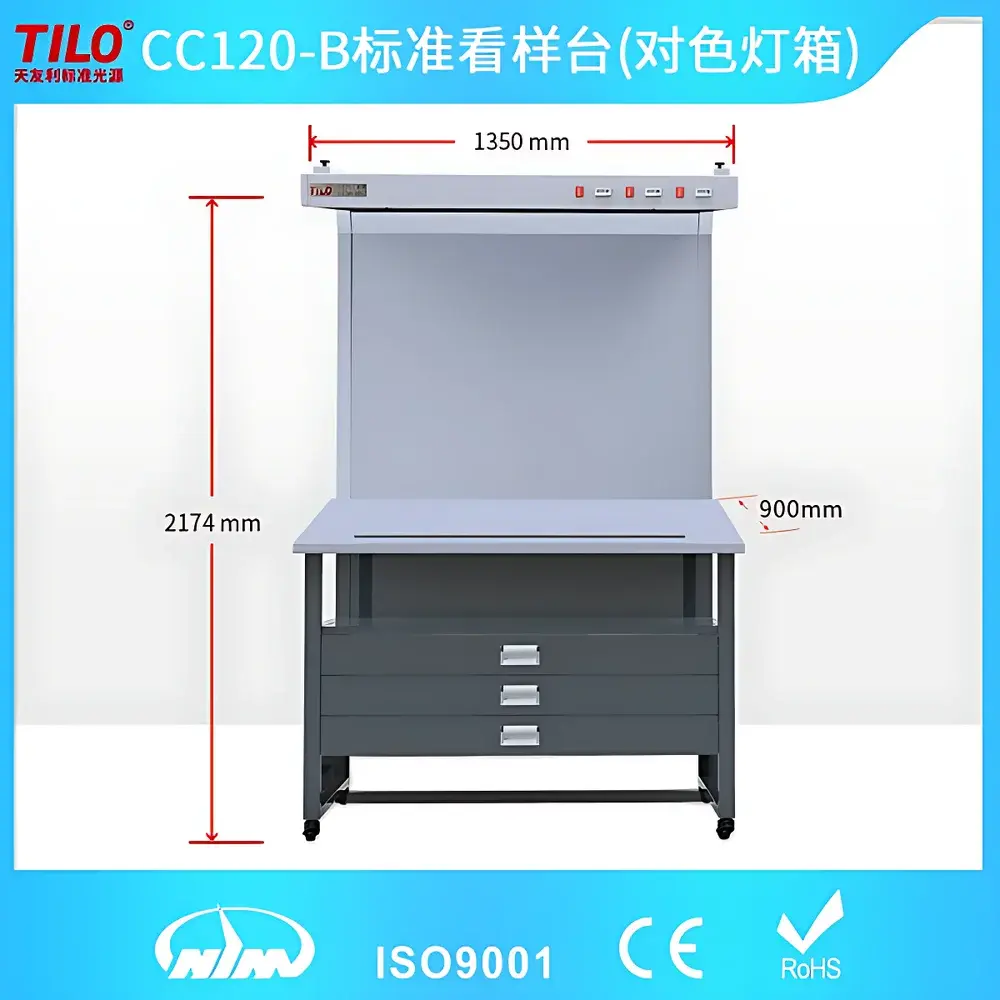
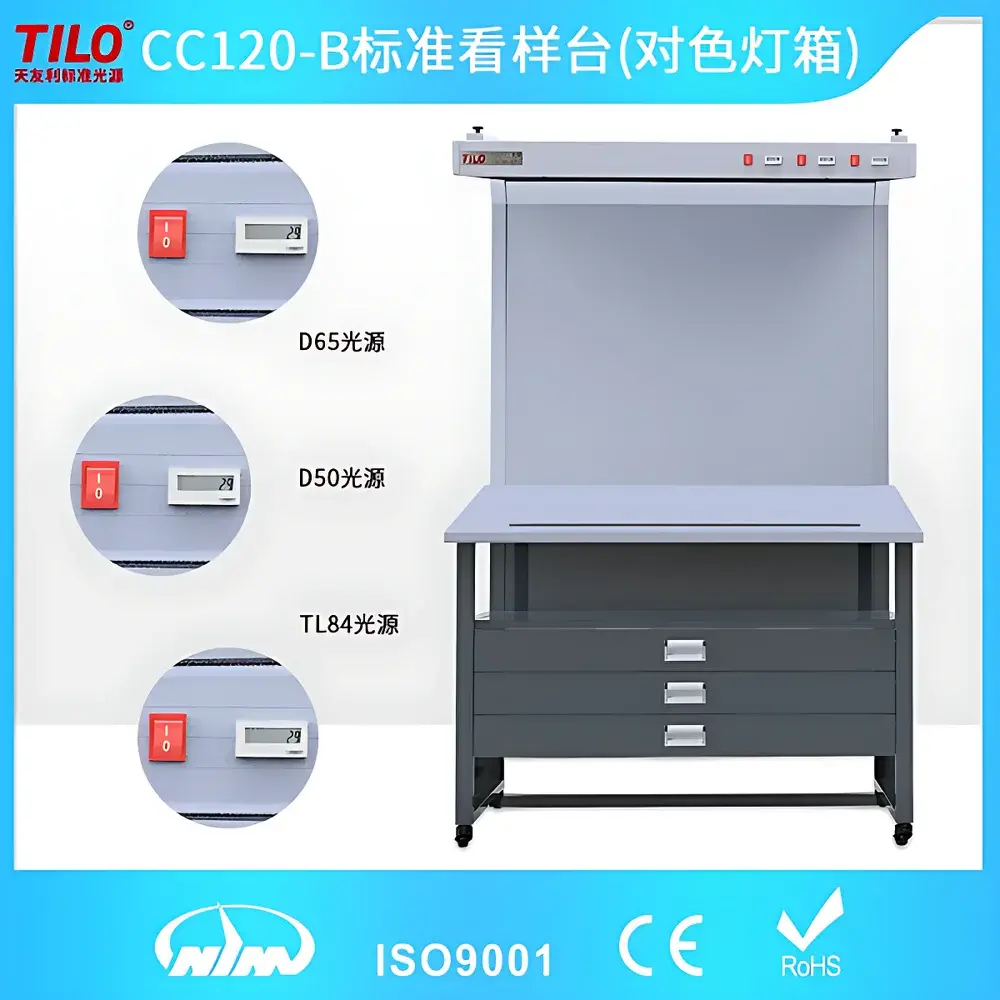
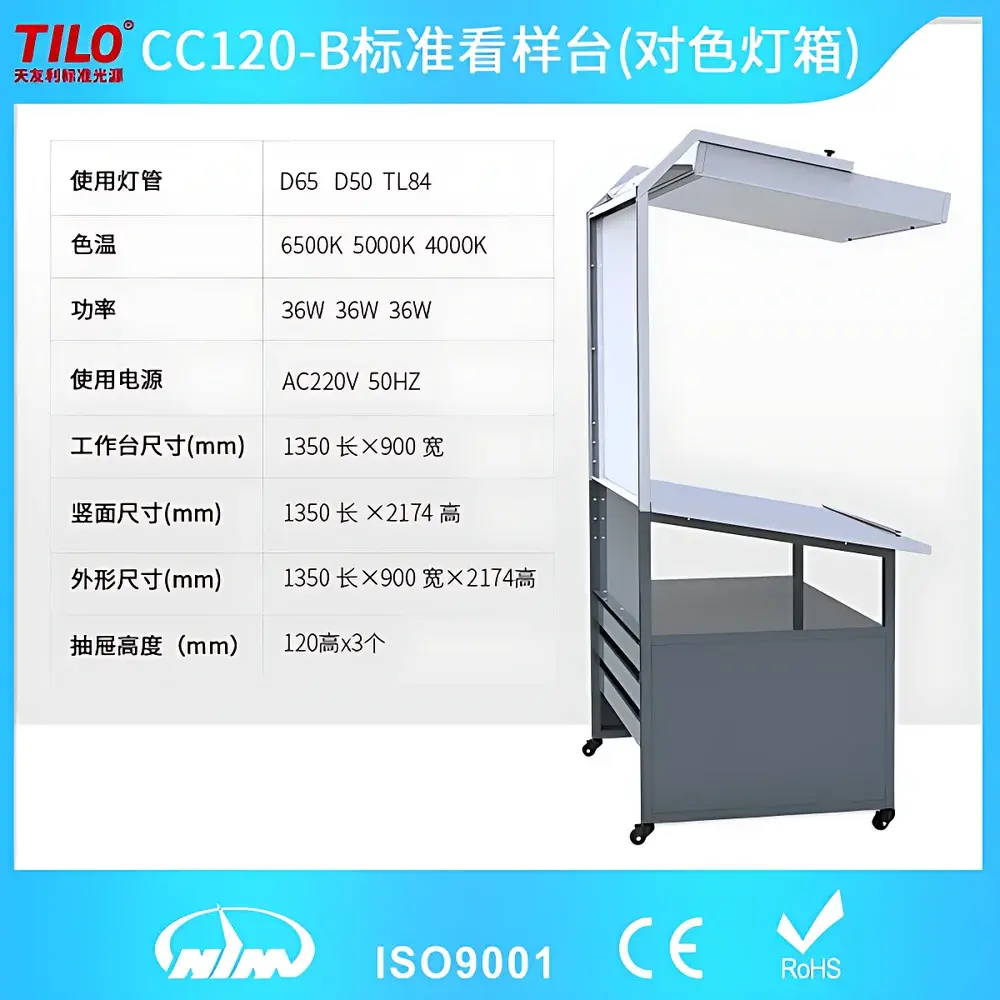
TILO CC120-B Standard Light Booth for Color Matching
| Brand | TILO |
|---|---|
| Model | CC120-B |
| Light Sources | Single / Dual / Triple Configurable |
| Compliance | ISO 3664:2009 |
| CRI | >95 |
| Construction | Full Metal Enclosure (Heavy-Gauge Steel Panels) |
| Illumination System | Graphica-Series Imported Fluorescent Lamps with Reflector & Diffuser Plate |
| Viewing Surface | Angled Ergonomic Workbench |
| Lamp Timer | Integrated Digital Hour Counter |
| Dimensions | Large Swing-Open Cabinet (Standardized Viewing Aperture per ISO 3664) |
| Application Scope | Print Proofing, Textile Dyeing, Plastics Color Inspection, Automotive Trim Evaluation, Quality Control in Color-Critical Manufacturing |
Overview
The TILO CC120-B Standard Light Booth is an engineered color evaluation system designed for precise visual color assessment under controlled, standardized illumination conditions. It operates on the fundamental principle of metamerism elimination—ensuring that color judgments remain consistent across varying observer conditions and ambient lighting environments. The booth conforms strictly to ISO 3664:2009, the internationally recognized standard governing viewing conditions for graphic technology and photography, specifying spectral power distribution (SPD), illuminance level (≥2000 lx at viewing plane), uniformity (>80% across field), and geometric configuration (0°/45° or diffuse/0° viewing geometry support). Its core function is to replicate standardized daylight (D50, D65), incandescent (A), fluorescent (F2, F7, F11), and optional UV-emitting light sources—enabling reliable detection of metamerism, shade matching, and batch-to-batch color consistency verification in production-critical workflows.
Key Features
- Triple-configurable light source architecture: Pre-wired for single-source (e.g., D50 only), dual-source (e.g., D50 + A), or triple-source (e.g., D50 + A + F2) operation—facilitating rapid side-by-side comparison without manual lamp replacement.
- Graphica-series imported fluorescent lamps: Engineered specifically for graphic arts applications, delivering stable spectral output and high color rendering index (CRI >95) across all specified illuminants.
- Full-metal enclosure with heavy-gauge steel panels: Provides structural rigidity, thermal stability, and electromagnetic shielding—minimizing drift during extended operation and ensuring long-term photometric repeatability.
- Ergonomically angled work surface: Optimized at 45° inclination to reduce specular reflection and eye fatigue during prolonged visual inspection sessions.
- Integrated digital lamp hour counter: Tracks cumulative usage per lamp set, supporting predictive maintenance and compliance with ISO 3664’s lamp aging recommendations (lamp replacement advised after 2000 hours).
- Aluminum extrusion housing with precision-machined reflector and opal diffuser plate: Ensures ≥85% spatial uniformity across the 1200 mm × 600 mm viewing aperture, meeting ISO 3664’s requirement for even irradiance distribution.
Sample Compatibility & Compliance
The CC120-B accommodates reflective samples up to 1200 mm × 600 mm in dimension—including printed sheets, textile swatches, plastic injection-molded parts, painted automotive panels, and coated metal substrates. Its viewing chamber meets ISO 3664:2009 dimensional and geometric specifications for critical color evaluation zones. The booth supports full traceability in regulated environments: lamp spectral data is certified by third-party photometric laboratories; calibration documentation aligns with ISO/IEC 17025-accredited reference standards. For GMP or ISO 9001-certified facilities, the system integrates into documented color management procedures—serving as a primary reference node in color specification handoffs between R&D, production, and QA labs.
Software & Data Management
While the CC120-B is a hardware-only visual evaluation platform (no embedded software), it is fully compatible with industry-standard color measurement ecosystems. Spectrophotometers (e.g., X-Rite Ci7800, Konica Minolta CM-3700A) and color management software (e.g., X-Rite Color iMatch, GretagMacbeth SpectraLight QC) utilize its standardized illumination to validate instrument-to-eye correlation. All lamp sets include spectral emission reports compliant with CIE S 012/E:2006, enabling digital integration into L*a*b* delta-E tolerance workflows. Audit trails for lamp replacement, recalibration dates, and environmental monitoring (temperature/humidity logs) are maintained externally per GLP/GMP requirements—no proprietary firmware or closed-loop data handling is involved.
Applications
- Prepress proof verification against final press output under D50 illumination—detecting metamerism between proofing systems (inkjet, laminated, digital) and offset lithography.
- Textile dye lot approval in wet-processing facilities, where D65 and TL84 sources simulate retail and daylight viewing conditions.
- Plastic component color release in automotive Tier-1 suppliers—comparing molded parts against master standards under D50 + UV to assess fluorescence effects.
- Quality gate inspection in packaging manufacturing: simultaneous evaluation of flexographic, gravure, and digital print outputs under identical spectral conditions.
- Color formulation validation in paint and coating labs—supporting ASTM D1729 and ISO 12647-2-compliant visual assessments prior to instrumental measurement.
FAQ
Does the CC120-B include UV illumination capability?
Yes—optional UV-A (365 nm) lamp modules can be installed to evaluate optical brightening agents (OBAs) in paper, textiles, and plastics, complying with ISO 3664 Annex B requirements.
What is the recommended lamp replacement interval?
Per ISO 3664:2009 Clause 6.3.2, fluorescent lamps must be replaced after 2000 hours of cumulative use or every 12 months—whichever occurs first—to maintain spectral fidelity and CRI performance.
Can the CC120-B be used for transmission sample evaluation?
No—the CC120-B is configured exclusively for reflective sample assessment. Transmission-capable booths require rear-mounted backlighting and diffusing panels not present in this model.
Is third-party calibration certification available?
Yes—TILO partners with ISO/IEC 17025-accredited photometry labs to provide traceable spectral irradiance reports and uniformity mapping upon request.
How does the CC120-B support compliance with FDA 21 CFR Part 11?
As a non-electronic, non-data-generating device, the CC120-B itself does not fall under Part 11 scope. However, its use within validated color review workflows satisfies Part 11’s “objective evidence” requirement when paired with documented SOPs and operator training records.