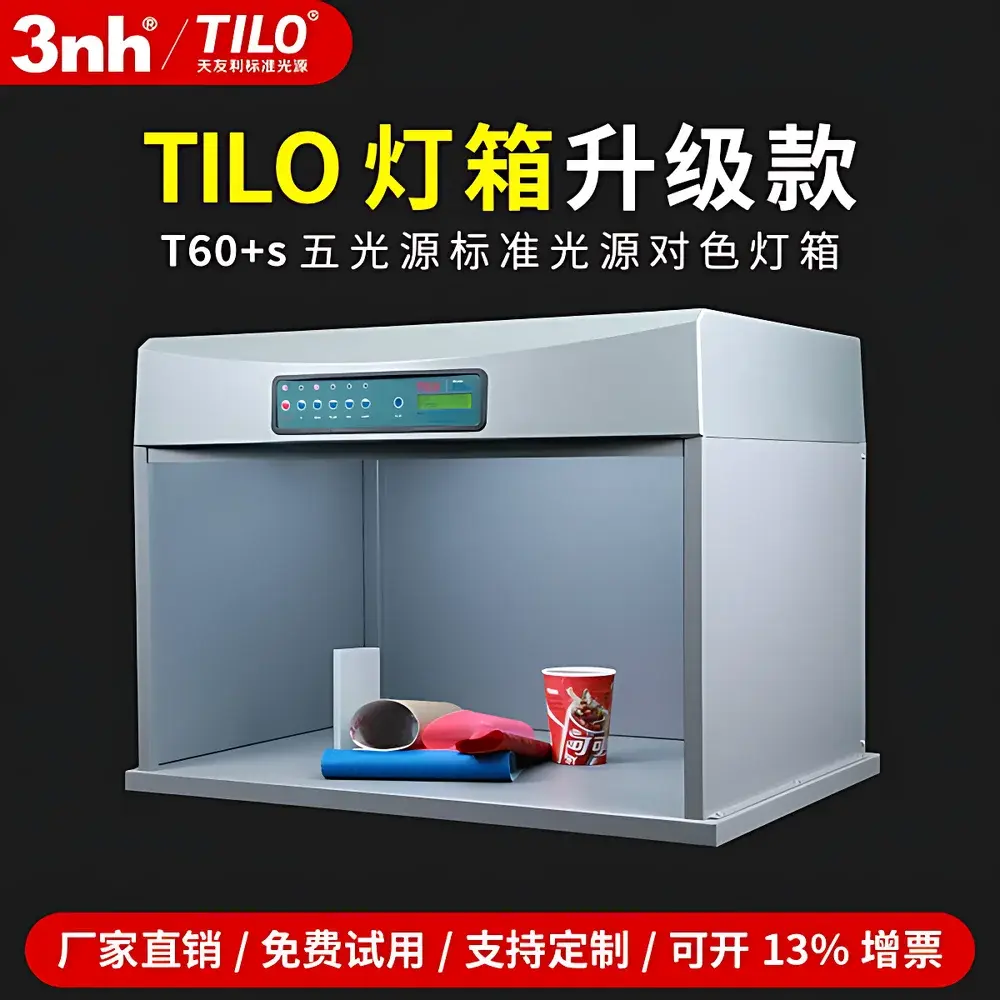
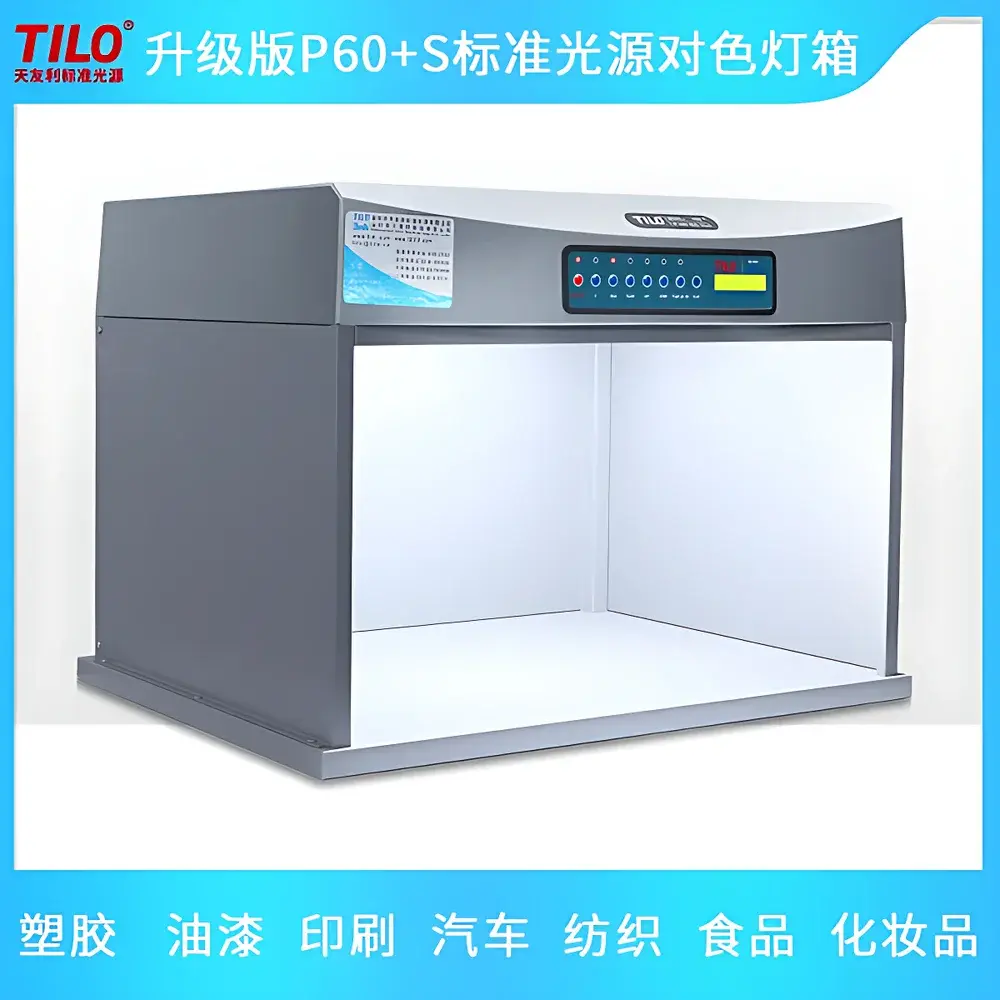
TILO T60+S Standard Light Source Color Matching Cabinet with 5/6 Illuminants and Steel Enclosure
| Brand | TILO |
|---|---|
| Origin | Guangdong, China |
| Model | T60+S |
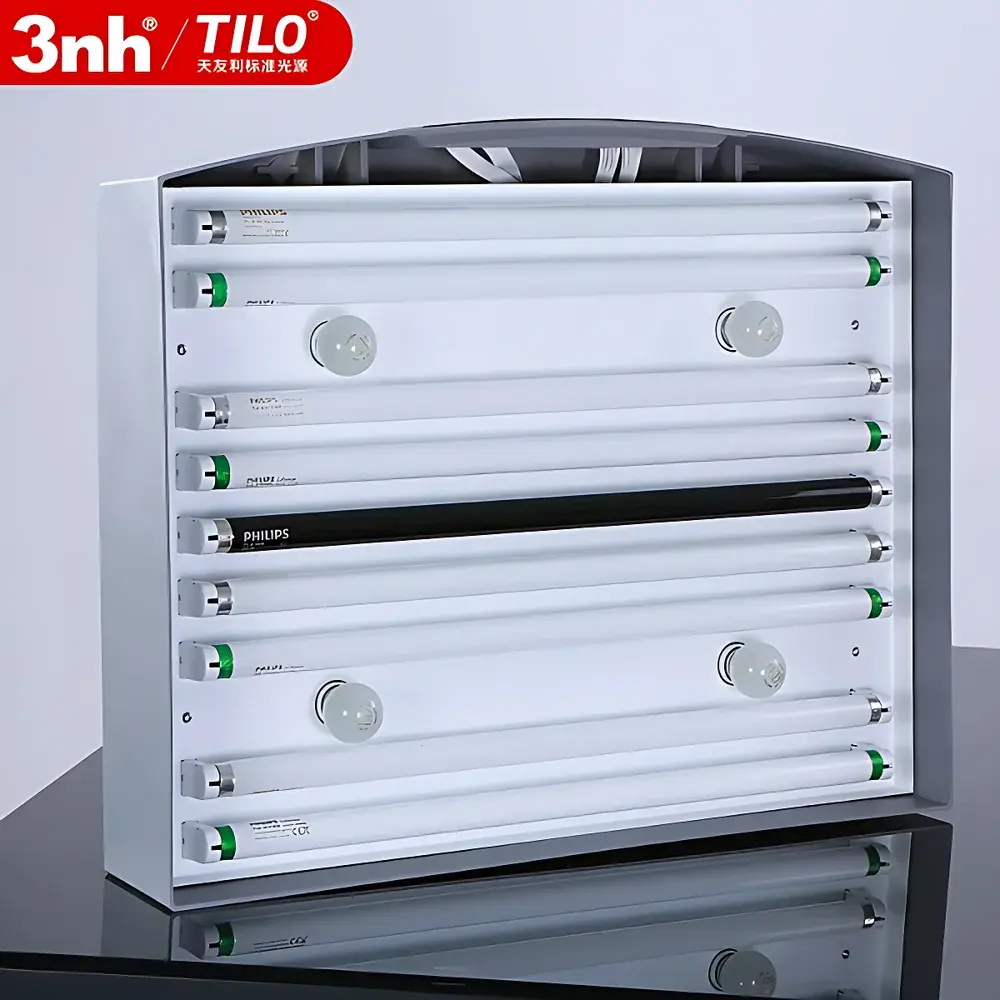
| Light Sources | D65, TL84, CWF, F/A, UV (5 standard) / Optional 6th source (U30 or Horizon) |
| Construction | Cold-rolled steel cabinet with seamless welded enclosure |
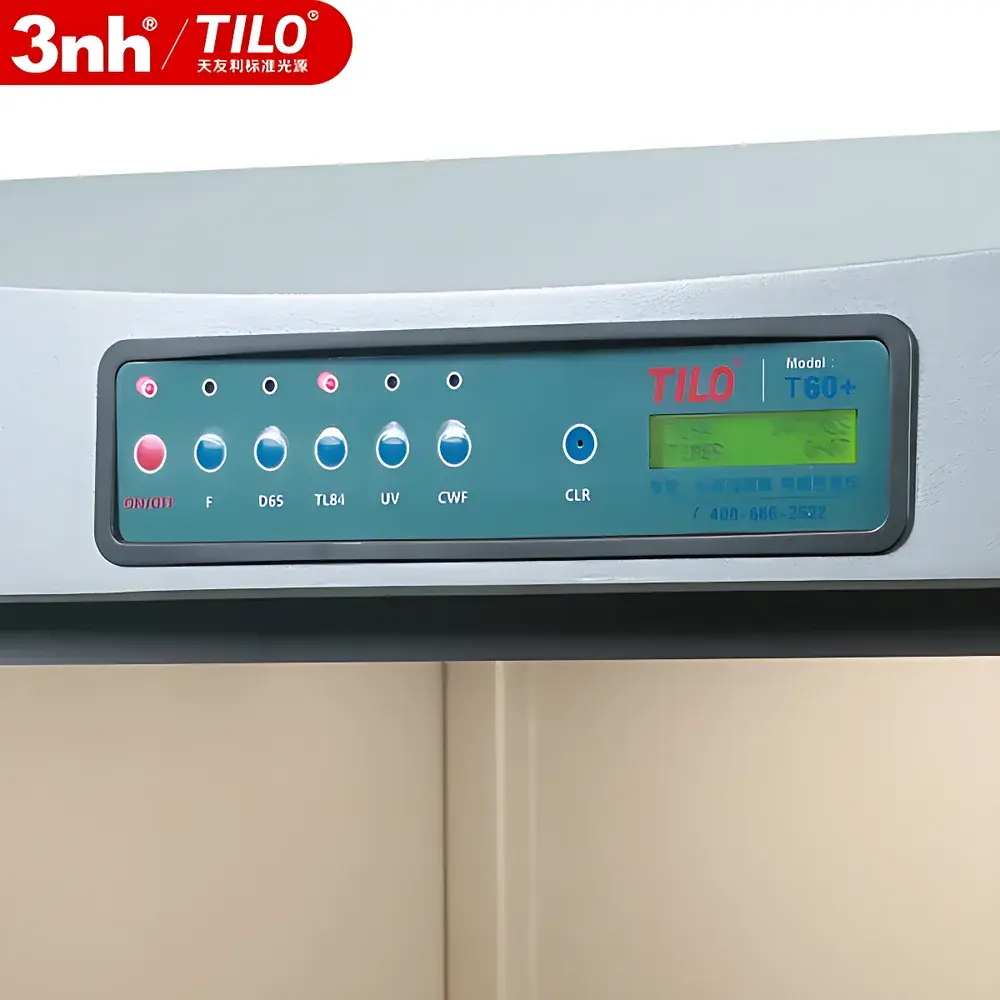
| Illuminant Control | Automatic sequential switching with real-time usage logging (hours, cycles) |
| Viewing Area | 500 × 500 mm (typical) |
| Compliance | Meets ISO 3664:2009, ASTM D1729, DIN 6173-2, CIE Publication No. 51 |
| Power Supply | 220 V AC, 50 Hz |
| Power Consumption | ≤ 120 W |
| Operating Temperature | 15–30 °C |
| Relative Humidity | ≤ 80% RH (non-condensing) |
| Optional Accessories | Adjustable anti-glare baffle, rubber leveling feet, customizable illuminant labeling |
Overview
The TILO T60+S Standard Light Source Color Matching Cabinet is an engineered optical evaluation system designed for precise visual color assessment under controlled, standardized illumination conditions. It operates on the principle of metamerism evaluation—enabling users to detect and quantify color differences that arise due to spectral mismatch between samples and reference standards across multiple CIE-standardized illuminants. The cabinet integrates five core light sources (D65, TL84, CWF, F/A, and UV) with optional sixth-source capability (U30 or Horizon), all housed within a fully sealed, cold-rolled steel enclosure. This robust architecture eliminates inter-illuminant leakage and external ambient interference—critical for achieving ISO 3664:2009-compliant viewing environments. Unlike traditional plastic-bodied cabinets, the T60+S employs a monolithic metal chassis with continuous weld seams and precision-machined gasket interfaces, ensuring long-term dimensional stability and zero photometric cross-talk between lamps.
Key Features
- Seamless cold-rolled steel enclosure with powder-coated finish—resistant to deformation, discoloration, and mechanical wear over >10 years of industrial use.
- Zero-light-leak design verified via photometric isolation testing; no measurable transmission between adjacent lamp zones.
- Intelligent illuminant management system: real-time tracking of cumulative operating hours, switch cycles, and active lamp identification per session.
- Instant-on solid-state ballast technology—eliminates warm-up delay and lamp flicker, enabling immediate, repeatable visual assessments without stabilization wait time.
- Modular baffle system (optional): adjustable matte-black anti-glare shield reduces retinal luminance exposure by >65%, mitigating observer fatigue during extended evaluation sessions.
- Non-slip rubber leveling feet (optional): decouples cabinet vibration from work surfaces while protecting benchtop integrity in QC labs and production floors.
- Configurable lamp labeling interface: supports user-defined nomenclature for internal traceability and alignment with site-specific lighting protocols (e.g., “Store Lighting” instead of “F/A”).
- Energy-efficient operation: total power draw ≤120 W; thermal output <1.2 K rise above ambient—ensuring stable chromaticity during prolonged use without sample heating artifacts.
Sample Compatibility & Compliance
The T60+S accommodates flat, rigid, and semi-flexible specimens up to 500 × 500 mm in dimension and 50 mm in thickness—including textiles, coated plastics, ceramic tiles, leather swatches, printed packaging, and cosmetic compacts. Its viewing geometry conforms to ISO 3664:2009 requirements for surround luminance, background reflectance (Munsell N8 neutral gray), and illuminance uniformity (±15% across field). The cabinet meets ASTM D1729 for color matching in industrial applications and DIN 6173-2 for graphic arts evaluation. All installed lamps are certified to CIE S 002:2018 spectral power distribution tolerances and undergo factory photometric calibration with NIST-traceable spectroradiometer verification. The system supports GLP-aligned documentation through timestamped usage logs exportable via USB interface.
Software & Data Management
While primarily a hardware-based visual assessment tool, the T60+S incorporates embedded firmware enabling audit-ready operational data capture. Each illuminant’s runtime, activation count, and last-use timestamp are stored in non-volatile memory with battery-backed retention (>10 years). Logs export as CSV files compatible with LIMS integration or internal QA databases. Firmware supports remote configuration updates via USB-Mini port and includes built-in self-diagnostic routines for lamp aging detection (lumen depreciation >15% triggers maintenance alert). Though not a digital imaging device, the cabinet is routinely deployed alongside spectrophotometers (e.g., Konica Minolta CM-3700A, X-Rite Ci7800) in workflows requiring correlative instrumental + human observer validation per ISO/IEC 17025 Clause 7.2.2.
Applications
The T60+S serves as a foundational tool in color-critical supply chains across textile dyeing, automotive interior trim validation, pharmaceutical blister packaging inspection, food-grade ink formulation, and cosmetics shade development. In textile QC labs, it enables simultaneous evaluation of wash-fastness and light-fastness specimens against master standards under D65 (daylight) and UV (fluorescence detection). For printing operations, the TL84/CWF pair validates match fidelity under retail fluorescent lighting conditions required by major retailers (e.g., Walmart, Tesco). In R&D settings, its U30 option supports daylight-simulated evaluation of photochromic and thermochromic materials. Regulatory submissions for FDA-regulated packaging (21 CFR Part 11) routinely cite T60+S-controlled viewing conditions as part of documented color consistency protocols.
FAQ
Does the T60+S comply with ISO 3664:2009 for graphic arts and photography?
Yes—the cabinet satisfies all geometric, photometric, and chromaticity requirements specified in ISO 3664:2009, including surround luminance ratio (3:1), background reflectance (N8), and illuminance uniformity.
Can I replace individual lamps without recalibrating the entire unit?
Lamp replacement follows CIE-recommended procedures; however, post-replacement verification using a calibrated spectroradiometer is required to maintain ISO compliance—no factory recalibration service is embedded.
Is the UV source rated for fluorescence excitation at 365 nm?
Yes—the included UV lamp emits peak irradiance at 365 nm ±5 nm with spectral bandwidth meeting ISO 105-B02 requirements for fluorescent whitening agent assessment.
What is the expected service life of the D65 lamp under continuous use?
Rated average life is 2,500 hours at nominal voltage; lumen maintenance remains ≥90% at 1,000 hours per IEC 62471 photobiological safety classification.
Does the cabinet support networked logging or Ethernet connectivity?
No—it relies on local USB export only; network integration requires third-party middleware or custom API bridging via serial-to-Ethernet converters.