
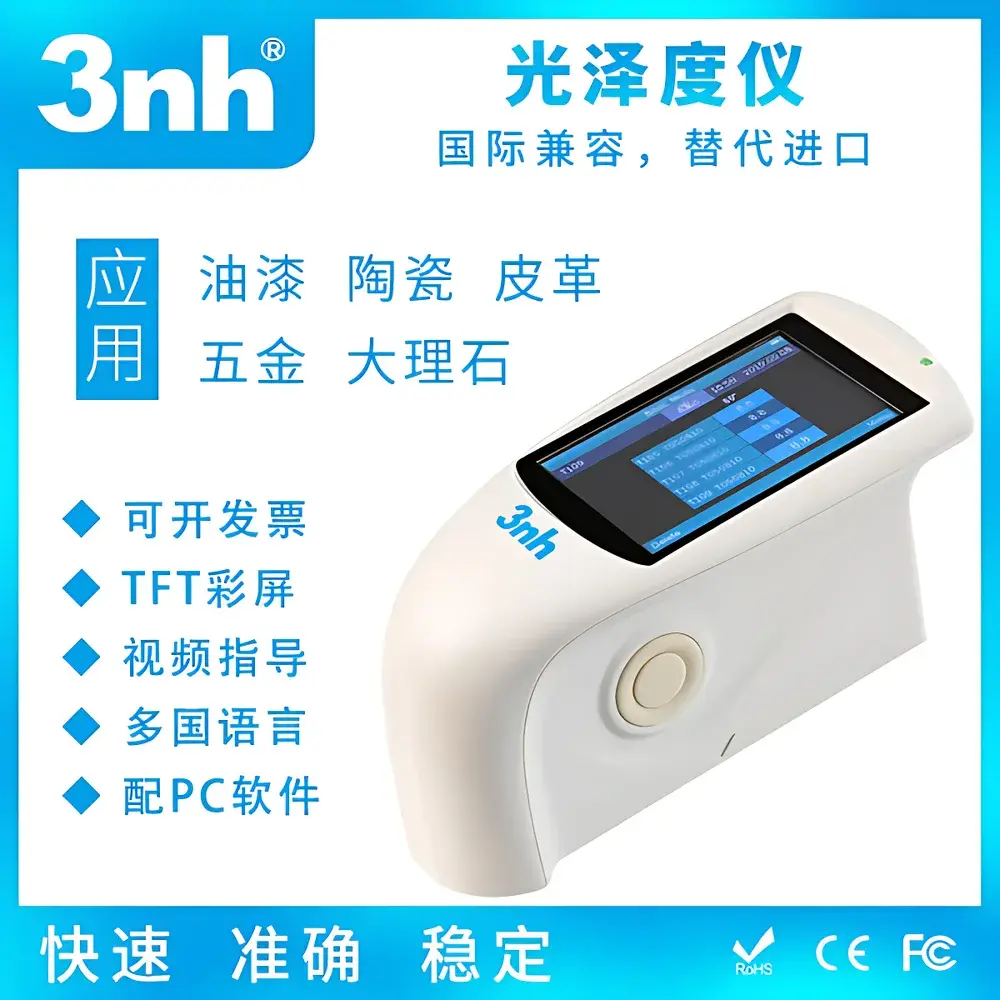
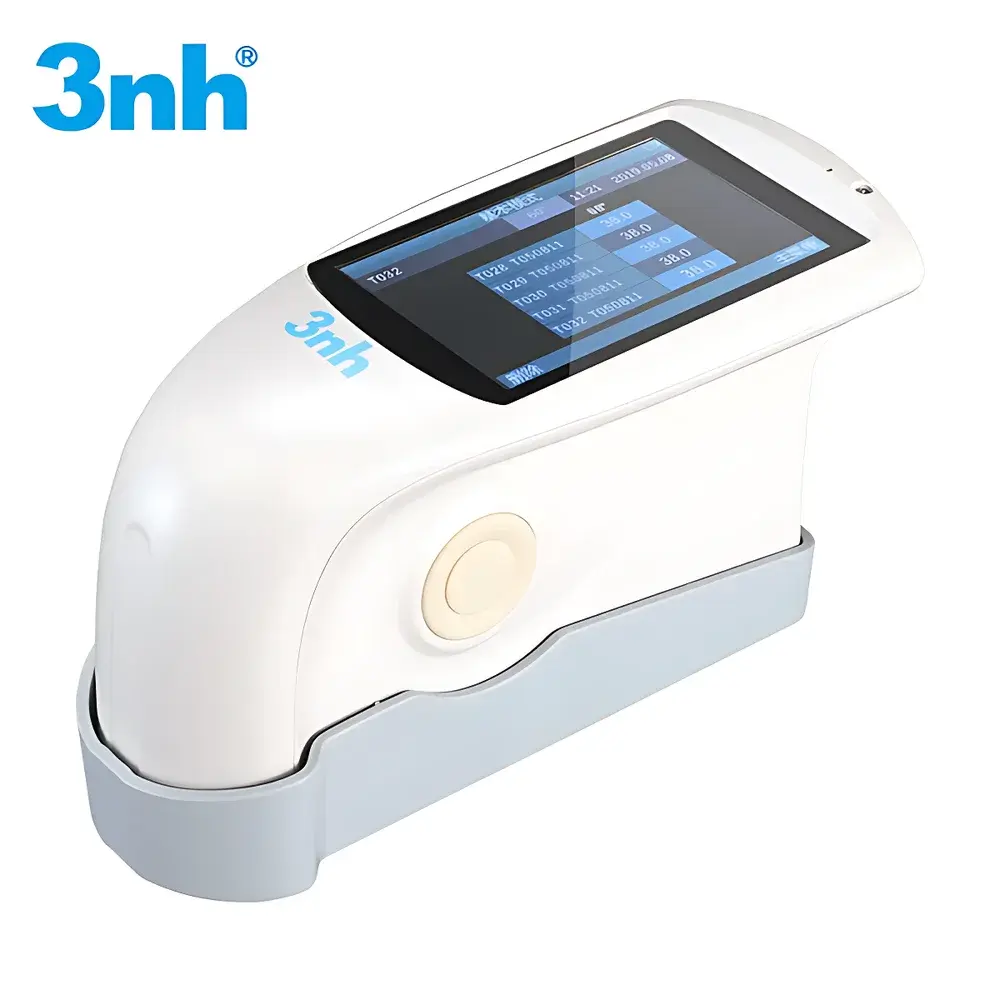
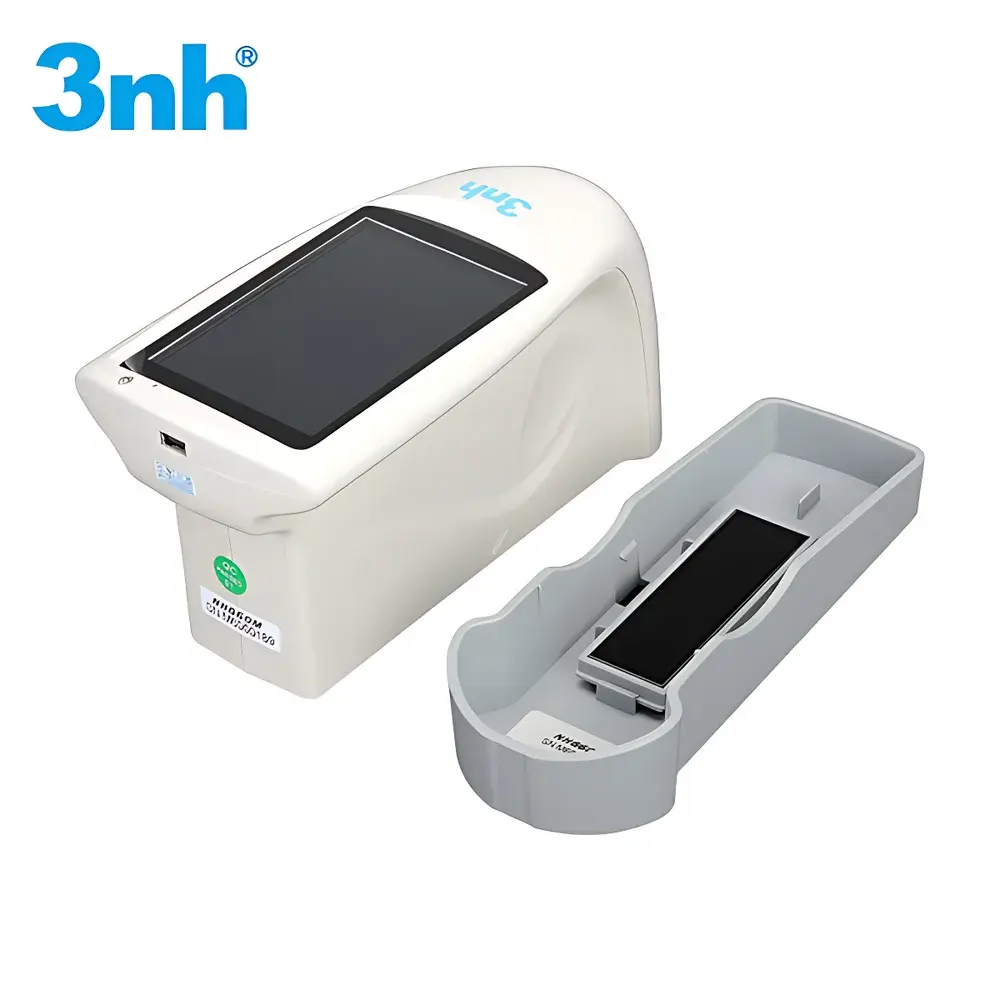
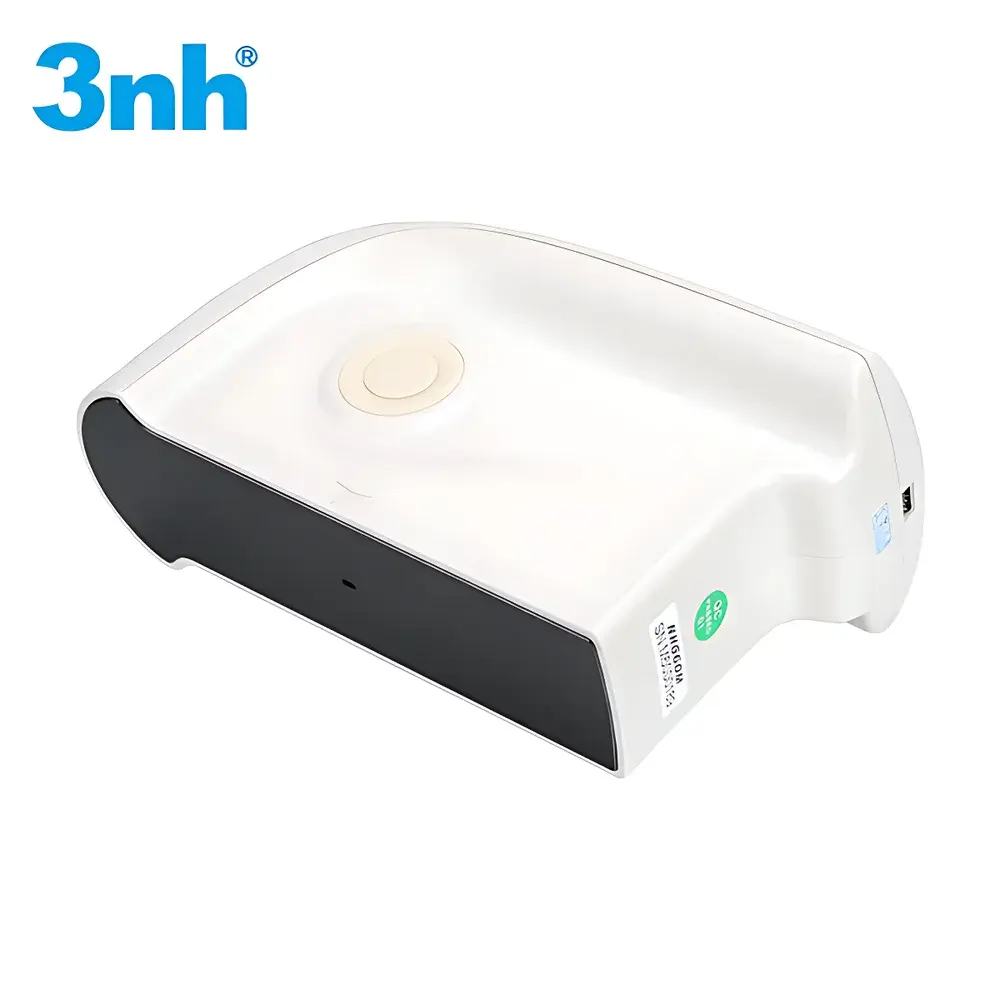
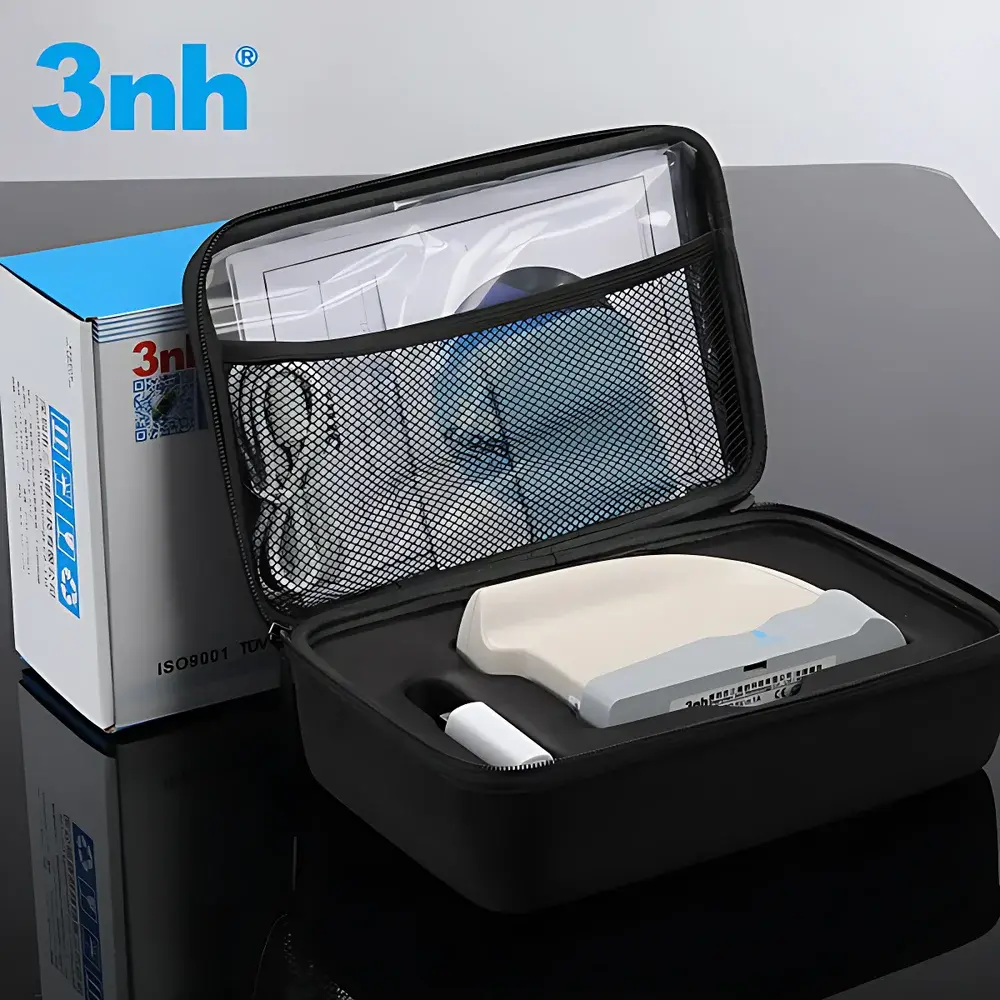
3nh NHG60M Micro-Aperture Precision Gloss Meter
| Brand | 3nh |
|---|---|
| Model | NHG60M |
| Type | Manual Gloss Meter |
| Compliance | ISO 2813, ASTM D523, ASTM D2457, GB/T 9754 |
| Display | 3.5-inch capacitive touchscreen (480 × 320 resolution) |
| Power | Rechargeable lithium-ion battery |
| Operating Modes | Standard / Calibration / Reference Mode |
| Auto-power-off | Yes |
| Software | PC-based quality management software with data export, statistical analysis, and audit trail support |
| Design | Ergonomic curved housing, micro-aperture optical path optimized for small-area and textured surfaces |
Overview
The 3nh NHG60M Micro-Aperture Precision Gloss Meter is a manually operated, high-fidelity optical instrument engineered for accurate and repeatable specular gloss measurement on small, curved, or structurally heterogeneous surfaces. It operates on the principle of specular reflectance—measuring the ratio of reflected luminous flux at the specular angle to that of a reference black glass standard (defined as 100 GU at 60°), in strict accordance with ISO 2813 and ASTM D523. Unlike conventional gloss meters with fixed 10 mm or 20 mm measurement apertures, the NHG60M integrates a proprietary micro-aperture optical system (≤3 mm effective spot size), enabling reliable assessment of localized gloss on features such as engraved logos, injection-molded ribs, coated electronic housings, and automotive trim components where macro-scale averaging introduces systematic error. Its fully sealed optical path minimizes ambient light interference, while temperature-compensated photodetector electronics ensure stable output across laboratory and production-floor environments (15–30 °C, <80% RH non-condensing).
Key Features
- 3.5-inch capacitive touchscreen interface with 480 × 320 resolution—supports intuitive gesture navigation, real-time waveform preview, and on-device calibration verification.
- Micro-aperture optical design optimized for measurements on areas as small as Ø3 mm, delivering spatial resolution unattainable with standard 60° gloss meters.
- Triple-mode operation: Standard measurement mode for routine QC; Calibration mode supporting user-defined reference standards (including non-60° GU values); Reference mode for comparative evaluation against stored baseline profiles.
- Ergonomically contoured housing with anti-slip matte finish and low-center-of-gravity geometry—designed for one-handed stability during angled or overhead measurements.
- Integrated rechargeable lithium-ion battery (rated for ≥12 hours continuous operation), eliminating dependency on external power sources during field audits or line-side inspections.
- Automatic power-down after 5 minutes of inactivity—compliant with IEC 62368-1 energy efficiency guidelines for portable test equipment.
Sample Compatibility & Compliance
The NHG60M is validated for use on non-metallic, non-transparent substrates including painted metal, powder-coated plastics, anodized aluminum, ceramic glazes, and laminated composites. Its micro-aperture configuration mitigates edge diffraction effects common when measuring near part boundaries or surface discontinuities. Instrument compliance extends to multiple international standards: ISO 2813 (plastics and paint), ASTM D523 (general-purpose gloss), ASTM D2457 (specular gloss of plastic films), and GB/T 9754 (Chinese national standard for non-metallic coatings). While not intrinsically certified for GLP or GMP environments, its firmware supports traceable calibration logging (date, operator ID, standard value, deviation), satisfying pre-audit documentation requirements under ISO/IEC 17025 Clause 6.4.2.
Software & Data Management
The included PC-based Quality Management Software (v3.2+) provides full bidirectional communication via USB-C. It enables batch data import/export (CSV, XLSX), statistical process control (SPC) charting (X-bar/R, Cp/Cpk), and automated report generation compliant with internal QA templates. Audit trail functionality records all parameter modifications—including manual standard input, calibration resets, and user logins—with timestamp and operator ID—supporting FDA 21 CFR Part 11 readiness when deployed with validated Windows OS configurations. Raw spectral reflectance logs (not interpolated GU values) are retained for forensic reanalysis.
Applications
- Automotive: Gloss uniformity mapping of interior trims, dashboard panels, and exterior body parts post-paint or clear-coat application.
- Consumer Electronics: Verification of anodized aluminum housing finish consistency across production lots (e.g., smartphone frames, laptop lids).
- Packaging: Quantitative gloss profiling of metallized PET films and UV-cured offset-printed cartons to detect coating thickness variation.
- Medical Devices: Surface finish validation of polymer housings for diagnostic instruments where tactile perception correlates with gloss reading.
- Academic Research: Correlation studies between surface roughness (Ra, Rz) and 60° gloss response on structured polymer replicas.
FAQ
What is the minimum measurable area for the NHG60M?
The effective measurement spot size is ≤3 mm in diameter—optimized for localized assessment without requiring sample masking or fixture adaptation.
Does the instrument support multi-angle gloss measurement?
No—the NHG60M is configured exclusively for 60° geometry per ISO 2813. For 20° or 85° measurements, refer to the 3nh NHG268 series.
Can calibration be performed using customer-supplied reference tiles?
Yes—users may manually enter certified GU values for proprietary standards via touchscreen interface, with full traceability logged in device memory.
Is firmware upgrade supported in-field?
Yes—updates are distributed as signed .bin files via 3nh’s secure portal and installed via USB-C without service center intervention.
What environmental conditions affect measurement stability?
Ambient temperatures outside 15–30 °C or relative humidity >80% may induce thermal drift in photodiode responsivity; stabilization time increases by ~2 minutes per 5 °C deviation from 23 °C.




