
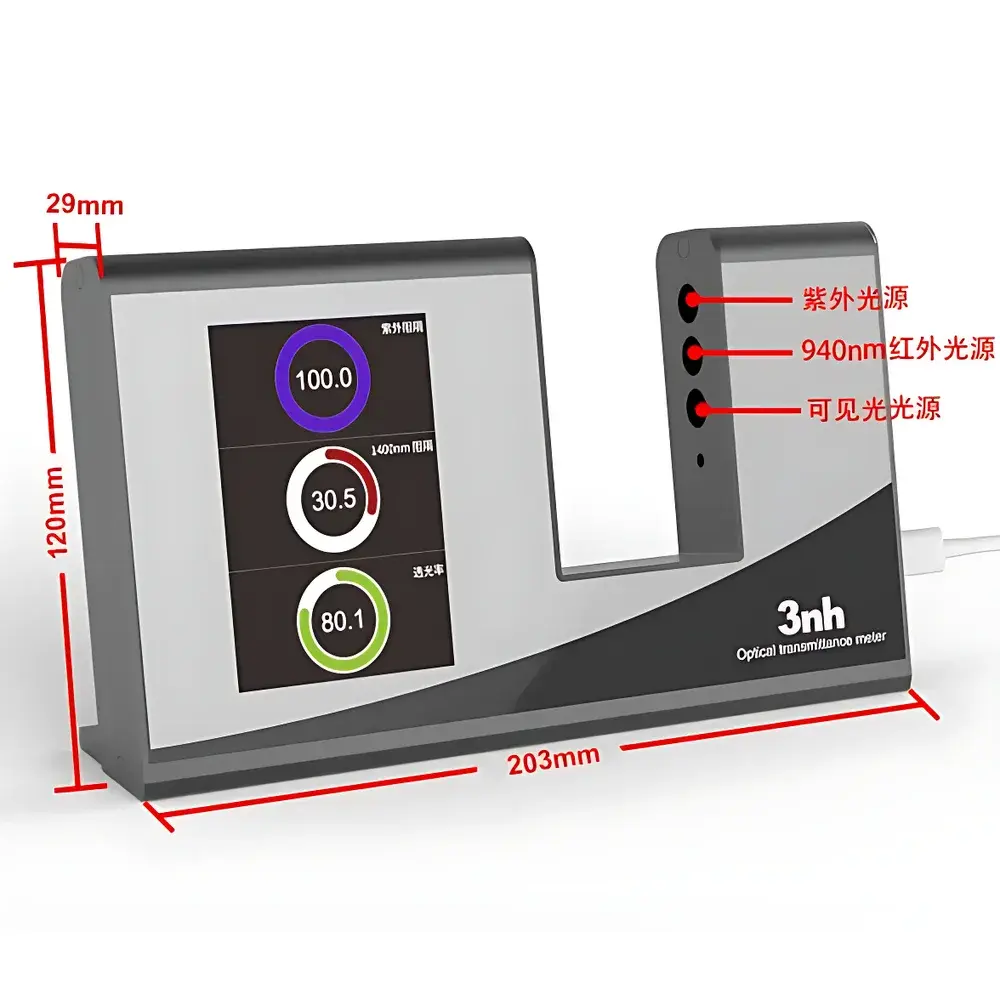
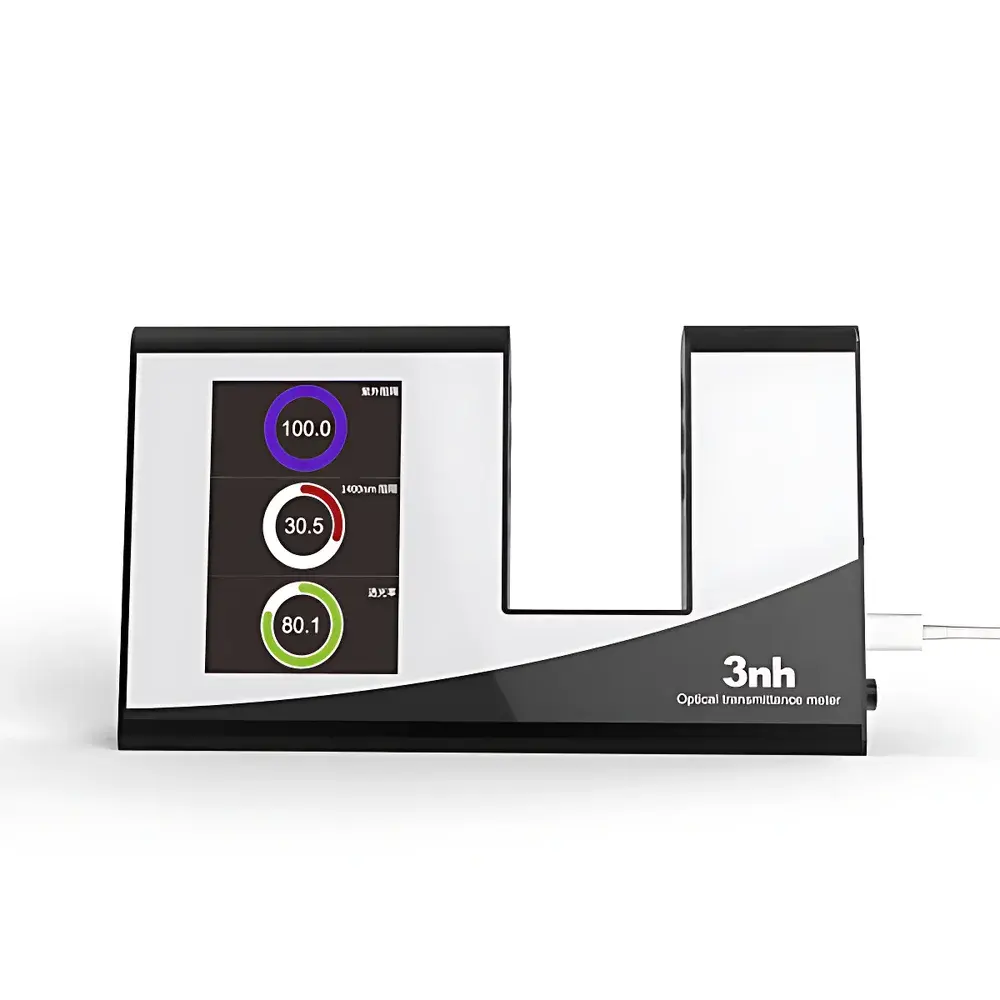
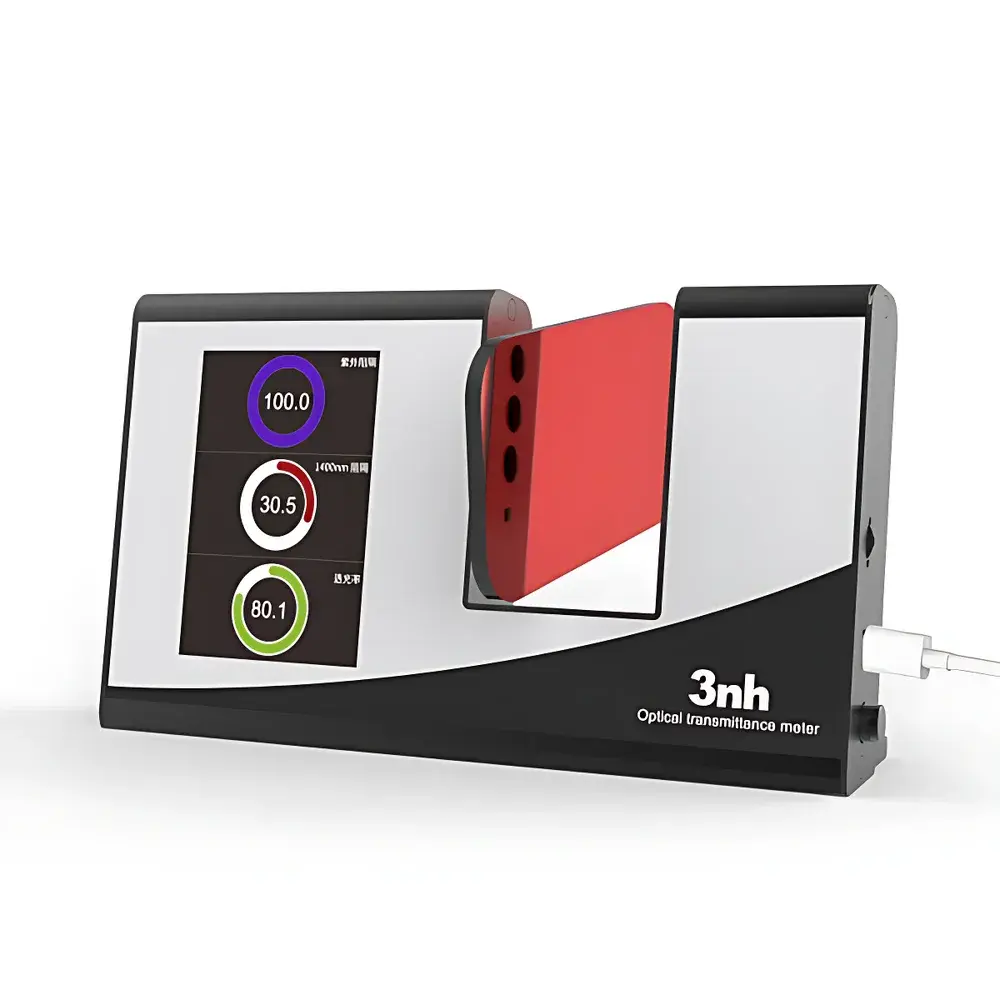
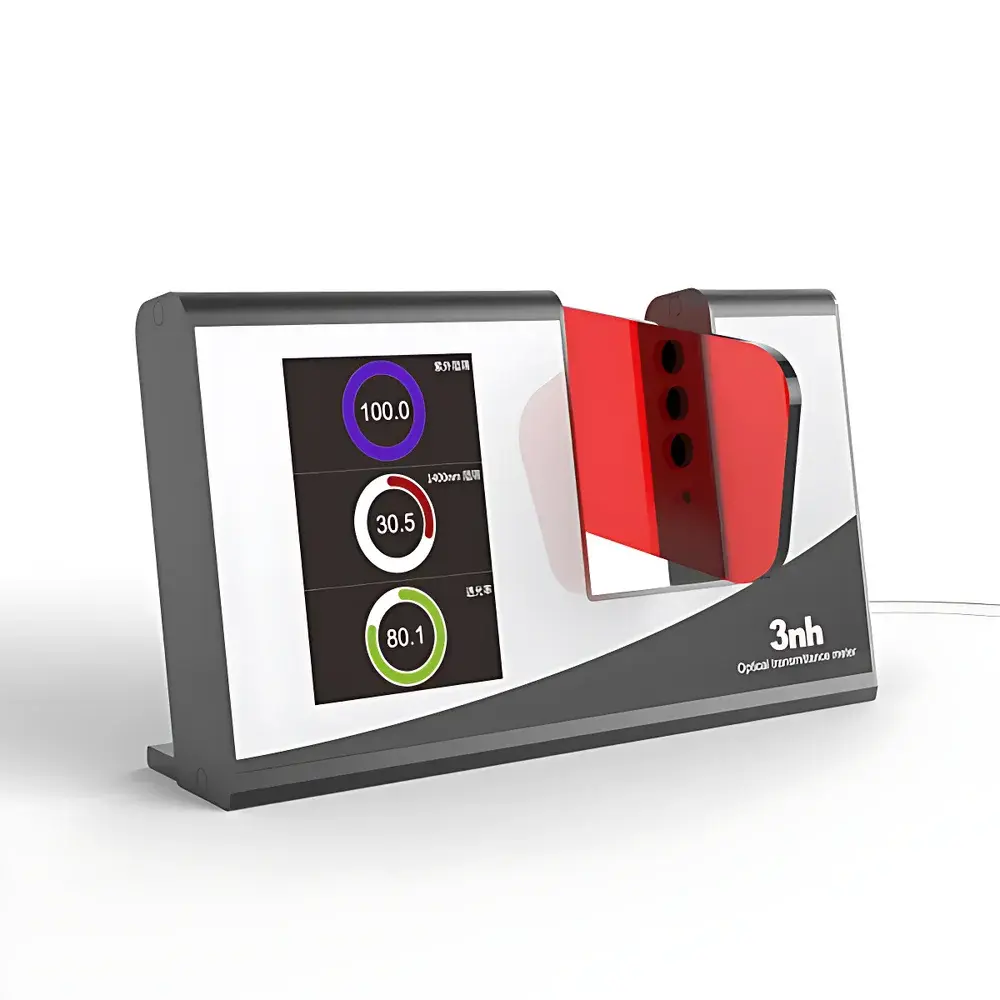
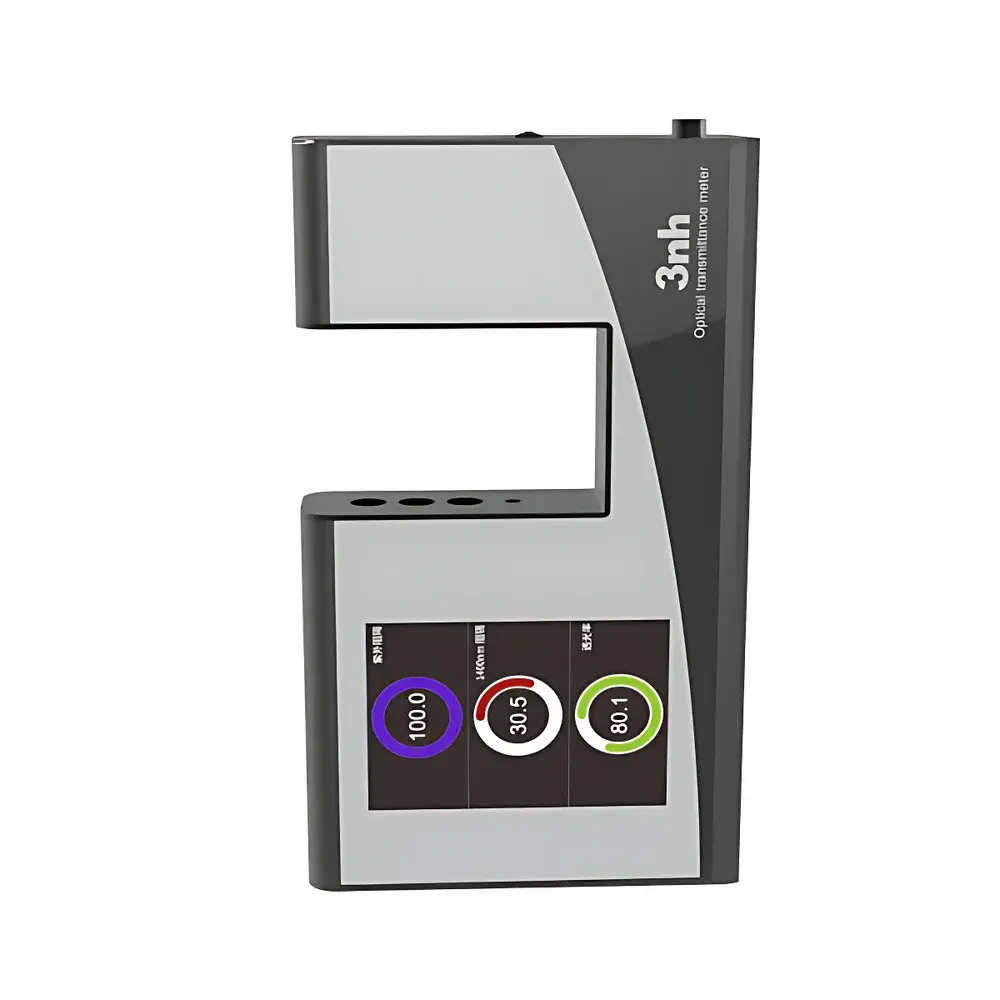
3nh YT1010 Multi-Source Optical Transmittance Meter
| Brand | 3nh |
|---|---|
| Origin | Guangdong, China |
| Manufacturer Type | Manufacturer |
| Product Category | Domestic |
| Model | YT1010 |
| Price | USD 215 (est.) |
| Type | Manual Operation |
| Transmittance Range | 0–100% |
| Transmittance Repeatability | ±0.1% |
| Measurement Wavelengths | 380–760 nm (visible), 940 nm (IR peak) |
| Detector | Silicon Photodiode |
| Resolution | 0.10% |
| Measurement Time | ~0.5 s |
| Accuracy | ±1.5% (colorless homogeneous transparent materials), ±1.0% (calibrated with NIST-traceable standard tiles) |
| Sample Thickness Limit | <47 mm |
| Dimensions | 203 × 120 × 29 mm |
| Weight | 515 g |
| Power Supply | 5 V DC via USB-C |
| Light Source Lifetime | ≥5 years / >3 million measurements |
| Display | 3.5-inch TFT true-color LCD |
| Operating Temp. | 0–40 °C, ≤85% RH (non-condensing), <2000 m altitude |
| Storage Temp. | −20–50 °C, ≤85% RH (non-condensing) |
| Interface | USB |
| Languages | English, Simplified Chinese |
Overview
The 3nh YT1010 Multi-Source Optical Transmittance Meter is a manually operated, benchtop-grade photometric instrument engineered for rapid, high-reproducibility quantification of optical transmittance across multiple spectral bands. It operates on the principle of comparative photometry: incident light from calibrated, discrete-wavelength sources passes through a planar transparent or semi-transparent sample, and the attenuated beam is captured by a thermally stabilized silicon photodiode detector. The ratio of transmitted to incident irradiance—expressed as percentage transmittance—is computed in real time using factory-trimmed gain coefficients and temperature-compensated analog-to-digital conversion. Unlike broadband integrator-based meters, the YT1010 employs three spectrally distinct illumination channels—UV-capable visible (380–760 nm CIE-standard visible spectrum), and narrowband infrared (940 nm peak)—enabling material-specific evaluation where wavelength-dependent absorption or scattering dominates performance (e.g., solar control glazing, IR-filtering polymer films, or UV-stabilized packaging). Its design prioritizes metrological integrity over automation: no moving parts, fixed optical path geometry, and zero-drift analog front-end ensure long-term stability without recalibration drift—critical for QC labs operating under ISO/IEC 17025 or GLP-compliant workflows.
Key Features
- Triple-source spectral architecture: Independent UV-enhanced visible (380–760 nm) and 940 nm infrared LED sources enable selective transmittance profiling aligned with industry-specific spectral weighting functions (e.g., solar-weighted transmittance per ISO 9050 or EN 410).
- High metrological fidelity: ±0.1% repeatability (1σ, n=10, same sample, ambient stable) and ±1.0% accuracy verified against NIST-traceable certified reference materials (CRMs) at time of shipment—documented in included calibration certificate.
- Sub-second measurement cycle: Full photometric acquisition and calculation completed within 0.5 seconds; no warm-up delay, no manual zeroing required—ideal for inline sampling in film extrusion or flat-glass tempering lines.
- Rugged mechanical design: All-metal housing with 29 mm low-profile form factor supports integration into confined test stations; 47 mm maximum sample thickness clearance accommodates laminated architectural glass, multi-layer OLED substrates, and thick acrylic panels.
- Thermally robust detection system: Silicon photodiode coupled with onboard temperature sensing and gain compensation ensures consistent responsivity across 0–40 °C operational range—eliminating seasonal recalibration in non-climate-controlled production environments.
- Dual-language interface with audit-ready logging: 3.5-inch TFT display supports English and Simplified Chinese; all measurements timestamped and stored locally with device ID and operator code (if enabled via firmware update).
Sample Compatibility & Compliance
The YT1010 is validated for planar, optically homogeneous specimens with parallel surfaces and minimal surface scatter (e.g., float glass, PET/PVC films, polycarbonate sheets, coated automotive glazing, and pharmaceutical blister packaging). It conforms to fundamental photometric definitions in CIE Publication 15:2018 and supports measurement protocols referenced in ASTM D1003 (haze and luminous transmittance), ISO 13468-1 (plastics—determination of luminous transmittance), and EN 673 (glass in building—determination of thermal transmittance, where 940 nm data informs near-infrared solar heat gain estimation). While not FDA 21 CFR Part 11 compliant out-of-the-box, raw data export via USB enables traceable integration into validated LIMS or ELN systems meeting GMP/GLP documentation requirements.
Software & Data Management
Data are stored internally (up to 2,000 records) with UTC timestamps, model ID, and measurement mode flag. USB-C interface permits direct export of CSV-formatted datasets—including transmittance values per source channel, measurement time, and environmental sensor readings (temperature, humidity)—to Windows/macOS hosts. Optional PC software (3nh Transmittance Manager v2.1, Windows only) provides batch statistical analysis (X̄, R, Cp/Cpk), SPC charting, and report generation compliant with ISO 9001 clause 8.2.3. Firmware updates preserve calibration constants and support future enhancements such as user-defined spectral weightings or pass/fail threshold alerts.
Applications
- Architectural glass manufacturing: Quantifying visible light transmittance (VLT) and near-infrared rejection (NIR-R) for energy-efficient façade certification (ASHRAE 90.1, LEED EQc8.1).
- Optical film R&D: Evaluating anti-reflective, IR-cut, and UV-blocking performance of multilayer dielectric coatings on PET or PC substrates.
- Automotive component QA: Verifying transmittance uniformity across curved laminated windshields and HUD-compatibly tinted side windows.
- Pharmaceutical packaging validation: Confirming consistent barrier film transparency for blister cavity inspection and light-sensitive drug stability testing (ICH Q1B).
- Academic optics labs: Teaching spectral photometry fundamentals, Beer–Lambert law verification, and source-detector linearity characterization.
FAQ
Does the YT1010 measure haze or gloss?
No. It is dedicated solely to transmittance measurement across three discrete spectral bands. Haze and gloss require separate instrumentation per ASTM D1003 and ISO 2813, respectively.
Can it measure curved or textured samples?
Only flat, parallel-surface specimens yield valid results. Curvature induces beam divergence and Fresnel reflection artifacts that violate the instrument’s collimated-path optical model.
Is external calibration required annually?
No. Factory calibration using CRMs is stable for ≥24 months under normal use. Users may verify performance quarterly using supplied quartz reference tiles (included).
What is the uncertainty budget for transmittance reporting?
Expanded uncertainty (k=2) is ±1.8% for VLT (380–760 nm) and ±2.2% for 940 nm IR channel, derived from Type A (repeatability) and Type B (CRM uncertainty, temperature coefficient, linearity error) components per GUM (JCGM 100:2008).
Is USB-C power delivery sufficient for continuous operation?
Yes. The 5 V DC input draws <350 mA; compatible with any USB 2.0+ power adapter or powered hub. Battery operation is not supported.





