
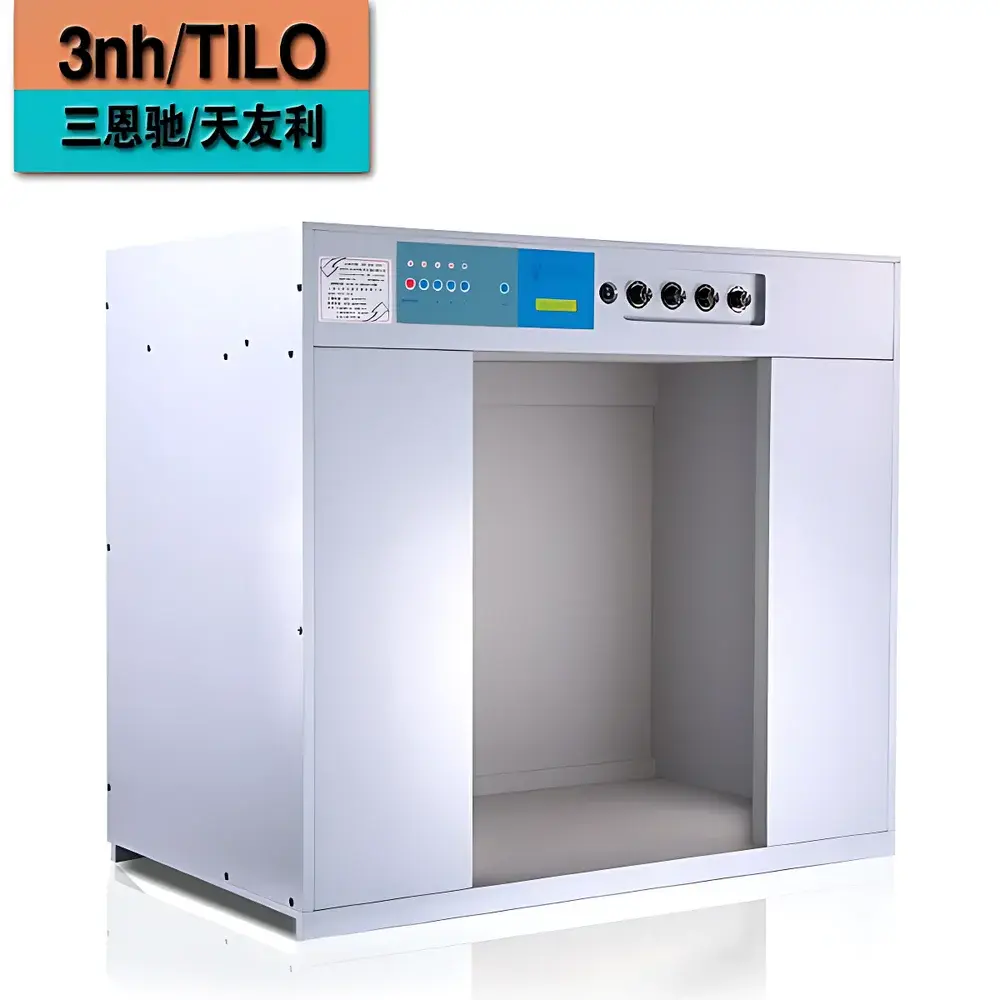
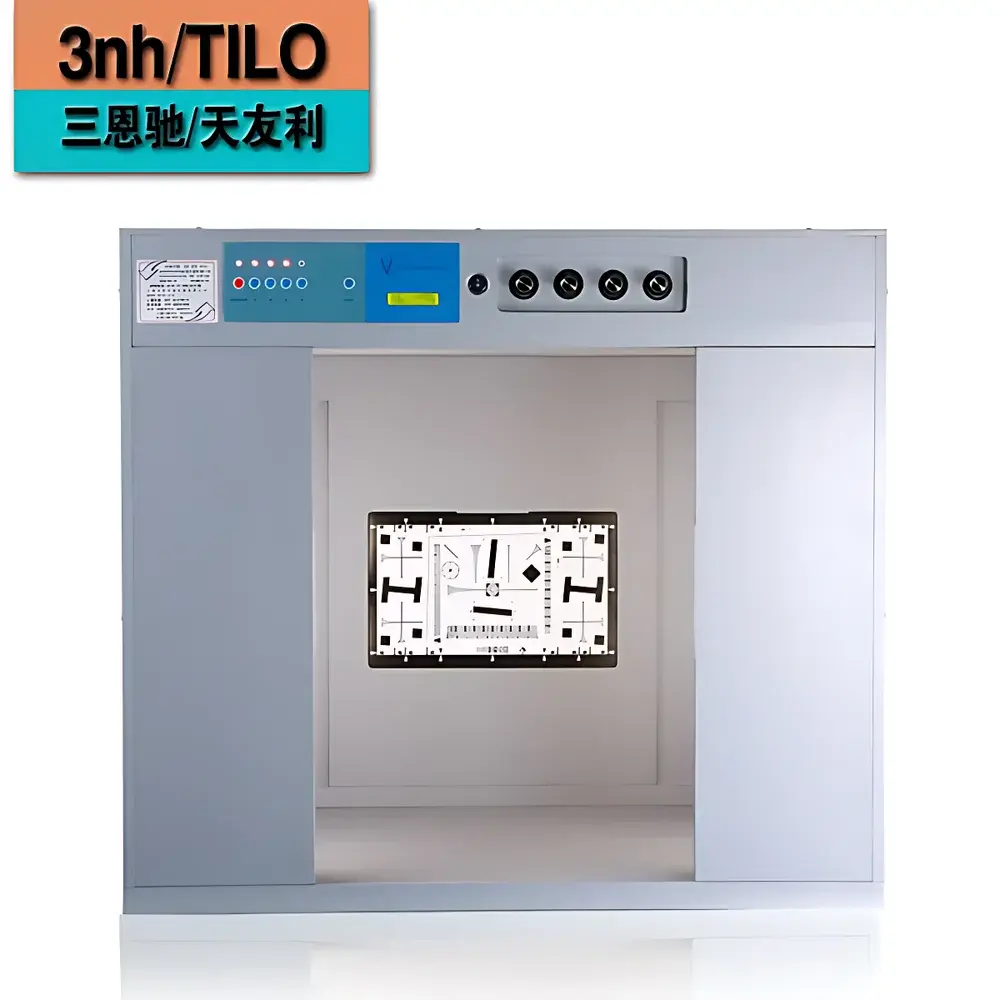
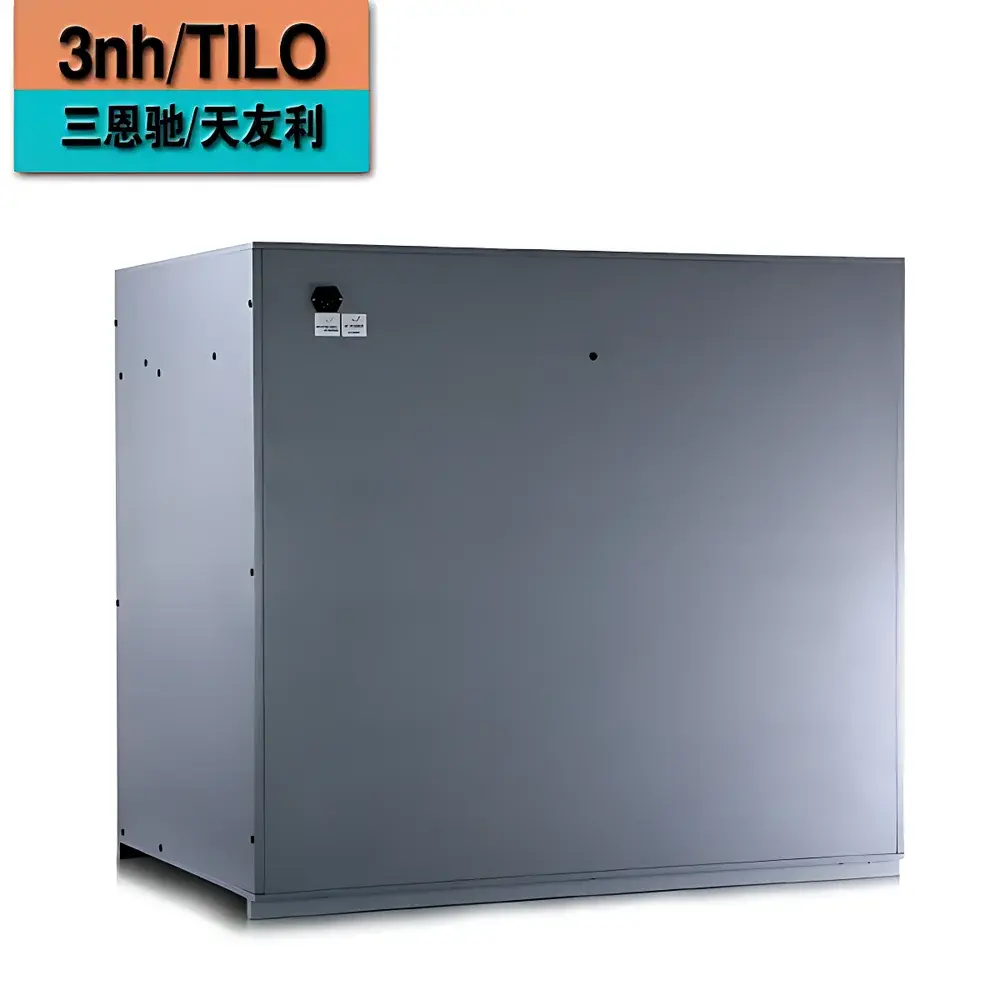
TILO VC(3) Desktop Standard Light Source Color Matching Cabinet with Integrated Imaging Support
| Brand | TILO |
|---|---|
| Model | VC(3) |
| Light Sources | D65 (standard), A, TL84 (interchangeable) |
| Control System | Microprocessor-based multi-source switching |
| Illuminance Range | 0–2000 lux (continuously adjustable) |
| Uniformity | ≥90% across 300 × 300 mm test area |
| Color Rendering Index (CRI) | Ra ≥ 95 for D65 and TL84 |
| Operating Temperature | 15–30 °C |
| Dimensions (W×D×H) | 560 × 360 × 480 mm |
| Weight | 18.5 kg |
| Compliance | ISO 3664:2009, ASTM D1729, CIE S 002/E:2022, GB/T 9761–2008 |
Overview
The TILO VC(3) Desktop Standard Light Source Color Matching Cabinet is an engineered optical measurement instrument designed specifically for controlled illumination in imaging-based color evaluation and camera sensor validation workflows. It operates on the principle of standardized illuminant simulation—reproducing spectral power distributions (SPDs) of internationally recognized reference light sources under stable photometric conditions. Unlike general-purpose lighting enclosures, the VC(3) integrates a calibrated reflective chamber architecture optimized for consistent irradiance delivery across the target plane, enabling repeatable radiometric and chromatic assessments of digital imaging systems—including industrial machine vision cameras, smartphone modules, and automotive ADAS sensors. Its core function is to eliminate ambient variability during image acquisition, ensuring that color fidelity, white balance response, exposure linearity, and dynamic range characterization are evaluated under metrologically traceable lighting conditions defined by ISO 3664:2009 and CIE S 002/E:2022.
Key Features
- Triple-standard illuminant configuration: factory-installed D65 (6500 K daylight simulator) as primary source, with user-replaceable A (2856 K incandescent) and TL84 (4000 K tri-phosphor fluorescent) lamps—each meeting CIE-defined spectral tolerances and certified for CRI ≥ 95.
- Microprocessor-controlled source switching: seamless transition between illuminants in <1.2 seconds with zero cross-talk or thermal drift; each lamp circuit includes individual current regulation and thermal stabilization.
- Continuous illuminance adjustment from 0 to 2000 lux via precision potentiometric control, calibrated against NIST-traceable photometers at 500 lx, 1000 lx, and 1500 lx reference points.
- Optimized reflective cavity design: matte-white interior surface (Munsell N9.5 equivalent) with geometrically calculated baffle placement ensures ≥90% spatial uniformity over a 300 × 300 mm working area—validated per ISO 3664 Annex B procedures.
- Dedicated usage logging system: embedded EEPROM records cumulative operational hours per lamp type independently, supporting preventive maintenance scheduling and GLP-compliant audit trails.
- Robust mechanical construction: cold-rolled steel chassis with electrostatic powder coating, vibration-damped feet, and EMI-shielded power supply for stable operation in laboratory and production-floor environments.
Sample Compatibility & Compliance
The VC(3) accommodates flat, rigid, or semi-rigid samples up to 300 × 300 mm and 50 mm thickness, including camera modules mounted on evaluation boards, lens assemblies, color chart substrates (e.g., X-Rite ColorChecker SG, GretagMacbeth BCRA II), and printed calibration targets. Its optical geometry conforms to the 0°/0° (normal incidence) reflective measurement configuration required by ISO 13655 for spectral reflectance validation. All installed light sources are certified to meet the spectral irradiance tolerances specified in ISO 3664:2009 for graphic technology viewing conditions and ASTM D1729–19 for color matching in industrial applications. The unit is fully compatible with automated imaging stations using USB3/UVC-compliant cameras and supports synchronization triggers via TTL-level I/O port for time-gated exposure control.
Software & Data Management
While the VC(3) operates as a standalone hardware platform, its programmable lamp sequencing and real-time illuminance monitoring interface seamlessly integrate with third-party vision software suites—including HALCON, OpenCV-based custom pipelines, and MATLAB Image Acquisition Toolbox—via RS-232 or optional USB-to-serial adapter. Lamp usage logs are exportable as CSV files for inclusion in laboratory information management systems (LIMS). For regulated environments, the device supports 21 CFR Part 11-compliant electronic record generation when paired with validated acquisition software featuring audit trail functionality, electronic signatures, and role-based access control. Firmware updates are delivered via secure HTTPS endpoint and require cryptographic signature verification prior to installation.
Applications
- Camera module OEM qualification: white balance convergence testing across multiple illuminants per JEDEC JESD22-A114 reliability protocols.
- Automotive ADAS sensor validation: evaluating low-light chromatic response consistency under D65 and A sources per ISO 16505 requirements.
- Smartphone imaging R&D: quantifying tone mapping behavior and color gamut coverage shifts under varying CCT and illuminance levels.
- Print and packaging QC labs: verifying color reproduction accuracy of proofing systems against ISO 12647-2 process standards.
- Academic optics research: controlled SPD manipulation for human visual perception studies and multispectral imaging algorithm development.
FAQ
What standards does the VC(3) comply with for color evaluation?
It meets ISO 3664:2009, ASTM D1729–19, CIE S 002/E:2022, and GB/T 9761–2008 for illuminant spectral distribution, uniformity, and stability requirements.
Can the VC(3) be integrated into an automated test bench?
Yes—RS-232 serial interface enables command-driven lamp selection, intensity control, and status polling; optional TTL trigger input allows external synchronization of image capture events.
Is lamp calibration documentation provided with the unit?
Each installed lamp is supplied with a manufacturer-issued spectral irradiance report (valid for 12 months), traceable to national metrology institutes via accredited calibration laboratories.
How often should lamps be replaced to maintain compliance?
D65 and TL84 lamps are rated for 2000 hours of operation at nominal output; usage logging facilitates scheduled replacement aligned with ISO 3664 recommended recalibration intervals.
Does the VC(3) support custom illuminant profiles beyond D65, A, and TL84?
No—the optical and thermal design is optimized exclusively for these three CIE-standard sources; spectral deviation outside this set would compromise uniformity and CRI performance.




