
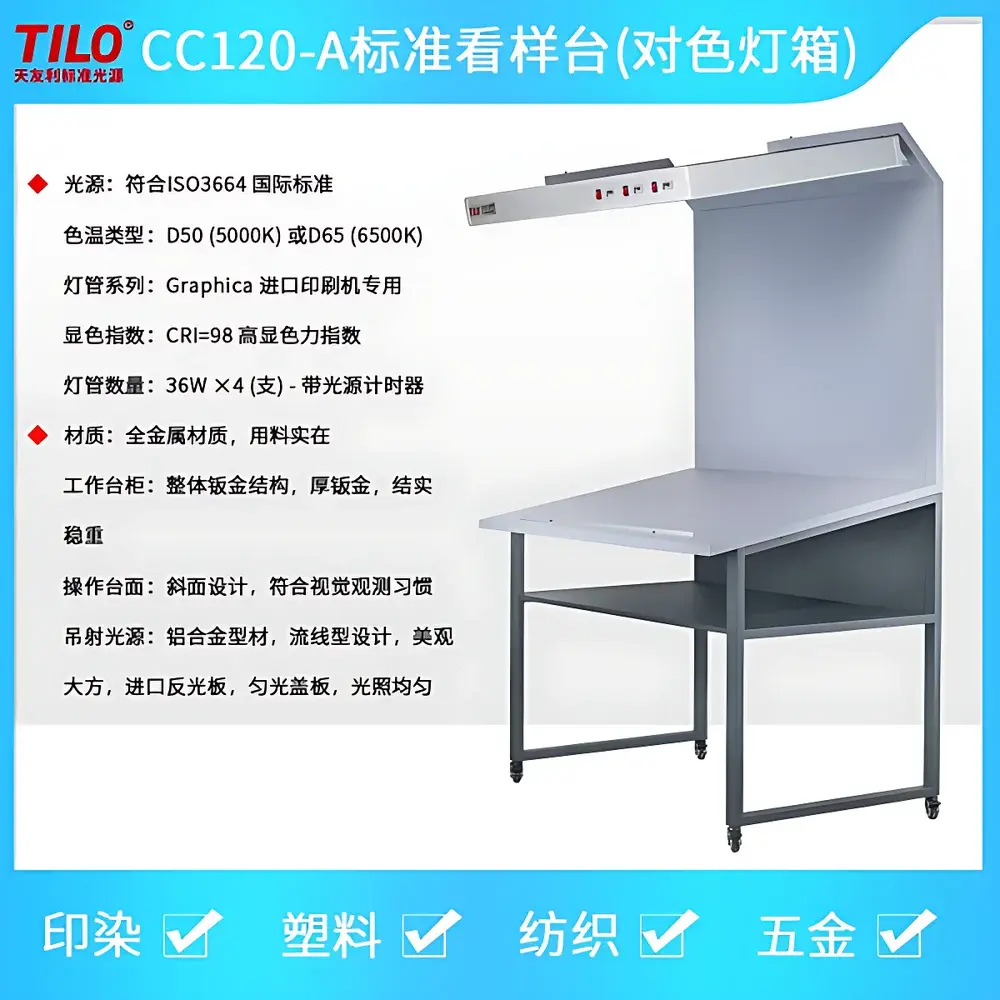
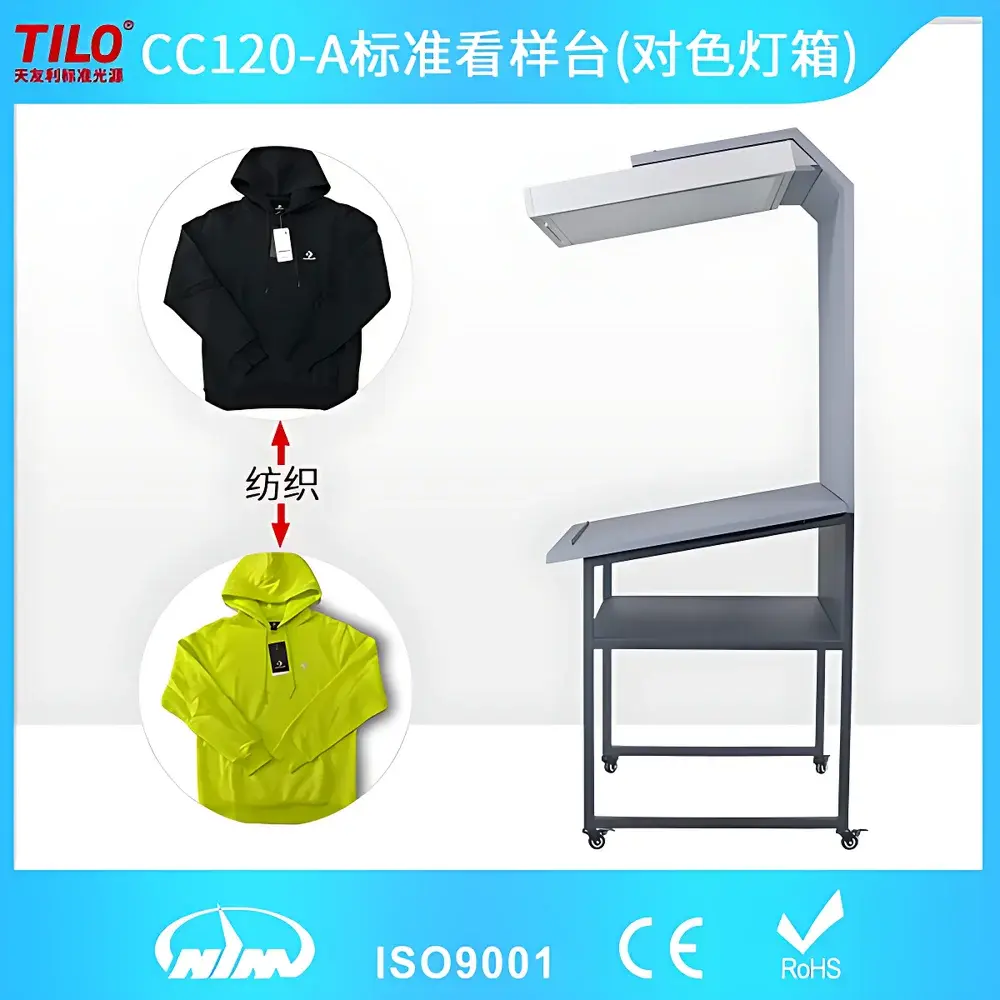
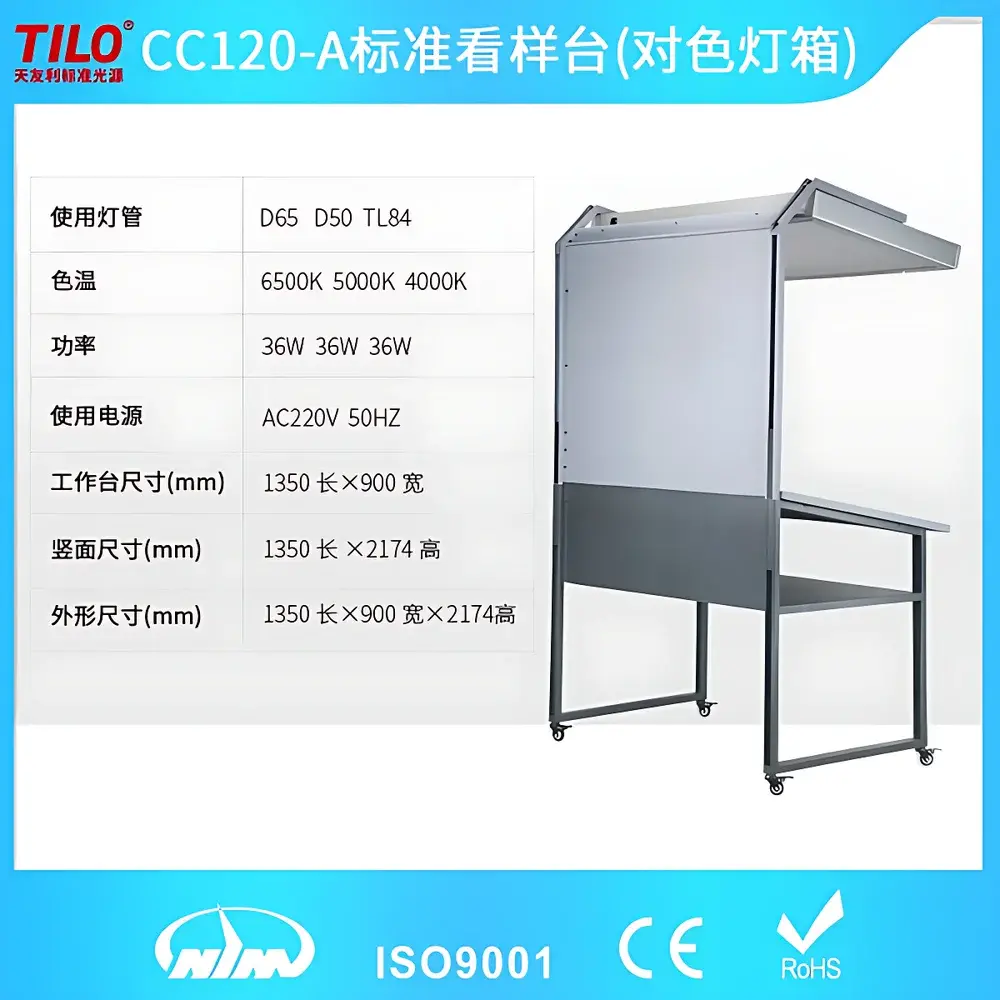
TILO CC120-A-2 Standard Light Booth for Color Matching and Proof Evaluation
| Brand | TILO |
|---|---|
| Origin | Guangdong, China |
| Model | CC120-A-2 |
| Light Sources | D50 (5000K) & D65 (6500K) |
| CRI | ≥98 |
| Lamp Type | Graphica-series imported fluorescent tubes |
| Lamp Power | 36W × 4 |
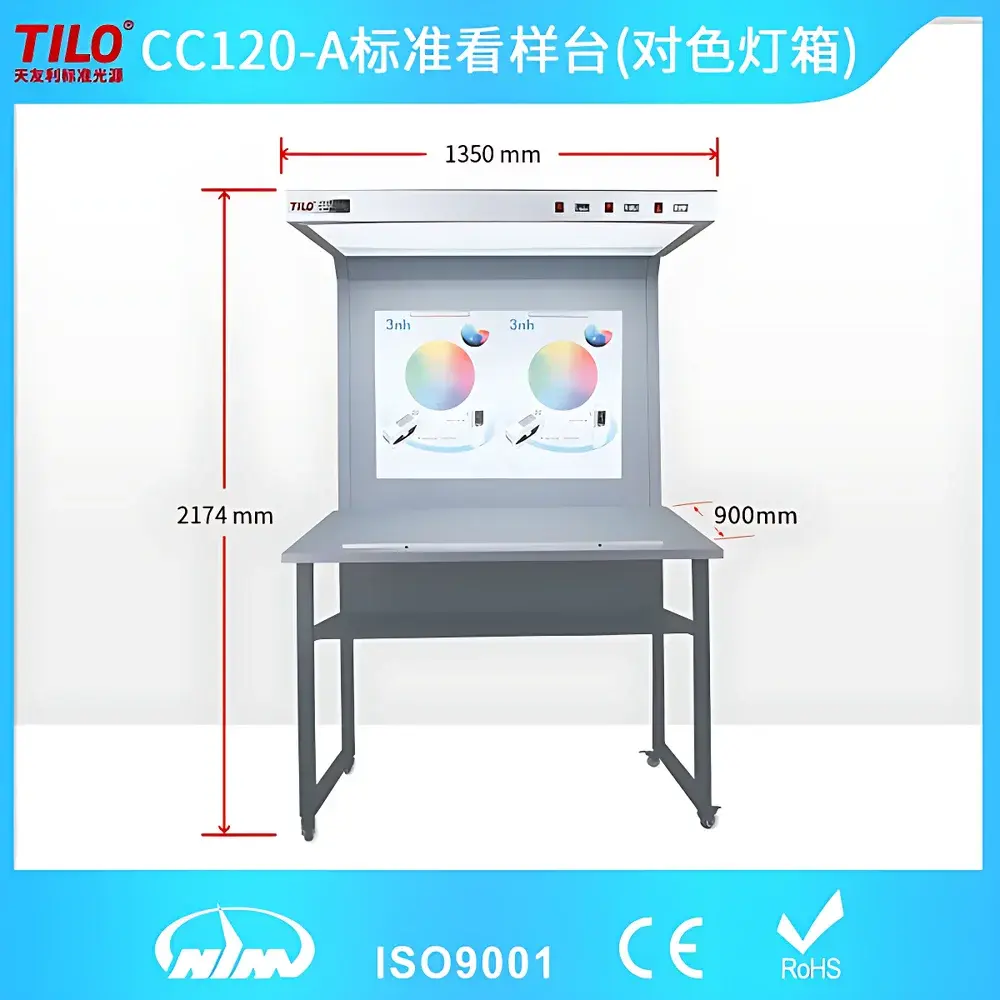
| Dimensions (L×W×H) | 1350 mm × 900 mm × 2174 mm |
| Work Surface | 1350 mm × 900 mm |
| Vertical Viewing Area | 1350 mm × 2174 mm |
| Construction | Full-metal sheet-metal cabinet with integrated storage shelf |
| Compliance | ISO 3664:2009 |
Overview
The TILO CC120-A-2 Standard Light Booth is an engineered solution for consistent, repeatable color evaluation in prepress, printing, packaging, textile, paint, and plastics industries. Designed in strict accordance with ISO 3664:2009 — the international standard governing viewing conditions for graphic technology and photography — this light booth delivers photometrically stable illumination essential for accurate visual assessment of color matches, proofs, and production samples. Its dual-standard capability supports both D50 (5000K) and D65 (6500K) illuminants, enabling compliance with regional and application-specific requirements: D50 is mandated for graphic arts and print proofing under ISO 3664, while D65 serves as the daylight reference for general industrial color matching per CIE and ASTM D1729. The booth utilizes four high-CRI (≥98) Graphica-series fluorescent lamps, specifically calibrated for spectral power distribution matching critical ISO-defined emission profiles. Unlike generic lighting fixtures, the CC120-A-2 integrates optical-grade reflectors, precision diffusers, and lamp-hour monitoring to ensure long-term photometric integrity across daily use cycles.
Key Features
- ISO 3664:2009–compliant illumination with selectable D50 and D65 modes, each independently validated for spectral irradiance and uniformity
- Four 36W Graphica-series fluorescent lamps delivering exceptional color fidelity (CRI ≥98) and minimal metamerism risk
- Full-metal, heavy-gauge sheet-metal construction with reinforced structural rigidity; no plastic housings or flimsy components
- Ergonomic angled work surface (1350 mm × 900 mm) aligned to optimal viewing geometry per ISO 3664 observer positioning guidelines
- Vertical viewing panel (1350 mm × 2174 mm) supporting full-sheet and large-format substrate inspection without repositioning
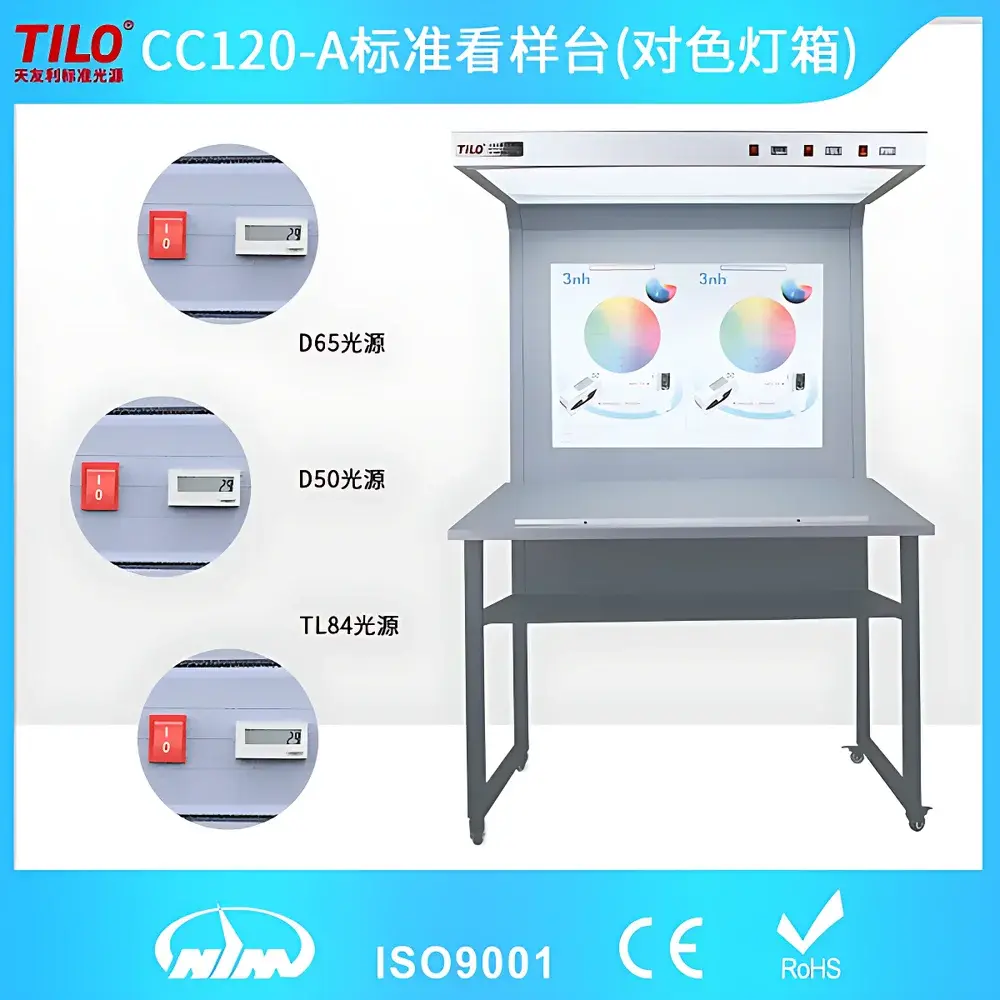
- Integrated lamp-hour counter for predictive maintenance and traceable lamp replacement scheduling
- Aluminum extrusion light rail with specular-grade reflective backing and opal diffuser plate ensuring ±5% spatial illuminance uniformity across entire viewing area
- Dedicated storage shelf (no drawers) preserving cabinet stability and minimizing vibration transmission during visual assessment
Sample Compatibility & Compliance
The CC120-A-2 accommodates reflective media up to large-format (B1 / “double demy”) dimensions — including press sheets, inkjet proofs, laminated substrates, coated papers, metallic foils, and textured textiles. Its enclosed geometry eliminates ambient light intrusion, satisfying ISO 3664’s requirement for controlled surround luminance (M1 condition). All optical components — from lamp spectral output to internal reflectivity — are certified against ISO/CIE reference spectroradiometric data. The system supports GLP-aligned workflows: lamp usage logs, operator ID tagging (via optional software integration), and audit-ready documentation for ISO 9001, ISO 14001, and G7-certified print facilities. While not FDA-regulated, its metrological traceability aligns with ASTM E308 and ISO 13655 spectral measurement prerequisites for instrument calibration validation.
Software & Data Management
The CC120-A-2 operates as a hardware-controlled visual assessment station and does not include embedded firmware or proprietary software. However, it is fully compatible with third-party color management ecosystems — including X-Rite Color iMatch, Datacolor TOOLS, and GMG ColorProof — when used in conjunction with spectrophotometers and digital proofing systems. Lamp-hour data can be exported manually for inclusion in facility-wide preventive maintenance schedules. For laboratories requiring electronic audit trails, the booth may be integrated into LIMS or MES platforms via external PLC-triggered I/O signals (e.g., lamp-on status, cycle count), supporting 21 CFR Part 11–aligned electronic record retention where applicable.
Applications
- Press proof verification against contract standards in commercial and packaging print environments
- Color approval workflows between brand owners, designers, prepress houses, and converters
- Ink formulation evaluation under standardized illuminants to minimize batch-to-batch metamerism
- Quality control of coated, embossed, or metallized substrates where gloss and texture affect perceived hue
- Calibration verification of spectrodensitometers and handheld spectrophotometers using physical reference standards
- Teaching and certification labs conducting ISO 3664–based color vision testing and observer training
FAQ
What standards does the CC120-A-2 comply with?
It meets ISO 3664:2009 for graphic technology viewing conditions, including spectral power distribution, illuminance level (2000 lux ±500 lux), uniformity, and surround conditions.
Can I replace the lamps with non-Graphica tubes?
No. Only ISO 3664–certified Graphica-series lamps guarantee spectral fidelity. Substitution invalidates compliance and voids warranty.
Is the unit suitable for transmissive film evaluation?
No. The CC120-A-2 is configured exclusively for reflective sample assessment. Transmissive applications require dedicated backlight units with UV-filtered D50/D65 sources.
What is the expected service life of the lamps?
Graphica lamps maintain photometric specification for 2,000 hours under continuous operation; the built-in hour meter enables scheduled replacement prior to spectral drift.
Does the booth support multiple simultaneous illuminants?
No. D50 and D65 modes are discrete and manually selected; simultaneous activation is prohibited by ISO 3664 to prevent perceptual interference.





