
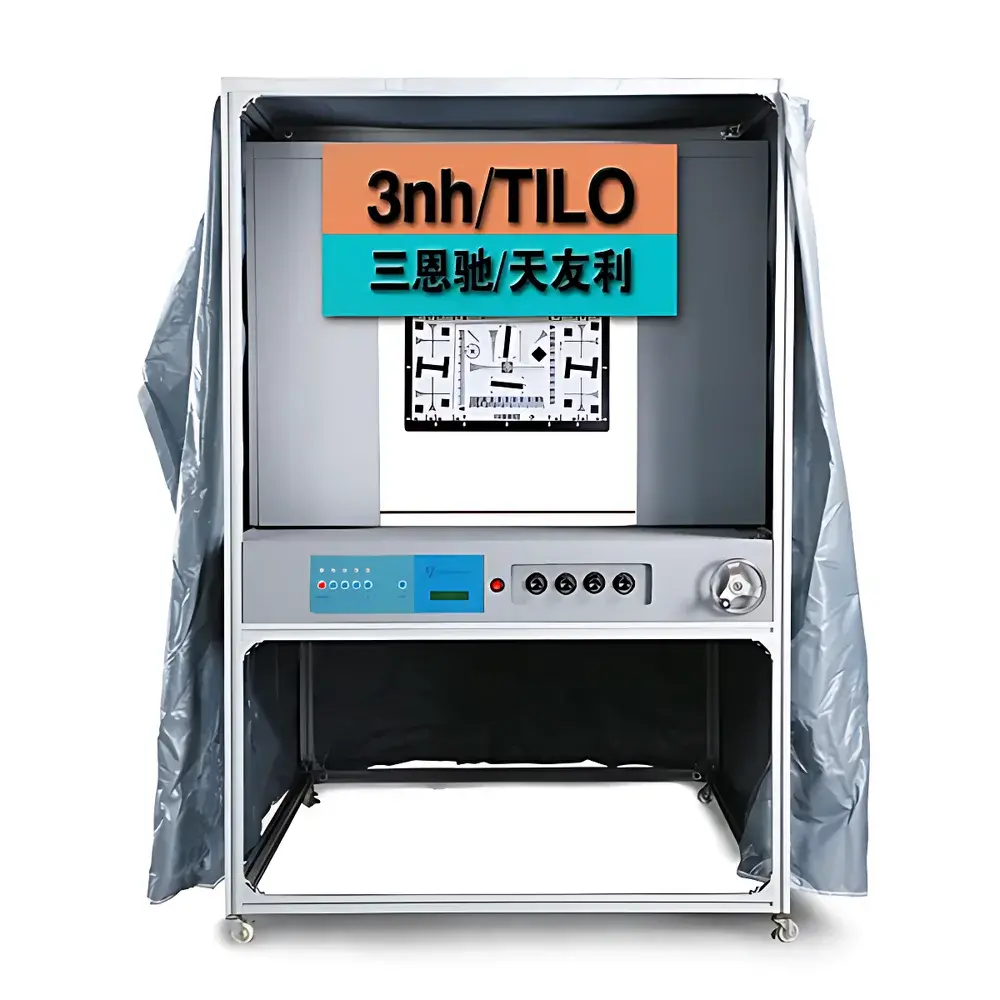
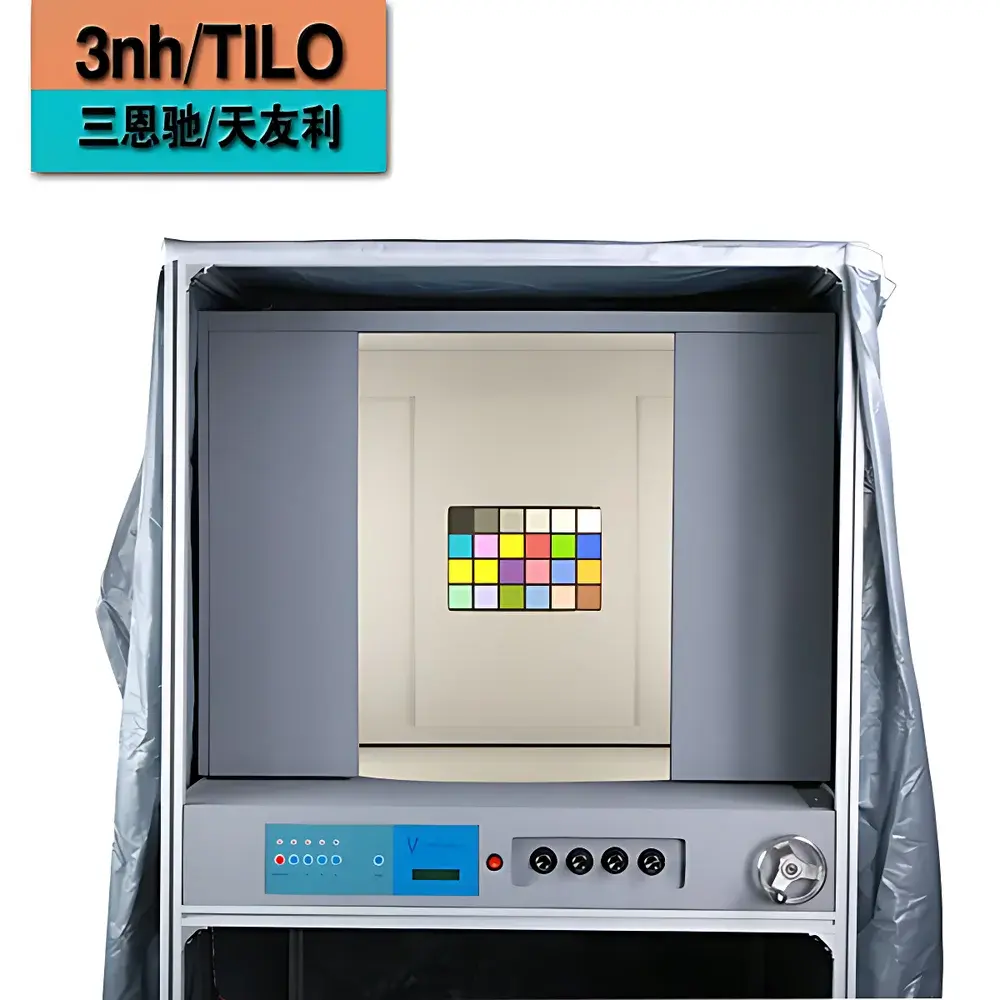
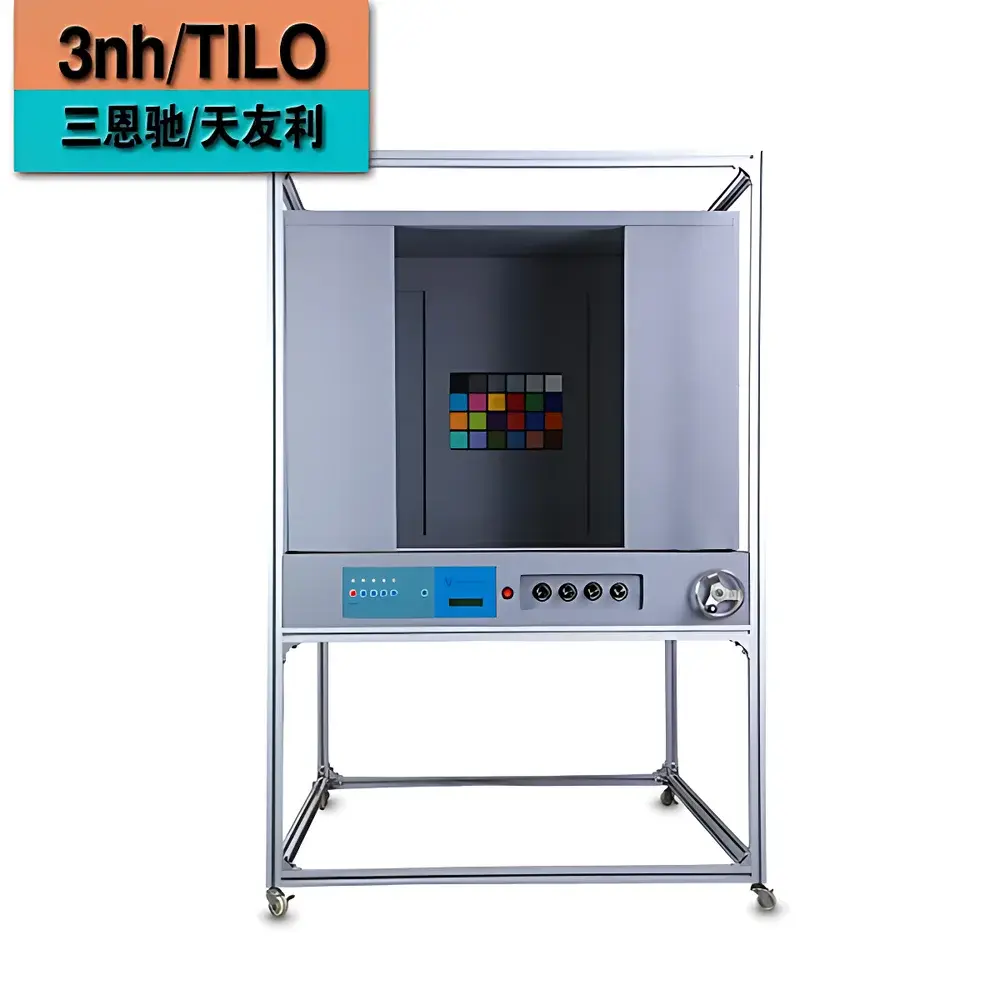
TILO VC2 Horizontal Camera Illumination Color Matching Cabinet
| Brand | TILO |
|---|---|
| Origin | Guangdong, China |
| Manufacturer Type | Authorized Distributor |
| Product Category | Domestic |
| Model | VC2 |
| Pricing | Available Upon Request |
| Light Sources | D65 (Standard), Optional TL84 |
| Illuminance Range | 750–3200 lux |
| Adjustable Illuminance | 1–100% (Continuous Dimming) |
| Illuminance Uniformity | >80% |
| Dimensions (W×D×H) | 98 × 60 × 85 cm |
| Background Color | Neutral Grey (Matte Absorptive Finish) |
| CIE-Compliant Illuminants | D65 (6500 K), TL84 (4000 K) |
| Control System | Microprocessor-Based Multi-Channel Switching |
| Timer Function | Independent Usage Logging per Light Channel |
| Lamp Configuration | 4 Independent Channels (3 Active + 1 Spare) |
Overview
The TILO VC2 Horizontal Camera Illumination Color Matching Cabinet is a purpose-engineered optical test environment designed specifically for the objective evaluation and calibration of imaging sensors, machine vision cameras, and automated optical inspection (AOI) systems. Unlike general-purpose light booths, the VC2 integrates photometric precision with industrial-grade controllability to meet the stringent requirements of camera module validation in R&D labs, manufacturing QC lines, and third-party testing facilities. Its core functionality is grounded in CIE-standardized illuminants—primarily D65 (6500 K), which replicates average daylight and serves as the reference condition for colorimetric measurements per ISO 13655:2017 and ASTM E308. A configurable TL84 channel (4000 K, triphosphor fluorescent) is available as an optional replacement lamp set, enabling compliance with retail lighting evaluation protocols defined in ISO 12647-2 and ISO 3664. The cabinet operates on the principle of controlled, uniform irradiance delivery within a geometrically stable enclosure, minimizing specular reflections and ambient interference through its matte neutral grey interior finish and optimized lamp array geometry.
Key Features
- Horizontal orientation optimized for integration with camera positioning stages, robotic arms, or inline AOI stations—eliminating vertical space constraints and facilitating repeatable sensor-to-target alignment.
- Microprocessor-controlled illumination management enabling millisecond-level switching between D65 and optional TL84 channels, with independent dimming resolution across 100 linear steps (1–100%).
- Dual-layer photometric stability: high-uniformity reflector design and calibrated lamp aging compensation ensure spatial illuminance uniformity exceeding 80% across the central 80% test area (per ISO/CIE spatial uniformity guidelines).
- Embedded usage logging system tracks cumulative operational hours per lamp channel separately—critical for scheduled lamp replacement, metrological traceability, and GLP-compliant audit trails.
- Modular lamp architecture supports field-swappable configurations: standard four-channel layout includes three active positions (D65 primary + two spares) plus one designated slot for F-series lamps (e.g., F11/F12) when specialized UV or narrowband spectral validation is required.
- All optical components—including reflectors, diffusers, and ballasts—meet IEC 61000-3-2 harmonic emission standards and carry CE/ROHS certification; lamp sets are sourced from ISO 9001-certified manufacturers with full spectral power distribution (SPD) documentation.
Sample Compatibility & Compliance
The VC2 accommodates flat-panel camera modules (up to 30 cm diagonal), lens assemblies, and printed calibration targets (e.g., X-Rite ColorChecker SG, ISO 12233 slanted-edge charts) mounted on adjustable fixtures. Its neutral grey interior (L* ≈ 50, CIE L*a*b*) suppresses secondary reflections and ensures chromatic neutrality during spectral response characterization. The cabinet complies with key international standards for visual and instrumental color assessment: ISO 3664:2009 (graphic technology), ISO 12647-2:2013 (process control), and CIE Publication 15:2018 (colorimetry). While not certified for clinical or pharmaceutical use, its D65 channel meets the illuminant specification referenced in FDA guidance documents for medical device image validation (e.g., guidance on digital pathology systems). Calibration reports for illuminance output and CCT stability are provided with each unit shipment.
Software & Data Management
The VC2 operates as a standalone hardware platform without proprietary software dependency. Illuminance levels and channel selection are managed via front-panel membrane keypad and LCD display. For integration into automated test sequences, RS-232 and optional USB-to-serial interfaces support SCPI command sets compatible with LabVIEW, Python (PySerial), and MATLAB instrument control toolboxes. Logged usage data can be exported as CSV files for inclusion in MES/QMS databases. All firmware revisions maintain backward compatibility and are validated against IEC 62304 Class B software lifecycle requirements. Audit trail functionality satisfies basic 21 CFR Part 11 read-only record retention needs when paired with timestamped external logging.
Applications
- Dynamic range and linearity testing of CMOS/CCD sensors under variable illuminance (750–3200 lux).
- White balance algorithm validation across multiple correlated color temperatures (CCTs).
- Color fidelity assessment (ΔE₀₀) of embedded ISP pipelines using standardized color charts.
- Auto-exposure convergence analysis under flicker-free, DC-stabilized illumination.
- Shading correction profile generation for multi-camera synchronization systems.
- Pre-shipment verification of automotive ADAS camera modules per ISO 16505 Annex C requirements.
FAQ
What is the recommended recalibration interval for the D65 lamp set?
Lamp spectral drift is monitored via built-in usage timers; TILO recommends replacement after 2,000 hours of cumulative operation or annually—whichever occurs first—to maintain CCT deviation within ±150 K of 6500 K.
Can the VC2 be integrated with a spectroradiometer for NIST-traceable validation?
Yes—the open-top design and standardized mounting dimensions allow unobstructed access for probe placement; users commonly employ Konica Minolta CS-2000 or Instrument Systems CAS 140D systems for point-measurement verification.
Is the neutral grey background replaceable?
The interior finish is applied as a permanent matte coating; however, TILO offers factory-recoating services upon return, with full spectral reflectance verification (380–780 nm) included in the service report.
Does the VC2 support flicker measurement per IEEE 1789-2015?
The electronic ballast design achieves <1% flicker percentage at 100 Hz (measured per CIE TN 006:2016), making it suitable for high-speed imaging validation but not intended for quantitative flicker metric reporting.
How is ambient light rejection verified during installation?
A simple verification protocol is included: place a black reference tile inside the chamber, close the door, and measure illuminance at center and corners using a calibrated lux meter—the ratio of min/max readings must exceed 0.8 to confirm adequate shielding.



