
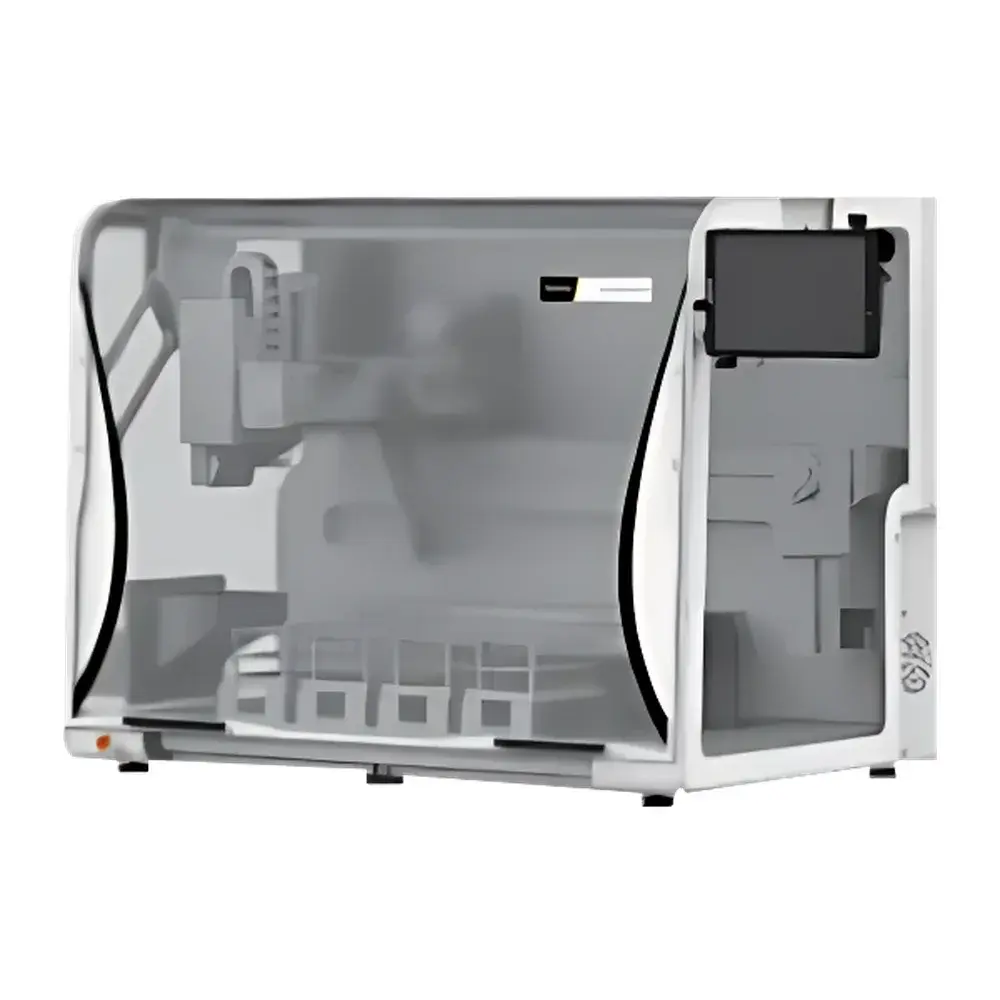
Revvity OMNI Prep 96 Automated High-Throughput Homogenization Workstation
| Brand | Revvity |
|---|---|
| Origin | USA |
| Manufacturer | Revvity, Inc. |
| Product Type | Imported |
| Model | OMNI Prep 96 |
| Pricing | Upon Request |
Overview
The Revvity OMNI Prep 96 Automated High-Throughput Homogenization Workstation is an engineered solution for reproducible, scalable, and operator-independent tissue and cell homogenization in life science laboratories. It operates on a programmable mechanical principle that replicates the controlled vertical and horizontal motion patterns of manual homogenization—using precision-engineered reciprocating probe actuators to deliver consistent shear forces across sample vessels. Unlike conventional rotor-stator or bead-beating systems, the OMNI Prep 96 employs a kinematically optimized dual-axis motion profile (Z-axis penetration depth + X/Y orbital oscillation), enabling uniform disruption of heterogeneous biological matrices—including fibrous tissues, plant material, frozen samples, and viscous lysates—without thermal runaway or nucleic acid shearing artifacts. Designed for integration into regulated environments, the system supports audit-ready operation under GLP and GMP frameworks, with hardware-level traceability of motion parameters, cycle counts, and user authentication logs.
Key Features
- True walk-away automation: Fully programmable homogenization protocols with configurable Z-axis stroke length (0–25 mm), oscillation frequency (100–1,200 rpm), and dwell time per cycle—enabling method standardization across shifts and sites.
- Parallel processing capability: Simultaneous homogenization of up to four samples in standard 1.5–50 mL tubes or deep-well plates, with independent motion control per station to accommodate variable sample viscosities and volumes.
- Probe-based mechanical homogenization: Utilizes OMNI disposable or autoclavable stainless-steel probes (0.5–10 mm diameter) compatible with single-use workflows and stringent contamination control requirements.
- Integrated safety architecture: Motor torque monitoring, real-time temperature feedback (via optional external probe interface), lid interlock sensors, and automatic emergency stop on overcurrent or positional error detection.
- Modular design for lab integration: Compact footprint (45 × 50 × 40 cm) with RS-232, USB, and Ethernet connectivity; supports scheduling via external LIMS or ELN systems through ASCII command protocol.
Sample Compatibility & Compliance
The OMNI Prep 96 accommodates a broad range of biological specimen types—including mammalian tissues (liver, muscle, brain), plant leaves and roots, microbial pellets, blood clots, and FFPE-derived lysates—across volume ranges from 100 µL to 45 mL per vessel. Probe selection and motion profiles are validated per ASTM D7212-18 (for tissue homogenate uniformity) and ISO 17025:2017 (for method validation in accredited testing labs). The workstation meets IEC 61000-6-2/6-3 for electromagnetic compatibility and UL 61010-1 safety certification. Its firmware architecture supports 21 CFR Part 11-compliant electronic records when paired with Revvity’s optional SecureLog software module, providing role-based access control, electronic signatures, and immutable audit trails for all run parameters and outcomes.
Software & Data Management
Control is executed via the OMNI Control Suite v3.x—a Windows-based application supporting method creation, parameter locking, batch queuing, and export of CSV-formatted run logs (including timestamp, probe ID, motion profile ID, motor current draw, and operator ID). All methods are stored in encrypted local database files with SHA-256 hash verification. For enterprise deployment, the system integrates with laboratory information management systems (LIMS) via HL7 or RESTful API endpoints, enabling bidirectional transfer of sample IDs, protocol assignments, and completion status. Raw motion data (position vs. time at 100 Hz sampling) can be exported for third-party statistical process control (SPC) analysis or multivariate modeling of homogenization efficiency.
Applications
- Pre-analytical sample preparation for genomic DNA/RNA extraction, where consistent lysis kinetics directly impact yield, fragment size distribution, and downstream qPCR/Nanostring performance.
- High-throughput biobanking workflows requiring standardized homogenization of thousands of tissue specimens prior to cryopreservation or biomarker assay development.
- Pharmaceutical QC of oral suspensions and topical emulsions, where particle dispersion uniformity correlates with dose accuracy and stability shelf-life.
- Microbiome research involving complex stool or soil matrices, where reproducible cell wall disruption ensures representative microbial community profiling by 16S rRNA sequencing.
- Regulatory submission support: Validated homogenization protocols contribute to analytical method transfer packages required by FDA, EMA, and PMDA for bioanalytical method validation (ICH M10).
FAQ
Can the OMNI Prep 96 be validated for use in GMP manufacturing environments?
Yes—when configured with SecureLog software and operated under documented SOPs, it satisfies Annex 11 and 21 CFR Part 11 requirements for computerized system validation, including IQ/OQ/PQ documentation templates provided by Revvity.
Is probe calibration required between runs?
No routine calibration is needed; however, probe wear is monitored via motor current signature analysis, and the system alerts users when actuator performance deviates beyond ±3% of baseline torque response.
Does the system support non-standard tube formats (e.g., custom microfluidic cartridges)?
Yes—custom fixture kits and motion profile libraries are available under Revvity’s Application Engineering Services program, subject to mechanical feasibility assessment.
How is cross-contamination prevented during multi-sample runs?
Each station uses dedicated probe holders with automated ejection mechanisms; disposable probes are recommended for high-risk applications, and stainless-steel probes undergo validated cleaning cycles using Revvity’s OMNI Clean Protocol (validated per ISO 15883-1).



