
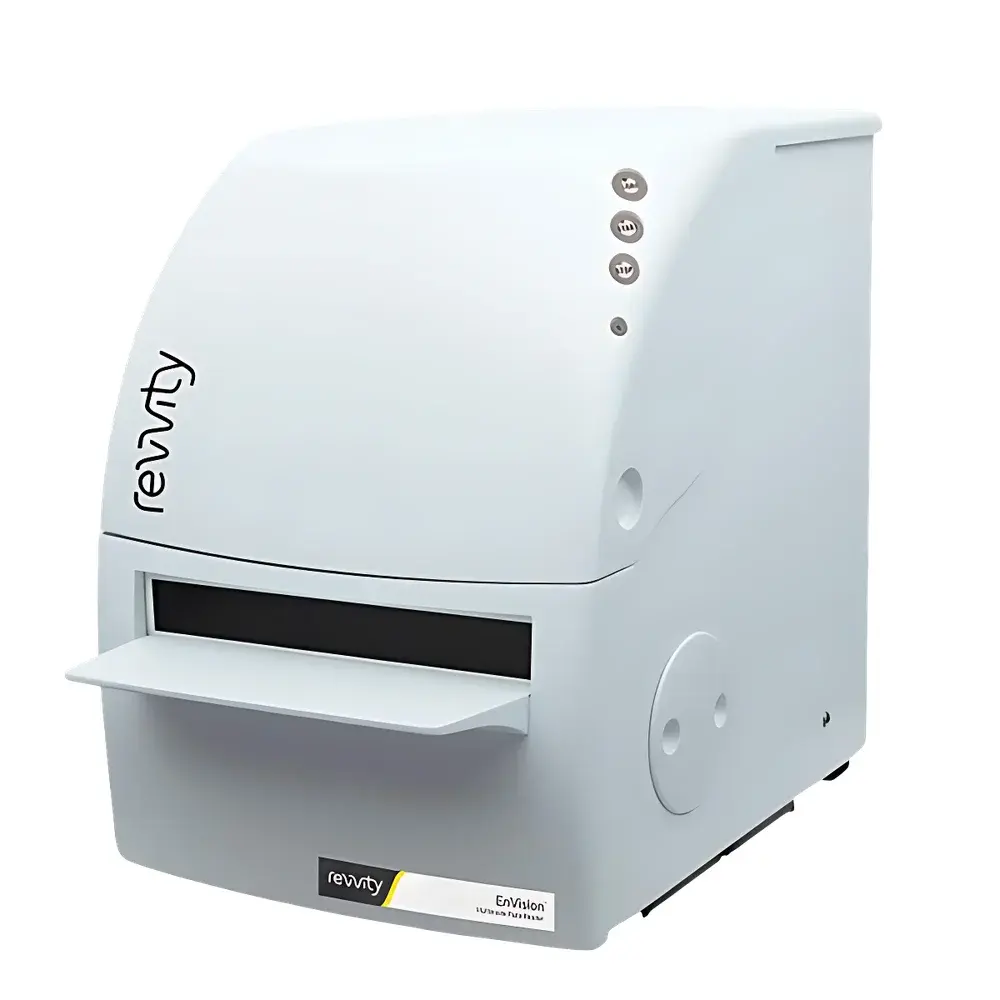
Revvity EnVision Multimode Microplate Reader
| Brand | Revvity |
|---|---|
| Origin | United Kingdom |
| Manufacturer Type | Original Equipment Manufacturer (OEM) |
| Product Origin | Imported |
| Model | EnVision |
| Functionality | Multimode |
| Automation Level | Fully Automated |
| Assay Modes | Endpoint, Kinetic, Scanning |
| Curve Fitting Options | Multiple Nonlinear Regression Models (e.g., 4PL, 5PL, Linear, Log-Log) |
| Detector Types | Photodiode & Photomultiplier Tube (PMT) |
| Wavelength Range | 200–1000 nm |
| Absorbance Range | 0–4 OD |
| Absorbance Linearity | 0–2 OD (±0.5% deviation) |
| Wavelength Switching Time | ≤12 s |
| Absorbance Precision | <0.1% CV at 1 OD |
Overview
The Revvity EnVision Multimode Microplate Reader is an engineered platform for quantitative, high-fidelity detection across all major non-radioactive assay modalities used in modern life science research and drug discovery. Built upon a hybrid optical architecture—integrating both tunable monochromators and precision interference filters—the EnVision delivers exceptional flexibility without compromising sensitivity or reproducibility. Its core measurement principles include absorbance (UV-Vis), fluorescence intensity (FI), fluorescence polarization (FP), time-resolved fluorescence (TRF), TR-FRET (e.g., LANCE®, HTRF®), luminescence (including ultra-sensitive chemiluminescence), and Alpha technology (Amplified Luminescent Proximity Homogeneous Assay). Each detection mode operates on purpose-built optical pathways with dedicated excitation sources, emission collection optics, and detector configurations—ensuring optimal signal-to-noise ratio (SNR), minimal crosstalk, and robust inter-laboratory comparability.
Key Features
- Hybrid optical design: Dual-path monochromator + filter-based excitation/emission selection enables broad spectral coverage (200–1000 nm) with high spectral purity and low stray light (<0.0005% at 220 nm).
- Dual-detector configuration: Independent photodiode for absorbance and high-gain PMT for luminescence/fluorescence; optional dual-PMT synchronization for real-time FP and TR-FRET quantification.
- Ultra-sensitive luminescence detection: Low-dark-current, single-photon-counting PMT with optimized aperture geometry minimizes spatial crosstalk and enhances detection limit for weak bioluminescent signals.
- Laser-excited TRF/TR-FRET module: Pulsed high-energy diode laser (337 nm or 377 nm) ensures rapid decay gating, superior SNR, and sub-second per-well read times.
- Patented Alpha detection optics: Integrated laser source, thermally stabilized detection chamber, and variable-aperture collimation aligned directly above microplate wells reduce path-length loss and suppress well-to-well interference.
- Barcode-enabled filter management: All filters and dichroic mirrors feature RFID or 2D barcodes for automatic recognition, calibration traceability, and multi-user protocol integrity.
- Modular scalability: Field-upgradeable detection modules; optional integrated pipettors, barcode scanners, and robotic plate handlers support seamless integration into GLP/GMP-compliant automated workflows.
Sample Compatibility & Compliance
The EnVision supports standard microplate formats (6–1536-well), including opaque, clear, white, and black plates with various surface chemistries (e.g., tissue-culture treated, streptavidin-coated, low-binding). It complies with ISO/IEC 17025 requirements for analytical instrument qualification and meets key regulatory expectations for assay validation under FDA 21 CFR Part 11, EU Annex 11, and ICH guidelines. Audit trail functionality, electronic signature support, and user-access-level controls are embedded within the EnVision software suite to facilitate compliance with GLP and GMP environments. All optical calibrations are traceable to NIST-certified standards, and system suitability tests (SSTs) are programmable per assay protocol.
Software & Data Management
EnVision’s proprietary WorkOut 2.5 software provides a validated, secure environment for method development, instrument control, data acquisition, and statistical analysis. The interface includes guided assay optimization wizards—automatically adjusting gain, integration time, Z-height, and orbital shaking parameters based on pilot runs. Raw data export supports CSV, XML, and SDMX formats compatible with third-party platforms such as Spotfire, GraphPad Prism, and CDD Vault. All data files retain full metadata (instrument ID, operator, timestamp, calibration history), and version-controlled protocols ensure method reproducibility across sites and instruments. Software updates follow a formal change control process aligned with ISO 13485 and 21 CFR Part 11 Annex A requirements.
Applications
The EnVision serves as a central analytical hub in target identification, lead optimization, ADME/Tox profiling, and biomarker validation. Typical applications include nucleic acid and protein quantification (A260/A280, fluorescent dyes), enzymatic activity assays (kinetics of alkaline phosphatase, caspase-3, CYP450 isoforms), cell health endpoints (ATP content, mitochondrial membrane potential, ROS generation), receptor-ligand binding (TR-FRET-based GPCR and kinase assays), gene expression (dual-luciferase reporter systems), and epigenetic modifications (histone methylation via AlphaScreen). Its ability to perform multiplexed, kinetic, and scanning measurements within a single run makes it particularly suited for high-content screening campaigns requiring temporal resolution and cross-modal correlation.
FAQ
What assay modes does the EnVision support?
It supports absorbance, fluorescence intensity, fluorescence polarization, time-resolved fluorescence, TR-FRET, luminescence (including flash and glow), and Alpha technology—all in a single platform.
Is the EnVision compliant with 21 CFR Part 11?
Yes—software includes role-based access control, electronic signatures, full audit trails, and data integrity safeguards required for regulated environments.
Can the EnVision be integrated into robotic liquid handling systems?
Yes—via standardized RS-232, USB, or Ethernet interfaces; optional plate stacker, barcode reader, and dual-channel dispenser modules enable full walk-away automation.
How is wavelength accuracy maintained over time?
Through factory-calibrated holmium oxide and didymium filters; routine verification using NIST-traceable reference standards is supported by built-in calibration routines.
Does the system support kinetic measurements with temperature control?
Yes—integrated incubation module maintains plate temperature from ambient +4°C to 45°C with ±0.5°C uniformity across all wells.
Related Products



