
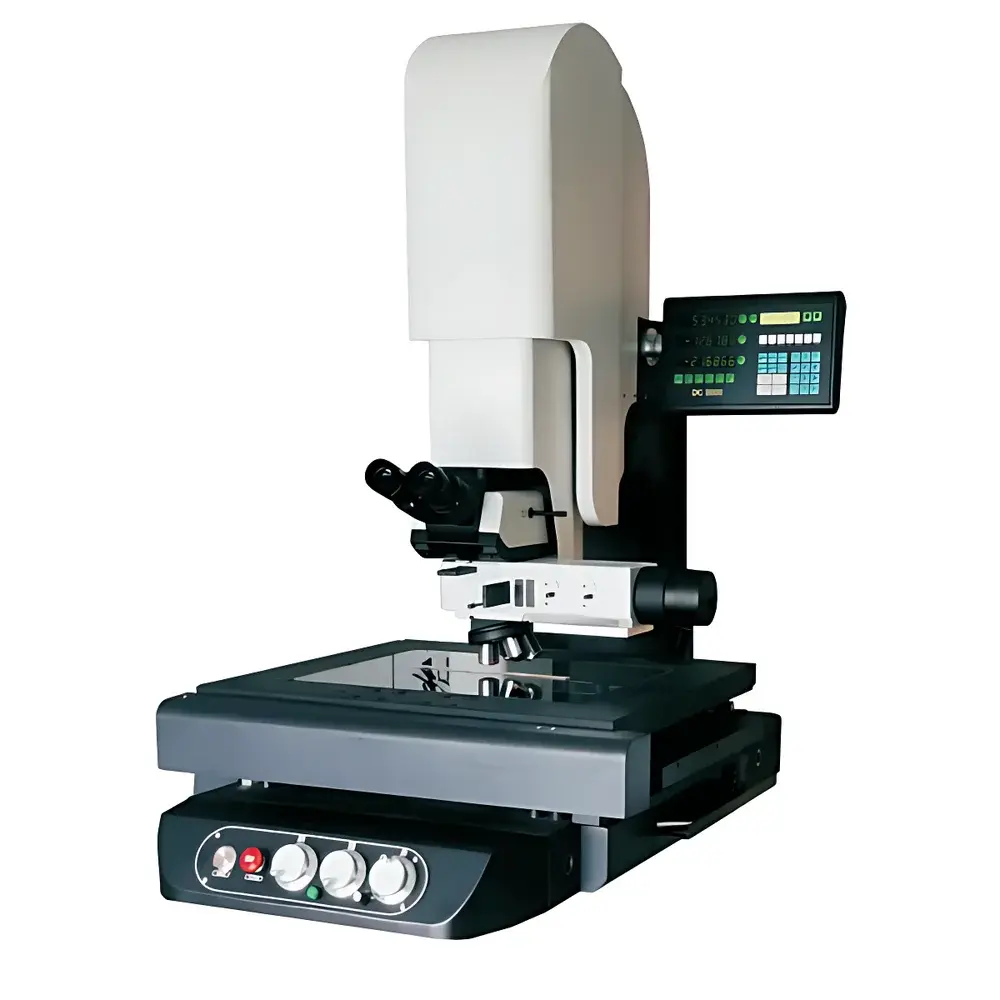
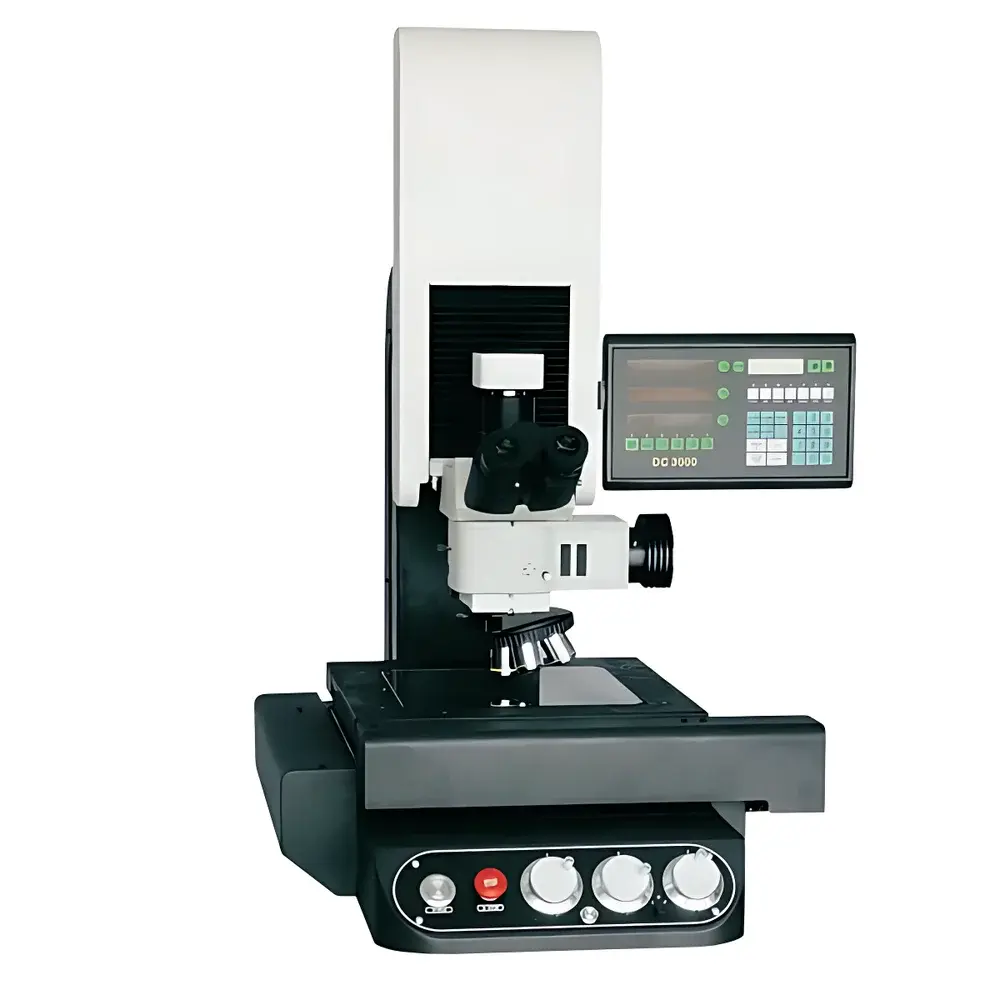
LEI-TECH LK-CS Series Fully Automated Upright Metallurgical Microscope with CNC-Controlled XYZ Motorized Stages and Integrated Image Analysis System
| Brand | LEI-TECH |
|---|---|
| Origin | Tianjin, China |
| Manufacturer Type | Direct Manufacturer |
| Product Category | Domestic |
| Model | LK-CS Series |
| Mounting Type | Upright |
| Image Analysis System | Integrated |
| Total Magnification Range | 50×–1000× |
| Eyepiece | Binocular, 10× |
| Objective Lenses | 5×, 10×, 20×, 50× (100× optional) |
| Optical Path | Infinity-Corrected Dual-Color-Corrected (UISC) |
| Illumination | Reflected Brightfield/Darkfield (12 V/100 W Halogen + LED option), Transmitted LED (5 W, NA 0.5 Condenser) |
| Observation Modes | Brightfield, Darkfield, DIC, Polarization |
| Focus Control | Motorized Z-axis with Software & Handwheel Precision Control |
| Stage Drive | Servo-Motorized XYZ Axes with Electronic Grating Scale Feedback (Resolution: 0.5 µm standard, 0.1 µm optional) |
| Measurement Accuracy | X-Y ≤ (2.5 + 0.02L) µm, Z ≤ (4 + 0.02L) µm (L in mm) |
| Software Features | Auto-Edge Detection, Auto-Registration, Auto-Focus, Extended Depth of Field (EFI), Multi-Field Image Stitching (MIA), SPC Reporting, CNC Programming, Batch Measurement Export |
Overview
The LEI-TECH LK-CS Series is a fully automated upright metallurgical microscope engineered for high-precision microstructural analysis and dimensional metrology in metallography laboratories, quality control departments, and R&D facilities. Built upon an infinity-corrected optical architecture (UISC—Universal Infinity-Super-Corrected), the system delivers diffraction-limited resolution, high contrast, and chromatic fidelity across all magnifications—from 50× to 1000×—enabling reliable grain size evaluation, phase identification, inclusion analysis, and coating thickness measurement. Its core functionality integrates optical microscopy with coordinate metrology: the motorized XYZ stage—driven by industrial-grade servo motors and monitored by high-resolution electronic grating scales (standard 0.5 µm, optionally 0.1 µm)—operates under closed-loop positional feedback, ensuring repeatability and traceability required for ISO/IEC 17025-compliant testing environments. Unlike conventional manual or semi-automated systems, the LK-CS platform supports true CNC-based measurement workflows, including programmable path execution, multi-point alignment, and repeatable field-of-view registration—critical for batch inspection of castings, welds, heat-treated alloys, and additive-manufactured components.
Key Features
- Upright metallurgical configuration with dual-path illumination: independently controllable reflected brightfield/darkfield (halogen or optional high-CRI LED) and transmitted LED (5 W, NA 0.5 condenser) for comprehensive sample interrogation.
- Infinity-corrected optical train with parfocal, apochromatic objectives (5×, 10×, 20×, 50×; 100× optional) optimized for high numerical aperture and minimal spherical aberration—essential for quantitative image analysis at ≥500× magnification.
- Motorized XYZ stage with servo-driven motion, real-time grating scale feedback, and triple-speed handpulse controller (fast/medium/slow) enabling sub-micron positioning stability—even during high-magnification Z-axis focusing.
- Dual-control interface: seamless switching between software-guided CNC programming and tactile handpulse operation—supporting both automated batch routines and operator-guided exploratory analysis.
- Advanced imaging capabilities including real-time Extended Focus Imaging (EFI) for depth-of-field synthesis and Multi-Field Image Acquisition (MIA) for gigapixel-scale panoramic mosaics—both processed on-board without external GPU dependency.
- Rugged granite base construction ensures long-term mechanical stability, thermal inertia, and vibration damping—critical for metrological consistency across shifts and ambient temperature fluctuations.
Sample Compatibility & Compliance
The LK-CS Series accommodates standard metallographic specimens (up to 4″ diameter, 50 mm height) mounted on glass or metal stubs, with optional extended-working-distance objectives supporting tall or irregularly shaped samples (e.g., turbine blades, powder metallurgy compacts). Its modular illumination and filter turret support ASTM E3, ISO 643, ISO 4967, and GB/T 10561 for inclusion rating; ASTM E112 for grain size determination; and ASTM E2015 for microindentation correlation. The system’s measurement uncertainty budget aligns with VDI/VDE 2634 Part 2 (optical coordinate measuring machines), and its software audit trail—including user login, parameter change logs, and result export timestamps—supports GLP/GMP documentation requirements per FDA 21 CFR Part 11 when configured with electronic signature modules.
Software & Data Management
The proprietary LEI-TECH MetroVision™ software provides a unified environment for acquisition, measurement, reporting, and data governance. It features automated edge detection using gradient-threshold segmentation, sub-pixel centroid localization, and NIST-traceable calibration via certified stage and lens standards. Measurement results are exportable in CSV, XML, or PDF formats compliant with enterprise LIMS integration protocols. SPC dashboards generate Cp/Cpk indices, histogram overlays, and trend charts directly from measurement databases. All software operations—including focus sequence definition, CNC path scripting, and report template customization—are performed within a validated framework that maintains version-controlled configuration files and encrypted local storage. Optional network licensing enables concurrent multi-user access across lab workstations while preserving role-based permissions (operator, supervisor, administrator).
Applications
- Metallographic QC: Grain boundary mapping, porosity quantification, second-phase particle sizing, and decarburization layer depth measurement in steels, aluminum alloys, and titanium grades.
- Failure analysis: Crack propagation tracing, intergranular corrosion assessment, and weld HAZ (heat-affected zone) characterization per AWS D1.1 or ISO 5817.
- Coating & surface engineering: Thickness measurement of PVD/CVD layers, thermal spray deposits, and electroplated finishes using focus-difference algorithms.
- Research metrology: Correlative analysis with SEM-EDS datasets, cross-validation of hardness indentation geometry, and in-situ thermal cycling observation (with environmental chamber integration).
- Education & training: Standardized curriculum modules for ASTM/ISO methodology instruction, including hands-on practice with certified reference materials (e.g., NIST SRM 1977, 1978).
FAQ
Does the LK-CS Series comply with ISO/IEC 17025 requirements for accredited testing laboratories?
Yes—the system’s measurement uncertainty model, calibration traceability (via NIST-traceable stage encoders and lens magnification standards), and software audit logging meet Clause 6.4.10 and Annex A.2 of ISO/IEC 17025:2017.
Can the microscope be integrated into an existing LIMS or MES infrastructure?
Yes—MetroVision™ supports OPC UA and HL7-compatible data export, with configurable RESTful API endpoints for bidirectional synchronization of sample IDs, measurement parameters, and pass/fail flags.
Is darkfield illumination included as standard or optional?
Darkfield capability is available as an optional add-on module with dedicated annular reflector and center-stop assembly—fully compatible with all standard objectives.
What is the maximum specimen height supported without objective collision?
With standard 50× objective, maximum working distance is 5.1 mm; with optional long-working-distance 50× (WD = 10.6 mm) or 20× (WD = 30.5 mm), heights up to 45 mm are accommodated.
Does the system support DIC (Differential Interference Contrast) imaging out of the box?
DIC functionality requires optional Wollaston prisms and polarizer/analyzer sets—installed in the dedicated slots within the nosepiece and illumination column—and is fully supported by MetroVision™’s DIC enhancement algorithms.




