
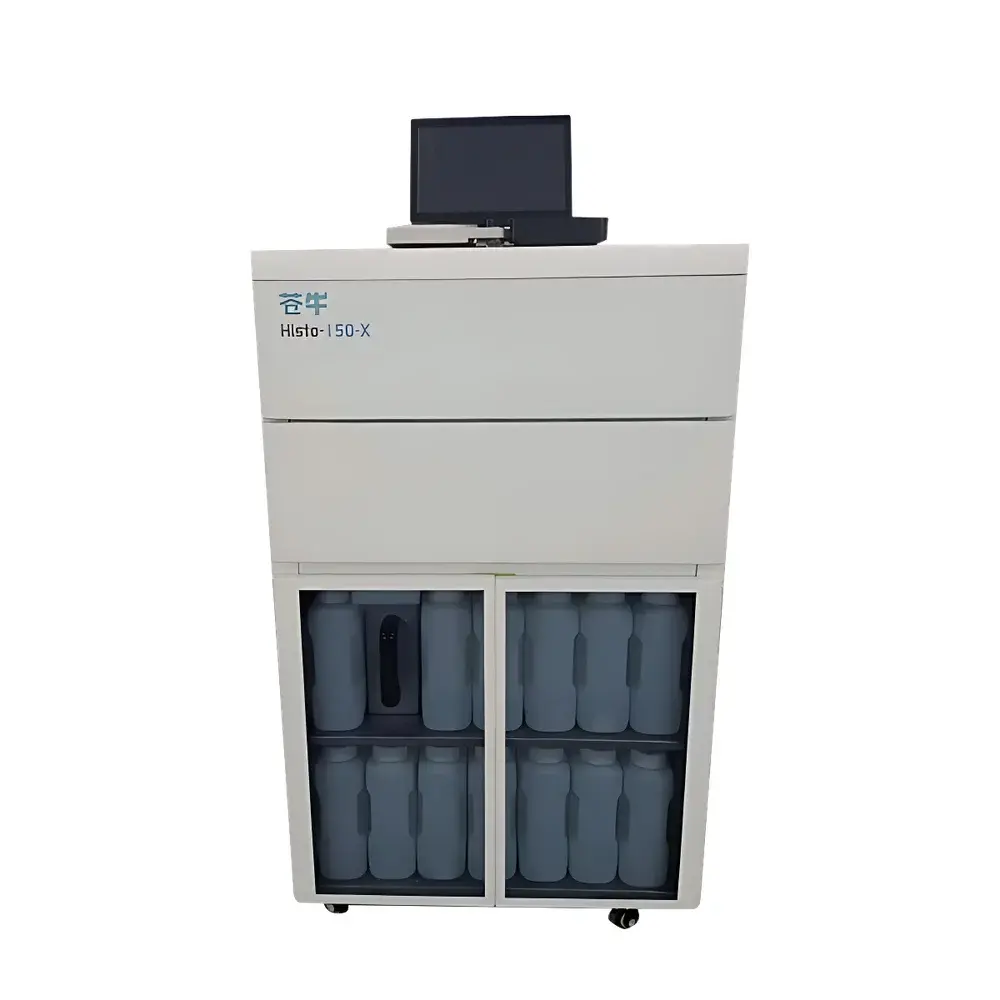
HISTO Histo-150-X Fully Enclosed Tissue Dehydrator
| Brand | HISTO |
|---|---|
| Origin | Zhejiang, China |
| Manufacturer Type | Authorized Distributor |
| Country of Origin | China |
| Model | Histo-150-X |
| Capacity | 300 standard tissue cassettes |
| Wax Tanks | 4 (3 × 4.3 L + 1 × 5.5 L) |
| Waste Wax Tank | 1 |
| Reagent Bottles | 13 (10 dehydration + 3 cleaning) |
| Temperature Control | 12 independent channels, ±1°C accuracy, max 70°C |
| Pressure Range | ±70 kPa |
| Dehydration Modes | 4 (Atmospheric, P, V, PV) |
| Heating Material | Monolithic aluminum alloy tank with Teflon coating, thermal conductivity >150 W/m·K |
| Agitation | Side-mounted mechanical stirrer |
| Level Sensing | Triple ultrasonic sensors |
| Fluid Path | Top-in / bottom-out design with gas–liquid isolation bottles |
| Exhaust | Activated carbon filtration + external vent interface |
| Display | 12″ color touchscreen, Windows 7 OS |
| Power | AC 100–240 V, 50–60 Hz, 2 kW |
| Dimensions (L×W×H) | 67 × 65 × 130 cm |
| Weight | 150 kg |
| Compliance | CE-marked architecture compatible with GLP/GMP documentation workflows |
Overview
The HISTO Histo-150-X Fully Enclosed Tissue Dehydrator is an automated, pressure-regulated laboratory instrument engineered for high-throughput histopathology laboratories requiring reproducible, operator-safe tissue processing prior to paraffin embedding. It operates on the principle of sequential solvent exchange—replacing water in fixed tissue specimens with graded alcohols and xylene substitutes, followed by infiltration with molten paraffin wax under controlled temperature and pressure conditions. Unlike open-basket or semi-automated systems, the Histo-150-X employs a fully sealed fluidic architecture with physically isolated gas and liquid pathways, eliminating cross-contamination risks between reagents and wax, and preventing volatile organic compound (VOC) exposure to personnel. Its monolithic aluminum dehydration chamber—machined from solid billet without welds—ensures structural integrity over decades of thermal cycling, while its high thermal conductivity enables rapid, uniform heating across the full 300-cassette capacity. Designed for compliance with ISO 15189 and CLIA-aligned workflow validation, the system supports audit-ready process logging and integrates seamlessly into centralized pathology information systems via Ethernet.
Key Features
- Monolithic aluminum dehydration chamber with Teflon-coated interior surface—minimizes reagent carryover, extends solvent life, and eliminates leakage pathways inherent in welded or bolted tanks.
- 12-channel independent temperature control system—distributes heating load across low-power resistive elements, ensuring ±1°C stability at up to 70°C across all wax and reagent compartments.
- Side-mounted mechanical agitation—avoids sediment disturbance from bottom-mounted impellers, delivering homogeneous reagent/wax contact without tissue displacement or cassette stacking interference.
- Triple ultrasonic liquid level sensing—immune to optical opacity, particulate suspension, or dye-induced signal attenuation; provides real-time volume monitoring for all 13 reagent and 4 wax reservoirs.
- Top-entry / bottom-drain fluid architecture—enables gravity-assisted drainage and reduces pump cavitation risk; combined with ceramic rotary valves rated for >1 million cycles, ensures long-term sealing integrity.
- Integrated activated carbon exhaust filtration with dedicated external vent port—meets OSHA PEL requirements for xylene (<100 ppm) and ethanol vapor exposure limits during routine operation.
- Automated wax rotation protocol—periodically evacuates aged wax into the insulated waste reservoir based on cumulative heating time and cycle count, maintaining consistent infiltration viscosity.
Sample Compatibility & Compliance
The Histo-150-X accommodates standard 3.5 × 2.5 cm plastic or metal tissue cassettes in configurations up to 300 units per run. It supports all conventional dehydration reagents—including ethanol (70–100%), isopropanol, chloroform, xylene, and xylene substitutes (e.g., Clear-Rite 3, Hemo-De)—as well as low-odor paraffin waxes (melting point 56–60°C). The system’s pressure control module supports four operational modes: ambient (0 kPa), positive pressure (P), vacuum (V), and combined pressure–vacuum (PV), enabling optimization for delicate tissues (e.g., brain, embryonic samples) or dense specimens (e.g., bone, calcified lesions). All firmware and software logs comply with ALCOA+ principles: attributable, legible, contemporaneous, original, accurate, complete, consistent, enduring, and available. Audit trails include user ID, timestamp, parameter changes, alarm events, and cycle completion reports—exportable in CSV or PDF for FDA 21 CFR Part 11–aligned review.
Software & Data Management
Running on embedded Windows 7 Professional, the Histo-150-X features a 12″ capacitive touchscreen interface with intuitive icon-driven navigation and multilingual support (English, Spanish, German, Simplified Chinese). Predefined dehydration and cleaning protocols are stored in non-volatile memory; users may create, duplicate, rename, and password-protect unlimited custom programs. Each protocol defines precise dwell times, temperature ramps, pressure profiles, agitation frequency, and fluid exchange sequences. Real-time graphical displays show current temperature curves, pressure transients, fluid levels, and active valve states. Two USB 2.0 ports permit local data backup or keyboard/mouse input; the RJ45 Ethernet interface enables remote monitoring via HISTO’s proprietary LabLink client or third-party LIS/HIS integration using HL7 v2.5.1 or ASTM E1384-compliant messaging. Remote alerting is delivered via SMTP email or mobile push notification through optional HISTO Connect cloud gateway—configured without exposing internal network segments.
Applications
- Routine surgical pathology labs processing 50–200 specimens daily, where consistency between shifts and operators is critical for diagnostic reliability.
- Research core facilities requiring traceable, repeatable dehydration for downstream molecular assays (e.g., RNA integrity preservation in alcohol-based protocols).
- Teaching hospitals training residents in standardized tissue processing—reducing inter-operator variability in clearing and infiltration steps.
- Contract research organizations (CROs) performing GLP-compliant toxicologic pathology studies, where equipment qualification (IQ/OQ/PQ) and change control documentation are mandatory.
- Biobanks implementing long-term archival protocols—leveraging the system’s inert fluid paths and low-oxidation wax storage to maintain paraffin quality over extended idle periods.
FAQ
What safety certifications does the Histo-150-X hold?
The instrument conforms to IEC 61010-1:2010 for electrical safety and IEC 61326-1:2013 for electromagnetic compatibility. It carries CE marking under the EU Machinery Directive 2006/42/EC and Low Voltage Directive 2014/35/EU.
Can the system be validated for GMP environments?
Yes—factory-installed IQ/OQ documentation packages are available; PQ templates align with USP Analytical Instrument Qualification and ISO/IEC 17025:2017 clause 5.5.2.
Is remote software update supported?
Firmware updates require authenticated USB media; no internet-connected auto-update functionality is implemented to preserve air-gapped lab security policies.
How is reagent cross-contamination prevented?
Dedicated per-bottle fluid paths, gas–liquid separation bottles, ceramic isolation valves, and programmable rinse cycles between reagent transfers eliminate carryover.
What maintenance intervals are recommended?
Ultrasonic sensor calibration annually; activated carbon filter replacement every 6 months or after 500 cycles; full system leak test quarterly per ASTM E432-16.




