
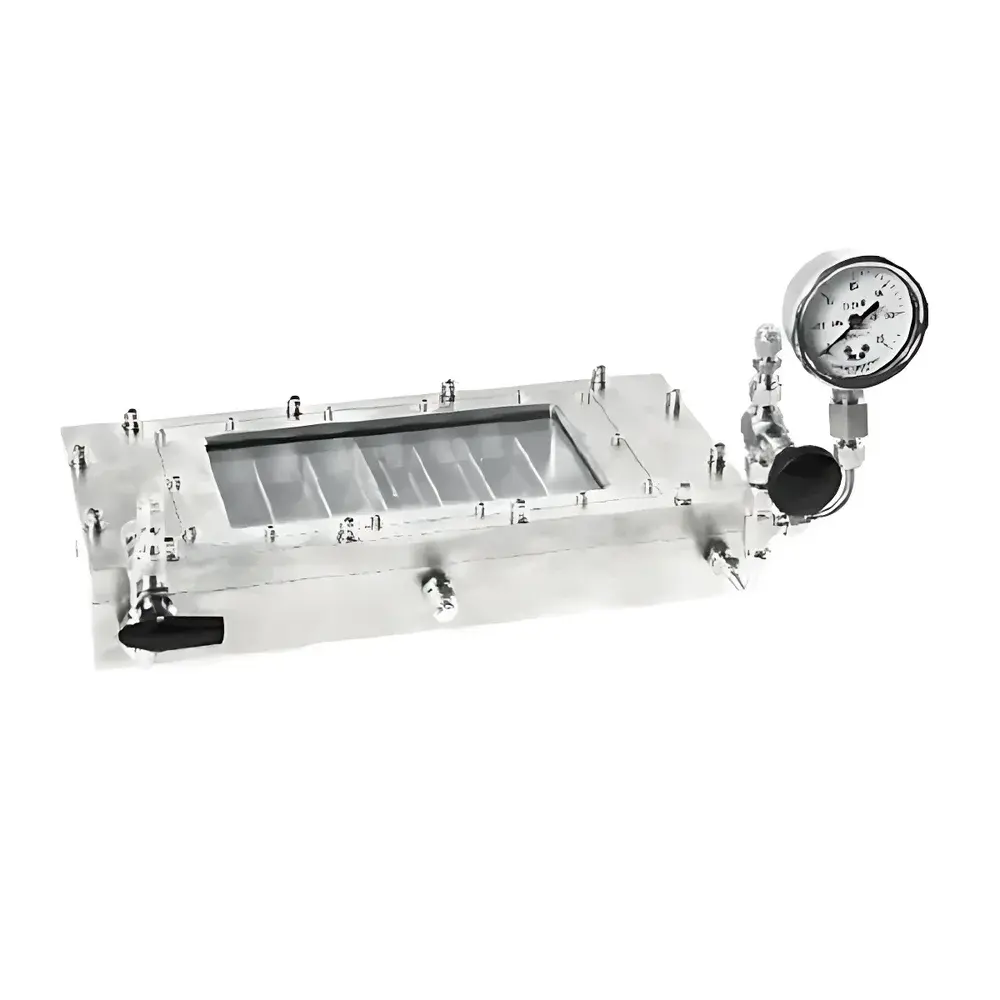
CEL-GPCR100 Stainless Steel Temperature-Controlled GB-Compliant Photocatalytic Reactor
| Brand | CEL (Zhongjiao Jin Yuan) |
|---|---|
| Origin | Beijing, China |
| Manufacturer Type | Direct Manufacturer |
| Origin Category | Domestic (China) |
| Model | CEL-GPCR100 |
| Pricing | Upon Request |
Overview
The CEL-GPCR100 Stainless Steel Temperature-Controlled GB-Compliant Photocatalytic Reactor is an engineered laboratory-scale reaction system designed specifically for standardized evaluation of photocatalytic air-purification materials in accordance with the Chinese national standard GB/T 23761–2009, “Test Method for Photocatalytic Activity of Air-Purification Materials.” This reactor implements a sealed, rectangular flow-through configuration optimized for gas–solid heterogeneous photocatalysis under controlled thermal and optical conditions. Its core measurement principle relies on quantitative assessment of gaseous pollutant degradation (e.g., formaldehyde, acetaldehyde, or NOx) over immobilized catalyst films under defined UV–vis irradiation, enabling reproducible kinetic analysis and comparative performance benchmarking. The reactor features a precision-machined 316L stainless steel monolithic body with integrated double-wall jacketing for accurate external temperature regulation—critical for isolating thermal effects from photochemical contributions and ensuring compliance with ISO/IEC 17025-aligned test protocols.
Key Features
- Monolithic 316L stainless steel construction with electropolished interior surfaces for corrosion resistance, low catalytic background, and ease of cleaning.
- Integrated thermostatic jacket enabling precise external temperature control (typically compatible with external circulators operating from 5 °C to 80 °C).
- Optical access via a 200 mm × 100 mm UV-grade fused silica viewport (transmission >90% down to 190 nm), mounted with adjustable clamping pressure to ensure uniform seal integrity and minimal stress birefringence.
- Dedicated catalyst mounting geometry: sample substrate (e.g., coated glass, ceramic tile, or metal foil) positioned at a fixed 5.0 mm gap from the quartz window—ensuring consistent photon flux density and defined residence time distribution.
- Modular gas-handling interface including Anlok® precision needle valves (US-made), three-way ball valves, and 3 mm stainless steel Swagelok®-style compression fittings throughout—eliminating dead volume and enabling rapid system evacuation and purging.
- Real-time monitoring ports: integrated pressure gauge (0–1 bar full scale, calibrated), thermowell port (3 mm–1/8″ NPT) for insertion of Pt100 or K-type sensors, and multiple sampling/injection points with septum-piercing capability.
Sample Compatibility & Compliance
The CEL-GPCR100 accommodates rigid planar catalyst substrates up to 200 mm × 100 mm × 10 mm thick, including TiO2-coated glass slides, doped metal oxide films on alumina ceramics, and polymer-supported nanocomposites. Its geometric design enforces laminar, unidirectional gas flow across the active surface—minimizing channeling and maximizing contact efficiency. Optional baffle plates introduce controlled flow tortuosity, extending effective gas–solid interaction time without compromising pressure stability. All wetted components comply with GB/T 23761–2009 dimensional and material specifications; the reactor has been validated for use in GLP-compliant laboratories performing method verification per CNAS-CL01:2018 requirements. It supports traceable calibration against certified reference gases (e.g., ISO 6141) and integrates seamlessly into ISO 14644-classified cleanroom environments.
Software & Data Management
While the CEL-GPCR100 operates as a standalone hardware platform, it is fully compatible with third-party data acquisition systems (e.g., LabVIEW™, MATLAB®, or custom Python-based DAQ) via analog outputs from pressure and temperature transducers. When paired with online gas analyzers (e.g., FTIR, GC–MS, or electrochemical NOx sensors), the reactor enables time-resolved kinetic profiling with audit-trail-capable timestamping. For regulated environments, integration with LIMS or ELN platforms can satisfy 21 CFR Part 11 requirements when combined with electronic signature modules and role-based access controls. All mechanical interfaces adhere to ISO 8573-1 (compressed air purity) and ASTM E2654 (gas delivery system validation) guidelines.
Applications
- Quantitative evaluation of photocatalytic oxidation (PCO) efficiency for indoor air purification materials under simulated daylight/UV-A irradiation.
- Accelerated aging studies of catalyst deactivation mechanisms (e.g., carbon deposition, sulfate poisoning) under controlled humidity and temperature gradients.
- Interlaboratory round-robin testing for GB/T 23761–2009 method validation and proficiency assessment.
- Development and screening of novel visible-light-responsive photocatalysts (e.g., g-C3N4, BiVO4, S-doped TiO2) under standardized flow conditions.
- Supporting R&D for ISO 22197 series (NOx, acetaldehyde, toluene decomposition) and JIS R 1701–2020 test protocols.
FAQ
What is the maximum allowable operating pressure for this reactor?
The reactor is rated for continuous operation up to 1.0 bar(g); exceeding this limit may compromise viewport integrity and void calibration traceability.
Can the reactor be used with corrosive gas mixtures such as H2S or Cl2?
While 316L stainless steel offers broad chemical resistance, prolonged exposure to halogenated or sulfur-containing species requires post-test passivation and visual inspection; compatibility must be verified case-by-case per NACE MR0175/ISO 15156.
Is temperature uniformity across the catalyst surface characterized?
Yes—thermal mapping using embedded micro-thermocouples confirms ±0.8 °C spatial uniformity over the central 150 mm × 80 mm region under steady-state conditions at 25–60 °C.
Does the system include documentation for IQ/OQ qualification?
A complete Factory Acceptance Test (FAT) report—including dimensional verification, leak test results (≤1×10⁻⁹ mbar·L/s He), and material certifications (EN 10204 3.1)—is supplied with each unit.
How is light irradiance calibrated and maintained during testing?
Irradiance is measured externally using a NIST-traceable UV-A radiometer (e.g., ILT950) positioned at the inner surface of the quartz window; users are advised to perform in-situ recalibration before each test campaign.



