
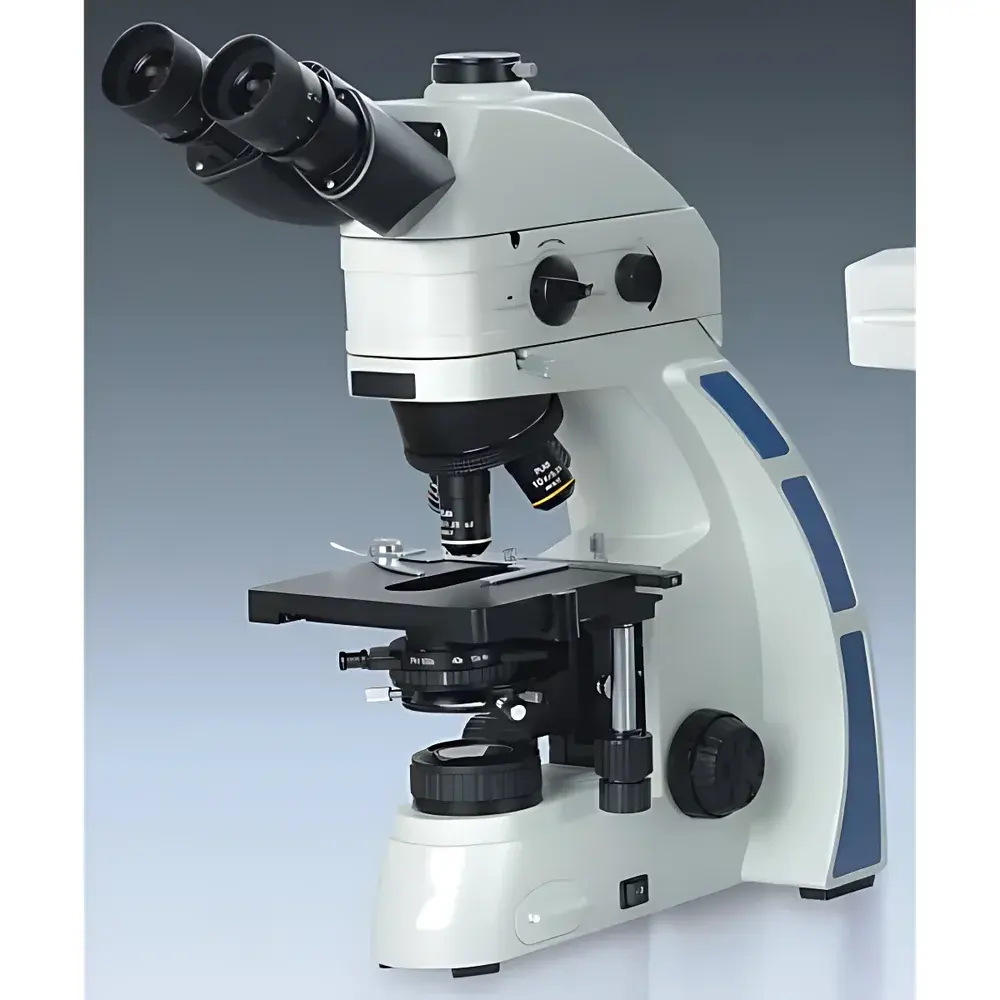
Lei-Tech LK-YG80 Upright Fluorescence Microscope
| Brand | Lei-Tech |
|---|---|
| Origin | Tianjin, China |
| Manufacturer Type | Direct Manufacturer |
| Product Category | Domestic |
| Model | LK-YG80 |
| Instrument Type | Upright Fluorescence Microscope |
| Excitation Source | High-Power LED (B/G/UV) |
| Microscope Class | Conventional Fluorescence Microscope |
| Eyepieces | PL10X/20 mm Wide-Field High-Eye-Point Plan Achromatic |
| Objective Lenses | 4X, 10X, 20X, 40X, 100X (Oil Immersion) |
| Fluorescence Filter Sets | Blue (B), Green (G), Ultraviolet (UV) |
| Illumination | Adjustable-intensity Cold/Warm White LED (CCT: 2850–5500 K) |
| Focus Mechanism | Manual Coaxial Coarse/Fine Adjustment with Upper Limit Stop and Tension Control |
| Condenser | NA 1.25 Abbe Condenser with Integrated Phase Contrast & Darkfield Attachment Ports |
| Observation Head | Trinocular, 30° Inclined, Interpupillary Distance 47–75 mm, Fixed Beam Splitter Ratio R:T = 8:2 |
| Stage | Dual-Layer Mechanical Platform (150 × 140 mm), Dual Slide Clips, Travel Range 76 × 50 mm, Precision 0.1 mm (Tri-Rail Guided) |
| Optical System | Infinity-Corrected Universal Image Correction System (UISC) |
| Imaging Capability | 20 MP CMOS Sensor (5440 × 3648), C-Mount Adaptor with Focusable Photo Tube |
| Optional Accessories | Polarizer/Analyzer Sets, Color Filters, Phase Contrast Annuli, Darkfield Stop Inserts |
Overview
The Lei-Tech LK-YG80 Upright Fluorescence Microscope is engineered for rigorous life science applications requiring high-fidelity fluorescence imaging, multi-modal contrast observation, and long-term operational stability in academic, industrial, and clinical research environments. Built upon an infinity-corrected optical architecture (UISC — Universal Image Correction System), the LK-YG80 eliminates spherical and chromatic aberrations across the full magnification range (40× to 1000×), ensuring consistent resolution, flatness of field, and color fidelity from edge to center. Its modular design supports simultaneous implementation of brightfield (BF), darkfield (DF), phase contrast (PH), simple polarization (POL), and fluorescence (FL) observation methods—without mechanical reconfiguration of core optical components. The system utilizes high-efficiency, thermally stabilized LED illumination for both transmitted light (adjustable CCT 2850–5500 K) and fluorescence excitation (B/G/UV bands), delivering >75,000 hours of stable output, minimal phototoxicity, and negligible heat transfer to live specimens.
Key Features
- Infinity-corrected UISC optical pathway enabling seamless integration of auxiliary modules (phase contrast, darkfield, polarization) without compromising parfocality or image uniformity.
- Trinocular observation head with 30° inclination, interpupillary adjustment (47–75 mm), and fixed 8:2 beam-splitting ratio optimized for concurrent visual inspection and high-resolution digital capture.
- NA 1.25 Abbe condenser with pre-centered alignment, integrated ports for phase annuli and darkfield stops, and independent height adjustment for precise Köhler illumination setup.
- Manual coaxial focus mechanism featuring dual-speed fine adjustment (0.002 mm per division), upper mechanical limit stop, and tension control—designed for reproducible focusing during extended training or teaching sessions.
- LED-based fluorescence excitation system with dedicated B/G/UV filter cubes, rapid on/off response, and calibrated intensity control—eliminating warm-up delay and spectral drift inherent in mercury or xenon arc lamps.
- 20-megapixel scientific CMOS camera interface (C-mount, focusable photo tube) supporting real-time HDR (High Dynamic Range) image processing, depth-of-field stacking, and multi-field mosaic acquisition.
Sample Compatibility & Compliance
The LK-YG80 accommodates standard glass microscope slides (26 × 76 mm) and coverslips (0.13–0.17 mm thickness), supporting both fixed and live-cell preparations—including tissue sections, blood smears, microbial cultures, and fluorescently labeled organoids. Its NA 1.25 condenser and oil-immersion 100× objective enable high-resolution subcellular imaging compliant with ISO 8578:2022 (Microscopy — Requirements for optical microscopes) and ASTM E2993-21 (Standard Guide for Microscopic Examination of Biological Specimens). While not classified as a medical device under FDA 21 CFR Part 809 or EU MDR 2017/745, the system meets GLP-aligned documentation standards for instrument qualification (IQ/OQ), including traceable calibration records for magnification, field number, and illumination uniformity. All electronic components conform to IEC 61010-1:2010 safety requirements for laboratory equipment.
Software & Data Management
The LK-YG80 integrates with Lei-Tech’s proprietary imaging suite (v4.2+), which supports DICOM-compliant metadata embedding, time-lapse sequence export (TIFF/AVI), and audit-trail logging per ISO/IEC 17025:2017 Annex A.2. Key software capabilities include:
- Real-time HDR synthesis: dynamically balances pixel saturation across high-contrast regions to preserve nuclear detail while retaining cytoplasmic texture.
- Depth fusion algorithm: acquires and merges Z-stack images at user-defined intervals (0.1–5 µm step size), generating extended-focus composites without post-processing latency.
- Mosaic stitching engine: auto-aligns and blends up to 128 adjacent fields (grid-based or freehand path) with sub-pixel registration accuracy (<0.5 µm RMS error).
- Export protocols compliant with FAIR data principles: structured JSON sidecar files containing exposure parameters, objective ID, filter set configuration, and stage coordinates.
No cloud dependency: all processing occurs locally; raw data remains under institutional control.
Applications
The LK-YG80 serves as a primary imaging platform in university teaching labs, pharmaceutical QC units, and contract research organizations performing:
- Fluorescent immunostaining validation (e.g., DAPI/FITC/TRITC triple labeling in histopathology workflows).
- Live-cell viability assays using calcein-AM/propidium iodide dual staining under ambient CO₂ conditions.
- Microbial morphology screening (Gram staining, capsule visualization, flagella detection) via combined brightfield and darkfield modes.
- Crystallization analysis in biofluids (urine, synovial fluid) using simple polarization to identify urate or calcium pyrophosphate dihydrate crystals.
- Phase contrast time-lapse of adherent cell migration, mitosis tracking, and neurite outgrowth quantification.
- Quality assurance of antibody conjugates through fluorescence intensity linearity testing across dilution series.
FAQ
Is the LK-YG80 compliant with ISO 13485 or FDA 21 CFR Part 11?
No—the instrument is not a regulated medical device and does not implement electronic signature or audit-trail features required for Part 11 compliance. However, its imaging software supports ALCOA+ data integrity principles when deployed within validated laboratory information management systems (LIMS).
Can the system be upgraded to motorized focus or automated filter turret?
Yes—Lei-Tech offers factory-installed upgrades including stepper-motorized Z-drive (0.001 mm resolution) and six-position LED-filter wheel with TTL synchronization, subject to optical path recalibration and firmware revision.
What is the warranty coverage and service response protocol?
The LK-YG80 carries a 24-month limited warranty covering parts and labor. Technical support operates 7×24 via remote diagnostics; on-site service is dispatched within 72 business hours in Tier-1 cities across China, supported by regional service centers in Beijing, Shanghai, Guangzhou, Chengdu, and Xi’an.
Does the microscope support oil immersion objectives beyond 100×?
The current optical train and mechanical stage are optimized for standard 100×/1.25 NA oil objectives. Higher-magnification objectives (e.g., 150×) require custom tube lens modification and are not supported out-of-the-box.
Are third-party cameras compatible with the C-mount interface?
Yes—any C-mount camera with flange distance 17.526 mm and sensor diagonal ≤ 24 mm (e.g., Basler ace acA2000-50gm, FLIR Blackfly S BFS-U3-200S6M) can be mechanically coupled; driver-level integration requires SDK licensing from the camera vendor.
Related Products





