
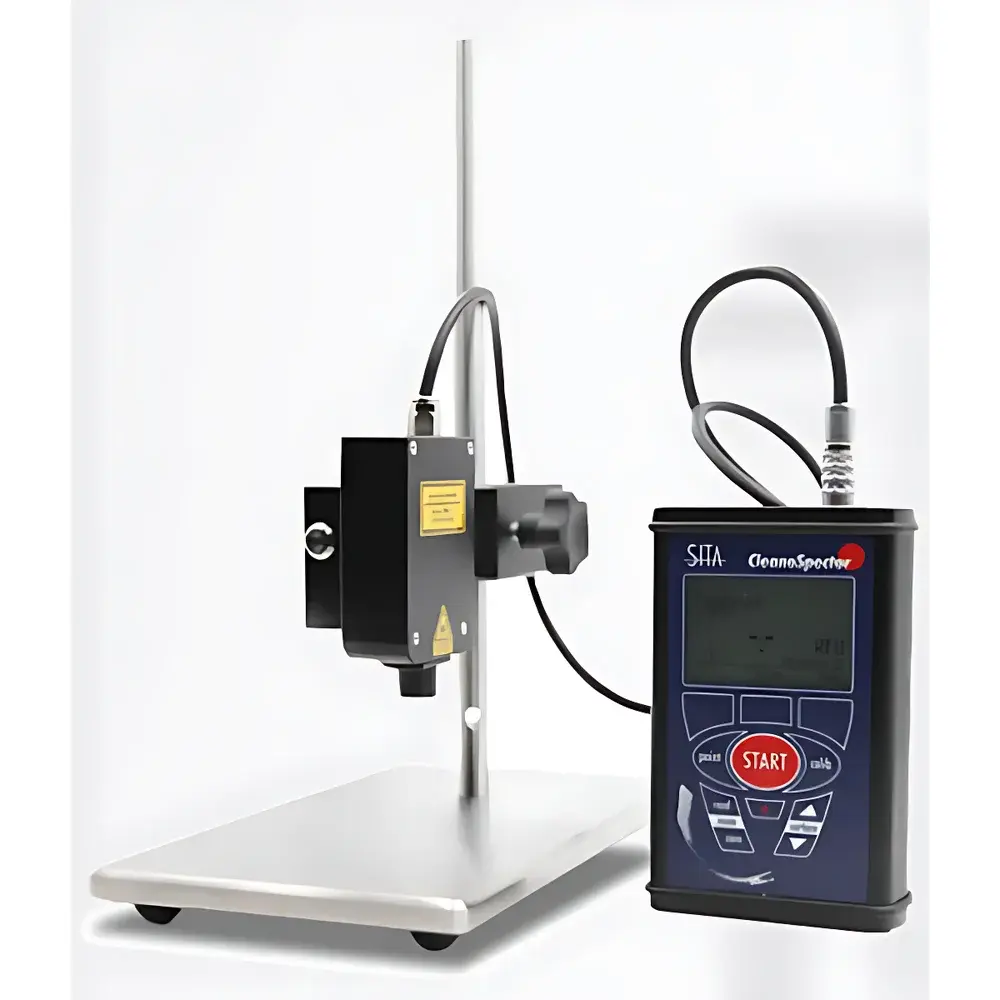
SITA CleanoSpector Surface Cleanliness Analyzer
| Brand | SITA |
|---|---|
| Model | CleanoSpector |
| Origin | Tianjin, China |
| Manufacturer | LEI-TECH Optics |
| Type | Handheld Fluorescence-Based Surface Contamination Analyzer |
| Measurement Principle | UV-Induced Fluorescence (365 nm excitation, 460 nm emission peak) |
| Units | RLU (Relative Light Units) and % Cleanliness |
| Range | 0.0 – 100.0 RLU |
| Sensitivity | <1 µg/m² non-volatile residue (e.g., oils, coolants, waxes) |
| Response Time | ~1 s per measurement |
| Probe Geometry | Fixed-focus coaxial optical head with 4.7 mm optimal working distance |
| Calibration | Auto-calibration on clean reference metal surface (steel, aluminum, copper, gold, etc.) |
| Power | Rechargeable Li-ion battery (8 h continuous operation) |
| Weight | 320 g (including probe and handle) |
| Data Storage | Internal memory for >5,000 timestamped measurements |
| Compliance | Designed for ISO 16232-C, VDA 19.1, ASTM D7215, and automotive OEM cleaning validation workflows |
Overview
The SITA CleanoSpector Surface Cleanliness Analyzer is an industrial-grade, handheld fluorescence detection instrument engineered for quantitative, non-destructive assessment of organic contamination on metallic and non-porous technical surfaces. It operates on the principle of UV-induced fluorescence spectroscopy: a calibrated 365 nm ultraviolet LED excites fluorophores present in residual hydrocarbons—such as machining oils, coolants, greases, waxes, and organic particulates—causing them to emit characteristic photons at longer wavelengths (peak emission ~460 nm). A high-stability photodiode sensor, integrated within a coaxial optical architecture, precisely measures this emitted fluorescence intensity. The instrument converts raw signal amplitude into two standardized outputs: Relative Light Units (RLU), proportional to contaminant mass loading, and % Cleanliness, where 100% corresponds to a validated reference state of zero detectable fluorescence—a condition traceable to certified clean metal substrates. Unlike reflectance- or gravimetric methods, the CleanoSpector delivers real-time, operator-independent results without solvent extraction, surface contact, or sample preparation. Its co-focal optical design ensures consistent measurement geometry across curved, inclined, or textured surfaces—including engine blocks, transmission housings, printed circuit board (PCB) carriers, and turbine blades—making it suitable for inline process verification and laboratory-grade validation.
Key Features
- Single-button operation with immediate readout—no software training required
- Fixed-focus coaxial probe optimized for 4.7 mm working distance; maintains measurement repeatability across flat, convex, and concave geometries
- Auto-calibration function executed directly on user-provided clean reference surfaces (e.g., stainless steel, aluminum 6061, copper C11000, gold-plated substrates)
- Temperature-invariant optical path: internal thermal compensation eliminates drift across ambient conditions from 5 °C to 40 °C
- Robust mechanical housing rated IP54 for shop-floor resilience against dust and incidental splashes
- Integrated rechargeable lithium-ion battery supporting ≥8 hours of continuous field use; optional AC adapter for benchtop operation
- Real-time pass/fail thresholding with configurable alarm limits (RLU or % mode)
Sample Compatibility & Compliance
The CleanoSpector is validated for use on conductive and non-conductive non-porous surfaces including ferrous and non-ferrous metals (steel, aluminum, titanium, brass), anodized aluminum, electroplated finishes, and ceramic-coated components. It detects only fluorescent organic residues—non-fluorescent particles (e.g., metal fines, silica dust) are not quantified. The system conforms to critical industry validation frameworks: it supports compliance with ISO 16232-C (road vehicles—cleanliness of components), VDA 19.1 (German Automotive Industry Association), and ASTM D7215 (standard practice for fluorescence-based cleanliness testing). When deployed within documented cleaning process validation protocols, its measurement data satisfies GLP/GMP audit requirements for traceability, including time-stamped records, operator ID tagging, and calibration event logging—all stored internally with no external dependency.
Software & Data Management
Raw and processed measurement data (RLU, % Cleanliness, timestamp, operator ID, calibration status, surface type tag) are stored onboard in non-volatile memory—capacity exceeds 5,000 entries. Export is supported via USB-C interface to standard CSV format compatible with LIMS, MES, and statistical process control (SPC) platforms. Optional SITA CleanData Desktop software provides advanced visualization: trend charts by shift/lot/part number, histogram distribution analysis, CPK/PPK capability reporting, and automated PDF report generation with digital signature fields. All data handling complies with FDA 21 CFR Part 11 requirements when used with validated software configuration, including electronic audit trails, role-based access control, and immutable record retention.
Applications
- Pre-coating verification prior to painting, powder coating, or adhesive bonding in automotive and aerospace manufacturing
- Post-cleaning validation of machined engine components, fuel injectors, hydraulic valves, and medical device parts
- Monitoring detergent efficacy and rinse cycle optimization in aqueous and solvent-based cleaning lines
- Root cause analysis of adhesion failures, paint defects, or vacuum chamber outgassing events
- Qualification of cleaning equipment performance (e.g., ultrasonic tanks, vapor degreasers, plasma cleaners)
- Supplier quality assurance audits per OEM-specific cleanliness specifications (e.g., BMW QV 2000, Ford WSS-M2P177-A2)
FAQ
How does the CleanoSpector differentiate between types of oil contaminants?
It does not chemically identify compounds; rather, it quantifies total fluorescent response. Different oils exhibit varying quantum yields under 365 nm excitation—calibration curves can be established for specific process fluids using gravimetrically prepared standards.
Can it measure contamination on painted or anodized surfaces?
Yes—if the topcoat is non-fluorescent and optically transparent to 365 nm UV light. Fluorescent pigments or UV-blocking clearcoats will interfere and require method qualification.
Is periodic recalibration required?
No routine recalibration is needed. The auto-calibration routine performed on a clean reference surface before each measurement session ensures traceability and eliminates drift-related uncertainty.
Does ambient lighting affect readings?
No—the coaxial optical design incorporates spectral filtering and synchronous detection, rejecting ambient visible and IR radiation. Measurements remain stable under full-spectrum factory lighting or direct sunlight.
What is the minimum detectable residue level?
The system reliably resolves non-volatile organic residues down to <1 µg/m² on polished metal substrates, as verified per ISO 16232 Annex D gravimetric correlation protocols.





