
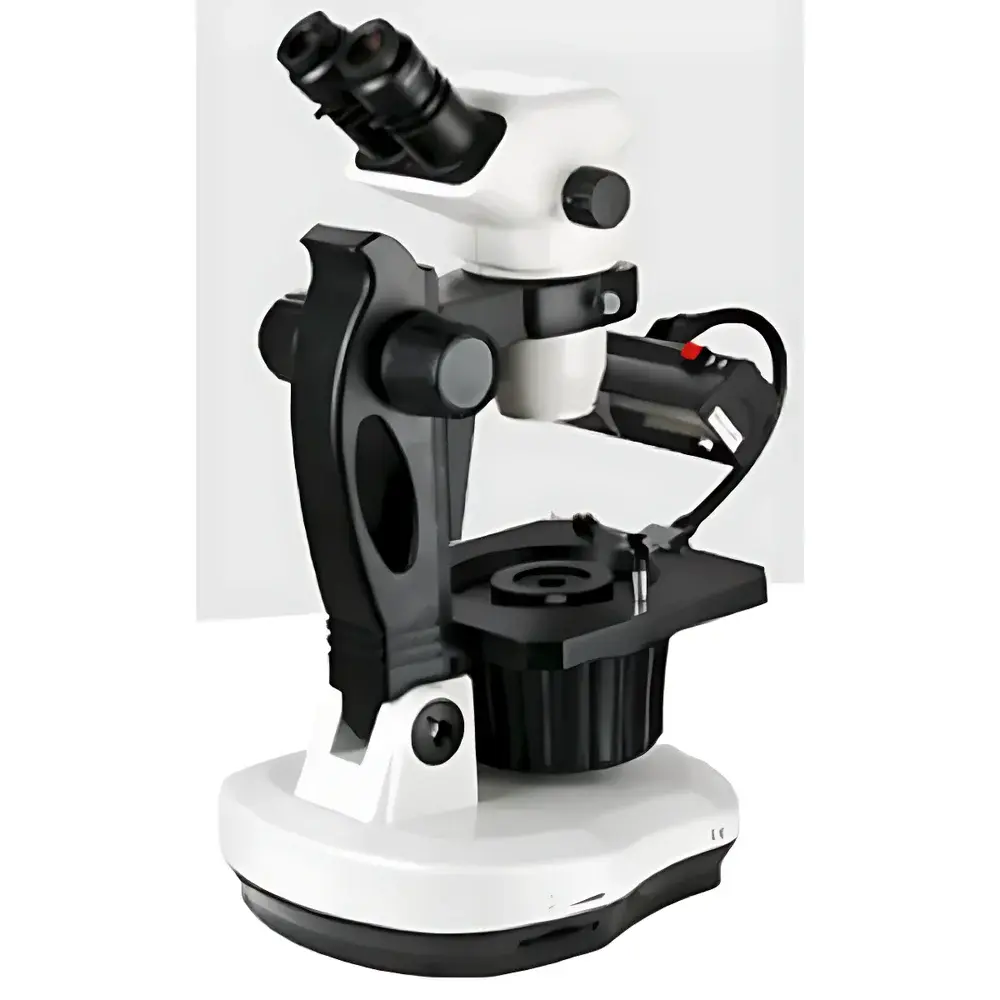
Lei-Tech LK-BSJD Gemstone and Diamond Identification Microscope
| Brand | Lei-Tech |
|---|---|
| Origin | Tianjin, China |
| Manufacturer Type | Direct Manufacturer |
| Country of Origin | China |
| Model | LK-BSJD |
| Price Range | USD 2,800 – 4,300 |
| Optical System | Greenough Stereoscopic Design |
| Zoom Ratio | 6.7:1 |
| Observation Modes | Brightfield (transmitted & reflected), Darkfield (transmitted), Polarized Light (transmitted) |
| Eyepiece Field of View | 10× / 22 mm |
| Zoom Magnification Range | 0.67× – 4.5× |
| Total Magnification Range | 6.7× – 45× (extendable to 3.5× – 90× with auxiliary objectives) |
| Working Distance | 100 mm |
| Top Illumination | 7 W daylight-balanced fluorescent lamp with flexible gooseneck arm |
| Bottom Illumination | 6 V / 30 W halogen lamp with integrated darkfield base |
| Auxiliary Objectives | 0.5×, 0.75×, 1×, 1.5×, 2× |
| Imaging System | 5 MP Sony CMOS sensor (1/2.8″), 60 FPS @ 1200 × 1920 resolution |
| Video Output | HDMI (4K-capable), USB 2.0 × 3, UVC-compliant interface |
| Wireless Connectivity | Wi-Fi 6 for mobile streaming to iOS, Android, HarmonyOS, and Windows devices |
| Software Functions | On-device measurement, annotation, image capture, video recording, calibration-based linear dimensioning |
Overview
The Lei-Tech LK-BSJD Gemstone and Diamond Identification Microscope is a purpose-engineered stereoscopic optical instrument designed for non-destructive, high-fidelity visual characterization of gemological specimens in laboratory, grading, and quality assurance environments. Built upon a Greenough optical architecture—optimized for depth perception, edge contrast, and minimal parallax—the system delivers consistent stereoscopic imaging across its full zoom range. Its modular illumination suite supports three fundamental observation modalities: brightfield (for surface texture, polish lines, and inclusion morphology under both transmitted and incident light), darkfield (to enhance subsurface scattering in translucent materials such as agate and quartz), and polarized transmitted light (to assess birefringence, extinction angles, and strain patterns in anisotropic crystals like jadeite and calcite). With a working distance of 100 mm, the LK-BSJD accommodates bulky cabochons, mounted stones, and rough specimens without mechanical interference, enabling ergonomic, extended-duration examination.
Key Features
- Greenough stereoscopic optical path ensures natural depth rendition and high-resolution lateral detail at all magnifications.
- 6.7:1 continuous zoom optics (0.67×–4.5×) paired with five interchangeable auxiliary objectives (0.5×–2×) extend usable magnification from 3.5× to 90× while preserving resolution and field flatness.
- Dual independent illumination subsystems: top-mounted 7 W daylight-balanced fluorescent source with articulating gooseneck for directional oblique lighting; bottom-mounted 6 V / 30 W halogen lamp with integrated darkfield annulus and large fan-shaped base housing a uniform LED transmitted-light array with 360° rotational stage.
- Real-time digital imaging platform featuring a 5-megapixel Sony CMOS sensor (1/2.8″ format), capable of 60 FPS video capture at 1200 × 1920 resolution and still-image acquisition with hardware-level auto-exposure and white balance.
- Native UVC compliance enables plug-and-play operation on Windows, macOS, Linux, HarmonyOS, and Android systems without proprietary drivers; HDMI output supports direct 4K display on calibrated monitors or grading-room televisions.
- Wi-Fi 6 wireless streaming allows synchronized multi-device viewing—enabling collaborative assessment between gemologists, graders, and clients using smartphones or tablets without network latency or compression artifacts.
Sample Compatibility & Compliance
The LK-BSJD is routinely deployed for identification and documentation of faceted diamonds, cabochon-cut gemstones (e.g., nephrite, jadeite, chalcedony), polished mineral specimens, and untreated rough material. Its illumination flexibility satisfies ASTM D5722–22 (Standard Guide for Visual Examination of Gemstones) and ISO 18365:2016 (Jewellery — Gemstone Identification — Methodology). The microscope’s mechanical stability, repeatable focus mechanism, and calibrated stage rotation support traceable documentation workflows required under GLP-aligned laboratory accreditation (e.g., ISO/IEC 17025). All electronic components comply with CE, FCC Part 15, and RoHS directives; optical elements are coated with anti-reflective MgF₂ layers to minimize ghosting and spectral distortion.
Software & Data Management
The embedded imaging firmware provides real-time measurement tools—including dynamic scale calibration, orthogonal line and angle annotation, area estimation, and inclusion mapping—with metadata tagging (date/time, operator ID, sample ID). Captured images and videos are stored in lossless TIFF or H.265-encoded MP4 formats, each embedded with EXIF data and optional digital signature for audit trail integrity. The desktop application supports batch export to CSV for inclusion in LIMS databases and exports annotated reports in PDF/A-1b format compliant with long-term archival standards. Mobile applications (iOS/Android) maintain full feature parity—including live remote control of zoom, focus, and illumination intensity—while enforcing TLS 1.3 encrypted transmission for HIPAA- and GDPR-sensitive institutional deployments.
Applications
- Diamond grading laboratories: Detection and classification of clarity characteristics (pinpoints, feathers, clouds) under variable contrast modes.
- Gemological education: Comparative demonstration of optic sign, pleochroism, and cleavage behavior across crystal systems.
- Custom jewelry workshops: In-process verification of setting integrity, prong symmetry, and stone seat fit prior to final polishing.
- Museum conservation: Non-contact assessment of historic stone deterioration, surface weathering, and prior repair evidence.
- Mineralogical research: Documentation of twinning, growth zoning, and fluid inclusion assemblages in hydrothermal quartz and pegmatitic beryl.
FAQ
Does the LK-BSJD support automated focus stacking?
No—focus stacking requires external motorized Z-axis control, which is not integrated into this manual-focus stereomicroscope platform. However, the high-resolution sensor and stable mechanical stage enable reliable manual stack acquisition for post-processing.
Is the halogen lower light replaceable in the field?
Yes—the 6 V / 30 W halogen bulb is user-replaceable using standard G6.35 socket tools; spare bulbs and alignment instructions are included in the accessory kit.
Can the system operate without a computer?
Yes—the onboard imaging module functions independently via HDMI output and touchscreen-enabled 10-inch display option (sold separately); no PC is required for basic capture, measurement, or presentation.
What is the calibration interval recommendation for metrological use?
For traceable dimensional reporting, we recommend annual recalibration of the stage micrometer and sensor pixel pitch using NIST-traceable reference standards, documented per ISO/IEC 17025 Clause 6.5.
Is third-party software (e.g., ImageJ, Fiji) compatible?
Yes—UVC compliance guarantees native recognition as a standard video input device on all major operating systems, enabling seamless integration with open-source and commercial image analysis platforms.




