
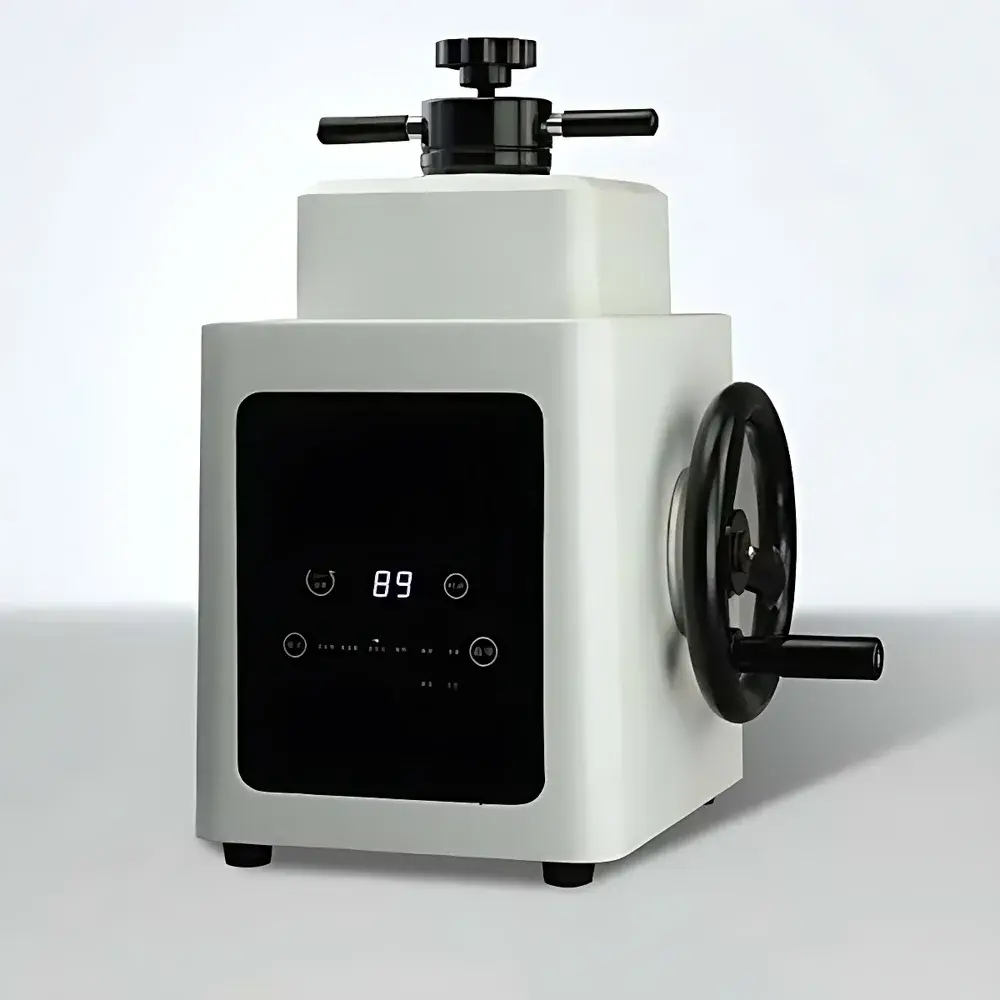
Lei-Tech LK-XQJ-20B Manual Metallographic Specimen Mounting Press
| Brand | Lei-Tech |
|---|---|
| Origin | Tianjin, China |
| Manufacturer Type | Direct Manufacturer |
| Country of Origin | China |
| Model | LK-XQJ-20B |
| Sample Diameter Options | Φ22 mm, Φ30 mm, Φ45 mm (one standard size supplied |
| Temperature Control Range | Ambient to 190 °C |
| Timer Range | 0–30 min |
| Total Power Consumption | ≤800 W |
| Input Voltage | Single-phase AC 220 V, 50 Hz |
| Dimensions (W×D×H) | 260 mm × 360 mm × 450 mm |
| Net Weight | 35 kg |
Overview
The Lei-Tech LK-XQJ-20B Manual Metallographic Specimen Mounting Press is a precision-engineered thermal compression mounting system designed for the reliable encapsulation of small, irregular, or fragile metallographic and petrographic specimens. It operates on the principle of thermosetting resin consolidation—applying controlled heat and mechanical pressure to embed samples in phenolic, epoxy, or acrylic resins—thereby producing dimensionally stable, edge-retentive mounts suitable for subsequent sectioning, grinding, polishing, and microscopic analysis. Unlike hydraulic or fully automated systems, this manually operated press delivers consistent, repeatable results through operator-controlled platen descent and dwell time, making it especially suited for academic laboratories, quality control facilities, and R&D environments where flexibility, cost-efficiency, and procedural transparency are prioritized.
Key Features
- Three interchangeable mold cavity diameters (Φ22 mm, Φ30 mm, Φ45 mm) accommodate diverse specimen geometries without requiring tooling changes—users select one standard size at time of order;
- Digital temperature controller with ±1 °C accuracy across a full range of ambient to 190 °C, ensuring precise resin curing kinetics for optimal hardness and minimal shrinkage;
- Independent digital timer (0–30 minutes) enables reproducible dwell time programming; system automatically de-energizes upon completion for safety and energy efficiency;
- Robust cast-aluminum frame and hardened steel platens provide long-term dimensional stability and resistance to thermal creep under repeated load cycles;
- Low-profile footprint (260 × 360 × 450 mm) and modest power draw (≤800 W, AC 220 V / 50 Hz) allow seamless integration into shared lab spaces with standard electrical infrastructure;
- Manual operation eliminates dependency on compressed air, PLCs, or proprietary software—reducing total cost of ownership and simplifying maintenance protocols.
Sample Compatibility & Compliance
The LK-XQJ-20B supports embedding of ferrous and non-ferrous metals, sintered alloys, ceramics, geological thin sections, and composite materials—provided specimens fit within the selected mold diameter and withstand temperatures up to 190 °C. It complies with foundational preparation standards referenced in ASTM E3, ISO 15510, and GB/T 9445, serving as a critical first step in workflows aligned with ISO/IEC 17025-accredited testing laboratories. While not intrinsically certified for GMP or GLP environments, its deterministic manual operation, traceable timer/temperature settings, and absence of firmware-based logic make it readily adaptable to documented SOPs requiring audit-ready process parameters.
Software & Data Management
This is a standalone electromechanical instrument with no embedded software, network interface, or data logging capability. All operational parameters—including setpoint temperature, dwell duration, and cycle initiation—are configured via front-panel digital controls. Users maintain full procedural traceability through laboratory notebooks or external electronic lab notebooks (ELNs), recording batch-specific settings alongside resin type, specimen ID, and operator initials. For labs operating under FDA 21 CFR Part 11 requirements, validation documentation (IQ/OQ) can be developed using manufacturer-provided technical specifications and third-party calibration certificates for the temperature sensor and timer module.
Applications
- Preliminary mounting of micro-scale metallic inclusions prior to SEM-EDS elemental mapping;
- Stabilization of brittle intermetallic phases for cross-sectional hardness profiling (e.g., Vickers or Knoop microhardness testing);
- Routine preparation of weld zone specimens in metallurgical failure analysis;
- Embedding of mineralogical thin sections for reflected-light microscopy and quantitative image analysis;
- Academic instruction in materials science laboratories—enabling students to observe direct cause-effect relationships between resin selection, temperature profile, and mount integrity;
- Preparation of reference standards for optical emission spectroscopy (OES) and spark discharge analysis.
FAQ
What resin types are compatible with the LK-XQJ-20B?
Phenolic, epoxy, and acrylic thermosetting resins—both cold-cure and hot-cure variants—may be used, provided their recommended cure temperature falls within the 0–190 °C range.
Is mold cleaning required between cycles?
Yes. Resin residue must be removed from mold cavities and platens using appropriate solvents (e.g., acetone for acrylics, alcohol for epoxies) before each use to ensure surface finish fidelity and prevent cross-contamination.
Can the unit be used with vacuum-assisted infiltration?
No. This is a compression-only mounting press; vacuum desiccation or impregnation requires separate equipment.
Does the device include calibration documentation?
The unit ships with a factory calibration report for the integrated temperature sensor and timer; annual recalibration against NIST-traceable references is recommended for ISO/IEC 17025 compliance.
What safety certifications does the LK-XQJ-20B carry?
It conforms to IEC 61010-1:2010 for electrical safety in laboratory equipment and carries CE marking per EU Low Voltage Directive 2014/35/EU.



