
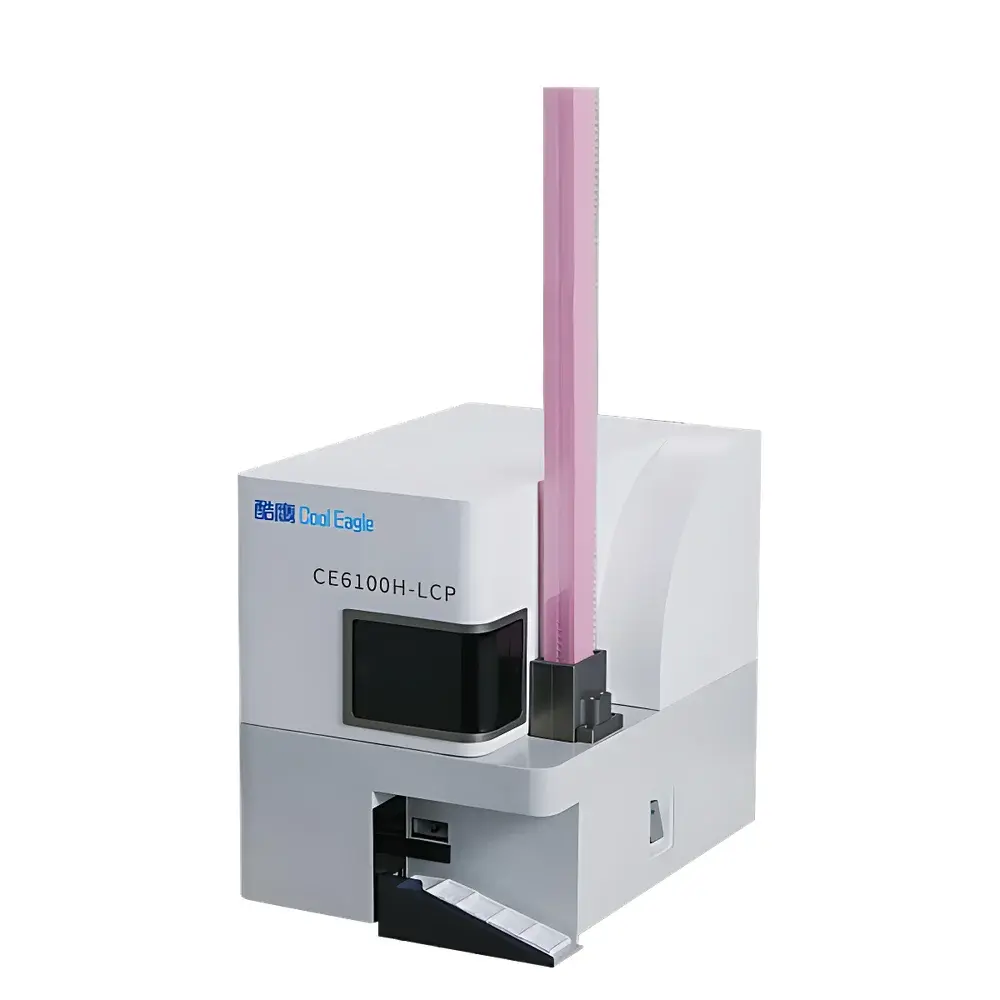
Cool Eagle CE6100H-LCP Laser Embedding Cassette Labeling System
| Brand | HISTO |
|---|---|
| Origin | Zhejiang, China |
| Manufacturer Type | Authorized Distributor |
| Country of Origin | China |
| Model | CE6100H-LCP |
| Price Range | USD 19,800–22,700 |
| Dimensions (L×W×H) | 440 × 290 × 350 mm |
| Weight | 25 kg |
| Power Supply | AC 100–240 V, 50–60 Hz |
| Operating Temperature | −5 °C to 40 °C |
| Power Consumption | 120 W |
| Cassette Capacity (Load) | 100 pcs |
| Throughput | >25 cassettes/min |
| Minimum Feature Size | 0.01 mm |
| Character Size | 1 mm × 1 mm (Chinese glyphs) |
| Air Handling | Vacuum-based dual-stage adsorption (liquid + solid phase) |
Overview
The Cool Eagle CE6100H-LCP is a fully automated, high-precision laser labeling system engineered for histopathology laboratories requiring reliable, maintenance-free identification of paraffin embedding cassettes. Unlike thermal transfer or inkjet-based solutions, this system employs non-contact fiber laser marking technology—generating permanent, abrasion-resistant alphanumeric codes directly on standard polypropylene or polycarbonate cassettes without consumables such as ribbons, inks, or solvents. The laser’s wavelength and pulse energy are optimized for controlled surface modification rather than ablation, ensuring consistent contrast across variable cassette surface finishes and batch lots. Designed for integration into routine tissue processing workflows, the CE6100H-LCP operates within Class II biosafety environments and meets electrical safety requirements per IEC 61010-1. Its compact footprint (440 × 290 × 350 mm) allows seamless placement adjacent to tissue processors, embedding stations, or digital slide scanners.
Key Features
- True zero-consumable operation: No ribbons, ink cartridges, or solvent-based marking agents—eliminating recurring cost and calibration drift associated with mechanical print heads.
- Sub-10 µm positional accuracy with 0.01 mm minimum resolvable feature size, enabling legible 1 mm × 1 mm Chinese characters and ISO-compliant alphanumeric identifiers (e.g., accession numbers, block IDs, orientation markers).
- Parallelized motion architecture: Cassette feeding, laser exposure, and ejection occur concurrently; non-printing mechanical cycles are decoupled and limited to ≤2 seconds per cycle.
- Controlled cassette ejection: A servo-driven pusher module deposits labeled cassettes onto the work surface in precise alignment—no free-fall impact, no stacking misalignment, no need for post-labeling manual reorientation.
- Vacuum-integrated fume management: A dedicated vacuum pump draws process emissions through a two-stage adsorption module—first capturing aerosolized polymer particulates via hydrophobic membrane filtration, then neutralizing volatile organic compounds (VOCs) using activated carbon impregnated with catalytic metal oxides.
- On-device template editor: Full WYSIWYG label layout design—including font selection (GB18030-compliant Unicode subsets), field mapping (static/dynamic), barcode symbology (Code 128, DataMatrix), and position anchoring—is performed natively on the 7-inch resistive touchscreen interface without launching external applications or rebooting.
Sample Compatibility & Compliance
The CE6100H-LCP accepts standard ANSI/SMPTE-compliant histology cassettes (25 × 38 mm, 30 × 40 mm, and 35 × 45 mm footprints) made from medical-grade PP, PC, or PS. Surface curvature, mold flash, and minor warpage (<0.15 mm deviation) are compensated via real-time Z-axis height sensing. The system complies with CE marking directives (2014/30/EU EMC, 2014/35/EU LVD), RoHS 2011/65/EU, and IEC 62304 Class B for medical device software. While not classified as an IVD device under IVDR 2017/746, its output supports traceability requirements aligned with ISO 15189:2022 (clause 5.9.2 — identification of samples throughout examination) and CAP checklist ANP.42320 (label permanence validation).
Software & Data Management
Firmware v3.2.x implements local data persistence with timestamped audit logs (user ID, template name, cassette count, error flags) stored on internal eMMC memory. Optional RS-232 or Ethernet (TCP/IP) connectivity enables bidirectional integration with LIS/HIS platforms via HL7 v2.5.1 ADT and ORU messages. All label templates are exportable as encrypted .celp binary files for version-controlled backup. Audit trail records satisfy FDA 21 CFR Part 11 requirements for electronic records when deployed with network-authenticated user accounts and configurable password policies (min. 8 chars, 90-day expiry, lockout after 5 failed attempts).
Applications
- Routine surgical pathology labs performing >200 specimens/day requiring unambiguous specimen-to-block linkage.
- Research core facilities supporting multi-institutional studies where longitudinal sample tracking across decades demands archival-stable labeling.
- Contract research organizations (CROs) conducting GLP-compliant toxicological studies—where label integrity must survive xylene dewaxing, antigen retrieval, and prolonged storage at −20 °C.
- Digital pathology implementation pipelines requiring synchronized barcode registration prior to whole-slide imaging acquisition.
- Teaching hospitals training residents in grossing protocols—where standardized, machine-readable cassette IDs reduce transcription errors during dictation handoff.
FAQ
Does the CE6100H-LCP support barcode scanning for closed-loop verification?
No—this model performs only label generation. Integration with external barcode readers (e.g., Honeywell Granit 1911i) requires custom middleware via RS-232 or Modbus TCP.
Can the laser mark metallic or coated cassettes?
Not recommended. The system is validated exclusively for untreated thermoplastic polymer cassettes meeting USP extractables specifications.
Is firmware update capability available over-the-air?
Updates require USB drive import; remote OTA functionality is not implemented due to clinical network segmentation policies.
What maintenance intervals are specified for the adsorption module?
The liquid-phase filter cartridge must be replaced every 6 months or after 10,000 cassettes; the solid-phase carbon bed requires replacement annually or after 20,000 cassettes—whichever occurs first.
Does the system meet UL 61010-1 for North American installation?
Yes—certified by TÜV Rheinland to UL 61010-1:2012 Edition, with NRTL recognition for use in U.S. and Canadian clinical laboratories.



