
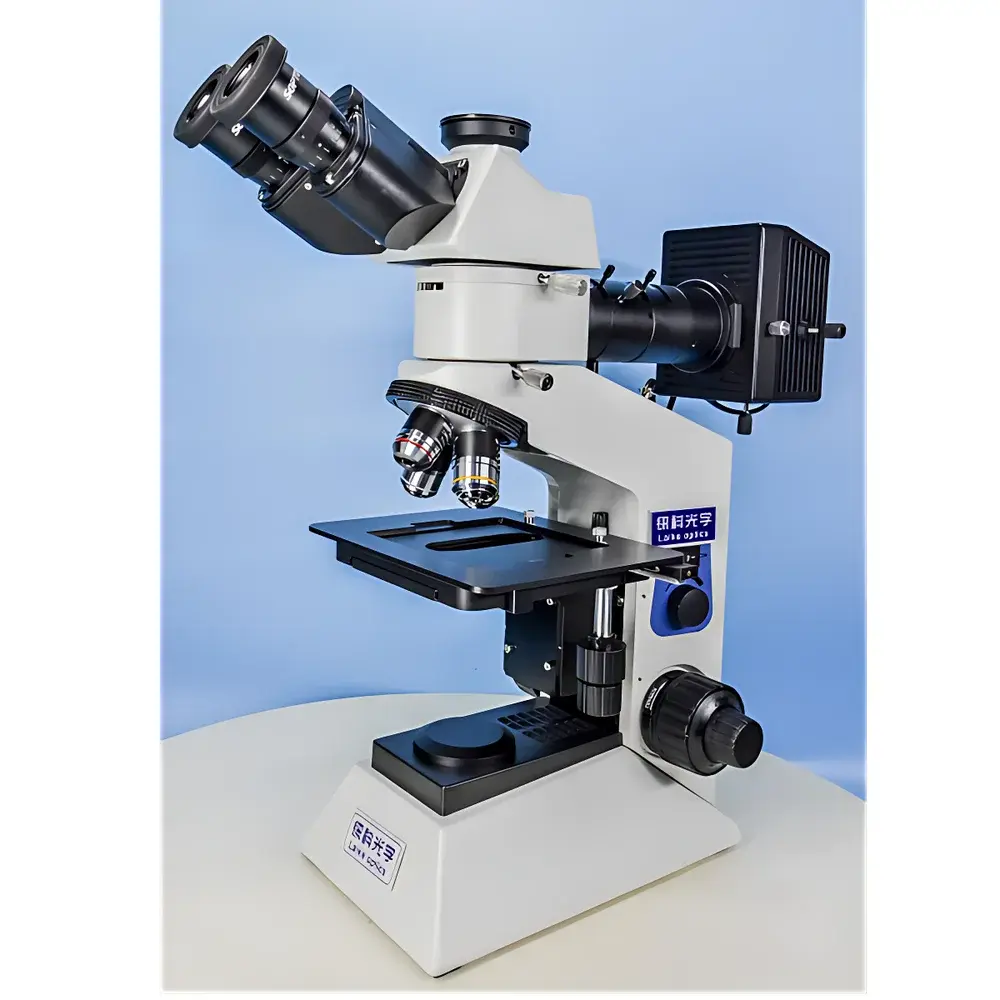
LEI-TECH LK-530M Upright Metallurgical Microscope
| Brand | LEI-TECH |
|---|---|
| Origin | Tianjin, China |
| Manufacturer Type | Direct Manufacturer |
| Microscope Type | Upright |
| Total Magnification Range | 50×–1000× |
| Eyepiece | PL10×, Field Number 18 mm |
| Objective Lenses | 5×, 10×, 20×, 50×, 100× (oil immersion capable) |
| Optical System | Infinity-Corrected, Dual-Achromatic Correction (UISC) |
| Illumination | Adjustable-intensity LED with neutral white CCT (3700–5000 K) |
| Observation Modes | Brightfield, Polarized Light |
| Condenser | Reflected Köhler Illumination with Anti-Reflection Design |
| Focus Mechanism | Coaxial coarse/fine focusing (25 mm coarse travel, 2 µm fine step resolution) |
| Stage | Dual-layer mechanical stage with low-position coaxial controls and auxiliary flat platform |
| Tube | Trinocular, 30° inclined, 360° rotatable, diopter-adjustable |
| Power Input | 100–240 V AC, auto-sensing |
Overview
The LEI-TECH LK-530M Upright Metallurgical Microscope is engineered for high-fidelity microstructural characterization of opaque, polished, and etched metallic and ceramic specimens. It employs an infinity-corrected optical path (UISC — Universal Infinity Space Correction), enabling precise chromatic and spherical aberration compensation across the full magnification range (50× to 1000×). Unlike finite-conjugate systems, the UISC architecture supports modular add-ons—including polarizers, analyzers, strain-free objectives, and external imaging interfaces—without compromising wavefront fidelity or image flatness. The microscope’s reflected-light Köhler illumination system delivers uniform, glare-free illumination essential for quantitative metallographic assessment under both brightfield and polarized light conditions. Its rigid, vibration-damped base and precision-machined optical train ensure long-term alignment stability, critical for reproducible measurements in QC laboratories and materials research environments.
Key Features
- Infinity-corrected dual-achromatic optical system (UISC) optimized for high-resolution metallurgical imaging and compatibility with analytical accessories.
- Neutral-white LED illumination (3700–5000 K CCT) with continuous intensity control; rated for >25,000 hours lifetime and minimal thermal drift—eliminating color shift and halogen replacement cycles.
- Five-position inward-swinging objective turret accommodating 5×, 10×, 20×, 50×, and 100× strain-free, semi-apochromatic objectives; 100× objective designed for oil immersion with numerical aperture ≥0.95.
- Trinocular observation tube (30° inclination, 360° rotation) with independent eyepiece diopter adjustment and standardized C-mount interface (1× relay lens) for digital camera integration.
- High-eye-point planachromatic eyepieces (PL10×, 18 mm field number) providing full-field sharpness without cover glass dependency—ideal for graticule insertion and measurement consistency.
- Reflected Köhler illumination with anti-reflection baffling and parfocalized condenser alignment—ensuring optimal contrast, edge definition, and background uniformity across all magnifications.
- Dual-layer mechanical stage with low-handled, coaxial X/Y translation (75 × 50 mm travel), integrated flat auxiliary platform for oversized samples (e.g., castings, wafers, geological thin sections).
- Coaxial coarse/fine focusing mechanism featuring 25 mm vertical travel, adjustable tension control, upper-limit stop, and 2 µm incremental resolution—designed for repeatable focus positioning in serial sectioning workflows.
Sample Compatibility & Compliance
The LK-530M accommodates standard metallurgical specimen formats: 25 mm, 30 mm, and 50 mm diameter mounts; unmounted bulk samples up to 40 mm height; and semiconductor wafers (up to 200 mm diameter) using optional stage adapters. Its polarized light capability supports birefringence analysis of carbides, intermetallics, and deformed grain structures per ASTM E3–22 (Standard Guide for Preparation of Metallographic Specimens) and ISO 4967:2013 (Steel — Determination of Content of Non-Metallic Inclusions — Standard Diagrams Method). The optical design conforms to DIN EN 61000-6-3 (EMC immunity) and IEC 61010-1:2010 (safety requirements for laboratory equipment). While the base instrument does not include a built-in imaging module, its C-mount interface complies with IEEE 1394/USB3.0 industrial camera standards for seamless integration into GLP/GMP-compliant documentation workflows.
Software & Data Management
The LK-530M is compatible with LEI-TECH’s certified metallurgical image analysis suite (v5.2+), which supports DICOM-compliant metadata tagging, audit-trail logging per FDA 21 CFR Part 11 (electronic signatures, user access tiers, change history), and automated report generation in PDF/A-1b, DOCX, and XLSX formats. The software embeds 570 standardized analysis modules aligned with GB/T, ASTM E112/E45/E1245, ISO 643/4967/6892, JIS G 0551–G 0555, and DIN EN 10247—covering grain size (ASTM E112), inclusion rating (ASTM E45), decarburization depth (ISO 3887), phase fraction quantification, and spheroidization assessment in ductile iron. Geometric measurement tools support calibrated distance, area, angle, aspect ratio, Feret diameter, and equivalent circle diameter calculations—all traceable to NIST-traceable stage micrometers. Image stitching (MIA) and extended depth-of-field synthesis (EFI) are performed in real time using GPU-accelerated algorithms compliant with ISO/IEC 17025:2017 clause 7.7 (data integrity and processing validation).
Applications
The LK-530M serves as a primary tool in academic metallurgy labs, foundry QC departments, semiconductor packaging facilities, geoscience core analysis centers, and power-generation component certification bodies. Typical use cases include: evaluation of graphite nodule count and shape distribution in ASTM A247 ductile iron; detection of delta ferrite and sigma phase in duplex stainless steels per ASTM A923; assessment of heat-affected zone (HAZ) microstructure in welded joints (AWS D1.1); identification of intergranular corrosion susceptibility via ASTM A262 Practice A; quantitative analysis of alumina inclusions in aluminum alloys (ISO 16232); and crystallographic orientation mapping of quartz and feldspar in granodiorite thin sections using conoscopic interference figures. Its stable optical platform also supports routine calibration of hardness testers (ASTM E10/E18) via indentation morphology verification.
FAQ
Does the LK-530M include a digital camera or image analysis software by default?
No—the base configuration is an optical-only instrument. A 20 MP scientific CMOS camera and the full-featured metallurgical analysis software are available as optional, validated add-ons.
Is the 100× objective suitable for oil immersion?
Yes—the included 100× objective is strain-free, semi-apochromatic, and specified for immersion oil (n = 1.518); it achieves resolution ≤0.25 µm at 550 nm wavelength.
Can the microscope be configured for differential interference contrast (DIC)?
Not natively—the LK-530M lacks prism slots and Nomarski-compatible condenser optics. However, third-party DIC slider kits compatible with infinity-corrected trinocular tubes may be retrofitted subject to optical path validation.
What electrical safety and EMC certifications apply?
The unit meets IEC 61010-1:2010 (Safety Requirements for Electrical Equipment for Measurement, Control, and Laboratory Use) and complies with CISPR 11 Group 1 Class B emission limits.
Is service and calibration support available outside mainland China?
LEI-TECH maintains authorized service partners in Germany, South Korea, and the United States; on-site calibration using PTB/NIST-traceable reference standards is available upon request with advance scheduling.





