
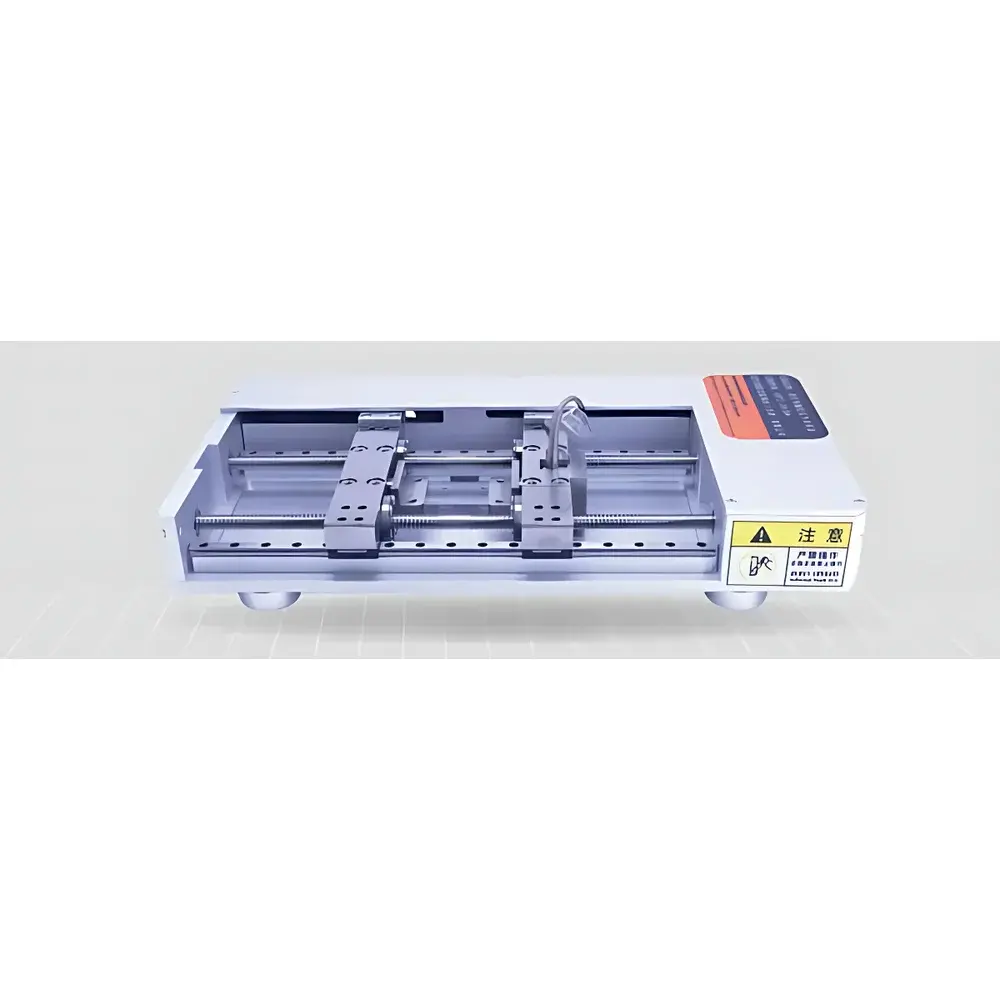
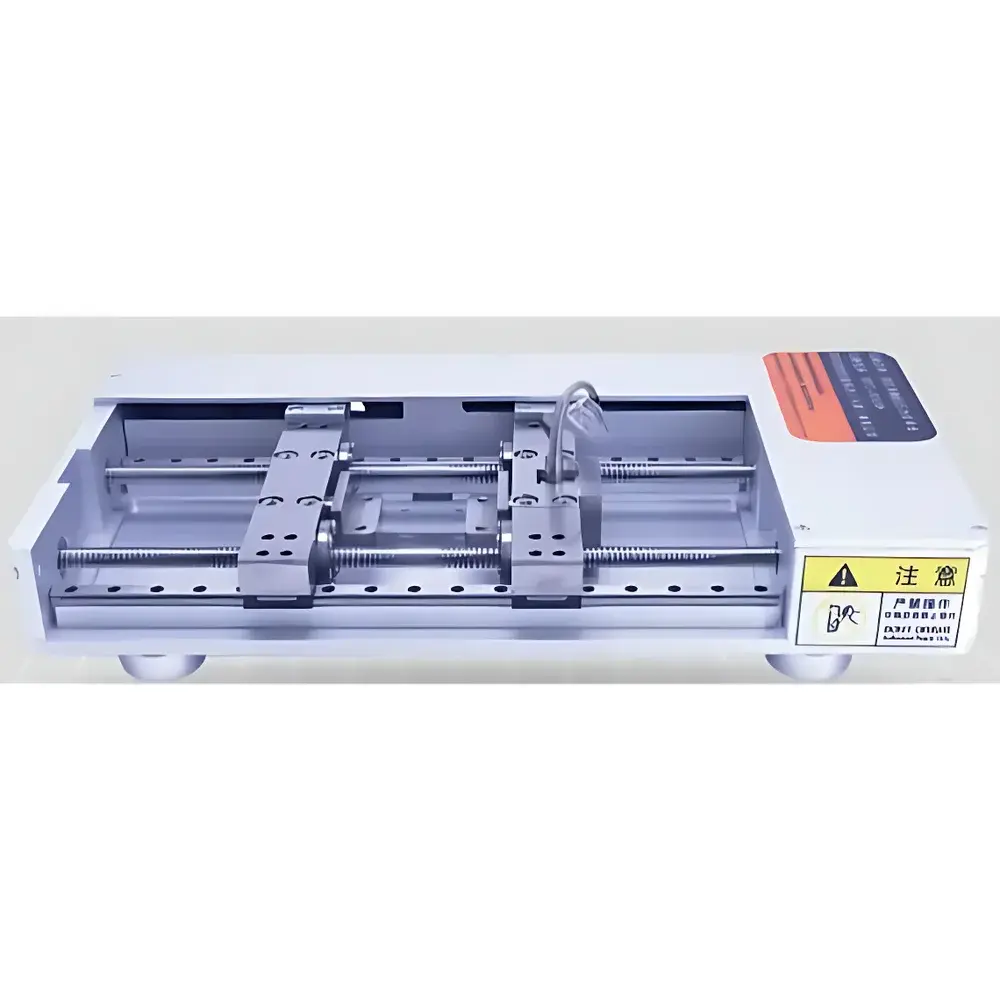
LEI-TECH IBTC-300S Miniature Multiscale In Situ Mechanical Testing System
| Brand | LEI-TECH |
|---|---|
| Origin | Tianjin, China |
| Manufacturer Type | Direct Manufacturer |
| Country of Origin | China |
| Model | IBTC-300S |
| Price | USD 12,300 (FOB Tianjin) |
Overview
The LEI-TECH IBTC-300S Miniature Multiscale In Situ Mechanical Testing System is an engineered platform designed for real-time, high-fidelity mechanical characterization of materials under concurrent observation in vacuum or controlled-environment analytical instruments. It operates on the principle of symmetric anti-screw actuation—employing dual counter-rotating precision leadscrews to induce axial loading while maintaining static sample center positioning. This architecture eliminates parasitic lateral displacement and rotational drift during deformation, enabling sub-micron spatial stability critical for synchrotron X-ray diffraction (XRD), scanning electron microscopy (SEM), and atomic force microscopy (AFM) integration. The system supports quasi-static to low-rate dynamic loading protocols (0.001–50 µm/s displacement rate) with closed-loop position control, making it suitable for investigating deformation mechanisms—including dislocation nucleation, phase transformation kinetics, crack initiation, and viscoelastic relaxation—in heterogeneous, anisotropic, or soft matter systems.
Key Features
- Miniaturized footprint (≤85 mm × 65 mm × 42 mm) optimized for insertion into SEM chambers, AFM stages, and laboratory-scale XRD goniometers without obstructing beam paths or detector geometry.
- Symmetric anti-screw actuation mechanism ensures zero net translation of the sample’s geometric center during loading—critical for uninterrupted in situ imaging and diffraction data collection.
- Dual-load-sensor configuration: integrated high-sensitivity micro-force transducer (±0.5 mN resolution, 50 mN full scale) and robust macro-force sensor (±0.1 N resolution, 300 N full scale), switchable via software without hardware reconfiguration.
- Modular sample stage interface compatible with standard SEM pin mounts, TEM grid holders, and custom-designed fixtures for thin films, nanowires, hydrogels, and biological tissues.
- Thermally stable aluminum alloy chassis with passive damping; operating temperature range: 15–35 °C ambient, non-condensing environment.
- Embedded 16-bit DAC/ADC subsystem with 1 kHz sampling rate for synchronized acquisition of load, displacement, and optional external signals (e.g., strain gauge output, thermal camera trigger).
Sample Compatibility & Compliance
The IBTC-300S accommodates specimens ranging from brittle ceramics (≥50 µm thick) to compliant hydrogels (≥200 µm thick), including metallic micropillars, polymer fibers, mineralized bone sections, and 2D layered materials. Sample mounting follows ASTM E8/E8M (tensile testing of metallic materials) and ISO 6892-1 (metallic materials – tensile testing at ambient temperature) geometries where applicable. While the system itself is not certified to ISO/IEC 17025, its mechanical calibration traceability aligns with NIST-traceable force standards (via third-party accredited calibration certificates). Data acquisition workflows support audit-ready metadata tagging per GLP and GMP requirements, including user ID, timestamp, environmental log (optional external humidity/temperature input), and instrument firmware version.
Software & Data Management
Control and analysis are performed using LEI-TECH’s proprietary MechVision Suite, a Windows-based application supporting real-time load-displacement curve plotting, customizable test sequences (ramp-hold, cyclic, creep), and batch export in HDF5 and CSV formats. The software includes built-in modules for Young’s modulus calculation (tangent/secant method), yield point detection (0.2% offset), and fracture energy integration. All test parameters and raw data streams are stored with SHA-256 checksum integrity verification. For regulated environments, optional FDA 21 CFR Part 11 compliance packages are available—including electronic signatures, role-based access control, and immutable audit trails of all parameter changes and data exports.
Applications
- In situ SEM tensile testing of additively manufactured Ti-6Al-4V microlattices to correlate local necking with crystallographic texture evolution.
- AFM-coupled nanoindentation and uniaxial stretching of electrospun PCL scaffolds to quantify strain-dependent modulus gradients across fiber networks.
- Synchrotron XRD mapping of lattice strain redistribution in Cu/Nb multilayers during interfacial shear loading.
- Time-resolved mechanical profiling of alginate hydrogels under physiological pH and ionic strength conditions, synchronized with fluorescence lifetime imaging.
- Fatigue behavior analysis of solder joint intermetallic compounds in cross-sectional TEM lamellae, using stepwise cyclic loading with post-cycle diffraction indexing.
FAQ
Is the IBTC-300S compatible with field-emission SEM systems?
Yes—the system has been validated in FE-SEM chambers (e.g., Zeiss GeminiSEM, Thermo Fisher Helios Hydra) with working distances ≥5 mm and chamber pressures ≤1×10⁻⁴ Pa.
Can I integrate my own optical extensometer or DIC system?
Yes—dedicated analog voltage output channels (±10 V, 16-bit) and TTL synchronization triggers are provided for third-party displacement sensors and high-speed cameras.
What calibration documentation is included?
Each unit ships with a factory calibration report covering force transducer linearity (±0.15% FS), displacement encoder resolution (5 nm), and thermal drift (<0.2 µm/°C over 20–30 °C). NIST-traceable recalibration services are offered annually.
Does the system support automated testing sequences across multiple samples?
Yes—MechVision Suite supports script-driven multi-sample protocols with auto-stage positioning (when paired with optional motorized XY stage controller).
Is remote operation supported for collaborative labs?
Yes—secure RDP and VNC-compatible remote desktop access is enabled by default; firewall-friendly port configuration and TLS-encrypted command logging are standard.





