
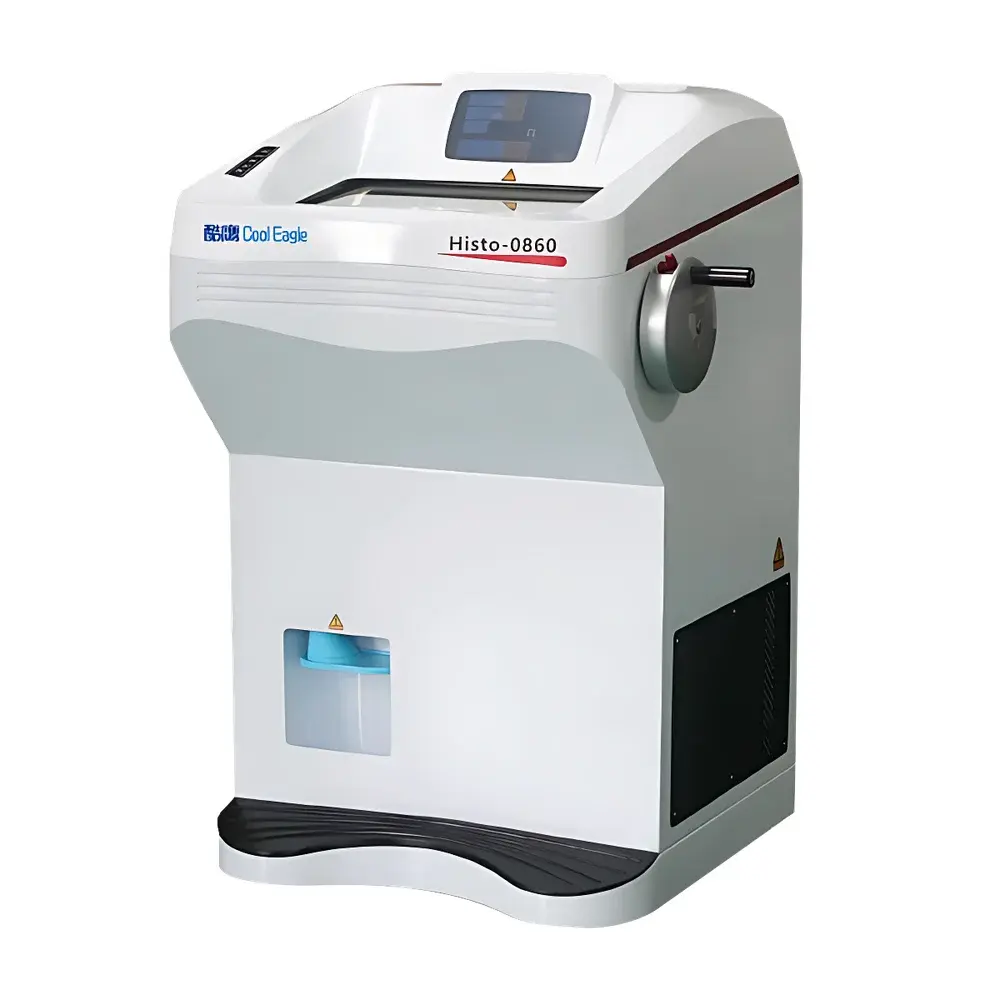
HISTO Cool Eagle Cryostat Microtome Histo-0860
| Brand | HISTO |
|---|---|
| Origin | Zhejiang, China |
| Manufacturer Type | Authorized Distributor |
| Country of Origin | China |
| Model | Histo-0860 |
| Price | USD 25,000 (FOB) |
| Section Thickness Range | 0.5–100 µm (adjustable in increments: 0.5 µm from 0.5–5 µm |
| Trim Thickness Range | 0–600 µm (5 µm increments up to 50 µm |
| Specimen Retraction | 0–60 µm (2 µm resolution) |
| Max Specimen Size | 55 mm × 80 mm |
| Horizontal Travel | 22 mm |
| Vertical Travel | 65 mm |
| Cryochamber Temp Range | 0°C to –50°C (programmable) |
| Cryostage Temp Range | 0°C to –60°C (Peltier-assisted) |
| Specimen Head Temp Range | 0°C to –50°C |
| Peltier-enhanced rapid-cooling zones | ≥6 |
| 10-inch Full-Color Touchscreen Interface (bilingual | English/Chinese) |
| Motorized Rough Advance Speeds | 0.9 mm/s and 0.45 mm/s |
| Specimen Head Rotation | X-axis 360°, Y-axis ±12° |
| Tissue Flattener Cooling | down to –50°C |
| Dimensions (W×D×H) | 700 × 760 × 1160 mm |
Overview
The HISTO Cool Eagle Cryostat Microtome Histo-0860 is a precision-engineered, fully integrated cryomicrotome designed for high-fidelity frozen sectioning in histopathology, neuroscience, and preclinical research laboratories. It operates on the principle of cryosectioning—rapidly freezing biological specimens to preserve ultrastructural integrity and antigenicity—and employs dual-stage thermoelectric (Peltier) and compressor-based refrigeration to maintain stable, independently controlled thermal environments across five critical zones: cryochamber, cryostage, knife holder, specimen head, and tissue flattener. This multi-point active cooling architecture ensures minimal ice crystal formation, consistent section morphology, and reproducible ribbon formation across diverse tissue types—including fatty, fibrous, and highly hydrated samples. The system meets core operational requirements for GLP-compliant histology workflows and supports traceable temperature logging essential for method validation under ISO 15189 and CLIA-aligned laboratory practices.
Key Features
- Independent five-zone cooling via dual Secop compressors and supplementary Peltier modules, enabling simultaneous stabilization at –60°C (cryostage), –50°C (specimen head and tissue flattener), and –50°C (chamber), with programmable setpoints and real-time thermal feedback.
- Motorized coarse advance with two selectable speeds (0.9 mm/s and 0.45 mm/s) for rapid specimen positioning and precise approach control during sectioning.
- High-resolution section thickness adjustment: 0.5–100 µm in variable increments (0.5 µm below 5 µm; 1 µm up to 20 µm; 2 µm up to 50 µm; 5 µm up to 100 µm), supporting both diagnostic-level thin sections and bulk trimming applications.
- Advanced 10-inch capacitive touchscreen interface with bilingual (English/Chinese) GUI, displaying real-time metrics including total section count, cumulative section thickness, retraction value, zone-specific temperatures, date/time stamp, and automated defrost scheduling.
- UV-C sterilization cycle integrated into the cryochamber lid, activated automatically upon door closure or manually via interface, reducing bioburden between specimens without chemical intervention.
- Ergonomic specimen head with 360° X-axis rotation and ±12° Y-axis tilt, secured by a quick-lock bayonet mount—enabling optimal tissue orientation while minimizing manual handling and compression artifacts.
- Anti-fog heated single-pane viewing window with uniform thermal distribution, eliminating condensation during extended operation and ensuring uninterrupted visual monitoring of section quality.
- Integrated tissue flattener with active cooling to –50°C, significantly accelerating specimen equilibration and improving section adhesion—particularly beneficial for hard-to-section tissues such as skin, cartilage, and calcified specimens.
Sample Compatibility & Compliance
The Histo-0860 accommodates standard OCT-embedded specimens up to 55 mm × 80 mm, with vertical travel of 65 mm and horizontal excursion of 22 mm—sufficient for full-face sectioning of large biopsy blocks and rodent organ sections. Its modular cryostage design supports interchangeable specimen holders and color-coded tissue trays (included), facilitating workflow segregation in multi-user labs. All thermal control systems comply with IEC 61000-6-3 (EMC) and IEC 61010-1 (safety). Temperature stability across operating ranges adheres to ASTM E2251-22 for cryostat performance verification. The system’s audit-trail-capable interface logs all temperature setpoints, section parameters, and sterilization events—supporting 21 CFR Part 11 readiness when deployed with validated LIMS integration.
Software & Data Management
No proprietary cloud platform is required. All operational data—including timestamps, section thickness settings, temperature profiles per zone, retraction values, and UV sterilization cycles—are stored locally in non-volatile memory with CSV export capability via USB port. The touchscreen firmware includes built-in sensor self-diagnostic routines that validate thermistor functionality prior to each session and flag calibration drift exceeding ±0.5°C. Optional RS-232 and Ethernet interfaces allow integration with laboratory information systems (LIS) for automated metadata capture. Firmware updates are performed offline using signed binary files, preserving integrity and version traceability in regulated environments.
Applications
- Routine intraoperative frozen section analysis in surgical pathology departments.
- Neuroanatomical mapping requiring serial 10–20 µm sections from perfusion-fixed rodent brains.
- Immunofluorescence and enzyme histochemistry where antigen preservation mandates sub-zero sectioning without chemical fixation.
- Dermatopathology workflows involving thick, elastic-rich skin biopsies demanding precise flattening and low-temperature support.
- Preclinical toxicology studies requiring standardized sectioning of liver, kidney, and lung tissues across multiple treatment cohorts.
- Quality control of biobanked tissue archives where morphological fidelity must be preserved during retrieval and sectioning.
FAQ
What is the minimum achievable section thickness, and what factors influence reproducibility at this range?
The Histo-0860 achieves 0.5 µm sections with calibrated knife geometry, optimal tissue hardness, and stable thermal equilibrium. Reproducibility depends on specimen temperature homogeneity, knife sharpness, and vibration isolation—recommended best practice includes 15-minute pre-equilibration at target stage temperature before sectioning.
Does the system support compliance with FDA 21 CFR Part 11 for electronic records?
Yes—the device generates time-stamped, user-attributed logs of all critical parameters; full Part 11 compliance requires implementation of institutional access controls, electronic signatures, and backup procedures per organizational SOPs.
How does the dual-compressor architecture improve reliability over single-compressor cryostats?
Independent compression circuits isolate thermal load fluctuations: e.g., opening the chamber door affects only the cryochamber circuit, while the cryostage maintains its setpoint. This minimizes thermal recovery latency and extends component service life.
Is the UV sterilization cycle validated for microbial reduction efficacy?
The 254 nm UV-C source delivers ≥10 mJ/cm² irradiance at the chamber surface, sufficient to achieve ≥3-log reduction of common environmental isolates (e.g., Bacillus atrophaeus) per ISO 15714:2019 test protocols.
Can third-party blades be used with the knife holder?
The system accepts standard disposable cryoblades (e.g., Leica CM1950, Thermo Scientific Shandon) via universal clamping mechanism; blade alignment and pressure calibration must be verified per manufacturer guidelines prior to use.



