
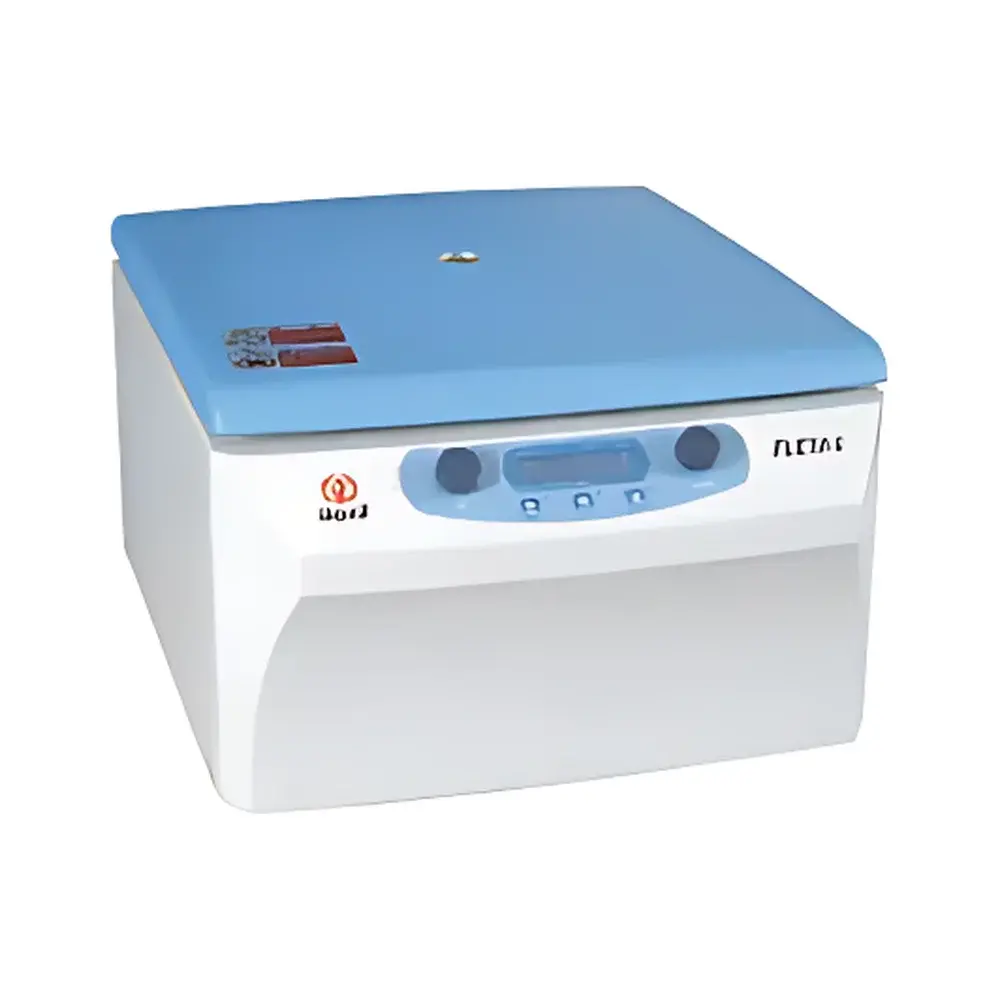
Hanil FLETA5 High-Capacity Benchtop Centrifuge
| Brand | Hanil |
|---|---|
| Origin | South Korea |
| Model | FLETA5 |
| Max Speed | 5,500 rpm (fixed-angle rotor) |
| Max RCF | 5,411 × g |
| Max Capacity | 32 × 15 mL tubes |
| Timer Range | 0–99 h 59 min 59 sec |
| Acceleration/Deceleration Profiles | 10 selectable steps |
| Acceleration Time | ≤12 s (0→5,500 rpm) |
| Deceleration Time | ≤20 s (5,500→0 rpm) |
| Noise Level | <60 dB(A) |
| Stored Programs | 100 |
| Display | Graphical LCD showing rpm, RCF, time, temperature (if refrigerated), rotor radius, acceleration/deceleration profile, and program ID |
| Power Supply | AC 220 V, 50/60 Hz, 500 W |
| Motor | Brushless DC (BLDC) |
| Dimensions (W×D×H) | 570 × 475 × 325 mm |
| Net Weight | 40 kg |
| Rotor Recognition | Automatic |
| Safety Features | Imbalance detection, lid-lock interlock with emergency release, stainless-steel chamber, metal housing & lid, viewing window on lid |
Overview
The Hanil FLETA5 is a high-capacity, microprocessor-controlled benchtop centrifuge engineered for reproducible, high-throughput sample separation in clinical, pharmaceutical, and academic laboratories. Designed around Couette-type rotational dynamics and optimized rotor aerodynamics, the FLETA5 delivers stable angular acceleration and precise deceleration control—critical for preserving pellet integrity in sensitive biological suspensions (e.g., whole blood, cell cultures, microbial pellets). Its fixed-angle rotor configuration supports standardized 15 mL conical tubes under ISO 13485-aligned manufacturing conditions, and the unit complies with IEC 61010-1:2012 safety requirements for laboratory electrical equipment. The BLDC motor ensures low thermal drift, extended service life (>20,000 hr MTBF), and consistent torque delivery across the full speed range—eliminating brush wear and electromagnetic interference common in brushed DC alternatives.
Key Features
- Graphical LCD interface with real-time display of rpm, RCF, elapsed time, selected program ID, acceleration/deceleration profile index, and rotor radius—enabling immediate verification of centrifugal field uniformity per ISO 21501-4.
- Intuitive rotary encoder + function key navigation reduces operator training time and minimizes input error during routine protocol execution.
- 100 programmable methods stored in non-volatile memory support GLP-compliant workflow standardization; each program retains independent acceleration/deceleration profiles, hold times, and final brake settings.
- 10-step acceleration/deceleration ramping (0–9) allows optimization for shear-sensitive samples—e.g., reducing vortex formation during spin-down of platelet-rich plasma (PRP) or minimizing resuspension of fragile bacterial pellets.
- Automatic rotor recognition prevents mismatched speed/RCF calculations by validating installed rotor geometry against firmware-defined parameters—ensuring compliance with USP <711> centrifugation validation criteria.
- Stainless-steel chamber and reinforced metal housing provide corrosion resistance and structural stability during continuous operation at maximum load.
- Integrated imbalance detection halts rotation within 0.8 seconds upon detecting ≥5 g mass asymmetry (per ASTM F2626-20), preventing mechanical resonance and bearing fatigue.
- Lid lock mechanism features dual-point engagement with emergency manual override—meeting EN 61010-2-020 mechanical safety provisions for access during power failure or thermal shutdown.
- Optical viewing window enables visual confirmation of tube alignment and sediment formation without interrupting the run—reducing contamination risk and improving QC traceability.
Sample Compatibility & Compliance
The FLETA5 accommodates up to 32 × 15 mL conical polypropylene or glass tubes using Hanil-certified fixed-angle rotors (e.g., FA-32×15). Adapters for 5 mL, 10 mL, and 50 mL tubes are available as optional accessories—each validated for centrifugal stress distribution per ISO 15195:2022. All rotors undergo dynamic balancing to ≤0.5 g·mm residual unbalance and are certified to ISO 15195 Annex B for long-term fatigue resistance. The system supports ambient-temperature operation only (non-refrigerated); users requiring temperature control must integrate external cooling solutions compliant with IEC 60335-2-40. Documentation includes CE marking, RoHS 2011/65/EU declaration, and factory calibration certificate traceable to KRISS (Korea Research Institute of Standards and Science).
Software & Data Management
While the FLETA5 operates as a standalone instrument, its embedded firmware supports audit-ready data logging: timestamped start/stop events, actual vs. set rpm deviation (±25 rpm), RCF calculation based on real-time rotor radius input, and fault codes (e.g., E03 = imbalance, E07 = lid open). Logged data is exportable via USB port in CSV format for integration into LIMS or electronic lab notebooks (ELN). Firmware versioning and parameter lockout modes facilitate 21 CFR Part 11 compliance when deployed in regulated environments—enabling role-based access control (administrator/operator) and electronic signature capture for method changes.
Applications
- Clinical diagnostics: Separation of serum/plasma from whole blood (ISO 15189:2022 Annex A.5.2), PBMC isolation, and urinalysis sediment concentration.
- Pharmaceutical QA/QC: Clarification of suspension formulations prior to HPLC analysis; recovery yield assessment of micronized APIs.
- Academic research: Pellet harvesting of E. coli, yeast, or mammalian cells for downstream lysis and protein extraction (protocols compatible with RIPA and TRIzol workflows).
- Food & beverage testing: Fat separation in milk homogenates per AOAC 989.10; yeast removal from fermentation broths.
- Environmental labs: Concentration of waterborne pathogens (e.g., Cryptosporidium) for PCR-based detection (EPA Method 1623.1).
FAQ
Does the FLETA5 support refrigeration?
No—the FLETA5 is an ambient-temperature-only centrifuge. Refrigerated variants are not offered in the FLETA series.
Can third-party rotors be used?
Hanil does not validate or warranty performance with non-Hanil rotors. Use of unauthorized rotors voids safety certification and may trigger automatic shutdown due to unrecognized geometry.
Is rotor calibration required before first use?
Yes—rotor radius must be manually entered via the control panel prior to initial operation. This value is critical for accurate RCF calculation per ISO 21501-4 Clause 6.3.
How is imbalance tolerance verified during factory testing?
Each unit undergoes dynamic imbalance testing at 110% of max speed with asymmetric loading (±5 g differential), confirming automatic stop response within 0.8 s and no vibration amplitude exceeding 2.5 mm/s RMS.
What is the recommended maintenance interval?
Brushless motor requires no scheduled brush replacement. Annual inspection of lid lock actuator, rotor threads, and chamber seals is advised per Hanil Service Bulletin SB-FLETA5-2023-01.



