
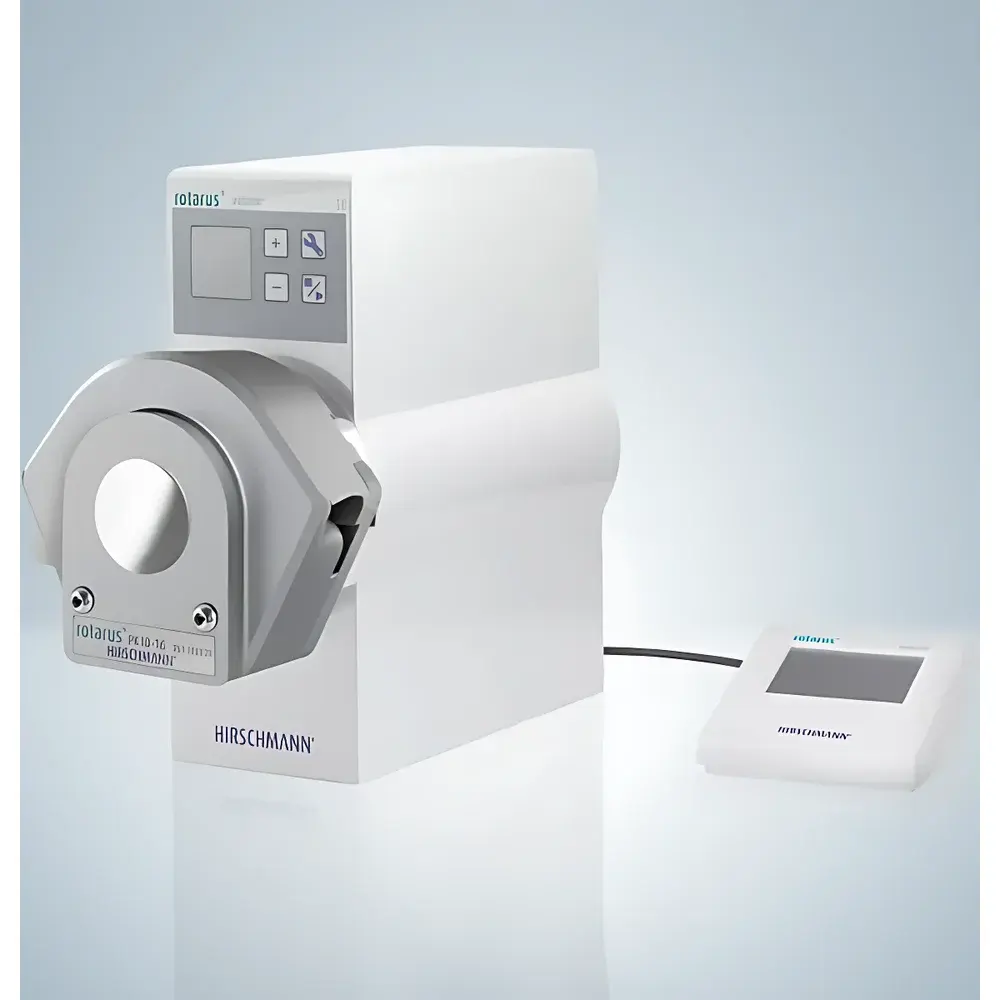
Hirschmann Rotarus® Volume 50 Peristaltic Dispensing Pump
| Brand | Hirschmann (Germany) |
|---|---|
| Origin | Germany |
| Model | Rotarus® Volume 50 |
| Motor Power | 50 W |
| Speed Range | 0.2–100 rpm |
| Protection Rating | IP54 (lab version), IP65 (stainless steel industrial version) |
| Control Interface | TFT touchscreen controller (external), integrated front-panel controls |
| Communication | RS232, USB |
| Power Supply | 24 V DC |
Overview
The Hirschmann Rotarus® Volume 50 is a precision-engineered peristaltic dispensing pump designed for repeatable, traceable, and programmable liquid handling in regulated laboratory and industrial environments. Operating on the principle of positive displacement via roller compression of flexible tubing, it delivers high reproducibility in volumetric dispensing without contact between the fluid path and mechanical components—ensuring contamination-free operation and eliminating cross-sample carryover. Its core architecture integrates a 50 W brushless DC motor with closed-loop speed control, enabling stable rotational output across the full 0.2–100 rpm range. Unlike conventional peristaltic pumps, the Rotarus® Volume 50 embeds intelligent fluid-path monitoring at the hardware level: integrated RFID readers identify pump head type and tubing specifications in real time, automatically loading compatible operational limits and calibration profiles. This ensures compliance with method integrity requirements under GLP and GMP frameworks where equipment configuration traceability is mandatory.
Key Features
- Intelligent RFID-based pump head and tubing recognition — prevents mismatched configurations and enforces parameter constraints aligned with validated tubing lifetimes and flow characteristics
- Real-time occlusion and tube rupture detection — uses pressure-sensitive motor current profiling and torque deviation analysis to halt operation upon abnormal resistance or loss of backpressure
- Dual-control architecture — combines an external 7-inch TFT touchscreen controller with a fully functional integrated front-panel interface, supporting both local operation and remote supervision
- Tool-free, single-motion pump head exchange — accommodates both single-channel and multi-channel (up to 8-channel) dispensing heads; head alignment and sealing are mechanically self-indexed
- IP54-rated powder-coated enclosure (laboratory variant) and IP65-rated stainless-steel housing (industrial variant) — certified to IEC 60529 for dust and water ingress protection, suitable for cleanrooms, wet-process lines, and production-floor deployment
- Comprehensive method management — stores up to 100 user-defined dispensing protocols including variable speed ramps, cycle counts, pause intervals, and cumulative volume targets
- Traceable calibration workflow — supports two-point volumetric calibration using gravimetric or timed-collection methods; all calibration events are timestamped and logged with operator ID and environmental metadata
Sample Compatibility & Compliance
The Rotarus® Volume 50 is compatible with a broad spectrum of chemically resistant tubing materials (e.g., PharMed® BPT, Norprene®, Viton®), supporting aqueous, organic, and mildly corrosive media across viscosities from 0.5 to 10,000 mPa·s. Its non-metallic fluid path eliminates metal ion leaching, making it suitable for cell culture media preparation, reagent dispensing in IVD manufacturing, and buffer distribution in bioprocessing. The system meets key regulatory expectations for instrument qualification: it supports IQ/OQ documentation templates compliant with ISO/IEC 17025 and ASTM E2500-18; audit trails for method changes, calibration, and error logs satisfy FDA 21 CFR Part 11 requirements when paired with validated LIMS or MES integration via RS232 or USB virtual COM port.
Software & Data Management
No proprietary software installation is required—the Rotarus® Volume 50 operates as a plug-and-play HID-compliant device over USB or standard serial protocol over RS232. All parameter settings, execution logs, and calibration records are stored internally in non-volatile memory with SHA-256 hashed integrity verification. Exportable CSV reports include dispensing event timestamps, actual vs. target volumes, motor load history, and RFID-read confirmation codes for each tubing batch. For enterprise integration, the pump supports Modbus RTU over RS232, enabling direct linkage to SCADA systems or PLC-controlled filling stations without middleware.
Applications
- Automated reagent dispensing in clinical diagnostics and ELISA workflow automation
- Buffer and media distribution in upstream bioprocessing (e.g., seed train inoculation, feed addition)
- Volumetric dosing in pharmaceutical formulation development and stability testing
- Continuous sampling and dilution in inline process analytical technology (PAT) setups
- High-integrity liquid transfer in ISO Class 5–7 cleanroom environments
- Integration into modular single-use bioreactor skids requiring low-shear, sterile fluid routing
FAQ
Does the Rotarus® Volume 50 support validation documentation for GMP environments?
Yes—it provides configurable electronic records for IQ/OQ execution, including test scripts, pass/fail criteria, and digital signature fields aligned with Annex 11 and EU GMP Annex 15 expectations.
Can third-party pump heads be used with this system?
The device accepts mechanically compatible pump heads from other manufacturers; however, RFID authentication and automated parameter loading are only active with Hirschmann-certified heads and tubing assemblies.
Is tubing lifetime tracked automatically?
RFID-tagged tubing batches store cumulative rotation count and maximum recommended rpm; the pump enforces hard stops when usage thresholds are exceeded, logging alerts in the audit trail.
What power supply options are available?
Only 24 V DC input is supported—no internal AC/DC conversion—to ensure electromagnetic compatibility in sensitive instrumentation zones and simplify integration into centralized DC power architectures.
How is accuracy verified during routine operation?
Gravimetric calibration is performed using NIST-traceable balances; the system calculates volumetric accuracy based on measured mass, fluid density, and dispensing duration, storing uncertainty budgets per method.



