
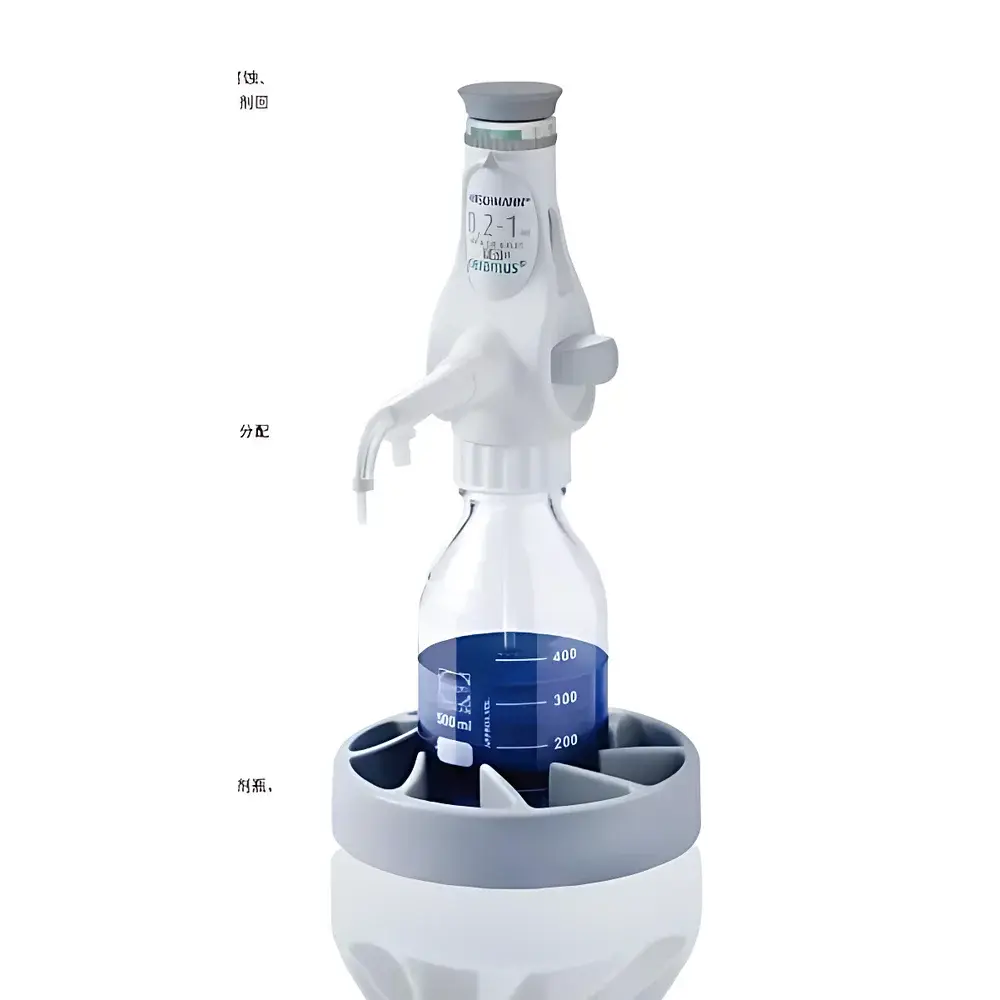
Hirschmann CERAMUS Trace Analysis Bottle Top Dispenser
| Brand | Hirschmann |
|---|---|
| Origin | Germany |
| Manufacturer Type | Authorized Distributor |
| Product Origin | Imported |
| Model | CERAMUS |
| Instrument Type | Manual Bottle Top Dispenser |
| Volume Range | 0.2–60 mL |
| Minimum Graduation | 0.05 mL |
| Accuracy | ≤0.5% |
| Precision (Repeatability) | ≤0.1% |
Overview
The Hirschmann CERAMUS Trace Analysis Bottle Top Dispenser is an ultra-high-purity liquid handling solution engineered specifically for trace-level analytical workflows where contamination, leaching, or chemical incompatibility must be rigorously excluded. Designed and manufactured in Germany, it operates on a precision piston-driven volumetric dispensing principle—utilizing positive displacement to ensure consistent, repeatable delivery across its full 0.2–60 mL range. Unlike spring-loaded or air-displacement dispensers, the CERAMUS employs a fully ceramic fluid path (piston, valve seat, and valve ball) combined with high-borosilicate glass sleeves and platinum/iridium alloy springs—materials selected for exceptional resistance to hydrofluoric acid, concentrated mineral acids (e.g., HNO₃, HCl, H₂SO₄), and aggressive solvents used in ICP-MS, IC, and EPA Method 200.7–200.9 sample preparation. Its design eliminates extractables and metal ion leaching, making it compliant with ISO/IEC 17025 requirements for trace-metal-free reagent handling.
Key Features
- Full-ceramic wetted components (Al₂O₃-based technical ceramics) certified for <1 ng/L metal ion release in ultrapure water elution tests per DIN EN ISO 15195
- High-borosilicate glass sleeve (Duran®-grade) with thermal shock resistance up to 500 °C and CTE matched to ceramic elements for long-term dimensional stability
- Platinum/iridium alloy valve spring (Pt90/Ir10) providing corrosion immunity and fatigue resistance over >100,000 actuation cycles
- Integrated reagent recirculation system enabling closed-loop priming and elimination of air bubbles—critical for viscous or degassed solvents
- Mechanically locked volume setting mechanism with dual-scale vernier dial (coarse + fine adjustment) ensuring reproducible setpoint retention without drift
- ISO 838-compatible neck adapter (GL45, GL32, GL28) with PTFE-sealed bayonet lock for leak-tight, vibration-resistant mounting
Sample Compatibility & Compliance
The CERAMUS is validated for use with Class 1–3 reagents per ISO 8655-3, including aqua regia, 48% hydrofluoric acid, 70% nitric acid, and organic solvents such as acetonitrile and methanol. It meets ASTM D5127 for trace metal analysis equipment qualification and supports compliance with USP (Water for Pharmaceutical Purposes) and EPA SW-846 Method 6020B (ICP-MS). All materials are documented under RoHS 2015/863/EU and REACH Annex XIV SVHC-free declarations. Device calibration certificates include gravimetric verification per ISO 8655-6 at three points (10%, 50%, 90% of max volume) with uncertainty ≤0.08% (k=2).
Software & Data Management
As a manual mechanical dispenser, the CERAMUS requires no firmware, power supply, or software interface. However, its design supports full integration into GLP/GMP environments through documented calibration logs, user-defined SOPs (e.g., “CERAMUS Dispensing Procedure v2.1”), and audit-trail-compatible record keeping. Optional accessories include serialized calibration verification kits with NIST-traceable weights and certified reference solutions for in-house performance checks. The unit’s mechanical simplicity ensures zero risk of electronic failure, electromagnetic interference, or data corruption—aligning with FDA 21 CFR Part 11 principles for manual systems where handwritten records remain primary evidence.
Applications
- Preparation of calibration standards for ICP-OES and ICP-MS in environmental, clinical, and semiconductor metrology labs
- Acid digestion workflows for soil, sediment, and biological tissue per EPA Methods 3050B, 3051A, and 3052
- Mobile phase delivery in ion chromatography (IC) for anion/cation analysis with sub-ppq detection limits
- Trace-doping of high-purity silicon wafers and photovoltaic-grade quartz crucibles
- Reference material dilution in national metrology institutes (NMIs) requiring ≤0.1% relative standard deviation across n=10 replicates
FAQ
What certifications accompany the CERAMUS dispenser upon shipment?
Each unit ships with a factory calibration certificate (traceable to PTB, Germany), material compliance dossier (RoHS, REACH, SVHC), and ceramic biocompatibility test report (ISO 10993-5 cytotoxicity screening).
Can the CERAMUS be sterilized in an autoclave?
No—ceramic components are not rated for steam autoclaving; instead, validated cleaning protocols using 6 M HNO₃ soak followed by Class 1 water rinses are recommended.
Is the volume scale adjustable without tools?
Yes—the dual-scale vernier dial allows tool-free, tactile volume setting with 0.05 mL resolution and mechanical lock engagement audible via distinct click feedback.
How often does recalibration require verification?
Per ISO/IEC 17025 Clause 6.4.6, gravimetric verification is recommended every 6 months or after 5,000 dispenses—whichever occurs first—and must be performed using Class E2 weights and ISO 4787-compliant methodology.
Does Hirschmann provide application support for method development?
Yes—Hirschmann’s Application Lab in Hamburg offers remote method validation services, including dispensing RSD assessment, acid compatibility testing, and SOP co-development aligned with ISO 17025 internal audit requirements.
Related Products



