
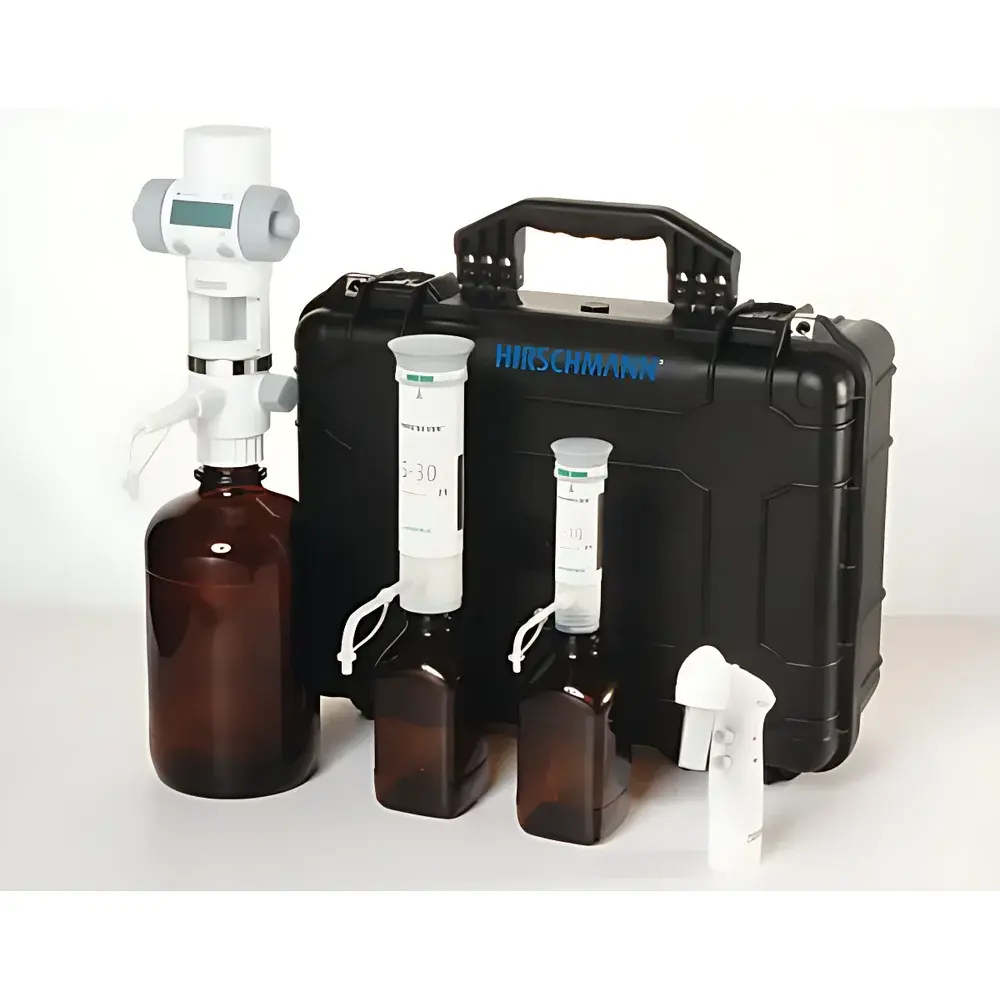
Hirschmann COD-Cr System for Chemical Oxygen Demand Determination by Potassium Dichromate Method
| Brand | Hirschmann |
|---|---|
| Origin | Germany |
| Manufacturer Type | Authorized Distributor |
| Origin Category | Imported |
| Model | COD-Cr |
| Pricing | Available Upon Request |
Overview
The Hirschmann COD-Cr System is a fully integrated, safety-engineered laboratory solution designed for accurate and reproducible Chemical Oxygen Demand (COD) determination in water and wastewater samples according to the standardized potassium dichromate oxidation method. Grounded in the principle of strong acid–catalyzed oxidation under reflux conditions—where Cr(VI) in acidic medium oxidizes organic matter quantitatively—the system implements the core reaction sequence defined in ISO 6060, ASTM D1252–06 (Method B), and China’s national standard GB 11914–1989. Unlike conventional manual protocols relying on open-vessel digestion and volumetric glassware, the COD-Cr System integrates precision liquid handling, controlled thermal reflux, and automated endpoint detection to minimize operator exposure to concentrated sulfuric acid (≥95%), potassium dichromate (a known carcinogen and environmental hazard), and silver sulfate catalyst. Its architecture conforms to GLP-compliant workflow design, emphasizing traceability, procedural consistency, and risk mitigation across environmental testing laboratories, mobile monitoring units, and emergency response vehicles.
Key Features
- Integrated reflux-digestion module with programmable temperature ramping (up to 150 °C) and precise 2-hour reflux timing per batch, ensuring complete oxidation of refractory organics.
- Motorized, corrosion-resistant reagent dispensing system for accurate, repeatable delivery of H2SO4, K2Cr2O7, and Ag2SO4 solutions—eliminating manual pipetting and reducing inter-operator variability.
- Digital potentiometric titration unit with automatic endpoint recognition (±0.02 mL resolution), replacing subjective visual endpoint judgment in Fe(NH4)2(SO4)2 titration.
- Modular footprint (W × D × H: 520 × 480 × 360 mm) optimized for integration into mobile monitoring vehicles, field labs, and compact QC spaces—fully compliant with EN 15257:2012 for portable environmental analyzers.
- Chemical-resistant fluid path constructed from PTFE, borosilicate glass, and Hastelloy C-276—validated for >10,000 cycles with 98% H2SO4 and Cr(VI) solutions.
- Integrated fume extraction interface compatible with standard lab ductwork or standalone activated carbon filtration units (optional).
Sample Compatibility & Compliance
The COD-Cr System accepts aqueous samples ranging from 0.5 to 700 mg/L COD (dilutable up to 10,000 mg/L), including raw sewage, industrial effluents, surface water, and leachates. Sample volume is configurable between 10–50 mL via calibrated ceramic syringe modules. All operational parameters—including digestion time, acid concentration, and titrant flow rate—are pre-validated against ISO/IEC 17025:2017 calibration requirements. The system supports full audit trails aligned with FDA 21 CFR Part 11 for electronic records and signatures when paired with optional Hirschmann LabSuite™ software. It meets CE marking requirements under Directive 2014/30/EU (EMC) and 2014/35/EU (LVD), and its reagent handling design complies with GHS hazard communication standards (UN No. 1467, UN No. 1479).
Software & Data Management
Hirschmann LabSuite™ (v3.2+) provides validated instrument control, real-time titration curve visualization, and automated COD calculation per Equation 1:
COD (mg/L) = [(A − B) × M × 8000] / V,
where A = titrant volume for blank, B = titrant volume for sample, M = molarity of ferrous ammonium sulfate, and V = sample volume (mL). Data export formats include CSV, PDF analytical reports (with digital signature), and XML for LIMS integration (ASTM E1467-compliant schema). Audit logs record user ID, timestamp, parameter changes, and calibration events—retained for ≥36 months per ISO 17025 clause 7.7. Software validation documentation (IQ/OQ/PQ protocols) is supplied with each installation.
Applications
- Routine compliance monitoring for municipal wastewater treatment plants (WWTPs) under EU Urban Wastewater Treatment Directive (91/271/EEC).
- Emergency spill response: rapid on-site COD assessment during chemical accidents or illegal discharge investigations.
- Industrial pretreatment verification for textile, pharmaceutical, and food processing facilities subject to local discharge permits.
- Research-grade method validation studies comparing COD with TOC or BOD5 metrics.
- Training platforms for accredited environmental testing laboratories seeking ISO/IEC 17025 accreditation.
FAQ
Does the COD-Cr System require external cooling water for condenser operation?
No—it features an integrated air-cooled reflux condenser with thermostatically regulated fan speed, eliminating dependency on tap water or chiller units.
Can the system be used with chloride-rich samples without mercury sulfate masking?
Yes; the digestion protocol includes optional chloride compensation mode (per ISO 6060 Annex C), enabling reliable results up to 2000 mg/L Cl− without HgSO4.
Is method validation support available for regulatory submissions?
Hirschmann provides application notes, recovery studies, and interlaboratory comparison data packages aligned with EPA Method 410.4 and ISO 6060 for submission to national accreditation bodies.
What maintenance intervals are recommended for routine operation?
Reagent lines require flushing every 50 runs; potentiometric sensor calibration is advised before each shift; annual preventive maintenance includes thermal calibration verification and pump actuator torque verification.







