
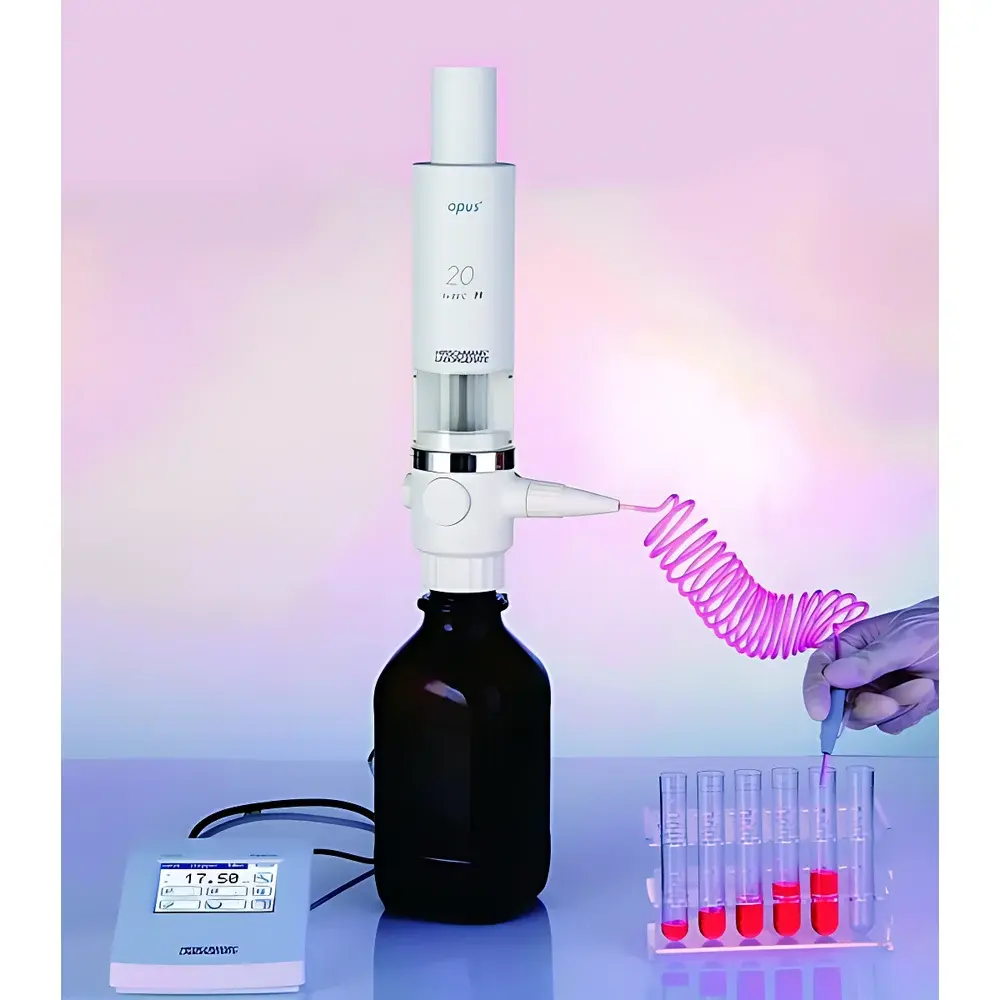
Hirschmann Electronic Dilution and Liquid Dispensing System (Liquid Handling Workstation)
| Brand | Hirschmann |
|---|---|
| Origin | Germany |
| Manufacturer Type | Authorized Distributor |
| Origin Category | Imported |
| Model | Yiye |
| Price Range | USD 13,500 – 40,500 (based on configuration) |
| Deck Capacity | Not applicable (benchtop standalone unit, no fixed deck slots) |
| Pipetting Accuracy | ±0.5–1.5% CV (typical, dependent on volume and tip type) |
| Pipetting Range | 1 µL – 10 mL (with optional multi-range syringe pumps) |
| Sample Throughput | Single-sample sequential processing (non-parallel, programmable batch mode supported) |
| Dimensions (W × D × H) | 600 × 400 × 500 mm |
Overview
The Hirschmann Electronic Dilution and Liquid Dispensing System (Model Yiye) is a precision-engineered benchtop liquid handling workstation designed for trace-level quantitative sample preparation in regulated analytical laboratories. Unlike robotic deck-based platforms, this system employs high-resolution, stepper-motor-driven syringe pumps with integrated pressure sensing and real-time flow monitoring to deliver gravimetrically validated dilutions and dispensing operations. Its core architecture follows the principles of positive displacement fluidics—ensuring minimal carryover, low dead volume (< 5 µL), and consistent performance across viscous, volatile, or surface-tension-sensitive solvents. The system is purpose-built for integration into LC-MS/MS, GC-MS, HPLC, and GC workflows where reproducible, audit-ready sample conditioning is critical—particularly in clinical toxicology, forensic drug screening, pesticide residue analysis (e.g., in accordance with EN 15662 or AOAC 2007.01), and pharmaceutical assay development per ICH Q2(R2) guidelines.
Key Features
- Modular syringe pump architecture supporting up to four independently controlled channels (configurable at order), each with selectable glass or PTFE-coated syringes (100 µL – 10 mL capacity)
- Integrated electronic balance interface (compatible with METTLER TOLEDO XSR/XSE and Sartorius Cubis® II) for gravimetric calibration and real-time mass-based volume verification
- Onboard touchscreen HMI with intuitive wizard-driven method setup, including serial dilution, standard addition, spiking, and matrix-matched calibration workflows
- Automated tip washing station with solvent-selectable rinse cycles (up to 3 wash solvents + air dry), minimizing cross-contamination between samples
- Full traceability via embedded event logging: timestamped records of all dispense events, pump positions, error codes, and user logins
- CE-marked and compliant with IEC 61000-6-2 (EMC immunity) and IEC 61010-1 (safety for laboratory equipment)
Sample Compatibility & Compliance
The Yiye system accommodates a broad range of sample matrices—including whole blood, urine, plasma, tissue homogenates, food extracts, and API solutions—without requiring hardware modification. It supports both aqueous and organic solvent systems (e.g., acetonitrile, methanol, ethyl acetate) with chemically resistant fluid paths (EPDM-free, PEEK and sapphire components). All operational protocols can be configured to meet GLP and GMP requirements: audit trails are immutable, user access levels are role-based (admin/operator/auditor), and electronic signatures comply with FDA 21 CFR Part 11 when paired with validated third-party LIMS or ELN environments. Method validation documentation (including linearity, accuracy, precision, and robustness data) is provided per ISO/IEC 17025:2017 Annex A.4 guidance.
Software & Data Management
The system runs Hirschmann LiquidControl™ v3.2 firmware, featuring a secure local database (SQLite with AES-256 encryption) and optional OPC UA server for bidirectional communication with chromatography data systems (CDS) such as Thermo Chromeleon™, Waters Empower™, or Agilent OpenLab CDS. Raw dispensing logs export in CSV or ASTM E1384-compliant XML format. Software updates are delivered via signed firmware packages; rollback capability ensures continuity during qualification. All data—including method files, calibration certificates, and maintenance logs—is archived with SHA-256 hash integrity verification. Remote diagnostics require prior TLS 1.2-encrypted authorization and do not permit unsolicited data extraction.
Applications
- Clinical & forensic toxicology: Automated preparation of calibrators and QCs for LC-MS/MS quantification of opioids, benzodiazepines, and novel psychoactive substances (NPS)
- Food safety testing: Multi-residue dilution of QuEChERS extracts prior to GC-MS/MS analysis per EU SANTE/11312/2021
- Pharmaceutical quality control: Accurate spiking of reference standards into placebo matrices for forced degradation studies (ICH Q5C)
- Environmental analysis: Dilution of EPA Method 1694 extracts (pharmaceuticals and personal care products in wastewater) to instrument linear range
- Bioanalytical method development: Reproducible generation of 10-point serial dilution curves with <2% inter-run CV (n = 6)
FAQ
Does the Yiye system support multi-step dilution protocols with intermediate mixing?
Yes—each dispense step can be followed by programmable vortex mixing (via external compatible shaker interface) or on-deck magnetic stirring; mixing duration, speed, and pause intervals are fully configurable.
Can it be validated for use in FDA-regulated environments?
Yes—the system supports IQ/OQ/PQ documentation packages, and its firmware includes built-in test routines for pump linearity, repeatability, and temperature drift compensation (tested from 15–30°C).
Is remote software update possible without physical access?
Firmware updates require authenticated USB media or local network upload with dual-factor admin approval; no cloud-based auto-update functionality is implemented.
What maintenance intervals are recommended?
Syringe seals and fluid path filters require replacement every 6 months under continuous operation; full performance verification (gravimetric accuracy check) is advised quarterly per ISO 8655-6.
How is carryover addressed for high-potency compounds?
The system implements triple-solvent wash (e.g., water → methanol → chloroform) with adjustable dwell time and vacuum-assisted drying; residual detection limits are verified using spiked blank injections per USP .



