
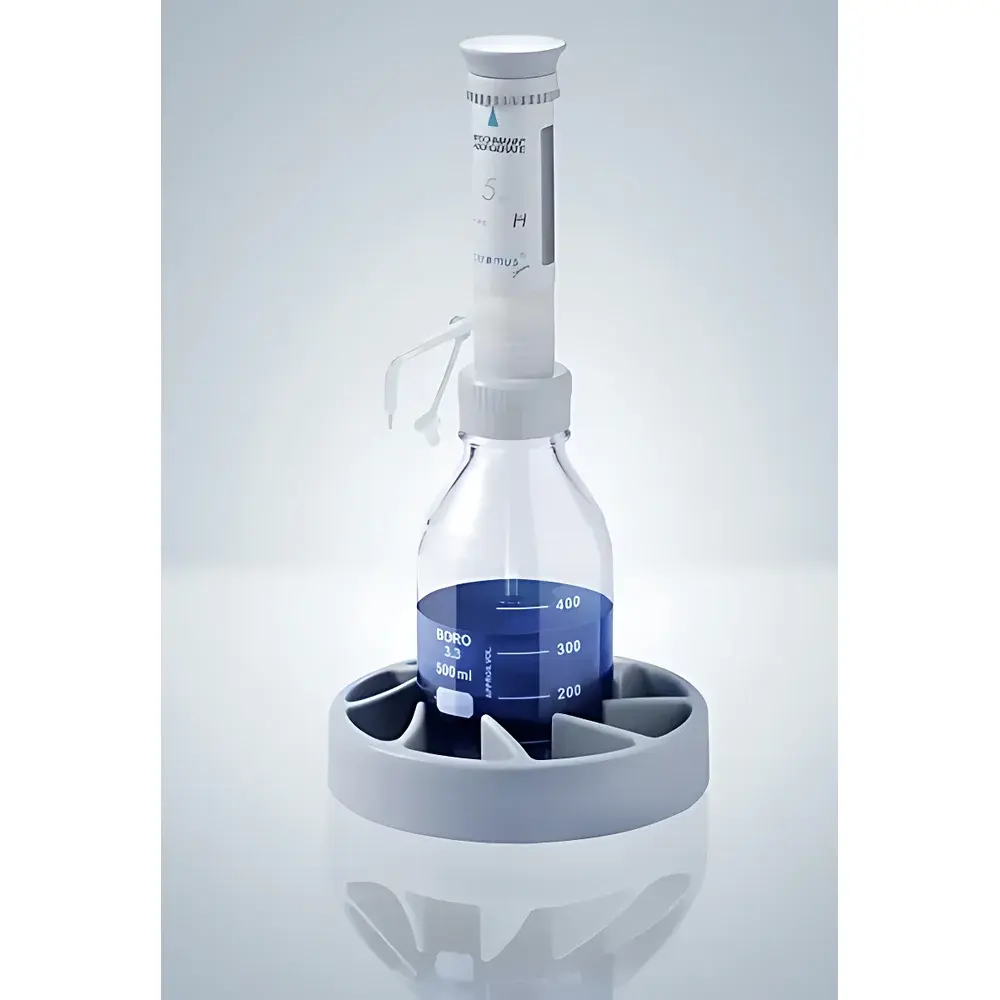
Hirschmann Ceramus Trace Analysis Bottle Top Dispenser
| Brand | Hirschmann |
|---|---|
| Origin | Germany |
| Type | Manual Bottle Top Dispenser |
| Model | Ceramus Trace Analysis |
| Volume Range | 0.4–2 mL |
| Minimum Increment | 0.05 mL |
| Accuracy | ±0.5% |
| Coefficient of Variation (CV) | ≤0.1% |
| Material Compatibility | All common laboratory reagents except hydrofluoric acid (HF) |
| Sterilization | Autoclavable at 121 °C, 20 min |
| Compliance | ISO 8655-3, DIN EN ISO 9001, GLP/GMP-aligned documentation support, FDA 21 CFR Part 11–ready audit trail capability in integrated software environments |
Overview
The Hirschmann Ceramus Trace Analysis Bottle Top Dispenser is an engineered precision liquid handling instrument designed for trace-level analytical workflows where reproducibility, chemical resistance, and metrological integrity are non-negotiable. Based on a patented stepped-volume displacement principle, the Ceramus operates via a high-purity ceramic piston housed within a chemically inert PTFE/PEEK body assembly—eliminating metal contact and ensuring long-term dimensional stability. Unlike conventional syringe-based or spring-loaded dispensers, the Ceramus employs mechanical digital volume indexing: each increment is defined by discrete, factory-calibrated gear positions—rendering recalibration unnecessary over its operational lifetime. Its measurement principle conforms to ISO 8655-3 (piston-type volumetric apparatus), with performance validated per gravimetric verification protocols traceable to national metrology institutes. This architecture delivers consistent volumetric delivery across wide viscosity ranges—from aqueous standards to concentrated acids—without drift, hysteresis, or adsorption-related carryover.
Key Features
- Ceramic Piston Technology: Fully sintered aluminum oxide (Al2O3) piston and cylinder provide exceptional resistance to aggressive media—including aqua regia, hot concentrated nitric acid, perchloric acid, and organic solvents—while maintaining sub-micron surface finish (<0.02 µm Ra) for minimal liquid retention.
- Zero-Calibration Lifetime Design: Mechanical volume indexing eliminates dependence on elastomeric seals or spring fatigue; all models undergo full-range gravimetric testing prior to shipment, with individual serial-numbered calibration certificates compliant with DIN EN ISO 9001 documentation requirements.
- Autoclavable Construction: Entire dispensing head—including piston, cylinder, valve, and housing—is rated for repeated sterilization at 121 °C / 20 min (EN 285), enabling safe use in biosafety level 2 (BSL-2) and BSL-3 laboratories; optional sterile-grade hydrophobic membrane filters (0.2 µm PTFE) integrate seamlessly into the vent path.
- Ergonomic & Containment-Optimized Form Factor: Compact footprint (≤85 mm height) permits unobstructed operation inside laminar flow cabinets; closed-system dispensing prevents aerosol generation, volatile loss, and operator exposure during handling of toxic, corrosive, or mutagenic substances.
- HF-Specific Variant (Ceramus HF): Dedicated configuration featuring fluorinated ethylene propylene (FEP) wetted components and modified sealing geometry for safe, accurate dispensing of hydrofluoric acid solutions—validated per ASTM D2670 for material compatibility.
Sample Compatibility & Compliance
The Ceramus Trace Analysis dispenser is validated for use with all standard laboratory reagents excluding anhydrous HF and molten alkali metals. Its ceramic/PTFE/PEEK construction resists degradation from oxidizing acids (e.g., HNO3, H2SO4, HClO4), halogenated solvents (CHCl3, CCl4), and strong bases (NaOH, KOH up to 50 wt%). Each unit ships with a Certificate of Conformance referencing ISO 8655-3, DIN 12650 (bottle top dispensers), and EN ISO 15195 (reference measurement procedures). Full inspection reports—including gravimetric test data at three volume points (low/mid/high), CV measurements, and visual defect logs—are provided as PDF attachments with unique serial traceability, directly embeddable into ISO 9001 quality management system records or GLP audit packages.
Software & Data Management
While the Ceramus Classic operates as a standalone mechanical device, its design supports integration into digitally governed environments. When paired with Hirschmann’s optional DispenseLog Pro interface module (sold separately), users gain electronic logging of dispense events—including timestamp, volume setpoint, operator ID, and ambient temperature/humidity metadata—structured to satisfy FDA 21 CFR Part 11 requirements for electronic records and signatures. Audit trails are immutable, password-protected, and exportable in CSV or XML formats compatible with LIMS platforms such as LabWare, STARLIMS, and Thermo Fisher SampleManager. All firmware updates undergo IEC 62304-compliant validation and include revision-controlled release notes.
Applications
- Trace metal analysis (ICP-MS, ICP-OES) requiring ultra-low contamination risk and certified volumetric accuracy.
- Preparation of certified reference materials (CRMs) and calibration standards under ISO/IEC 17025-accredited conditions.
- Quality control in pharmaceutical manufacturing (USP , ) for acid digestion reagent addition in dissolution testing and elemental impurity screening.
- Nuclear fuel cycle laboratories handling uranyl nitrate, plutonium nitrate, and other radioactive acidic solutions.
- Environmental testing labs performing EPA Method 200.8, 6020B, and ISO 17294-2 sample preparation with stringent blank control requirements.
FAQ
Is the Ceramus dispenser suitable for hydrofluoric acid (HF)?
Yes—but only the dedicated Ceramus HF model (Order No. 9342300), which replaces all ceramic and PEEK components in contact with HF with FEP and ETFE equivalents. Standard Ceramus units must never be used with HF.
Does it require periodic recalibration?
No. The mechanical indexing mechanism and ceramic wear surfaces ensure metrological stability over ≥10,000 dispense cycles. Full gravimetric verification data is supplied with each unit; routine user verification is recommended per ISO/IEC 17025 but formal recalibration is not required.
Can it be sterilized in an autoclave?
Yes. All wetted and structural parts withstand steam sterilization at 121 °C for 20 minutes without dimensional change or seal degradation. Post-sterilization cooling must occur in situ to avoid thermal shock-induced microcracking.
How is traceability maintained for ISO 9001 compliance?
Each dispenser carries a unique 8-digit serial number linked to a DIN EN ISO 9001–compliant Certificate of Inspection, including gravimetric test results, uncertainty budgets, and technician sign-off—all digitally signed and archived for ≥10 years.
What maintenance is required?
Routine cleaning with deionized water followed by air-drying suffices for most applications. For viscous or crystallizing reagents, disassembly and ultrasonic cleaning in ethanol is recommended every 500 cycles; no lubrication or part replacement is needed under normal use.



