
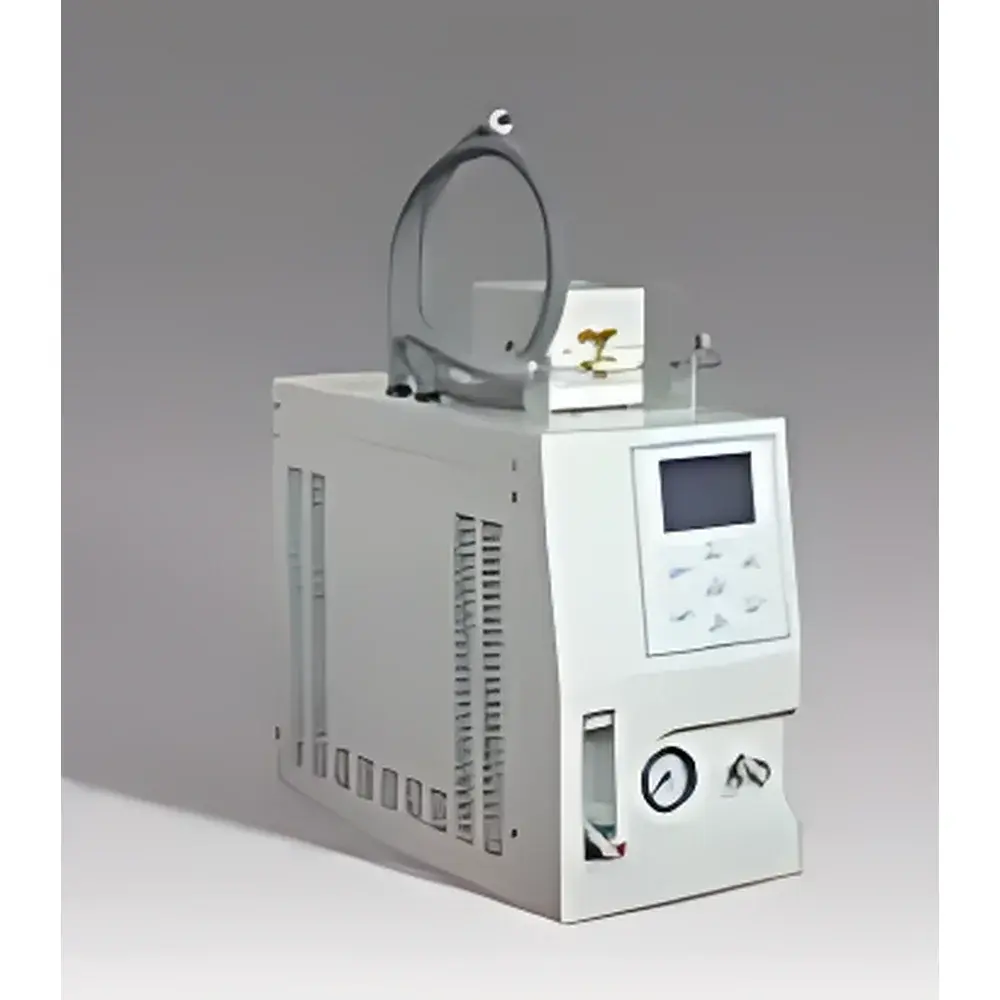
JX-3 Thermal Desorber
| Origin | Beijing, China |
|---|---|
| Manufacturer Type | Authorized Distributor |
| Origin Category | Domestic (China) |
| Model | JX-3 |
| Pricing | Available Upon Request |
| Desorption Temperature Range | Ambient to 380 °C |
| Valve Oven Temperature Range | Ambient to 150 °C |
| Transfer Line Temperature Range | Ambient to 150 °C |
| Calibration Simulation Time | 0–60 min |
| Desorption Heating Time | 0–60 min |
| Sample Injection Time | 0–10 min |
| Trap Tube Dimensions | Ø6 mm, Length >120 mm |
Overview
The JX-3 Thermal Desorber is a benchtop, microprocessor-controlled thermal desorption unit engineered for quantitative release and transfer of volatile and semi-volatile organic compounds (VOCs and SVOCs) from sorbent-packed tubes into gas chromatography (GC) or GC–mass spectrometry (GC–MS) systems. It operates on the principle of controlled thermal desorption—where analytes adsorbed onto solid-phase sorbents are thermally liberated under inert carrier gas flow, then focused cryogenically or via cold trap before injection onto the analytical column. Designed for compatibility with major GC platforms—including Agilent, Thermo Fisher, Shimadzu, and PerkinElmer—the JX-3 supports both single-stage and two-stage desorption workflows. Its architecture prioritizes minimal carryover, high transfer efficiency, and reproducible thermal profiles—critical for compliance-driven environmental, occupational hygiene, and indoor air quality (IAQ) testing.
Key Features
- Programmable temperature control across three independently heated zones: desorption furnace (ambient to 380 °C), valve oven (ambient to 150 °C), and transfer line (ambient to 150 °C), each with ±0.5 °C stability and real-time PID feedback.
- Integrated high-precision pressure-regulated gas delivery system featuring stainless-steel 316 diaphragm valves and ultra-stable pressure control (±0.01 bar), ensuring consistent carrier gas flow during desorption and focusing phases.
- Entire gas path constructed from electropolished, passivated 316 stainless steel tubing; all static seals utilize low-outgassing silicone elastomer; dynamic seals in heated zones employ high-temperature PTFE ferrules rated to 260 °C.
- Heated six-port switching valve housed within the same oven as the transfer line—eliminating unheated junctions and reducing cold spots that contribute to analyte condensation or breakthrough.
- Optimized tube-to-line interface geometry: proprietary tapered, zero-dead-volume fittings calculated for Ø6 mm sorbent tubes (>120 mm length), minimizing residence time and maximizing peak sharpness.
- Compact embedded control system based on industrial-grade 8-bit microcontroller with non-volatile parameter storage, USB interface for firmware updates, and front-panel keypad navigation with LCD status display.
Sample Compatibility & Compliance
The JX-3 accommodates standard ¼″ OD stainless steel or glass sorbent tubes packed with common media including Tenax TA, Carbopack B/C, Carboxen, and multi-bed configurations (e.g., Tenax/Carbotrap/Carboxen). It supports EPA Methods TO-17 and ISO 16017-1 for ambient and workplace air analysis, and is routinely validated for use in laboratories operating under GLP and ISO/IEC 17025 frameworks. While not inherently 21 CFR Part 11 compliant, its parameter logging capability (via optional RS-232 or USB data export) enables traceable method execution when integrated into validated laboratory information management systems (LIMS). All thermal and timing parameters are user-definable and auditable, supporting full method documentation per ASTM D6196 and EN 14662 requirements.
Software & Data Management
The JX-3 operates autonomously without proprietary PC software; all method parameters—including desorption ramp rates, hold times, valve actuation sequences, and cooling delays—are configured directly via the front panel. For integration into automated workflows, ASCII-formatted status logs (timestamped temperature, pressure, valve state, and elapsed time) can be exported at user-defined intervals via serial or USB interface. These logs are compatible with third-party data acquisition platforms (e.g., LabVIEW, MATLAB, or custom Python scripts) for synchronization with GC acquisition software. Optional firmware upgrades provide enhanced event-triggering logic—such as GC-ready signal output upon completion of desorption and valve switching—to enable seamless handshake with external instruments.
Applications
- Environmental monitoring: quantification of benzene, toluene, ethylbenzene, xylenes (BTEX), polycyclic aromatic hydrocarbons (PAHs), and chlorinated solvents in ambient, stack, and soil vapor samples.
- Occupational health and safety: assessment of worker exposure to VOCs in manufacturing, painting, printing, and semiconductor fabrication facilities per OSHA and NIOSH sampling protocols.
- Indoor air quality (IAQ) investigations: identification and quantification of formaldehyde, terpenes, plasticizers, and flame retardants in residential, commercial, and healthcare settings.
- Materials emissions testing: determination of volatile organic compound emissions from carpets, adhesives, composite wood products, and automotive interior components per ASTM D5116 and ISO 16000 series standards.
- Method development and validation: support for optimizing desorption conditions, evaluating sorbent performance, and establishing calibration curves using standard permeation tubes or dynamic spiking techniques.
FAQ
Does the JX-3 support cold trapping?
No—the JX-3 is a single-stage thermal desorber and does not include an integrated cryofocusing stage. It is designed for direct transfer to GC inlets equipped with split/splitless injectors or dedicated thermal desorption interfaces.
Can it be used with GC–MS systems?
Yes—provided the GC–MS inlet accepts standard ¼″ OD transfer lines and supports appropriate inlet temperatures (≥250 °C) for efficient volatilization of desorbed analytes.
What maintenance is required for long-term reliability?
Routine inspection of silicone and PTFE seals every 6 months; annual recalibration of temperature sensors using NIST-traceable reference thermocouples; periodic cleaning of stainless steel tubing with solvent flushes if analyzing heavily contaminated samples.
Is remote operation possible?
Remote configuration is not supported natively, but real-time status monitoring and parameter export are enabled via serial/USB communication using simple ASCII command sets documented in the technical manual.
How is method reproducibility ensured across multiple users?
All method parameters are stored in non-volatile memory and recalled by name; operator access to critical settings (e.g., maximum temperature limits) can be password-protected via firmware configuration.




