
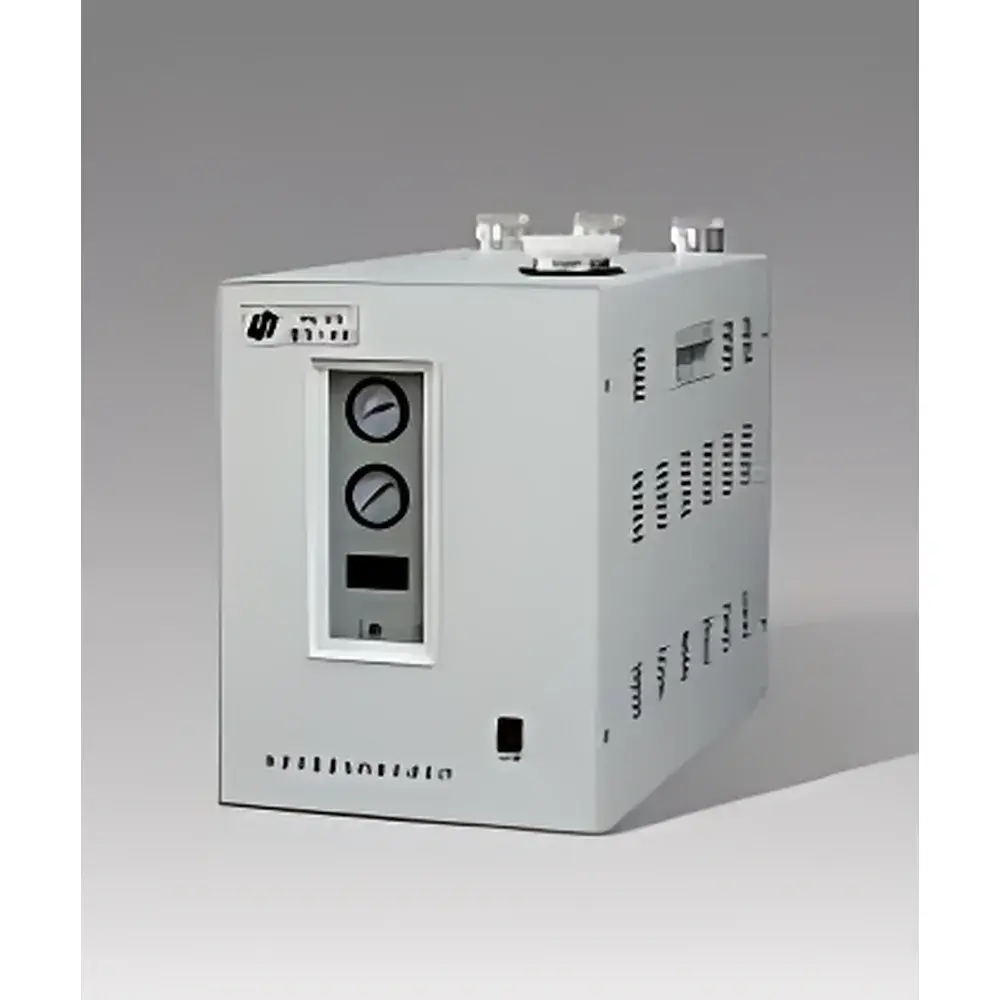
NA-500 Integrated Nitrogen & Zero-Air Generator
| Origin | Beijing, China |
|---|---|
| Manufacturer Type | Authorized Distributor |
| Origin Category | Domestic (PRC) |
| Model | NA-500 |
| Pricing | Available Upon Request |
| Nitrogen Purity | <3 ppm O₂, Dew Point −56 °C |
| Nitrogen Flow Rate | 0–500 mL/min |
| Nitrogen Output Pressure | 0.4 MPa |
| Zero-Air Flow Rate | 0–2000 mL/min |
| Zero-Air Output Pressure | 0.4 MPa |
| Power Consumption | 275 W |
| Dimensions (W×D×H) | 470 × 260 × 380 mm |
| Net Weight | ~28 kg |
Overview
The NA-500 Integrated Nitrogen & Zero-Air Generator is an engineered solution for laboratories requiring high-purity, on-demand nitrogen and instrument-grade zero-air—two critical carrier and detector gases for gas chromatography (GC), GC–MS, and elemental analyzers. Unlike cylinder-based supply systems, the NA-500 employs membrane separation for nitrogen generation and catalytic oxidation combined with desiccant drying for zero-air production. This dual-path architecture eliminates reliance on external gas cylinders, reducing logistical overhead, safety risks associated with high-pressure storage, and variability in gas quality across batches. The system delivers nitrogen with oxygen content below 3 ppm and a dew point of −56 °C—meeting ASTM D6304 and ISO 8573-1 Class 2.2.1 specifications for compressed gases used in analytical instrumentation. Simultaneously, the zero-air stream undergoes deep hydrocarbon removal (<0.1 ppm total HC), CO oxidation to CO₂, and subsequent CO₂ scrubbing, yielding air compliant with EPA Method TO-15 and ASTM D1946 requirements for trace-level volatile organic compound (VOC) analysis.
Key Features
- Integrated dual-gas architecture: simultaneous, independent control of nitrogen and zero-air streams via dedicated pressure-regulated outlets
- Stainless-steel internal gas reservoirs and triple-stage stainless-steel filtration (particulate, coalescing, and chemical adsorption) ensure long-term gas integrity and minimize downstream contamination
- Trace-oxygen scavenging module integrated into the nitrogen path, utilizing low-sulfur, sulfur-free catalyst formulations compatible with electron-capture (ECD), thermal conductivity (TCD), and flame ionization (FID) detectors
- Zero-air subsystem features precision catalytic converters, auto-draining condensate traps, and high-stability pressure regulation (±0.01 MPa) to maintain consistent flow during GC oven ramping or detector switching
- Full automation with microprocessor-based control: real-time monitoring of inlet pressure, outlet flow, dew point, and filter saturation status; automatic shutdown on overpressure, overheating, or low coolant level
- Silicone-free, low-sulfur elastomeric seals throughout the gas path—validated per USP for extractables profiling—to prevent sulfur-induced baseline drift or detector poisoning
Sample Compatibility & Compliance
The NA-500 is designed for universal compatibility with all major GC platforms—including Agilent, Thermo Fisher, Shimadzu, PerkinElmer, and Waters—regardless of detector configuration (FID, TCD, ECD, NPD, FPD, or mass spectrometric interfaces). Its output specifications align with ICH Q2(R2) guidance on system suitability for chromatographic methods and support GLP/GMP-compliant environments when paired with audit-trail-enabled data loggers. The generator meets CE marking requirements under Directive 2014/30/EU (EMC) and 2014/35/EU (LVD), and its gas purity profile satisfies ISO/IEC 17025 clause 5.9.1 for calibration gas traceability when used with certified reference materials. No external purge or conditioning is required prior to operation; system stabilization time to specification is ≤15 minutes after power-on.
Software & Data Management
While the NA-500 operates as a standalone hardware unit without embedded touchscreen or cloud connectivity, it includes analog 0–10 VDC and digital RS-232 outputs for integration into laboratory building management systems (BMS) or centralized gas monitoring networks. Optional data acquisition modules enable continuous logging of operational parameters—including flow rate, pressure, temperature, and runtime hours—into CSV or SQL-compatible databases. All logged data supports 21 CFR Part 11 compliance when deployed with validated third-party software featuring electronic signatures, role-based access control, and immutable audit trails. Maintenance alerts are triggered based on cumulative runtime thresholds (e.g., filter replacement at 6,000 hours), ensuring adherence to manufacturer-recommended service intervals.
Applications
- Carrier gas supply for capillary GC and GC–MS systems requiring ultra-low oxygen and moisture
- Make-up gas and detector air source for FID, NPD, and FPD detectors demanding hydrocarbon-free, CO₂-free air
- Calibration gas dilution systems in environmental labs performing EPA Method 8260/8270 analyses
- Support gas for headspace samplers, purge-and-trap concentrators, and automated thermal desorbers
- Standby or backup gas source in pharmaceutical QC labs operating under Annex 1 and FDA Process Validation guidelines
FAQ
Does the NA-500 require external cooling or ventilation?
No—its convection-cooled design operates continuously at ambient temperatures up to 35 °C with ≥10 cm rear clearance for airflow.
Can the nitrogen and zero-air outputs be used simultaneously at maximum flow?
Yes—the system’s dual independent compressors and thermal management allow concurrent full-load operation without cross-contamination or pressure drop.
What maintenance is required, and how often?
Primary maintenance includes annual replacement of the oxygen scavenger cartridge and desiccant bed, plus biannual inspection of coalescing filters—no user-serviceable valves or pumps are present.
Is the NA-500 suitable for use in explosion-proof environments?
It is not intrinsically safe-rated; installation requires compliance with NEC Class I, Division 2 or ATEX Zone 2 guidelines, including proper grounding and isolation from flammable vapor zones.
How is gas purity verified during routine operation?
Integrated electrochemical O₂ and dew point sensors provide continuous readouts; optional external verification via calibrated trace oxygen analyzers (e.g., Michell Easidew) is recommended quarterly per ISO/IEC 17025 internal audit protocols.



