
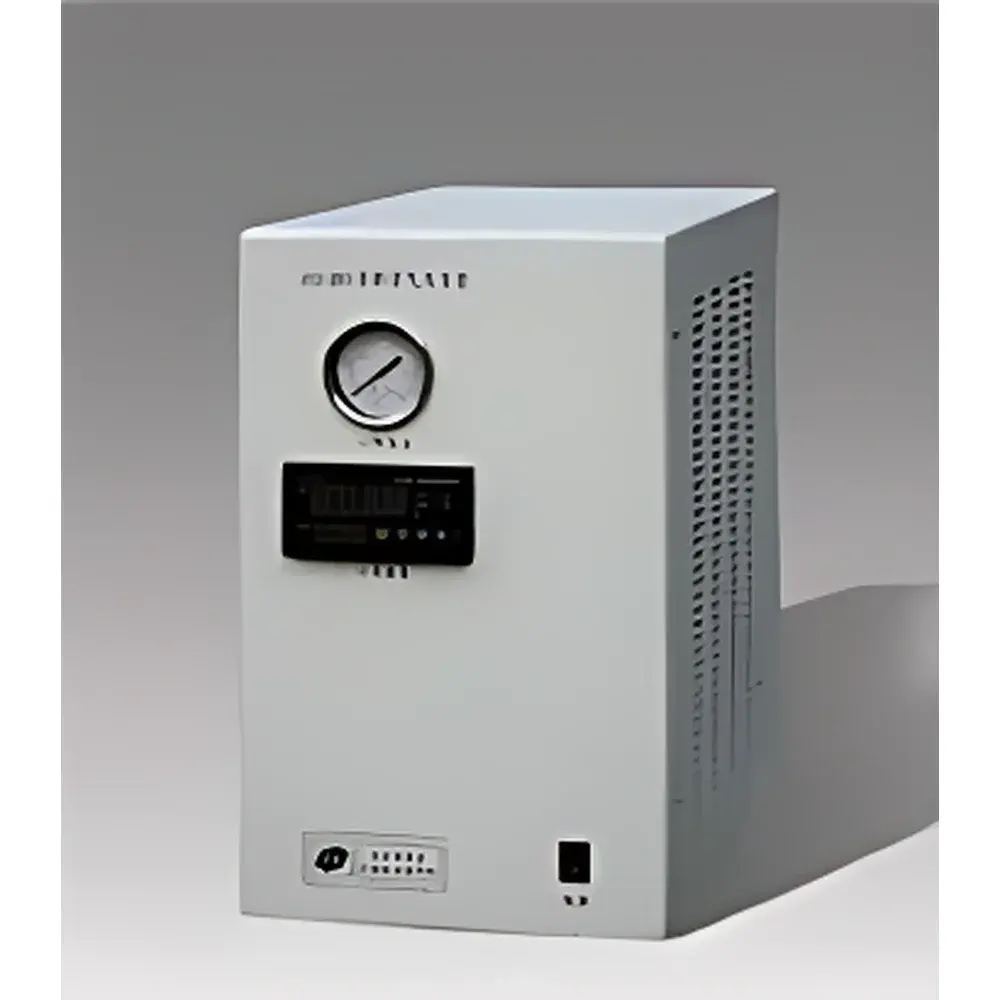
ZA-1000 Zero-Air Generator with Hydrocarbon Removal
| Origin | Beijing, China |
|---|---|
| Manufacturer Type | Authorized Distributor |
| Origin Category | Domestic (China) |
| Model | ZA-1000 |
| Price | Upon Request |
| Output Hydrocarbon (as CH₄) | <0.1 ppm |
| Max. Input Hydrocarbon (as CH₄) | <100 ppm |
| Max. Input Pressure | 0–0.6 MPa |
| Max. Output Flow Rate | 1000 mL/min |
| Power Supply | 220 V ±10%, 50–60 Hz |
| Power Consumption | 200 W |
| Catalyst Operating Temperature | 450–500 °C (factory-set at 450 °C) |
| Ambient Operating Temperature | 0–40 °C |
| Ambient Relative Humidity | <85 % RH |
| Dimensions (W×D×H) | 400 × 360 × 220 mm |
| Net Weight | ~12 kg |
Overview
The ZA-1000 Zero-Air Generator with Hydrocarbon Removal is a catalytic purification system engineered to produce ultra-low-hydrocarbon air—commonly referred to as “zero air”—for high-sensitivity analytical instrumentation. It operates on the principle of high-temperature catalytic oxidation, wherein total hydrocarbons (THC), including methane and other volatile organic compounds, are quantitatively converted into carbon dioxide and water vapor over a platinum-palladium (Pt-Pd) supported catalyst bed maintained at 450–500 °C. This process ensures consistent delivery of purified air with residual hydrocarbon concentration below 0.1 ppm (as methane), meeting stringent requirements for gas chromatography (GC) detector make-up gas, flame ionization detector (FID) fuel/air supply, ambient air monitoring calibration, and trace-level environmental analysis. Unlike membrane-based or activated carbon-only systems, the ZA-1000 achieves stable, long-term hydrocarbon removal through thermally robust heterogeneous catalysis—eliminating breakthrough risk under variable inlet conditions up to 100 ppm THC and 0.6 MPa input pressure.
Key Features
- High-efficiency Pt-Pd catalyst system operating at precisely controlled 450 °C (factory preset), enabling complete oxidation of C₁–C₆ hydrocarbons without requiring periodic replacement under normal use
- Stable output flow up to 1000 mL/min at regulated pressure, compatible with dual-FID configurations and multi-instrument air distribution networks
- Low-sulfur silicone O-rings throughout the gas path minimize sulfur-containing contaminants that could compromise GC baseline stability or poison sensitive detectors
- Integrated thermal management with overtemperature protection and real-time heater status indication ensures operational safety and compliance with IEC 61010-1 for laboratory electrical equipment
- Compact benchtop footprint (400 × 360 × 220 mm) and lightweight design (~12 kg) facilitate integration into crowded instrument rooms or mobile analytical labs
- Universal AC input (220 V ±10%, 50–60 Hz) with low power draw (200 W), minimizing facility load and heat dissipation concerns
Sample Compatibility & Compliance
The ZA-1000 accepts standard compressed air sources—including oil-free compressors, nitrogen-air blends, or bottled air—as feed gas. It is compatible with inlet hydrocarbon concentrations up to 100 ppm (as CH₄) and pressures up to 0.6 MPa, making it suitable for integration downstream of industrial-grade air preparation systems. The unit meets essential performance criteria referenced in ASTM D1941 (Standard Test Method for Total Hydrocarbons in Ambient Air), EPA Method TO-15 (Determination of Volatile Organic Compounds in Air), and ISO 8573-1:2010 Class 1 particulate/oil/water purity requirements when paired with appropriate pre-filtration. While not certified to UL/CSA standards out-of-box, its electrical architecture conforms to GLP-aligned lab infrastructure expectations and supports audit-ready operation in regulated environments where documented air purity is required (e.g., ISO/IEC 17025-accredited testing laboratories).
Software & Data Management
The ZA-1000 is a standalone hardware system with no embedded microprocessor, touchscreen, or digital interface. Its operational parameters—including heater setpoint, status indicators, and power-on self-test—are managed via front-panel mechanical controls and LED status lights. This analog architecture eliminates firmware vulnerabilities, reduces electromagnetic interference (EMI) risks near sensitive detectors, and ensures deterministic behavior across extended deployments. For laboratories requiring electronic logging, optional external data acquisition modules (e.g., 4–20 mA temperature output adapters or relay-based run-time counters) can be integrated via third-party DAQ systems compliant with FDA 21 CFR Part 11 when used in GxP workflows. Maintenance records—including catalyst service intervals, inlet filter replacements, and calibration verifications—should be retained per internal SOPs aligned with ISO/IEC 17025 clause 7.6.
Applications
- Flame Ionization Detector (FID) fuel and make-up gas supply in GC and GC-MS systems
- Calibration gas generation for ambient air quality analyzers (e.g., ozone monitors, NOₓ chemiluminescence detectors)
- Baseline stabilization in trace-level VOC analysis using thermal desorption–GC–MS
- Carrier gas purification in purge-and-trap systems where hydrocarbon contamination must remain below detection limits
- Reference air source for sensor validation, chamber purging, and cleanroom environmental monitoring
- Support gas for FTIR spectroscopy and cavity ring-down spectroscopy (CRDS) platforms requiring ultra-low-background air
FAQ
What hydrocarbon species does the ZA-1000 remove?
It catalytically oxidizes total hydrocarbons—including methane, ethane, propane, benzene, and other VOCs—into CO₂ and H₂O. Performance is validated against methane; equivalent removal efficiency applies to C₁–C₆ aliphatics and aromatics under specified operating conditions.
Is the catalyst replaceable, and what is its expected lifetime?
Yes—the catalyst cartridge is field-replaceable. Under continuous operation with inlet air ≤10 ppm THC and proper upstream filtration (coalescing + activated carbon), typical service life exceeds 12 months. Lifetime decreases proportionally with elevated inlet hydrocarbon loading or moisture exposure.
Can the ZA-1000 be used with nitrogen or synthetic air as input?
Yes. It accepts any dry, particle-free compressed gas stream containing oxygen. For nitrogen-rich feeds, supplemental O₂ (≥5% v/v) must be introduced upstream to sustain catalytic oxidation kinetics.
Does it require periodic calibration?
No routine calibration is needed. However, users should verify outlet hydrocarbon concentration annually—or after catalyst replacement—using a certified FID or photoionization detector (PID) per internal QA procedures.
What maintenance is required?
Routine inspection of inlet particulate filters (recommended every 3 months), verification of O-ring integrity, and annual catalyst performance validation constitute the core maintenance protocol. No software updates or firmware patches apply.
Related Products



