
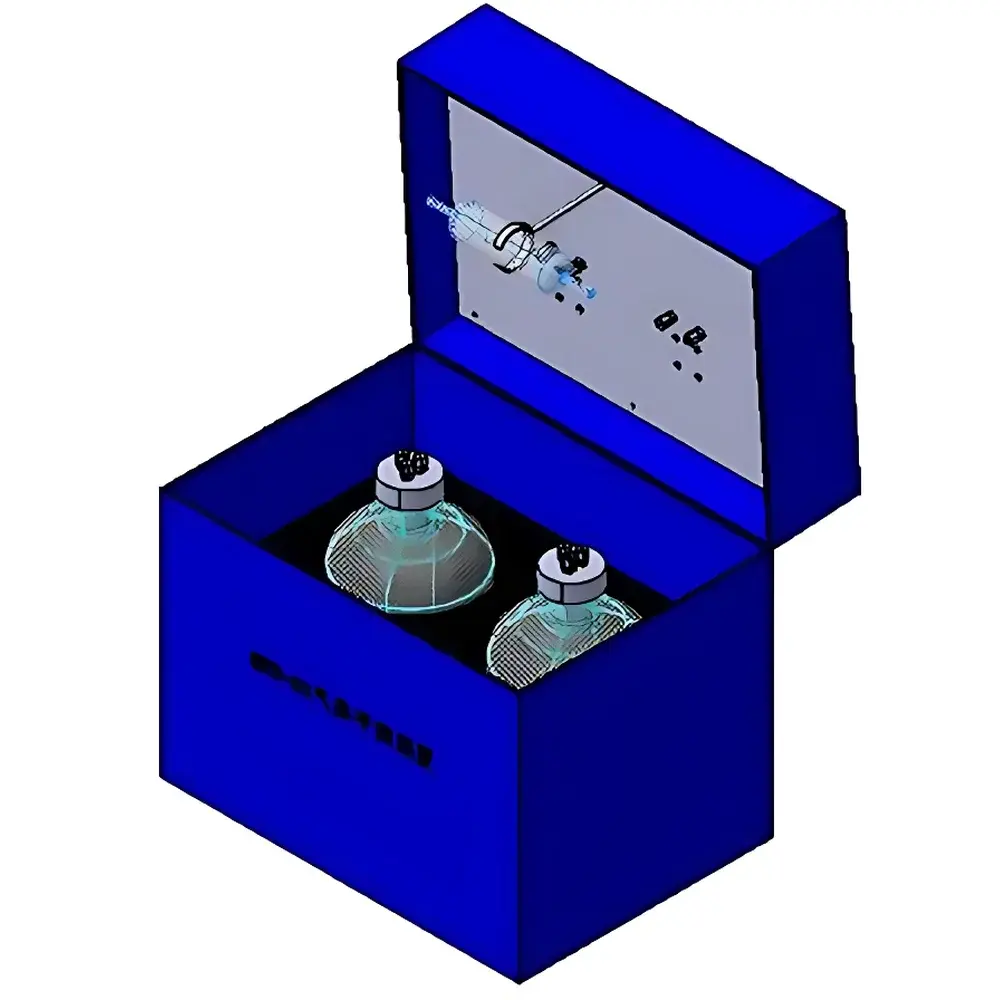
LUDAHY QPH-01 Gas-Liquid Equilibration Apparatus
| Brand | LUDAHY |
|---|---|
| Origin | Beijing, China |
| Manufacturer Type | Authorized Distributor |
| Country of Origin | China |
| Model | QPH-01 |
| Pricing | Available Upon Request |
Overview
The LUDAHY QPH-01 Gas-Liquid Equilibration Apparatus is a precision-engineered laboratory system designed for controlled equilibration of seawater (or other aqueous solutions) with defined gas phases—typically ambient air, synthetic air, or custom gas mixtures—to establish thermodynamic equilibrium of dissolved gases and volatile solutes. Based on the principle of dynamic headspace equilibration, the apparatus facilitates reproducible partitioning of gaseous species (e.g., O₂, CO₂, N₂, CH₄, dimethyl sulfide) between the liquid and vapor phases under regulated temperature, pressure, and agitation conditions. This equilibrium state is essential for accurate quantification of dissolved gas concentrations via subsequent analysis using gas chromatography (GC), cavity ring-down spectroscopy (CRDS), or membrane inlet mass spectrometry (MIMS). The QPH-01 is not a standalone analytical instrument but a critical sample preparation module within marine biogeochemistry, ocean acidification research, and environmental trace gas monitoring workflows.
Key Features
- Modular stainless-steel and borosilicate glass construction ensures chemical inertness and long-term stability during repeated exposure to saline matrices and humid gas streams.
- Temperature-controlled water bath integration (±0.1 °C stability) enables precise regulation of equilibration temperature—critical for Henry’s law constant applicability and minimizing kinetic artifacts.
- Adjustable gas flow rate (0.5–5 L/min) with digital mass flow controllers supports both steady-state and dynamic equilibration protocols per ASTM D3693 and ISO 15681-2 guidelines.
- Dual-port gas inlet/outlet configuration allows for closed-loop recirculation or open-flow purging modes, accommodating both equilibrium and purge-and-trap sampling strategies.
- Integrated pressure relief valve and calibrated pressure gauge (0–200 kPa) ensure safe operation under slight overpressure conditions while maintaining atmospheric reference integrity.
- Sealed, leak-tested equilibration chamber (1–5 L volume range) minimizes cross-contamination and enables replicate equilibrations without system reconditioning.
Sample Compatibility & Compliance
The QPH-01 accommodates seawater samples across salinity ranges of 0–40 psu and pH 6.5–8.5, including filtered (0.2 µm) and unfiltered suspensions. It is compatible with standard 1-L and 2-L Schott bottles, as well as custom gas-tight sampling vessels equipped with septum-sealed septa. All wetted materials comply with USP Class VI biocompatibility standards and are certified non-leaching for trace-metal clean protocols (e.g., GEOTRACES intercalibration requirements). The apparatus supports GLP-compliant documentation when operated with validated SOPs and integrated electronic logbooks. While not FDA-cleared, its design aligns with principles outlined in EPA Method 502.2 (Volatile Organic Compounds in Water) and ISO/IEC 17025–2017 for method validation of equilibration-based sampling systems.
Software & Data Management
The QPH-01 operates as a hardware platform requiring external process control and data acquisition. Optional integration with LabVIEW™ or Python-based control scripts enables automated logging of temperature, gas flow, pressure, and equilibration duration. All operational parameters are timestamped and exportable in CSV or HDF5 format for audit trails. When paired with compliant chromatographic or spectroscopic analyzers, the full workflow—including equilibration time, temperature setpoint, and gas composition—can be embedded into LIMS metadata fields to satisfy 21 CFR Part 11 requirements for electronic records and signatures, provided appropriate user access controls and audit trail configurations are implemented at the system level.
Applications
- Quantitative determination of dissolved O₂ and CO₂ partial pressures (pO₂, pCO₂) in coastal and open-ocean surveys.
- Calibration of optode and electrochemical sensors against gravimetrically prepared gas-saturated standards.
- Stable isotope ratio analysis (δ¹³C-CO₂, δ¹⁸O-O₂) where isotopic fractionation during equilibration must be minimized and characterized.
- Investigation of air–sea gas exchange kinetics under controlled turbulence and bubble injection regimes.
- Pre-concentration of low-abundance volatile organic compounds (VOCs) from large-volume seawater samples prior to GC-MS detection.
- Method development for standardized interlaboratory comparisons under GO-SHIP or SOCCOM protocols.
FAQ
What gas flow rates are recommended for seawater equilibration?
Typical flow rates range from 1.0 to 2.5 L/min for 2-L samples at 20 °C; optimal flow is determined empirically based on target analyte volatility and required equilibration time.
Can the QPH-01 be used with corrosive gas mixtures (e.g., H₂S or Cl₂)?
No—standard configuration uses EPDM and silicone elastomers unsuitable for strong oxidizers or acidic gases; custom fluoropolymer seals and Hastelloy components are available upon engineering review.
Is temperature calibration traceable to NIST standards?
Yes—the integrated Pt100 sensor is supplied with a factory calibration certificate traceable to NIST SRM 1750; field recalibration using certified reference thermometers is supported.
Does the system include validation documentation for ISO 17025 accreditation?
The QPH-01 is supplied with a Factory Acceptance Test (FAT) report; users must perform Installation Qualification (IQ), Operational Qualification (OQ), and Performance Qualification (PQ) per their internal quality management system.
Related Products







