
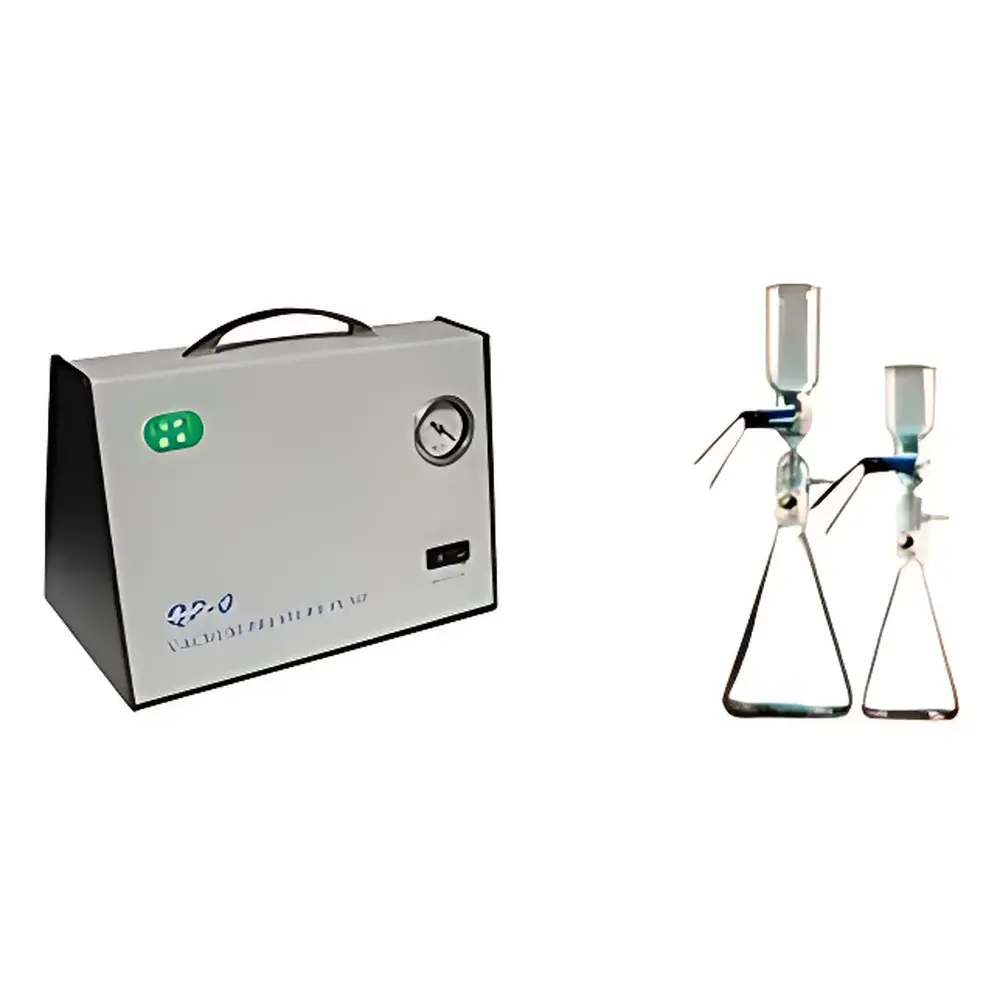
Solvent Filter System QL-01
| Origin | Tianjin, China |
|---|---|
| Manufacturer Type | Distributor |
| Origin Category | Domestic |
| Model | QL-01 |
| Pricing | Upon Request |
| Vacuum Pump Model | QP-01 |
| Filtration Bottle Options | FB-10T (1000 mL), FB-20T (2000 mL) |
| Filter Cup Capacities | 300 mL, 500 mL |
| Filter Flask Volumes | 1000 mL, 2000 mL |
| Fritted Disc Material | Borosilicate Glass |
| Frit Pore Size | Standard Grade (40–60 µm) |
| Clamp Material | Anodized Aluminum |
| Operating Temperature Range | –20 °C to +250 °C |
| Pressure Rating | ≤ –0.098 MPa (absolute) |
Overview
The Solvent Filter System QL-01 is a modular, vacuum-assisted laboratory filtration platform engineered for reliable solvent clarification, sample pre-treatment, and particulate removal in analytical and preparative workflows. It operates on the principle of pressure-driven vacuum filtration, where a negative pressure differential—generated by the integrated QP-01 oil-free diaphragm vacuum pump—draws liquid through a sintered glass frit (typically 40–60 µm pore size) housed within a borosilicate glass filtration assembly. This system is routinely deployed upstream of HPLC, GC, ICP-MS, and gravimetric fat extraction procedures (e.g., Soxhlet or Goldfish methods) to eliminate suspended particles, precipitates, or undissolved residues that could compromise column integrity, detector response, or quantitative accuracy. Its design adheres to standard laboratory ergonomics and compatibility protocols, enabling seamless integration with common receiver flasks, adapters, and vacuum manifolds across global instrumentation ecosystems.
Key Features
- Borosilicate glass construction (Class A equivalent) with thermal shock resistance up to 270 °C, ensuring stability during hot-solvent filtration or steam sterilization cycles.
- Precision-molded, uniform-wall filtration bottles (FB-10T and FB-20T) conforming to ISO 3585 and ASTM E438 Type I, Class A dimensional tolerances—enabling interchangeability with major international brands including Schott Duran®, Kimax®, and Pyrex®.
- QP-01 oil-free vacuum pump delivering stable ultimate vacuum ≤ –0.098 MPa (≤ 20 mbar abs), continuous duty cycle operation, and acoustic noise level < 52 dB(A) at 1 m—minimizing lab ambient interference and eliminating hydrocarbon contamination risk.
- Modular configuration: Interchangeable 300 mL and 500 mL filter cups mate with either 1000 mL or 2000 mL triangular collection flasks via standardized ground-glass joints (ISO 29771, 24/29 or 29/32 taper).
- Anodized aluminum clamping mechanism provides consistent, non-marring mechanical retention without deformation under sustained vacuum load.
- Sintered glass frits manufactured to ISO 4793 specifications for reproducible flow rates and particle retention efficiency; compatible with aggressive organic solvents (e.g., chloroform, acetone, THF) and aqueous bases/acids (pH 1–13).
Sample Compatibility & Compliance
The QL-01 system accommodates a broad range of sample matrices, including organic solvent extracts (e.g., petroleum ether, hexane, ethyl acetate), aqueous digestates, polymer solutions, and biological tissue homogenates. Its borosilicate components comply with USP , ISO 3585, and DIN 12331 for laboratory glassware. While not certified as GMP-compliant out-of-the-box, the system supports GLP-aligned documentation when used with traceable calibration records, maintenance logs, and validated cleaning SOPs. All wetted parts are autoclavable (121 °C, 20 min), supporting reuse in regulated environments where material accountability is required.
Software & Data Management
The QL-01 is a manually operated, hardware-only system with no embedded electronics or digital interface. As such, it does not require firmware, drivers, or software licensing. Process parameters—including vacuum level, filtration duration, and volume processed—are recorded manually or integrated into LIMS via external pressure transducers or balance interfaces (e.g., Mettler Toledo XS series with RS232/USB output). For audit readiness, users may document operational conditions per FDA 21 CFR Part 11 guidelines using electronic lab notebooks (ELNs) with electronic signatures and version-controlled SOP attachments.
Applications
- Pre-filtration of mobile phases and standards prior to HPLC/UHPLC injection to prevent column clogging and backpressure spikes.
- Clarification of lipid extracts in AOAC 991.36 and ISO 1444–1 compliant fat analysis workflows.
- Removal of catalyst residues or silica gel fines following solid-phase extraction (SPE) or column chromatography.
- Particulate control in environmental water analysis (EPA Method 1664, 525.3) and pharmaceutical dissolution testing (USP ).
- Routine preparation of particle-free solvents for spectroscopic blanking, Karl Fischer titration, and viscometry.
FAQ
Is the QL-01 system suitable for filtering corrosive acids such as concentrated HNO₃ or HF?
No—while borosilicate glass resists most mineral acids, hydrofluoric acid (HF) etches glass and must be filtered using fluoropolymer-based systems (e.g., PTFE frits and PVDF housings).
Can the FB-20T bottle be used with a 300 mL filter cup?
Yes—the ground-glass joint dimensions are standardized; however, optimal filtration efficiency is achieved when cup volume is matched to expected filtrate volume to minimize splashing and foaming.
Does the QP-01 pump require periodic oil changes?
No—it is an oil-free diaphragm pump; maintenance is limited to checking inlet filters and replacing diaphragms per manufacturer-recommended service intervals (typically every 10,000 operating hours).
Are replacement fritted discs available in alternative pore sizes?
Yes—standard replacements include 10–15 µm (fine), 40–60 µm (medium), and 100–160 µm (coarse) grades, all compliant with ISO 4793 and supplied with certificate of conformance.
Can this system be validated for use in a GMP environment?
Yes—though the base unit lacks built-in data logging, full IQ/OQ/PQ validation packages can be developed around its mechanical performance, material certifications, and procedural controls when integrated into a documented quality system.



