
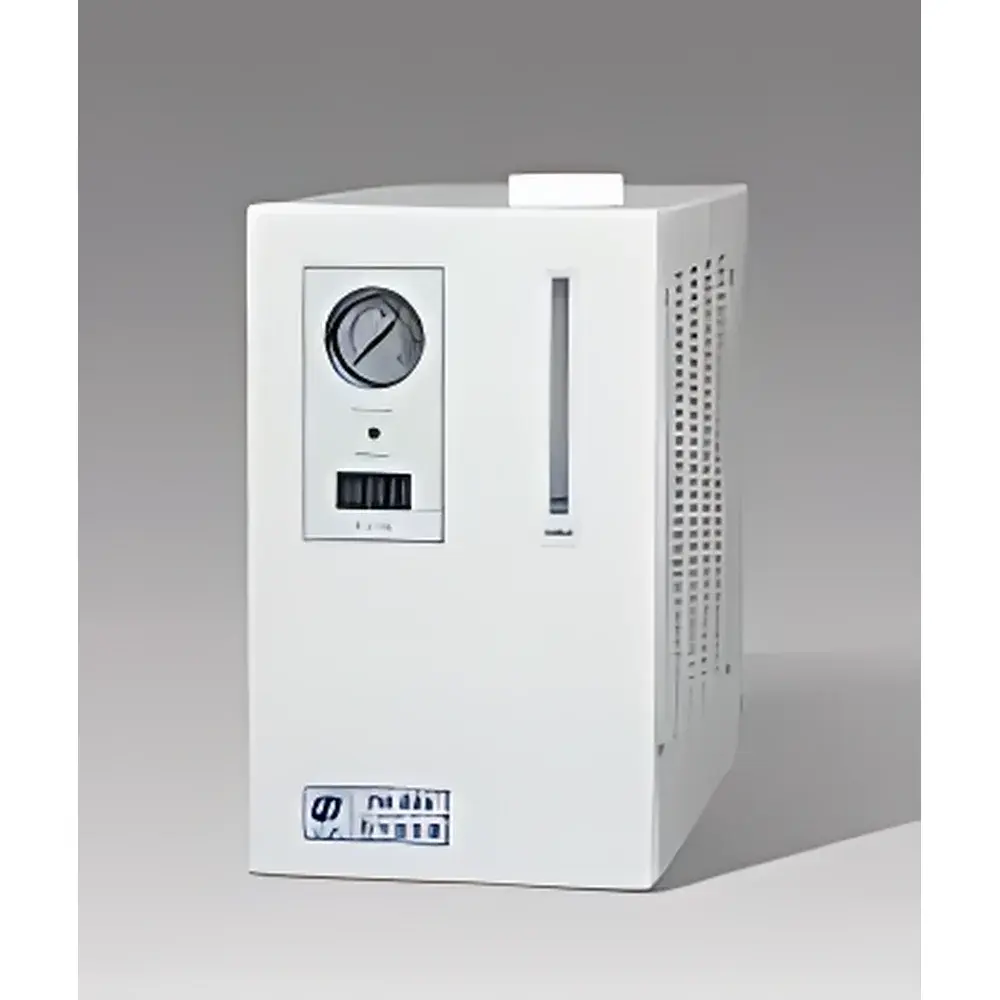
TH-500 Pure-Water-Based High-Purity Hydrogen Generator
| Origin | Beijing, China |
|---|---|
| Manufacturer Type | Authorized Distributor |
| Origin Category | Domestic (PRC) |
| Model | TH-500 |
| Pricing | Available Upon Request |
| Hydrogen Purity | 99.999% |
| Flow Rate | 0–500 mL/min |
| Output Pressure | 0–0.4 MPa |
| Pressure Stability | < 0.001 MPa |
| Power Supply | 220 V ±10%, 50 Hz |
| Power Consumption | 200 W |
| Dimensions (W×D×H) | 400 × 360 × 220 mm |
| Net Weight | ~14 kg |
| Electrolyte Technology | Solid Polymer Electrolyte (SPE) |
| Water Feed | Deionized (DI) water only |
| Sealing Material | Low-sulfur silicone elastomer gaskets |
| Control System | Integrated pressure & flow regulation with auto-water-level shutdown |
Overview
The TH-500 Pure-Water-Based High-Purity Hydrogen Generator is an engineered solution for laboratories requiring continuous, on-demand hydrogen supply at ultra-high purity (≥99.999%) for analytical instrumentation—particularly gas chromatography (GC) and GC–MS systems. Unlike traditional alkaline electrolysis generators, the TH-500 employs solid polymer electrolyte (SPE) membrane technology, enabling direct electrolysis of deionized (DI) water without caustic KOH or NaOH solutions. This eliminates alkali carryover, corrosion risks, and baseline drift in sensitive detectors—critical for reproducible retention time alignment, peak symmetry, and long-term column integrity. The system operates under precisely regulated pressure (0–0.4 MPa) and flow (0–500 mL/min), delivering stable output with pressure fluctuations held below ±0.001 MPa—ensuring consistent carrier gas velocity across temperature-programmed GC methods per ISO 17025 and ASTM D3612 compliance frameworks.
Key Features
- SPE-based electrolysis cell using imported proton exchange membrane (PEM), optimized for low overpotential operation and extended service life (>8,000 hours typical)
- Zero-alkali design: Eliminates liquid electrolyte handling, reducing maintenance frequency and operator exposure risk per OSHA 29 CFR 1910 standards
- Low-sulfur silicone sealing system: Minimizes sulfur-containing volatile impurities (<0.1 ppb S-equivalent), preserving detector sensitivity and preventing irreversible poisoning of Ni–methanizer or Pulsed Discharge Detectors (PDD)
- Integrated dual-parameter control: Microprocessor-driven feedback loop simultaneously regulates both output pressure and mass flow rate, maintaining setpoint stability across ambient temperature shifts (15–30 °C operating range)
- Intelligent water management: Conductivity-based level sensing triggers automatic shutdown when DI water reservoir falls below operational threshold, protecting the PEM stack from dry-out and thermal degradation
- Compact footprint (400 × 360 × 220 mm) and lightweight construction (~14 kg) enable seamless integration into crowded GC benches or mobile lab carts
Sample Compatibility & Compliance
The TH-500 is compatible with all major GC platforms—including Agilent 7890/8890, Thermo Scientific TRACE 1300/1600, Shimadzu GC-2030, PerkinElmer Clarus series, and Bruker Scion models—regardless of split/splitless injector configuration or detector type (FID, TCD, ECD, NPD, FPD). Its hydrogen output meets ASTM D6299 requirements for GC carrier gas purity and aligns with USP and EP 2.2.47 specifications for residual moisture and total hydrocarbon content (<0.1 ppm). All internal wetted materials comply with FDA 21 CFR Part 11 traceability guidelines when paired with validated data logging software; the generator itself supports GLP/GMP audit trails via optional RS-232/USB interface.
Software & Data Management
While the TH-500 operates as a standalone unit with front-panel LED indicators for pressure, flow, water level, and fault status, it supports optional PC-based monitoring via ASCII protocol over RS-232 or USB virtual COM port. Logged parameters include real-time flow (mL/min), outlet pressure (MPa), cell voltage (V), coolant temperature (°C), and cumulative runtime (hours). Data export is compatible with CSV format for integration into LIMS environments (e.g., LabWare, STARLIMS) and satisfies ALCOA+ principles for attributable, legible, contemporaneous, original, accurate, complete, consistent, enduring, and available records.
Applications
- Carrier gas for capillary GC analysis of volatile organic compounds (VOCs), residual solvents (ICH Q3C), and environmental pollutants (EPA Method 8260)
- Fuel gas for flame ionization detectors (FID), ensuring optimal H2:air stoichiometry and minimizing carbon deposition on jet nozzles
- Reagent gas in hydride generation atomic absorption spectroscopy (HG-AAS) for As, Se, Sb, Bi, Te, and Pb
- Hydrogenation support gas in catalytic microreactor studies and online reaction monitoring setups
- Calibration gas source for hydrogen sensors and leak detection systems requiring certified reference-grade output
FAQ
What type of water must be used with the TH-500?
Deionized (DI) water with resistivity ≥15 MΩ·cm and total organic carbon (TOC) < 50 ppb is required. Tap water, distilled water, or RO-only water will cause premature membrane fouling and invalidates warranty.
Does the TH-500 require periodic electrolyte replacement?
No. The SPE membrane is a solid-state, maintenance-free component. Only DI water replenishment is needed—no KOH refills, no pH adjustment, and no membrane cleaning protocols.
Can the TH-500 be used with GC systems requiring >0.4 MPa inlet pressure?
No. Maximum rated output is 0.4 MPa (≈58 psi). For high-pressure GC applications (e.g., some supercritical fluid chromatography interfaces), an external pressure booster is required and must be validated separately for gas purity retention.
How often should the water reservoir be refilled during continuous operation?
At 500 mL/min flow and full load, the standard 2.5 L reservoir lasts approximately 8–9 hours. Refill frequency depends on actual flow setting and duty cycle; low-flow applications (48 hours.
Is the TH-500 compliant with CE or UL safety standards?
Yes. The unit carries CE marking per EN 61010-1:2010 (Safety Requirements for Electrical Equipment for Measurement, Control, and Laboratory Use) and conforms to EMC Directive 2014/30/EU. UL certification is pending; current design meets UL 61010-1 structural and insulation requirements.



