
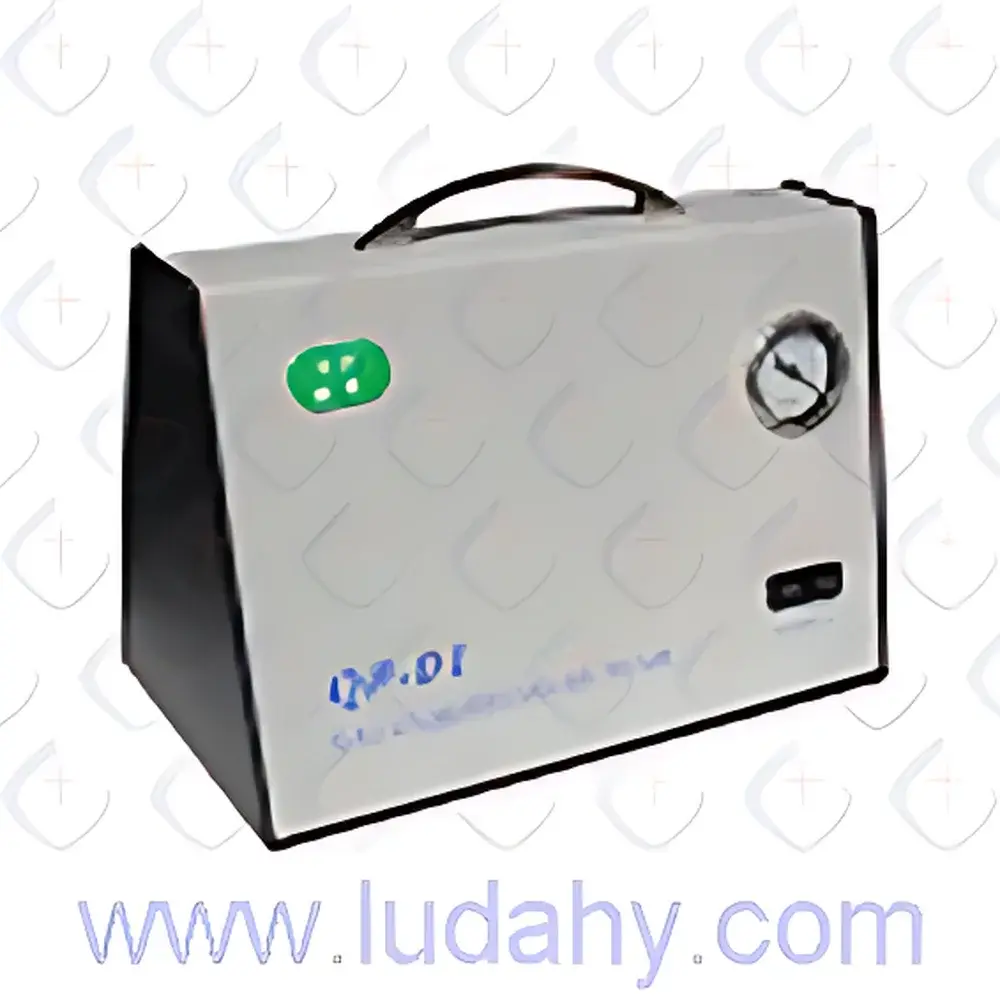
QP-01 Oil-Free Vacuum Pump
| Origin | Tianjin, China |
|---|---|
| Manufacturer Type | Distributor |
| Product Origin | Domestic (China) |
| Model | QP-01 |
| Price Range | USD 70–280 |
| Instrument Category | Other Vacuum Pumps |
| Pump Type | Oil-Free Diaphragm Vacuum Pump |
Overview
The QP-01 Oil-Free Vacuum Pump is a compact, maintenance-free diaphragm-based vacuum source engineered for routine laboratory applications requiring clean, hydrocarbon-free vacuum generation. Unlike oil-lubricated rotary vane pumps, the QP-01 employs an elastomeric diaphragm actuated by an eccentric cam mechanism to displace gas volume—eliminating the risk of oil backstreaming, vapor contamination, or periodic oil replacement. Its operation relies on positive displacement principles with non-contacting moving parts, ensuring consistent performance across variable inlet pressures (typically 100–10 mbar range) and enabling stable base pressures down to approximately 5–10 mbar (absolute), depending on ambient conditions and system conductance. Designed for benchtop integration, the pump delivers reliable vacuum for filtration, solvent evaporation, vacuum drying, and sample preparation workflows where chemical compatibility and operator safety are prioritized over ultra-high vacuum capability.
Key Features
- Oil-free operation ensures zero hydrocarbon emission—critical for GC sample introduction, mass spectrometry auxiliary pumping, and analytical chemistry workflows sensitive to organic residue.
- Low-noise design (<62 dB(A) at 1 m distance) supports use in shared lab environments without acoustic shielding or dedicated mechanical rooms.
- Compact footprint (approx. 220 × 120 × 180 mm) and lightweight construction (<4.5 kg) facilitate portability between fume hoods, gloveboxes, and modular workstations.
- Thermally protected AC motor (220 V / 50 Hz) with integrated thermal cutoff prevents coil overheating during extended duty cycles or partial flow restriction.
- Chemically resistant PTFE-coated diaphragm and EPDM valves provide compatibility with mild acids, alcohols, acetone, and aqueous solutions—enabling safe use with common lab solvents.
- No scheduled lubrication or oil changes required; service intervals are limited to diaphragm replacement every 5,000–8,000 operating hours under typical load conditions.
Sample Compatibility & Compliance
The QP-01 is suitable for non-corrosive, non-particulate, and non-condensable gas streams. It is not rated for continuous pumping of high-vapor-pressure solvents (e.g., ether, chloroform) without cold traps, nor for abrasive particulates or aggressive halogenated compounds (e.g., chlorine, bromine vapors). While not certified to ISO 8573-1 Class 0 for compressed air purity, its oil-free architecture inherently meets Class 1 particulate and Class 0 oil aerosol requirements per ISO 8573-1:2010 for vacuum-side output. The unit complies with GB/T 19001–2016 (equivalent to ISO 9001:2015) quality management standards as implemented by its domestic manufacturer. Electrical safety conforms to GB 4793.1–2019 (IEC 61010-1:2010), including dielectric strength, creepage, and clearance requirements for laboratory equipment.
Software & Data Management
The QP-01 operates as a standalone analog device with no embedded microcontroller, firmware, or digital interface. It features a single-pole single-throw (SPST) power switch and optional analog vacuum gauge connection (0–10 V or 4–20 mA output compatible with third-party controllers). No proprietary software, cloud connectivity, or audit trail functionality is provided. As such, it satisfies basic GLP documentation requirements through external logbook entries or LIMS-integrated pressure monitoring systems. For regulated environments requiring 21 CFR Part 11 compliance, users must implement independent electronic record controls at the system level—not within the pump itself.
Applications
- Vacuum-assisted gravity filtration of biological suspensions and precipitates in teaching and research labs.
- Rotary evaporation support for low-boiling-point solvents where oil contamination would compromise product purity.
- Desiccator evacuation for moisture-sensitive reagents and hygroscopic standards.
- Gas sampling manifold priming prior to GC or FTIR analysis.
- Small-scale vacuum impregnation of porous materials (e.g., catalyst supports, membranes).
- Pre-vacuum conditioning of environmental test chambers and humidity-controlled enclosures.
FAQ
What is the ultimate vacuum level achievable with the QP-01?
Typical ultimate pressure is 5–10 mbar (absolute) at sea level under clean, dry conditions with minimal system volume and leak rate.
Can the QP-01 be used with aggressive solvents like nitric acid vapor?
No—strong oxidizers, halogens, and highly corrosive vapors will degrade the diaphragm and valve elastomers; consult chemical compatibility charts before use.
Does the pump require calibration or periodic verification?
Not inherently; however, users performing critical vacuum-dependent assays should verify system pressure using a traceable reference gauge annually or per internal SOP.
Is the QP-01 suitable for continuous 24/7 operation?
It is rated for intermittent duty (up to 8 hours/day average); continuous operation requires active cooling and pressure regulation to prevent thermal stress on the motor and diaphragm.
How often does the diaphragm need replacement?
Under nominal load (≤70% of max flow, ambient temperature <35°C), expected service life is 5,000–8,000 hours; visual inspection for cracking or loss of elasticity is recommended every 2,000 hours.



