
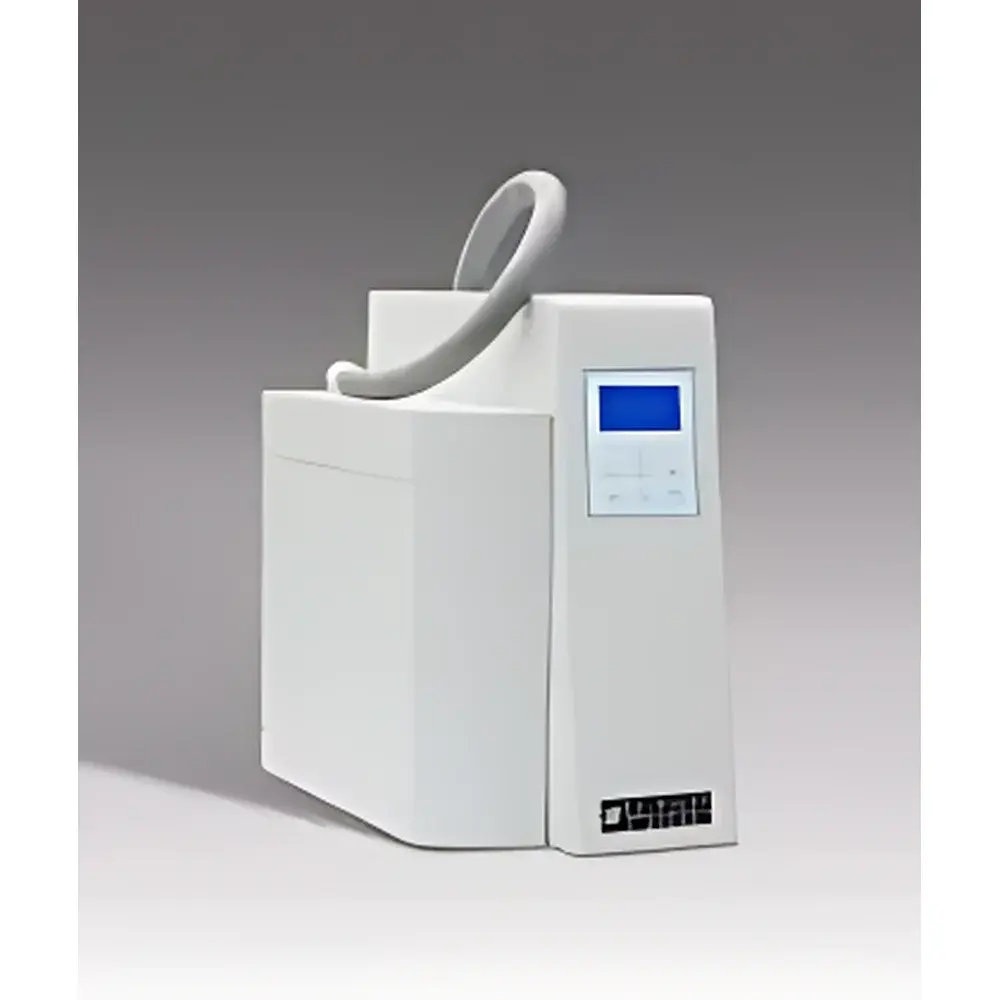
Brookfield HS-3 Automated Headspace Sampler
| Origin | Beijing, China |
|---|---|
| Manufacturer Type | Authorized Distributor |
| Origin Category | Domestic (PRC) |
| Model | HS-3 |
| Pricing | Available Upon Request |
| Sample Heating Range | 40–200 °C |
| Valve Heating Range | 40–200 °C |
| Transfer Line Heating Range | 40–200 °C |
| Sampling Time | 0–20 min |
| Pressurization Time | 0–30 s |
| Purge Time | 0–60 min |
| Injection Time | 0–20 min |
| Loop Volume | 1 mL |
| Vial Capacity | 10 mL or 20 mL |
| Sample Positions | 12 |
| Heating Zone | Single-zone (1 position) |
| RSD | ≤1.5% (for 200 ppm ethanol in water) |
| Power Consumption | 300 W |
| Dimensions (W×D×H) | 500×180×400 mm |
| Net Weight | ~25 kg |
Overview
The Brookfield HS-3 Automated Headspace Sampler is a precision-engineered, single-zone thermal desorption system designed for reliable and reproducible headspace gas-phase sampling prior to gas chromatographic analysis. Based on the equilibrium partitioning principle—where volatile analytes distribute between a liquid/solid matrix and its overlying vapor phase—the HS-3 enables quantitative extraction of trace-level volatiles without solvent interference or matrix contamination. Its architecture follows standardized headspace methodology per ASTM D7217, ISO 11843-2, and USP <467>, supporting compliance-driven laboratories in pharmaceutical, environmental, food safety, and forensic applications. The instrument operates via programmable thermal equilibration, pressurized vial transfer, loop-based sample introduction, and synchronized GC trigger signaling—ensuring full method traceability and minimal operator dependency.
Key Features
- 12-position autosampler carousel with programmable sequence execution and vial identification logic
- Independent, PID-controlled heating zones for sample vials (40–200 °C), injection valve (40–200 °C), and transfer line (40–200 °C), minimizing condensation and carryover
- 1 mL fixed-volume quantitative loop with high-reproducibility pneumatic actuation (RSD ≤1.5% at 200 ppm ethanol in water)
- Full automation: one-touch initiation of heating, pressurization (0–30 s), purge (0–60 min), sampling (0–20 min), and injection (0–20 min)
- GC synchronization interface supporting TTL/RS-232 output for coordinated oven ramp start, data acquisition trigger, and event logging
- Universal 1/8″ or 1/4″ stainless-steel GC interface compatible with Agilent, Thermo Fisher, Shimadzu, PerkinElmer, and other major GC platforms
- Robust industrial-grade chassis (500×180×400 mm, ~25 kg) with EMI-shielded electronics and thermal insulation for stable ambient operation
Sample Compatibility & Compliance
The HS-3 accommodates standard crimp-top or screw-cap 10 mL and 20 mL headspace vials—including those compliant with ASTM D6866, ISO 17025-accredited validation protocols, and FDA 21 CFR Part 11 requirements when paired with validated chromatography data systems (CDS). It supports aqueous, semi-solid, polymeric, and viscous matrices—commonly applied to residual solvent testing (ICH Q3C), blood alcohol quantification, flavor/aroma profiling, and VOC emissions screening. All thermal and timing parameters are user-configurable and audit-trail enabled within compliant CDS environments. The system meets electromagnetic compatibility (EMC) standards per IEC 61326-1 and electrical safety requirements under IEC 61010-1.
Software & Data Management
Operation is managed via embedded firmware with non-volatile parameter storage and real-time status feedback (LED indicators and optional serial diagnostics). While the HS-3 does not include proprietary PC software, it delivers deterministic TTL and RS-232 command-response communication for seamless integration with third-party chromatography data systems—including OpenLab CDS, Chromeleon, Empower, and custom LabVIEW or Python-based control scripts. All method parameters—including temperature ramps, dwell times, and GC handshake signals—are stored per-sample in the instrument’s internal memory, enabling GLP/GMP-compliant re-execution without external file dependency. Audit trails, calibration logs, and run history can be exported via serial dump for regulatory review.
Applications
- Residual solvent analysis in active pharmaceutical ingredients (APIs) and excipients per ICH Q3C guidelines
- Quantitative ethanol determination in clinical toxicology and forensic blood samples
- Volatile organic compound (VOC) profiling in packaged foods, beverages, and cosmetics
- Off-gas analysis from polymers, adhesives, and composite materials per ASTM D3960
- Environmental monitoring of BTEX (benzene, toluene, ethylbenzene, xylenes) in soil/water extracts
- Method development and validation support for USP <467>, EP 2.4.24, and JP 17
FAQ
Does the HS-3 support multi-zone heating for vial racks?
No—the HS-3 employs a single, precisely controlled heating block for one vial at a time. This design prioritizes thermal homogeneity and method robustness over parallel processing, aligning with ISO 11843-2 recommendations for low-RSD headspace quantitation.
Can the 1 mL loop be replaced with alternative volumes?
No—loop volume is fixed at 1 mL per mechanical and pneumatic design constraints. Quantitative accuracy is certified at this volume; deviations would invalidate RSD and calibration traceability.
Is the HS-3 compliant with 21 CFR Part 11 for electronic records?
The instrument itself is Part 11–capable via hardware-level event logging and secure parameter storage; full compliance requires integration with a validated CDS that implements audit trail, electronic signature, and role-based access controls.
What maintenance intervals are recommended?
Valve seals and septa should be inspected every 500 injections; transfer line tubing and loop integrity verified quarterly. No routine calibration is required beyond initial factory verification—thermal accuracy is maintained via NIST-traceable RTD sensors and closed-loop PID control.





