
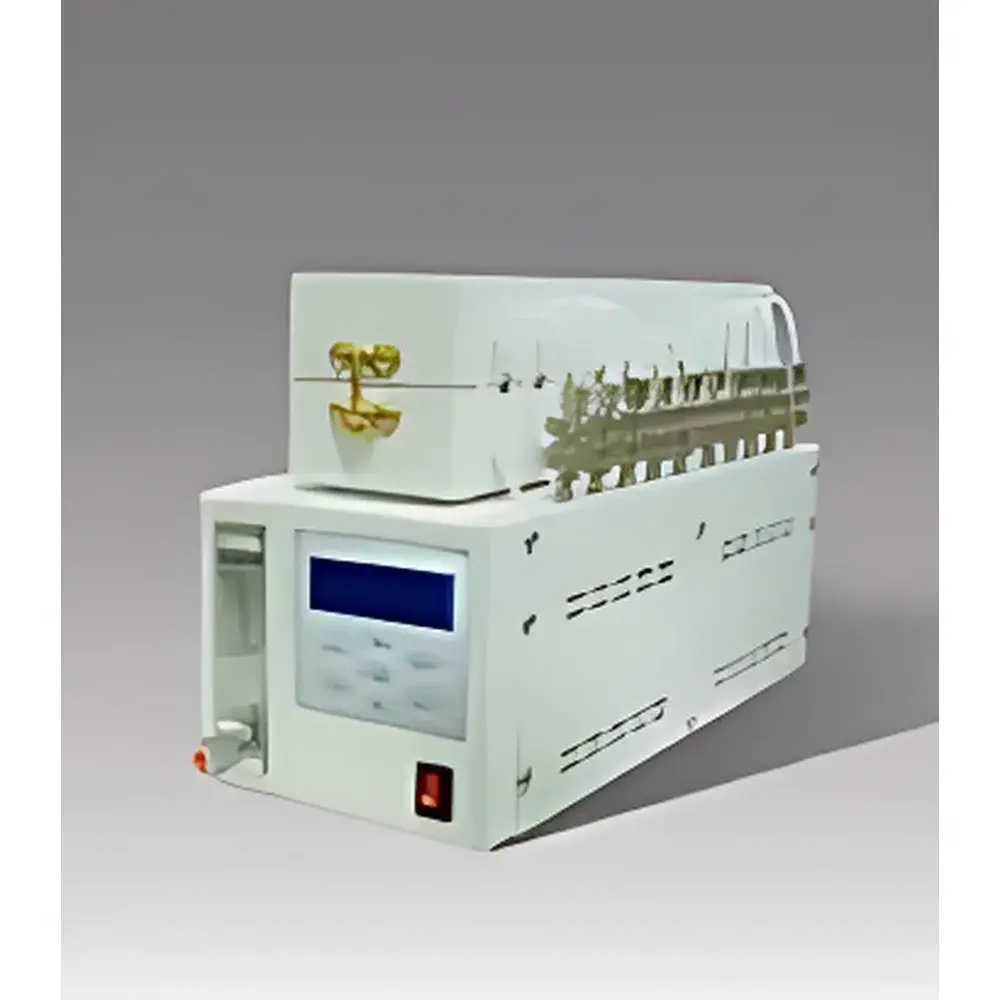
JH-1 Adsorption Tube Aging Instrument
| Origin | Beijing |
|---|---|
| Manufacturer Type | Distributor |
| Origin Category | Domestic (China) |
| Model | JH-1 |
| Pricing | Upon Request |
| Temperature Control Range | Ambient to 380 °C |
| Temperature Accuracy | ±1 °C |
| Calibration/Simulated Sampling Flow Rate | 100–1000 mL/min |
| Activation/Desorption Time Range | 1 min to 24 h (programmable) |
| Repeatability | >95% |
| Tube Dimensions Supported | Ø6 mm diameter, length >120 mm |
| Power Supply | 220 V ±10%, 50–60 Hz |
Overview
The JH-1 Adsorption Tube Aging Instrument is a precision-engineered thermal conditioning system designed for the controlled activation and thermal desorption (TD) tube preconditioning required in volatile organic compound (VOC) monitoring workflows. It operates on the principle of programmable resistive heating under inert gas purge—typically high-purity nitrogen—to thermally clean, stabilize, and outgas sorbent-packed adsorption tubes prior to field sampling or laboratory analysis. This process removes residual contaminants, moisture, and volatile background species from Tenax®, Carbopack™, Carboxen®, or multi-bed sorbent tubes, ensuring baseline integrity, minimizing carryover, and maximizing analyte recovery during subsequent thermal desorption–gas chromatography–mass spectrometry (TD-GC-MS) or TD-GC-FID analyses. Engineered for reproducibility in environmental air quality labs, occupational hygiene testing facilities, and accredited VOC emission monitoring programs, the JH-1 meets foundational operational requirements aligned with EPA Method TO-17, ISO 16017-1, and ASTM D6196 for sorbent tube preparation.
Key Features
- Programmable temperature control from ambient to 380 °C with ±1 °C stability across the full operating range—critical for consistent activation of diverse sorbent chemistries including graphitized carbon blacks and polymer-based media.
- Integrated flow-controlled inert gas manifold supporting calibrated simulated sampling flow rates from 100 to 1000 mL/min, enabling traceable validation of tube permeability and pressure drop characteristics.
- Adjustable activation duration spanning 1 minute to 24 hours, allowing method-specific optimization for single-bed or multi-bed tube configurations per ISO 16017-1 Annex B protocols.
- Automated cooling phase following activation cycle, reducing operator intervention and eliminating risk of thermal shock to fragile fused-silica or stainless-steel tube housings.
- Minimalist gas interface: single N₂ inlet connection suffices for operation—no external regulators or mass flow controllers required—reducing system complexity and leak points.
- Embedded safety architecture including overtemperature cutoff, gas-flow interlock, and thermal fuse protection, compliant with IEC 61010-1 safety standards for laboratory electrical equipment.
Sample Compatibility & Compliance
The JH-1 accommodates standard 6 mm OD adsorption tubes exceeding 120 mm in length—including commercially available 3.5″ and 6″ formats—without requiring adapters or mechanical modification. Its uniform axial heating profile ensures radial temperature homogeneity within ±2 °C along the active sorbent bed, mitigating channeling or incomplete deactivation. The instrument supports routine verification using certified reference tubes and is compatible with GLP-compliant documentation practices when paired with external electronic lab notebooks (ELNs). While not itself certified to ISO/IEC 17025, its operational parameters align with method validation criteria specified in US EPA Compendium Method TO-17 Section 6.2 and ISO 16017-1 Clause 7.3 for tube aging protocol qualification.
Software & Data Management
The JH-1 operates via an embedded microcontroller with tactile membrane keypad and LED display; no PC connectivity or proprietary software is included. All method parameters—including target temperature, ramp rate, hold time, and gas flow setpoint—are stored in non-volatile memory and retained after power cycling. Audit-ready operation logs (start time, end time, peak temperature achieved, final cooldown temperature) are viewable on-screen and may be manually transcribed for QC records. For laboratories requiring 21 CFR Part 11 compliance, integration with third-party LIMS or ELN systems is supported through timestamped manual entry; optional RS-232 or USB-to-serial adapters (not supplied) enable basic data export for archival.
Applications
- Pre-sampling activation of sorbent tubes used in EPA Method TO-17 and ISO 16017-1 compliant ambient air, indoor air, and workplace air monitoring campaigns.
- Reconditioning of reused tubes in cost-sensitive environmental laboratories—validated by repeat desorption efficiency testing per ASTM D6196 Annex A4.
- Method development for novel sorbent formulations where precise thermal history control impacts breakthrough volume and analyte retention.
- Quality assurance in tube manufacturing facilities performing batch release testing per internal SOPs referencing ISO 16000-6 Annex C.
- Supporting ISO 17025-accredited testing laboratories maintaining documented evidence of tube preconditioning as part of measurement uncertainty budgets.
FAQ
What inert gas is recommended for operation?
High-purity nitrogen (≥99.999%) is strongly recommended to prevent oxidation of carbon-based sorbents and avoid introducing hydrocarbon impurities.
Can the JH-1 be used for thermal desorption of samples, or only for tube activation?
The JH-1 is designed exclusively for tube aging and preconditioning—not analytical desorption. It lacks cryofocusing, transfer-line heating, or GC interface capabilities.
Is calibration certification provided with the instrument?
A factory-verified temperature calibration report (traceable to NIST standards) is available upon request at time of purchase; annual recalibration is advised per ISO/IEC 17025 Clause 6.5.
Does the instrument support multiple tube batches simultaneously?
No—the JH-1 processes one tube at a time. Parallel throughput requires multiple units or integration with automated tube handling platforms.
What maintenance is required for long-term reliability?
Routine inspection of the heating chamber insulation, periodic verification of gas inlet fittings for leaks, and annual thermocouple verification constitute the primary preventive maintenance schedule.
Related Products






