
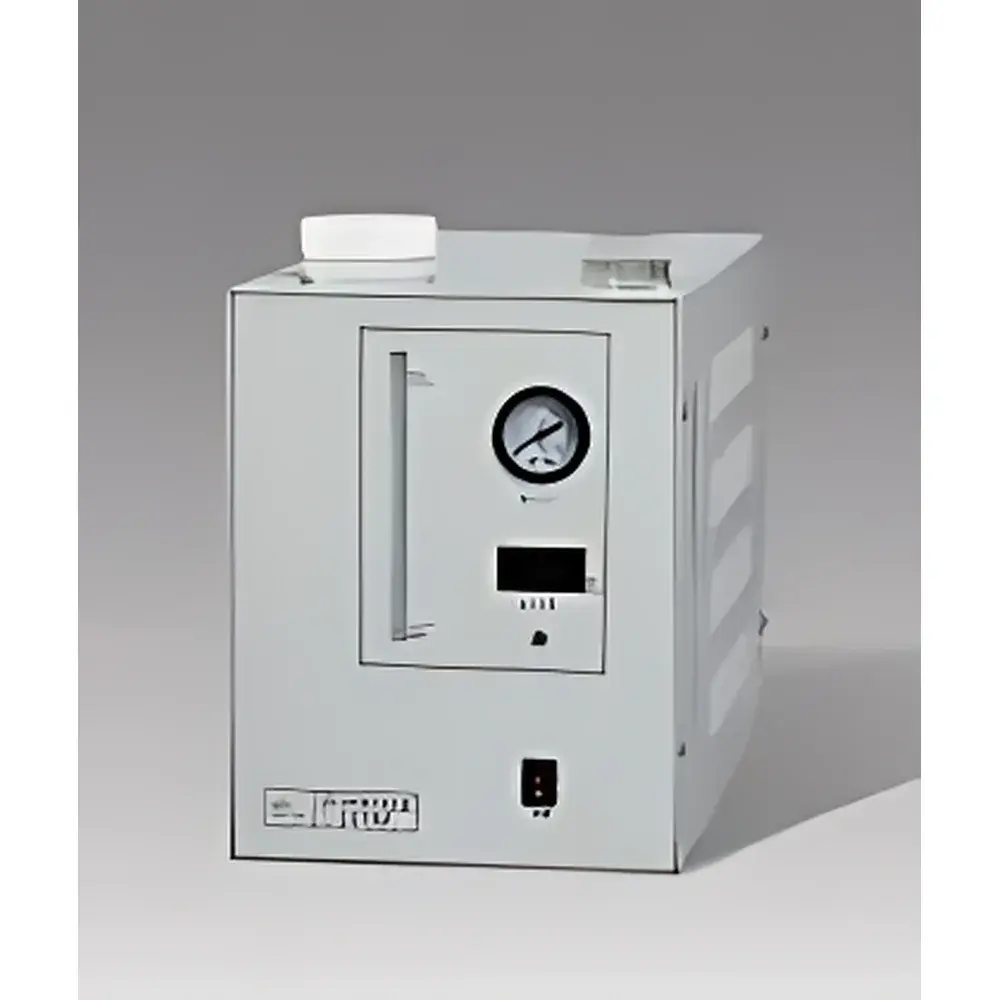
SPN-300A Nitrogen Generator by Sinopharm Chemical Reagent Co., Ltd.
| Origin | Beijing, China |
|---|---|
| Manufacturer Type | Authorized Distributor |
| Origin Category | Domestic (PRC) |
| Model | SPN-300A |
| Pricing | Available Upon Request |
| Nitrogen Purity | <3 ppm O₂, Dew Point ≤ −56 °C |
| Flow Rate | 0–300 mL/min |
| Output Pressure | 0–0.4 MPa (air-source dependent) |
| Pressure Stability | <0.003 MPa (subject to inlet air stability) |
| Power Supply | 220 V ±10%, 50 Hz |
| Power Consumption | 150 W |
| Operating Environment | 1–40 °C, RH <85% |
| Dimensions (W×D×H) | 360 × 200 × 260 mm |
| Net Weight | ~9 kg |
| Display & Control | Real-time pressure/flow digital readout, auto-pressure-hold, auto-flow-regulation |
| Filtration | Stainless-steel particulate filter + low-sulfur silicone O-rings |
| Safety | Integrated anti-backflow and alkali-reversal protection |
Overview
The SPN-300A Nitrogen Generator is a compact, membrane-based gas separation system engineered for reliable on-demand nitrogen supply in analytical laboratories. It utilizes selective permeation through hollow-fiber polymeric membranes—where oxygen, water vapor, and carbon dioxide diffuse preferentially—leaving high-purity nitrogen as the retentate stream. This physical separation method avoids consumables such as catalysts or desiccants, ensuring consistent output without scheduled regeneration cycles. Designed for integration with gas chromatography (GC), liquid chromatography–mass spectrometry (LC-MS), and other instrumentation requiring inert carrier or purge gas, the SPN-300A delivers stable flow and pressure under variable demand conditions. Its modular architecture supports continuous operation in ambient environments ranging from 1 °C to 40 °C, making it suitable for both climate-controlled labs and shared core facilities.
Key Features
- Real-time digital monitoring of output pressure and nitrogen flow rate via integrated LED display, enabling immediate verification of operational status.
- Auto-regulating flow control circuitry dynamically adjusts nitrogen delivery between 0 and 300 mL/min to match instrument demand—eliminating manual throttling and minimizing gas waste.
- Stainless-steel particulate filtration upstream of the membrane module ensures removal of airborne contaminants from the compressed air feed, preserving membrane integrity and long-term performance.
- Low-sulfur silicone elastomer seals and O-rings throughout the gas path prevent sulfur-related baseline drift in sensitive detectors (e.g., electron capture detectors or pulsed discharge helium ionization detectors).
- Dual-stage safety logic includes automatic shutdown upon detection of abnormal backpressure or reverse alkaline migration—critical when interfaced with systems using sodium hydroxide scrubbers or alkaline electrolytic air dryers.
- Energy-efficient design consumes only 150 W at full load, supporting sustainability goals without compromising output stability or purity compliance.
Sample Compatibility & Compliance
The SPN-300A is compatible with all standard laboratory-grade compressed air sources meeting ISO 8573-1 Class 3:3:3 specifications (≤0.1 µm particles, ≤3 mg/m³ oil, dew point ≤−20 °C). Its nitrogen output meets ASTM D6866-22 requirements for carrier gas in GC applications and satisfies USP criteria for inert gas quality in pharmaceutical stability testing. While not certified to ISO/IEC 17025 for calibration traceability, the unit’s pressure and flow stability (<0.003 MPa variation) supports GLP-compliant data acquisition when paired with validated instrument methods. No regulatory submission documentation (e.g., FDA 21 CFR Part 11 audit trails) is generated internally; however, its deterministic analog control architecture ensures reproducible operation across shifts and users.
Software & Data Management
The SPN-300A operates via embedded microcontroller firmware with no external software dependency. All operational parameters—including runtime hours, cumulative flow volume, and fault event logs—are stored in non-volatile memory and accessible via front-panel navigation. No USB, Ethernet, or Bluetooth interfaces are provided; this design prioritizes electromagnetic compatibility (EMC) in proximity to sensitive analytical instruments and eliminates cybersecurity attack surfaces. For laboratories requiring centralized monitoring, analog 4–20 mA output signals (optional accessory) can be routed to building management systems or SCADA platforms for trend analysis of gas consumption patterns over time.
Applications
- Carrier gas supply for capillary GC and GC–MS systems requiring ultra-low oxygen (<3 ppm) and moisture (dew point ≤−56 °C) to prevent column degradation and detector contamination.
- Purge gas for headspace samplers, thermal desorption units, and autosampler needle wash stations where residual oxygen accelerates oxidation of volatile organic compounds.
- Blanketing gas during sample preparation workflows involving air-sensitive reagents (e.g., organolithium compounds, metal hydrides) in synthetic chemistry labs.
- Inert atmosphere maintenance in glove boxes used for battery electrode coating or perovskite solar cell fabrication, where rapid nitrogen replenishment compensates for minor leaks.
- Backup nitrogen source during scheduled maintenance of central lab gas plants—minimizing instrument downtime without reliance on high-pressure cylinders.
FAQ
What compressed air quality is required for optimal SPN-300A performance?
The generator requires inlet air meeting ISO 8573-1 Class 3:3:3—specifically ≤0.1 µm particulates, ≤3 mg/m³ total oil content (aerosol + vapor), and a pressure dew point ≤−20 °C. Failure to meet these thresholds may accelerate membrane fouling and reduce nitrogen purity over time.
Can the SPN-300A be used with mass spectrometers requiring ultra-high-purity nitrogen?
While the SPN-300A achieves <3 ppm O₂ and ≤−56 °C dew point—suitable for most GC carrier applications—it does not meet the <0.1 ppm O₂ and <−70 °C dew point requirements of some high-resolution MS ion sources. Supplemental purification (e.g., oxygen scavenger traps) is recommended for such use cases.
Is routine maintenance required beyond filter replacement?
Yes. The stainless-steel particulate filter should be inspected quarterly and replaced annually—or more frequently in dusty environments. Membrane lifetime exceeds 15,000 operating hours under compliant air conditions; no periodic recalibration is necessary.
Does the unit support remote start/stop or alarm signaling?
No. The SPN-300A features local-only operation. Optional analog outputs (4–20 mA) for pressure and flow can interface with external PLCs for supervisory alerts, but native digital communication protocols are not supported.
How does ambient temperature affect dew point performance?
The −56 °C dew point specification assumes operation within the rated 1–40 °C ambient range. Below 10 °C, condensate formation in downstream lines may occur if uninsulated tubing is used; above 35 °C, sustained output pressure may drop slightly due to reduced membrane selectivity.



