
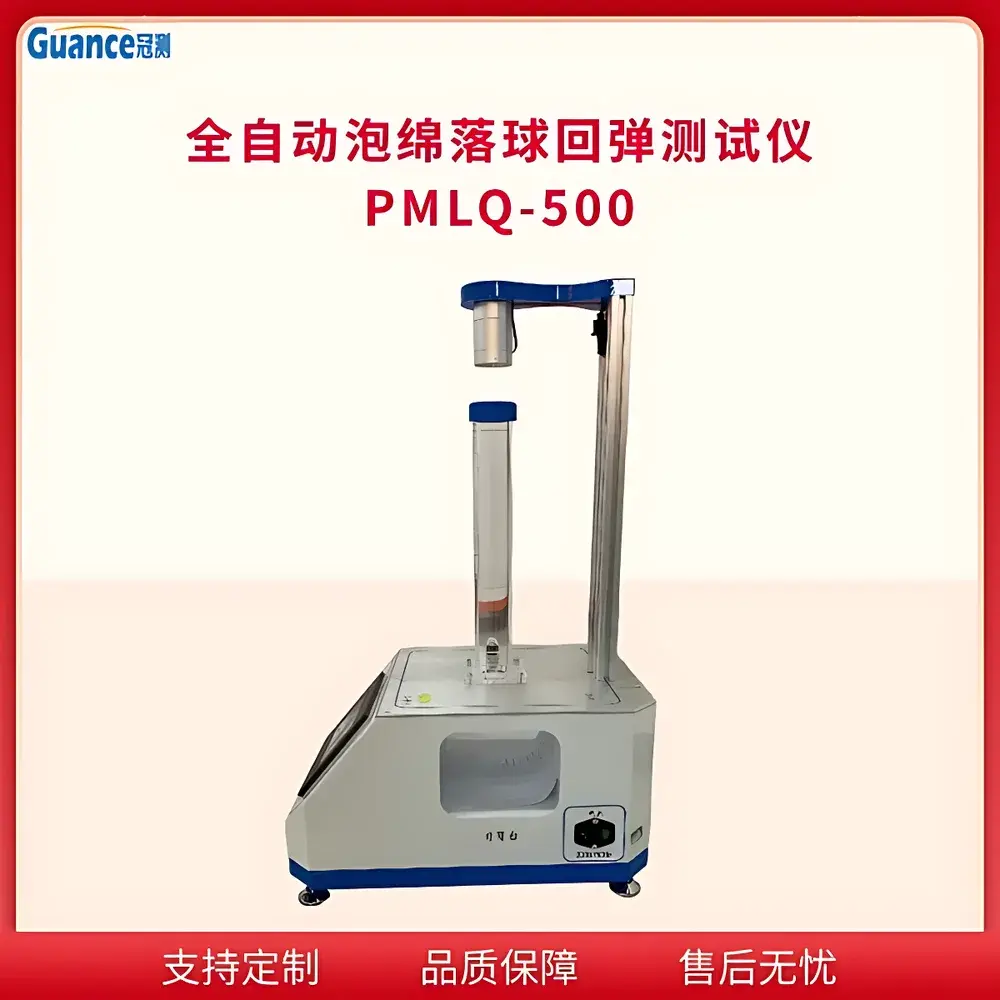
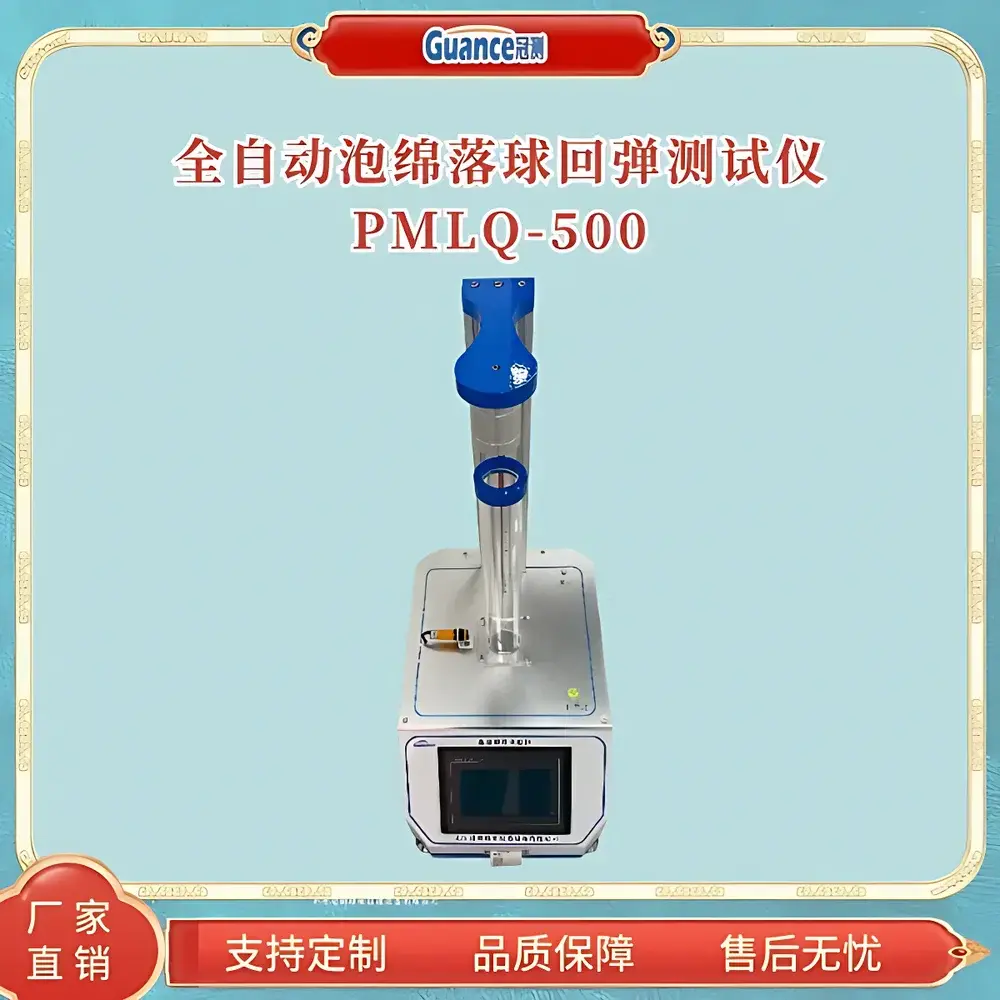
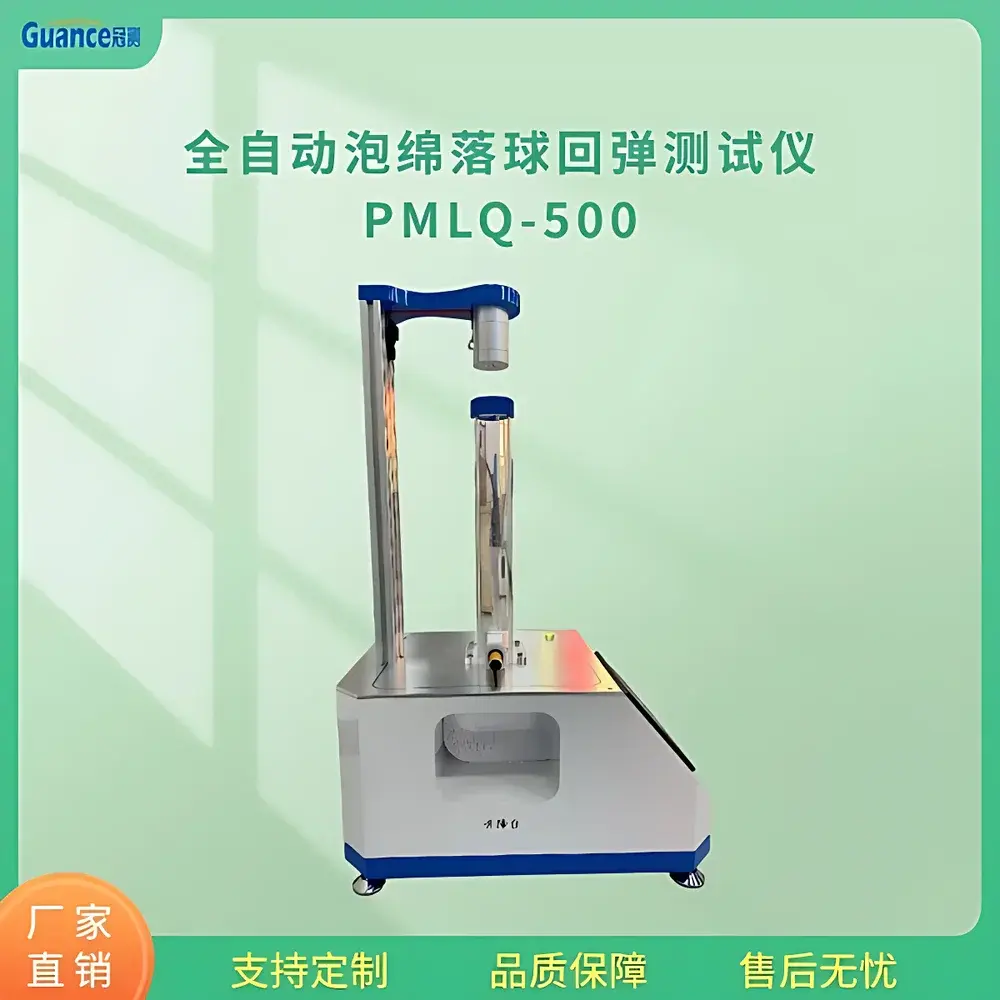
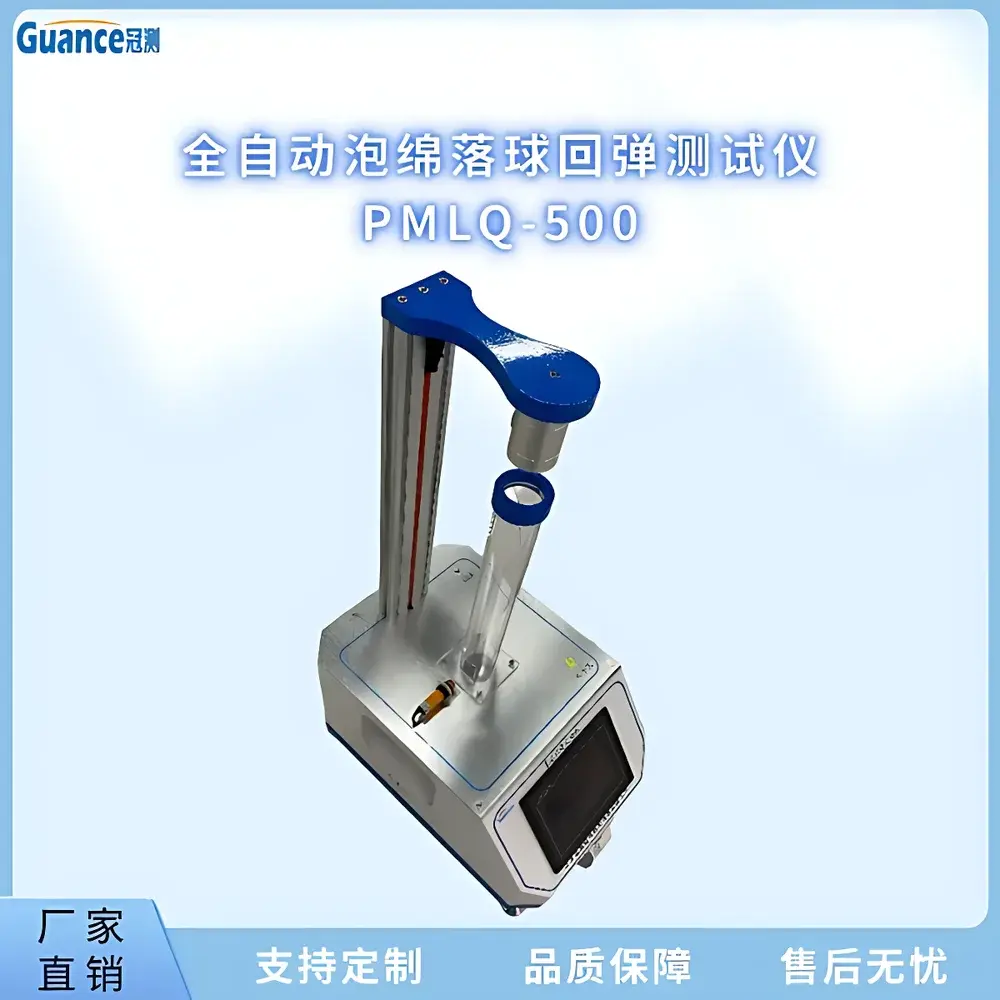
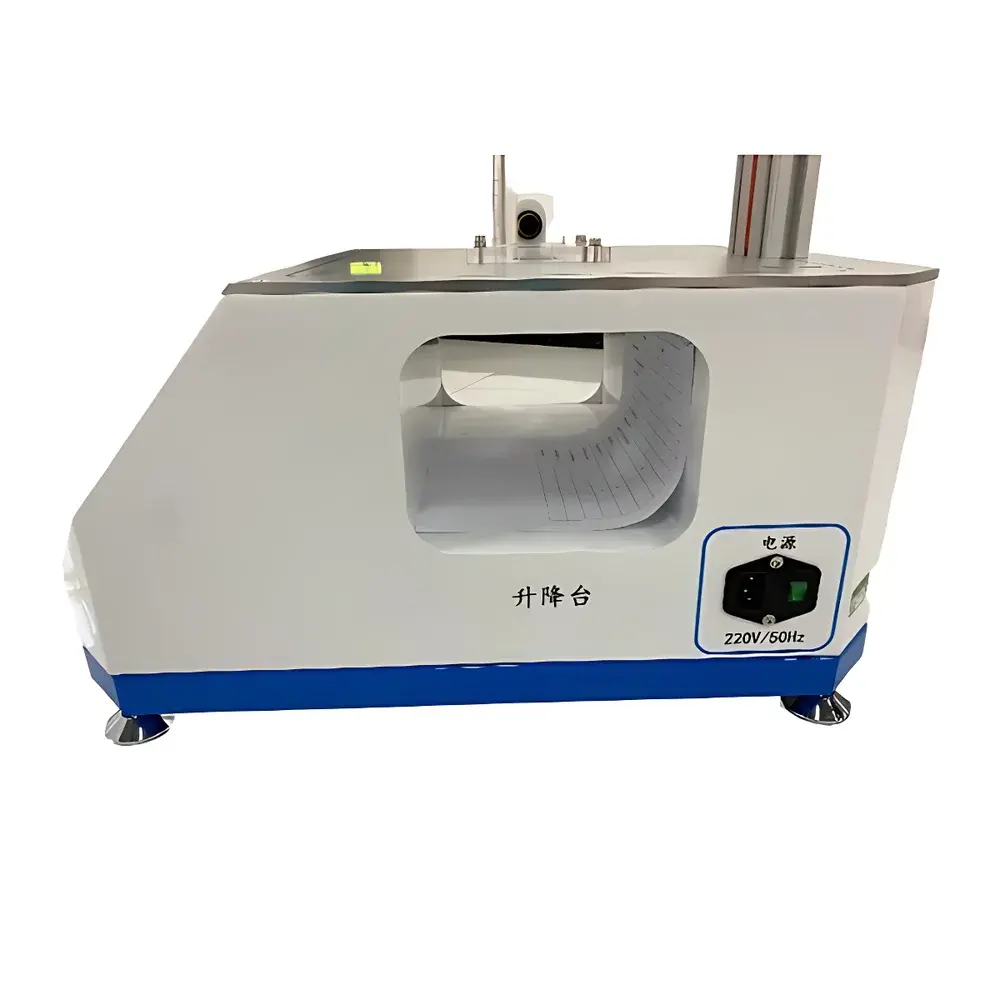
GuanCe Instruments PMLQ-500.2 Ball Rebound Tester for Flexible Polyurethane Foam
| Brand | GuanCe Instruments |
|---|---|
| Origin | Beijing, China |
| Manufacturer Type | Authorized Distributor |
| Country of Origin | China |
| Model | PMLQ-500.2 |
| Compliance Standards | GB/T 6670–2008, ISO 8307:2017, ASTM D3574–2022, GB/T 10652–2001 |
| Ball Drop Height | 460 mm (GB/ISO), 500 mm (ASTM) |
| Ball Diameter | Ø16 mm |
| Guide Tube | Transparent acrylic, inner diameter Ø50 mm |
| Rebound Accuracy | <1% |
| Specimen Dimensions | 100 mm × 100 mm × (50–100) mm |
| Specimen Sets per Test | 3 |
| Height Detection | Automatic optical height sensing with digital storage |
| Rebound Ratio Calculation | Fully automated single-value and mean rebound ratio (R = h₁/h₀ × 100%) |
| Dual Release Mode | Electromagnetic (standard), manual mechanical release |
| Reading Method | Integrated high-resolution optical sensor + calibrated scale for manual verification |
| Form Factor | Benchtop |
| Dimensions (L×W×H) | 560 × 360 × 860 mm |
| Weight | 25 kg |
| Power Supply | 220 V AC, 50 Hz |
Overview
The GuanCe Instruments PMLQ-500.2 Ball Rebound Tester is a precision benchtop instrument engineered for the quantitative evaluation of resilience in flexible polymeric foams—primarily soft and semi-rigid polyurethane (PU) foams used in bedding, automotive seating, packaging, and medical cushioning applications. It operates on the standardized ball rebound principle defined in ISO 8307:2017, ASTM D3574–2022, and GB/T 6670–2008: a hardened steel sphere of precisely controlled mass and diameter is released from a fixed vertical height within a low-friction, optically transparent guide tube; upon impact with a conditioned foam specimen, the maximum rebound height is measured. The rebound ratio—expressed as a percentage of the initial drop height—is calculated to quantify elastic recovery performance. This method correlates directly with energy absorption, hysteresis loss, and long-term compression set behavior, making it indispensable for QC laboratories validating material consistency across production batches.
Key Features
- Electromagnetic ball release mechanism ensures zero rotational torque and perfect axial alignment during free fall—fully compliant with ISO 8307 Section 6.2 and ASTM D3574 Section 7.3 requirements for “non-rotating, centrally aligned impact”.
- Dual-mode height detection: High-precision optical sensor captures rebound trajectory at 1 kHz sampling rate, while a laser-etched acrylic scale enables manual visual verification—critical for GLP-compliant audit trails and outlier validation.
- Siemens S7-1200 PLC-based control architecture delivers deterministic timing (<±0.5 ms jitter), real-time fault diagnostics, and immunity to electromagnetic interference common in industrial lab environments.
- 7-inch capacitive touchscreen HMI with embedded Chinese/English bilingual interface supports intuitive test setup, parameter locking, and user-level access control (operator, supervisor, admin).
- Automated statistical processing per standard protocol: For each test sequence (3 specimens × 3 impacts), the system discards outliers using ASTM E178–22 Grubbs’ test criteria, computes arithmetic mean rebound ratio, and logs raw height data with timestamps and operator ID.
- Benchtop footprint (560 × 360 × 860 mm) and modular design enable seamless integration into ISO 17025-accredited testing labs without structural modification.
Sample Compatibility & Compliance
The PMLQ-500.2 accommodates standard test specimens measuring 100 mm × 100 mm × (50–100) mm, conforming to dimensional tolerances specified in ISO 8307 Clause 5.1 and GB/T 10652–2001 Annex A. Specimens must be preconditioned at 23 ± 2 °C and 50 ± 5 % RH for ≥16 h prior to testing, per ISO 293 and ASTM D618. The instrument’s rigid aluminum base plate and adjustable leveling feet ensure stable contact between specimen and support surface—eliminating edge effects that compromise measurement reproducibility. All mechanical components—including the Ø16 mm chrome-plated steel impact ball (density 7.85 g/cm³, hardness 60–65 HRC)—are traceably certified to NIST-traceable dimensional and mass standards. Full compliance documentation—including calibration certificates, uncertainty budgets (k=2), and test report templates aligned with ISO/IEC 17025:2017 Clause 7.8—is provided with shipment.
Software & Data Management
Firmware v3.2 includes embedded data management compliant with FDA 21 CFR Part 11 requirements: electronic signatures, role-based audit trails, immutable raw data storage (CSV + PDF), and automatic backup to USB or network drive. Test reports include metadata such as environmental conditions (optional external hygrothermograph integration), operator credentials, equipment calibration status, and pass/fail flags against user-defined specification limits (e.g., “R ≥ 55% ± 3%”). Data export supports LIMS interoperability via HL7 or ASTM E1384-compliant XML schema. Software updates are delivered remotely via secure HTTPS channel with SHA-256 signature verification—no physical media required.
Applications
- Quality control of flexible PU foam formulations during R&D and manufacturing—tracking effects of catalysts, blowing agents, and polymer molecular weight distribution on resilience.
- Supplier qualification testing per OEM specifications (e.g., Ford WSS-M99P126-A2, GM GMW15634, Toyota TSD1110G).
- Failure analysis of foam degradation due to UV exposure, thermal aging, or hydrolysis—rebound ratio decline correlates strongly with crosslink density loss measured by DMA.
- Regulatory submission support for medical device cushioning (ISO 10993-10 biocompatibility testing packages) and furniture flammability certifications (CAL TB 117–2013).
- Academic research on viscoelastic structure–property relationships in porous elastomers, including correlation studies with dynamic mechanical analysis (DMA) and compression set (ASTM D3574 Method B).
FAQ
What standards does the PMLQ-500.2 fully satisfy?
It meets all mechanical, procedural, and reporting requirements of ISO 8307:2017, ASTM D3574–2022 (Method C), GB/T 6670–2008, and GB/T 10652–2001—including ball geometry, drop height tolerance (±0.5 mm), guide tube straightness, and statistical treatment of replicate measurements.
Is electromagnetic release mandatory for accreditation?
Yes. Manual release introduces uncontrolled variables (lateral force, angular momentum) that violate ISO 8307 Section 6.2 and invalidate results under ISO/IEC 17025. The PMLQ-500.2’s solenoid actuator is validated to achieve <0.1° angular deviation and <0.3 mm lateral displacement.
Can test data be exported to Excel or LIMS without proprietary software?
Yes. Raw CSV files contain timestamped rebound heights, calculated ratios, specimen IDs, and environmental metadata. No vendor-specific runtime or license is required to parse or import these files.
What maintenance is required to sustain measurement accuracy?
Annual verification of ball mass (±0.1 g), guide tube verticality (±0.2°), and optical sensor linearity (NIST-traceable step gauge) is recommended. Calibration certificates are issued per ISO/IEC 17025 with measurement uncertainty stated at k=2.
Does the system support multi-language reporting for global supply chain use?
Yes. Report templates are configurable in English, Simplified Chinese, German, French, and Japanese—each adhering to local regulatory formatting conventions (e.g., CE marking footers, FDA-required disclaimers).



