
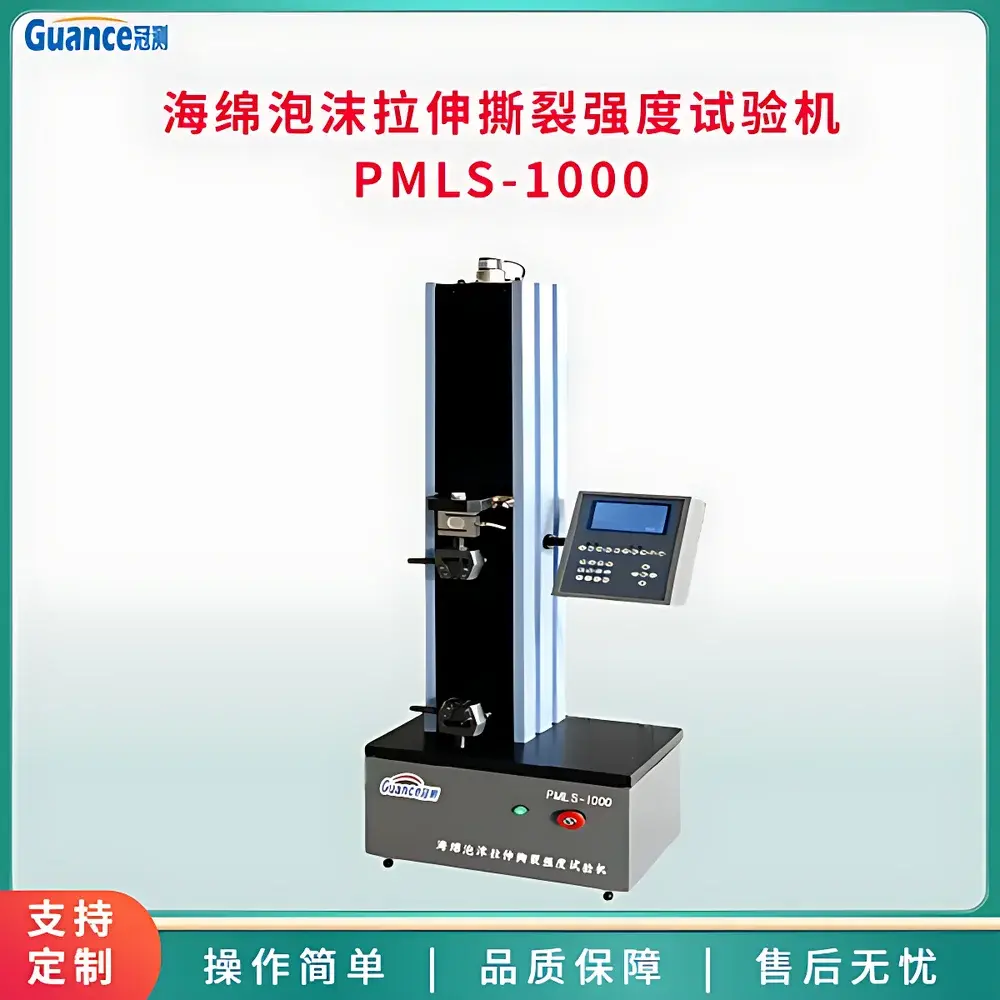
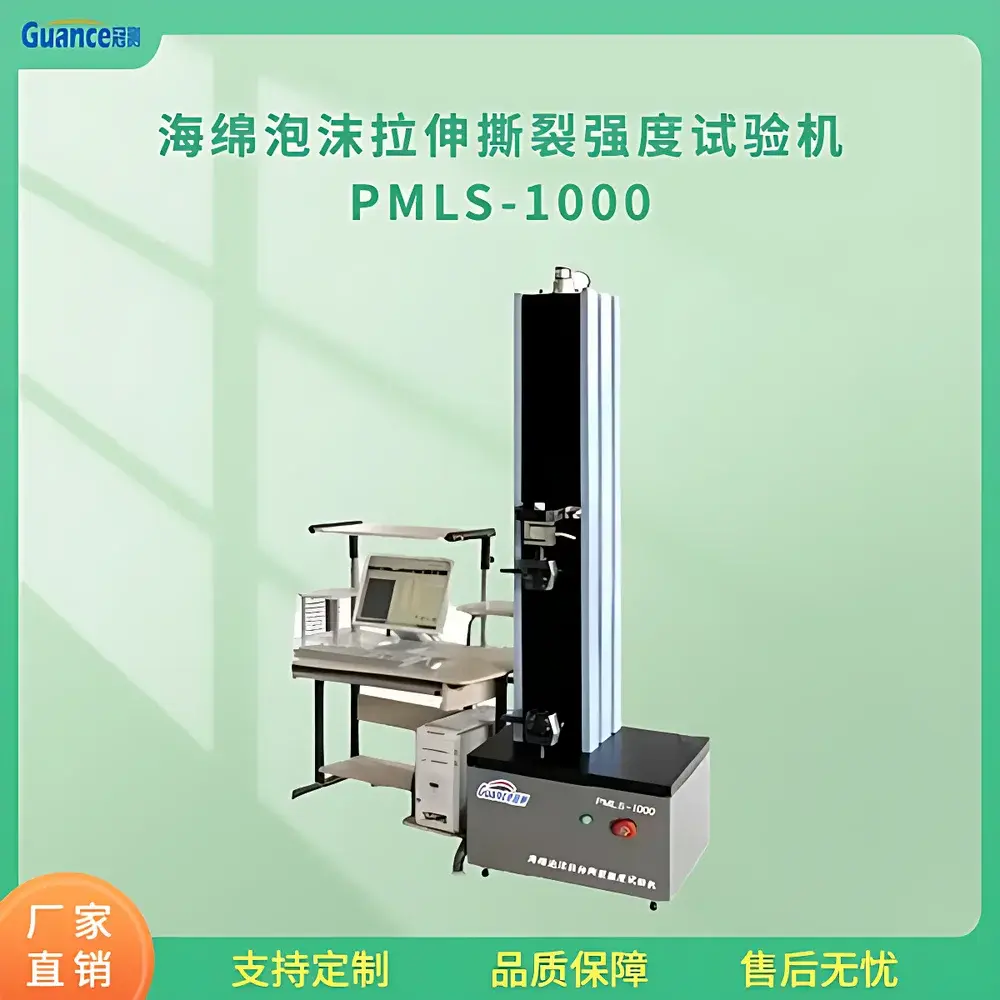
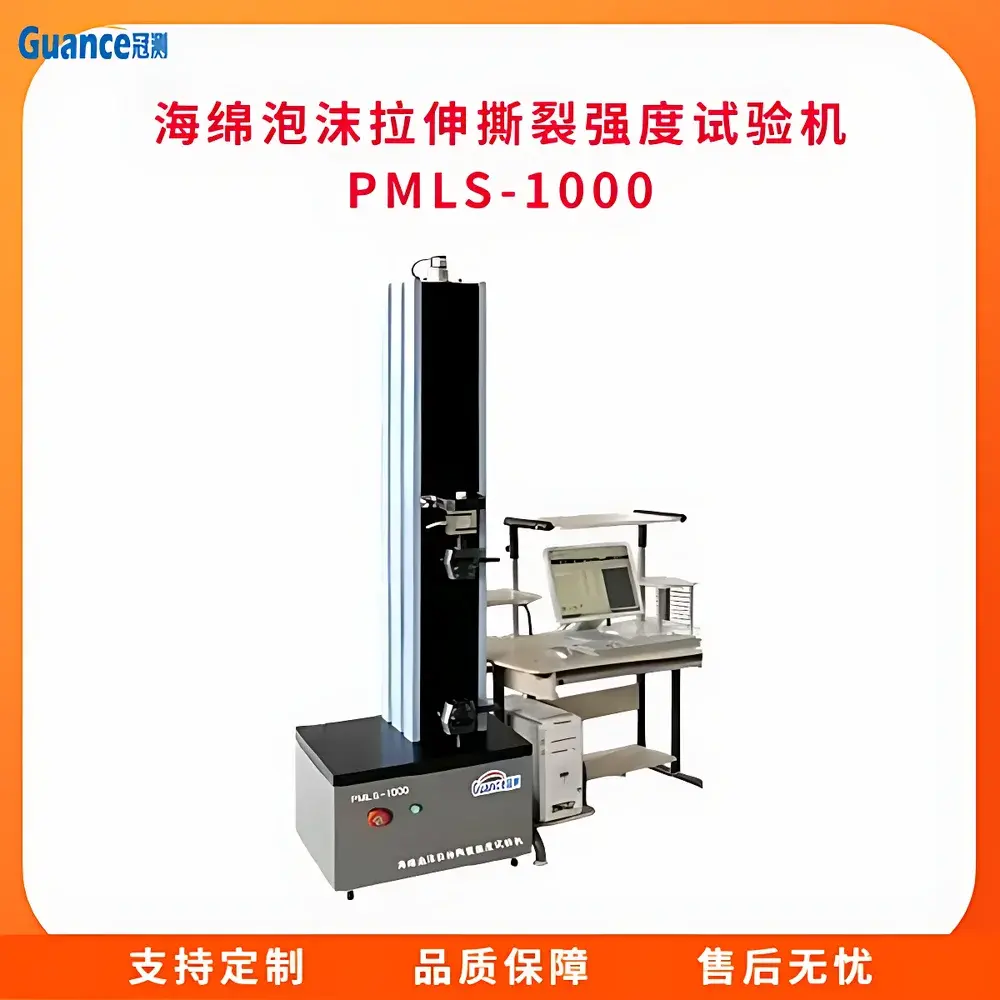
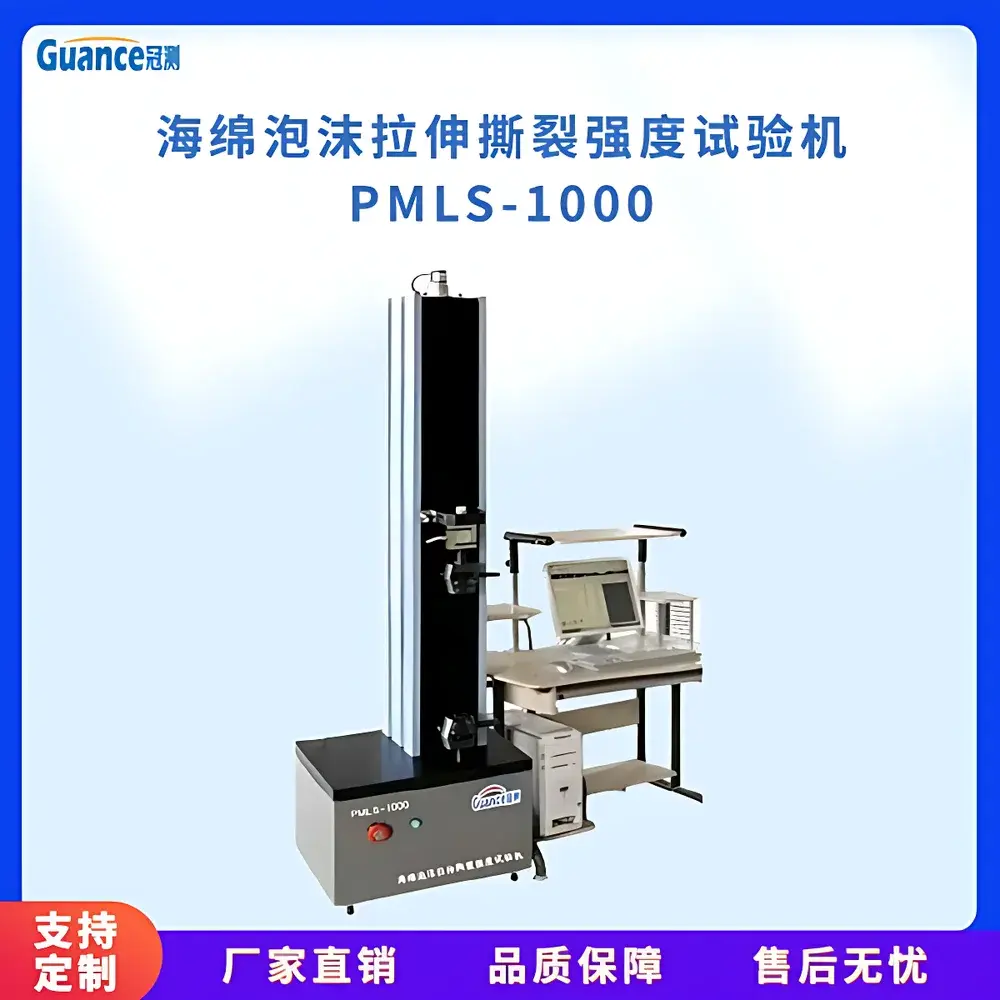
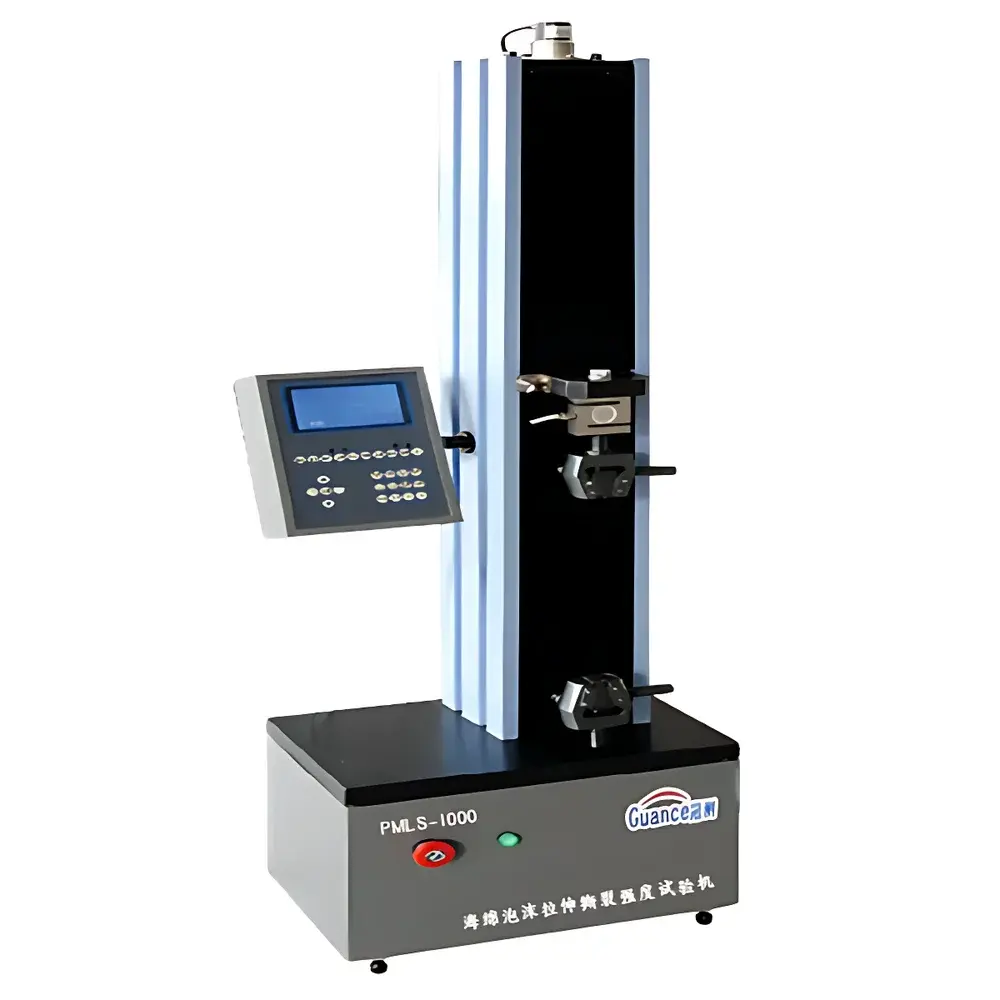
GuanCe Instruments PMLS-1000.4 Foam Tear Resistance Tester
| Brand | GuanCe Instruments |
|---|---|
| Origin | Beijing, China |
| Manufacturer Type | Authorized Distributor |
| Country of Origin | China |
| Model | PMLS-1000.4 |
| Max Test Force | 1000 N |
| Force Accuracy | ±1% of reading |
| Displacement Resolution | 0.01 mm |
| Displacement Accuracy | ±1% of reading |
| Crosshead Speed Range | 0.05–300 mm/min |
| Speed Accuracy | ±1% |
| Stroke | 800 mm (excluding fixtures) |
| Dimensions (L×W×H) | 435 × 275 × 1700 mm |
| Power Supply | 220 V, 50 Hz |
Overview
The GuanCe Instruments PMLS-1000.4 Foam Tear Resistance Tester is a precision-engineered mechanical testing system designed specifically for evaluating the tensile strength, elongation at break, and tear resistance of flexible polymeric foam materials—including polyurethane (PU), polyethylene (PE), ethylene-vinyl acetate (EVA), and other open- or closed-cell elastomeric foams used in packaging, automotive seating, medical cushioning, and furniture applications. Based on uniaxial tensile loading principles per ASTM D3574, ISO 1798, and GB/T 10808–2006, the instrument applies controlled displacement to standardized specimens using a single-column electromechanical architecture. Its force measurement relies on high-stability load cells calibrated traceably to national standards, while motion control is achieved via a fully digital servo motor coupled with a precision-ground ball screw and arc-synchronous belt reduction system—ensuring repeatable loading profiles across wide speed ranges.
Key Features
- Single-column rigid frame construction optimized for stability during low-force, high-elongation foam testing
- Full-range, non-stepped force measurement up to 1000 N with accuracy better than ±1% of reading
- Adjustable crosshead speed from 0.05 mm/min to 300 mm/min, programmable with three-step instantaneous switching for multi-phase test protocols
- 0.01 mm displacement resolution and real-time position feedback via high-resolution optical encoder
- Integrated 7-inch color LCD touchscreen interface supporting Chinese/English bilingual operation without external PC dependency
- Automatic return-to-initial-position function post-test, reducing operator intervention and improving throughput
- Dual-layer safety protection: mechanical limit switches plus software-defined stroke and overload limits (3–5% over full scale)
- Onboard thermal printer for immediate hardcopy output of peak force, elongation, tear energy, and stress–strain curve metadata
Sample Compatibility & Compliance
The PMLS-1000.4 accommodates standard test specimens per ISO 1798 (dumbbell-shaped, 100 mm gauge length), ASTM D3574 (Type A, B, C tear specimens), and GB/T 6344–2008 (rectangular strips, 25 mm width). It supports both tensile and trouser-tear configurations using interchangeable fixtures—such as pneumatic clamps for uniform grip pressure and notched blade assemblies for controlled initiation. All test methods align with regulatory expectations for quality assurance in ISO 9001-certified production environments. While not FDA 21 CFR Part 11 compliant out-of-the-box, audit-ready data logs (timestamped force/displacement arrays, user ID, test parameters) can be exported via USB for integration into validated LIMS or QMS platforms under GLP/GMP frameworks.
Software & Data Management
The embedded firmware enables real-time visualization of load vs. displacement curves, with dynamic overlays of yield point, maximum tensile strength, and % elongation. Data are stored internally (≥1000 test records) and exportable in CSV format for post-processing in MATLAB, Excel, or statistical process control (SPC) software. Calibration coefficients are password-protected and stored in non-volatile memory; periodic verification follows ISO/IEC 17025 guidelines using certified reference load cells. Firmware updates are delivered via USB flash drive—no internet connectivity required—maintaining cybersecurity integrity in regulated lab settings.
Applications
- Quality control of cushioning foams in e-commerce packaging and logistics protection systems
- R&D evaluation of biodegradable foam alternatives (e.g., starch-based or PLA-blended foams) for sustainability compliance
- Validation of foam aging behavior after thermal cycling or humidity exposure per ASTM D3574 Annex A
- Tear propagation analysis in medical device packaging (e.g., sterile barrier systems using reticulated polyurethane)
- Supplier qualification testing against contractual specifications for automotive interior trim components
- Failure mode analysis of foam laminates subjected to peel or shear stresses in composite assemblies
FAQ
What international standards does the PMLS-1000.4 directly support?
It is configured to execute test procedures defined in ISO 1798:1997, ASTM D3574–22, GB/T 10808–2006, and GB/T 6344–2008.
Is the system compatible with third-party data acquisition software?
Yes—raw analog outputs (±10 V) and RS232 serial interface allow integration with LabVIEW, Python-based DAQ scripts, or custom SCADA systems.
Does the instrument require annual recalibration by an accredited lab?
While field verification using traceable weights is recommended quarterly, formal recalibration per ISO/IEC 17025 should be performed annually by a CNAS-accredited service provider.
Can the machine test wet or cryogenically conditioned foam samples?
Only ambient-condition testing is supported; environmental chambers must be externally integrated and validated separately.
What maintenance intervals are specified for the mechanical drive system?
Lubrication of the ball screw and inspection of synchronous belts are advised every 500 operational hours or semiannually, whichever occurs first.





