
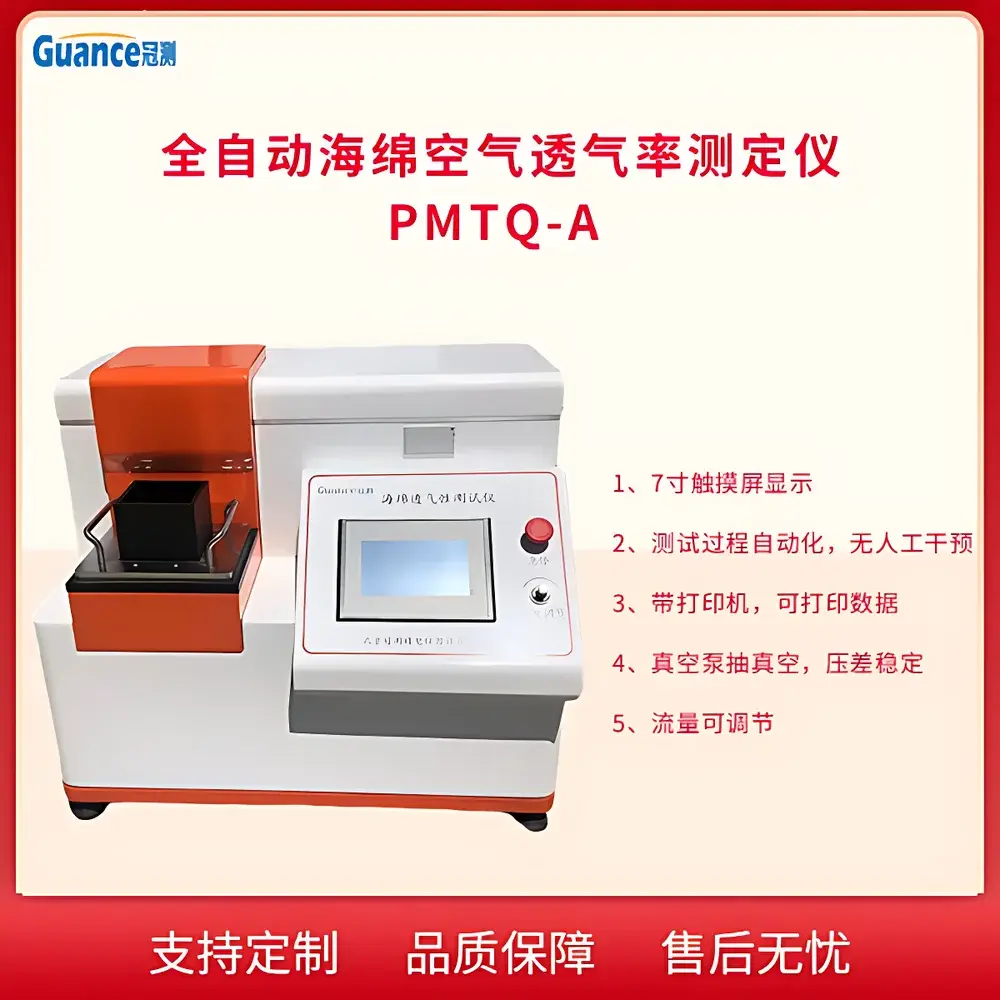
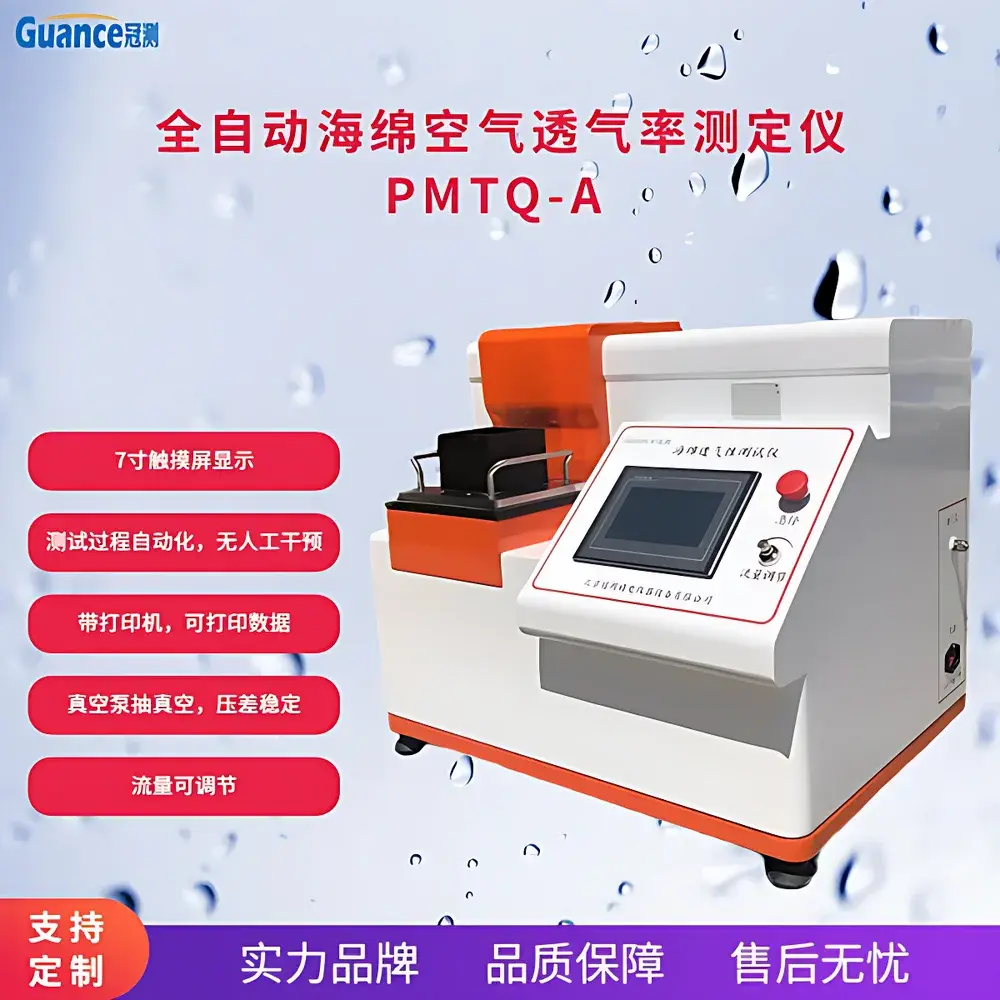
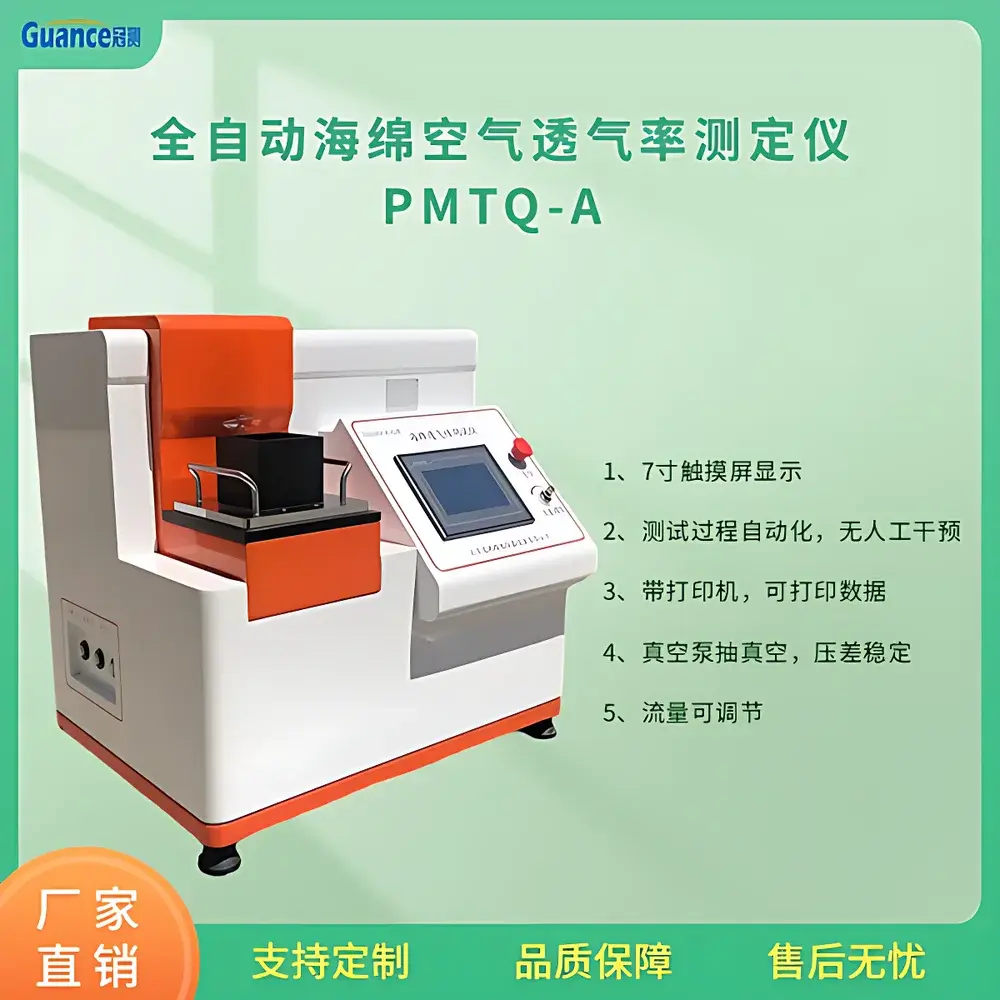
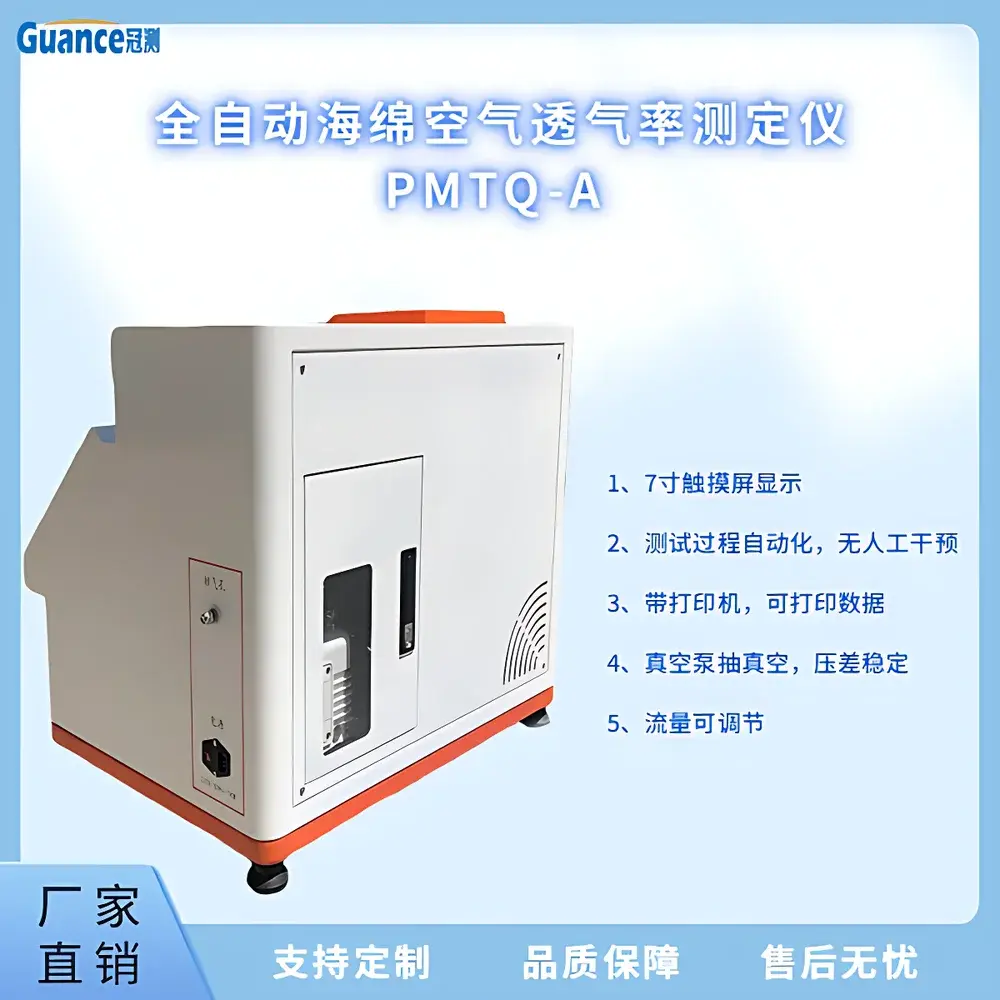
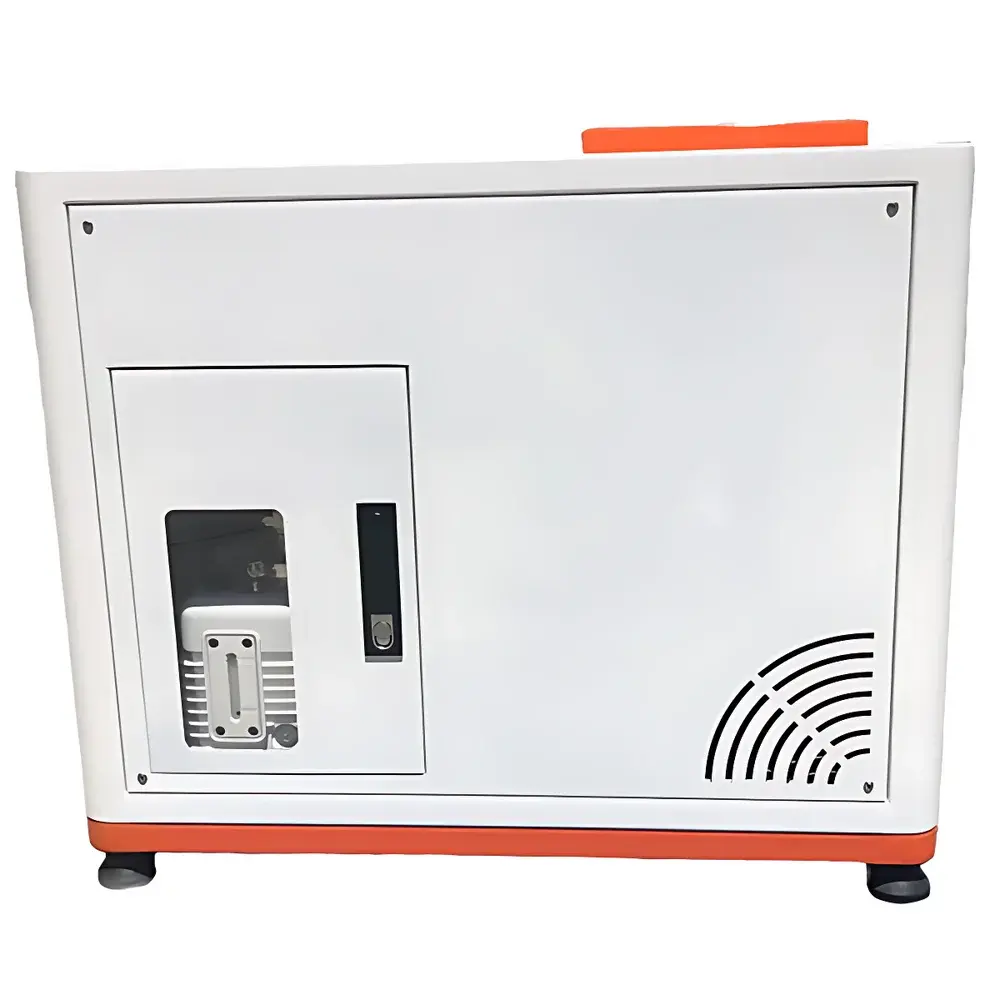
GuanCe Instruments PMTQ-A High-Polymer Air Permeability Tester
| Brand | GuanCe Instruments |
|---|---|
| Origin | Beijing, China |
| Manufacturer Type | Authorized Distributor |
| Country of Origin | China |
| Model | PMTQ-A |
| Price | USD 2,650 (FOB Beijing) |
| Compliance | ISO 4638:1984, GB/T 10655, AQ 1088-2011, ASTM D3574-2005 |
| Touchscreen Interface | 7-inch capacitive LCD |
| Test Duration | ≤10 s per sample |
| Vacuum Pump | 1.3 m³/h (4.8 L/s), ultimate vacuum 5 × 10² Pa |
| Flow Range | 0–50 L/min |
| Differential Pressure Sensors | Dual-range (0–400 Pa and 0–100 Pa) |
| Test Chamber Dimensions | 100 mm × 100 mm × 104 mm (L×W×H) |
| Specimen Size | 102 mm × 102 mm, thickness 0–100 mm |
| Air Permeability Range | 0–999.9 × 10⁻¹⁰ m² |
| Temperature Range | −40 °C to +80 °C |
| Chamber Material | 4 mm 304 brushed stainless steel |
| Safety Protections | Over-temperature, over-pressure, over-flow, and motor overload protection |
| Dimensions (W×D×H) | 800 mm × 630 mm × 700 mm |
| Weight | 85 kg |
| Power Rating | 1 kW |
Overview
The GuanCe Instruments PMTQ-A High-Polymer Air Permeability Tester is an engineered solution for the precise, repeatable quantification of air permeability in porous polymeric materials—primarily flexible open-cell foams, elastomeric sealants, spray-applied polyurethane coatings, and other breathable polymeric substrates used in packaging, automotive NVH damping, mining ventilation sealing, and medical cushioning applications. Operating on the principle of steady-state laminar airflow through a defined cross-sectional area under controlled differential pressure, the PMTQ-A implements Darcy’s law-based calculation to determine air permeability (k, expressed in m²) as a function of volumetric flow rate, applied pressure gradient, specimen thickness, and temperature-compensated dynamic viscosity of air. Designed as a direct functional replacement for the legacy RXQ-1 instrument, it fully conforms to the procedural requirements of ISO 4638:1984, GB/T 10655, AQ 1088-2011, and ASTM D3574-2005 Section 12 (Air Permeability of Flexible Cellular Materials). Its architecture integrates a dual-range differential pressure sensing system, high-stability mass flow measurement, and real-time thermal compensation—enabling traceable, GLP-compliant testing without manual interpolation or post-test correction.
Key Features
- 7-inch industrial-grade capacitive touchscreen HMI with intuitive workflow navigation and multilingual UI support (English default)
- Automated test execution cycle completed in ≤10 seconds per specimen—minimizing operator dependency and throughput variability
- Dual differential pressure sensor array (0–100 Pa and 0–400 Pa) with auto-ranging logic to optimize signal-to-noise ratio across low- and medium-permeability regimes
- Integrated temperature-compensated air viscosity algorithm compliant with ISO 8503-2 and CIPM-2007 density/viscosity reference models
- Real-time display of 7 concurrent parameters: differential pressure (Pa), volumetric flow (L/min), air permeability (×10⁻¹⁰ m²), ambient temperature (°C), linear flow velocity (mm/s), specific flow resistance (Pa·s/m), and flow resistivity (Pa·s/m²)
- Configurable test termination modes: time-based automatic stop or manual override via touchscreen
- On-device statistical engine supporting single-run reporting and multi-run averaging (n = 3–10) with standard deviation and CV% calculation
- Robust 304 stainless steel test chamber (4 mm wall thickness) with precision-machined gasket interface ensuring leak-tight sealing at ≤1 × 10⁻⁴ Pa·m³/s helium leak rate
- Comprehensive hardware safety layer: dual-stage thermal cutoff, pressure relief valve, flow limiter, and vacuum pump current monitoring
Sample Compatibility & Compliance
The PMTQ-A accommodates specimens up to 102 mm × 102 mm × 100 mm—covering standard foam block formats per ASTM D3574 and GB/T 10655. It supports both uncompressed and conditioned (pre-compressed to specified thickness) testing protocols. The instrument is validated for use with polyurethane (PU), ethylene-vinyl acetate (EVA), thermoplastic polyolefin (TPO), silicone elastomers, and acrylic-based spray sealants—materials commonly evaluated for breathability in packaging barrier layers, mine roof sealant qualification (per AQ 1088-2011), and acoustic damping composites. All firmware and calibration routines adhere to ISO/IEC 17025:2017 documentation requirements. Raw data logs include timestamped metadata (operator ID, calibration certificate number, environmental conditions) to support FDA 21 CFR Part 11 audit readiness when deployed in regulated GMP environments.
Software & Data Management
Data acquisition and reporting are handled by embedded firmware with local storage (8 GB internal flash) capable of retaining ≥10,000 test records. Each record contains full parameter history at 10 Hz sampling resolution, enabling post-hoc validation of pressure stabilization and flow linearity. Export options include CSV (comma-separated values) and PDF report templates aligned with ISO 17025 Annex A3 structure—featuring instrument ID, calibration due date, uncertainty budget references, and digital signature fields. Optional Ethernet/Wi-Fi connectivity enables integration into laboratory information management systems (LIMS) via Modbus TCP or HTTP REST API. Audit trails log all user actions—including method edits, calibration events, and data deletions—with immutable timestamps and operator authentication.
Applications
- Quality control of polyurethane foam mattress cores and automotive seat cushions per ISO 4638 and ASTM D3574
- Performance verification of coal mine roof sealants under AQ 1088-2011 airflow resistance thresholds
- R&D screening of breathable polymer films for modified atmosphere packaging (MAP)
- Validation of acoustic damping composites in transportation interiors where airflow resistivity correlates with sound absorption coefficient (ISO 9053)
- Comparative evaluation of recycled vs. virgin PU foam permeability degradation after aging (thermal/UV/humidity exposure)
- Regulatory submission support for medical device cushioning materials requiring透气性 documentation per ISO 10993-1 biocompatibility assessment pathways
FAQ
What standards does the PMTQ-A explicitly support?
ISO 4638:1984, GB/T 10655, AQ 1088-2011, and ASTM D3574-2005 Section 12.
Is the instrument supplied with calibration certificates?
Yes—NIST-traceable calibration certificates for the differential pressure sensors, flow sensor, and temperature probe are included, valid for 12 months from shipment.
Can test methods be customized beyond standard protocols?
Yes—up to five user-defined test profiles can be stored, allowing variable pressure setpoints, dwell times, and pass/fail thresholds.
Does the system meet cybersecurity requirements for networked lab deployment?
Firmware v2.3+ includes TLS 1.2 encryption, role-based access control (admin/operator/guest), and disabled default credentials—aligned with IEC 62443-3-3 SL2 baseline.
What maintenance is required for long-term accuracy?
Annual recalibration is recommended; filter replacement every 6 months; vacuum pump oil change every 2,000 operating hours.
Related Products





