
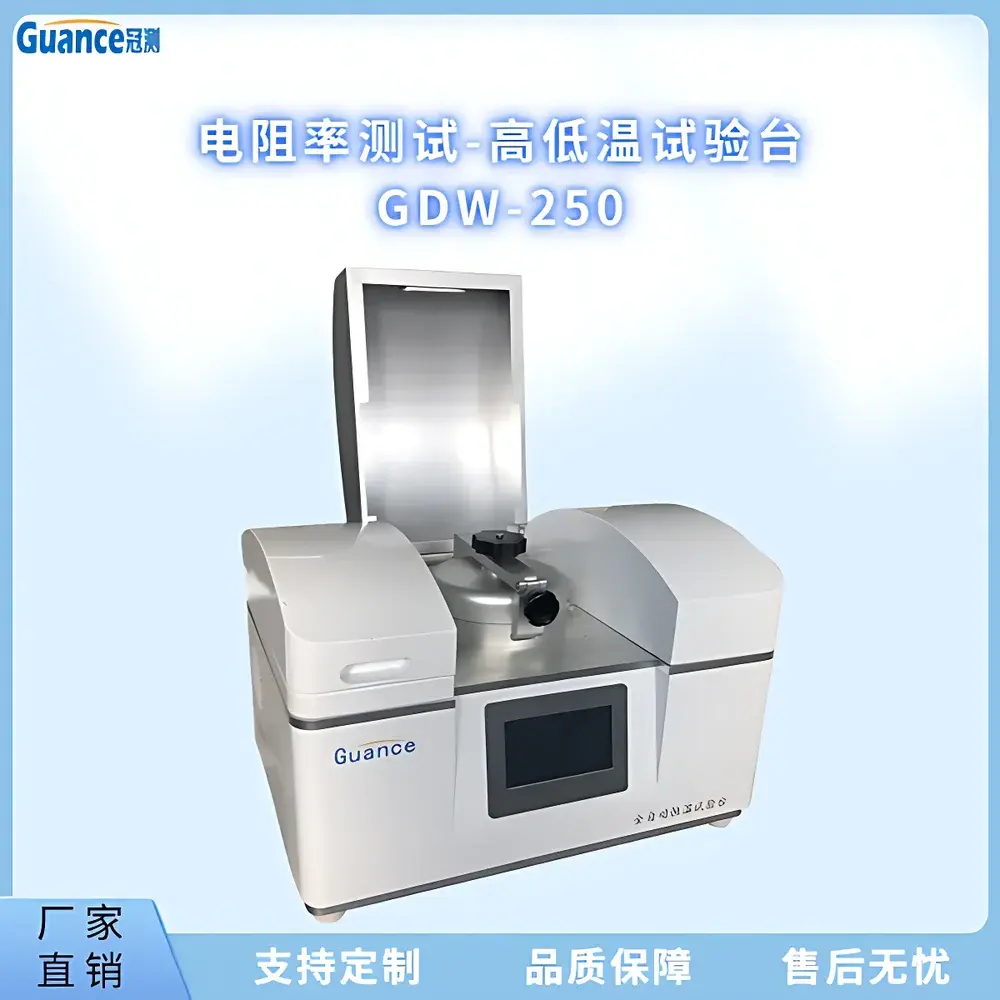
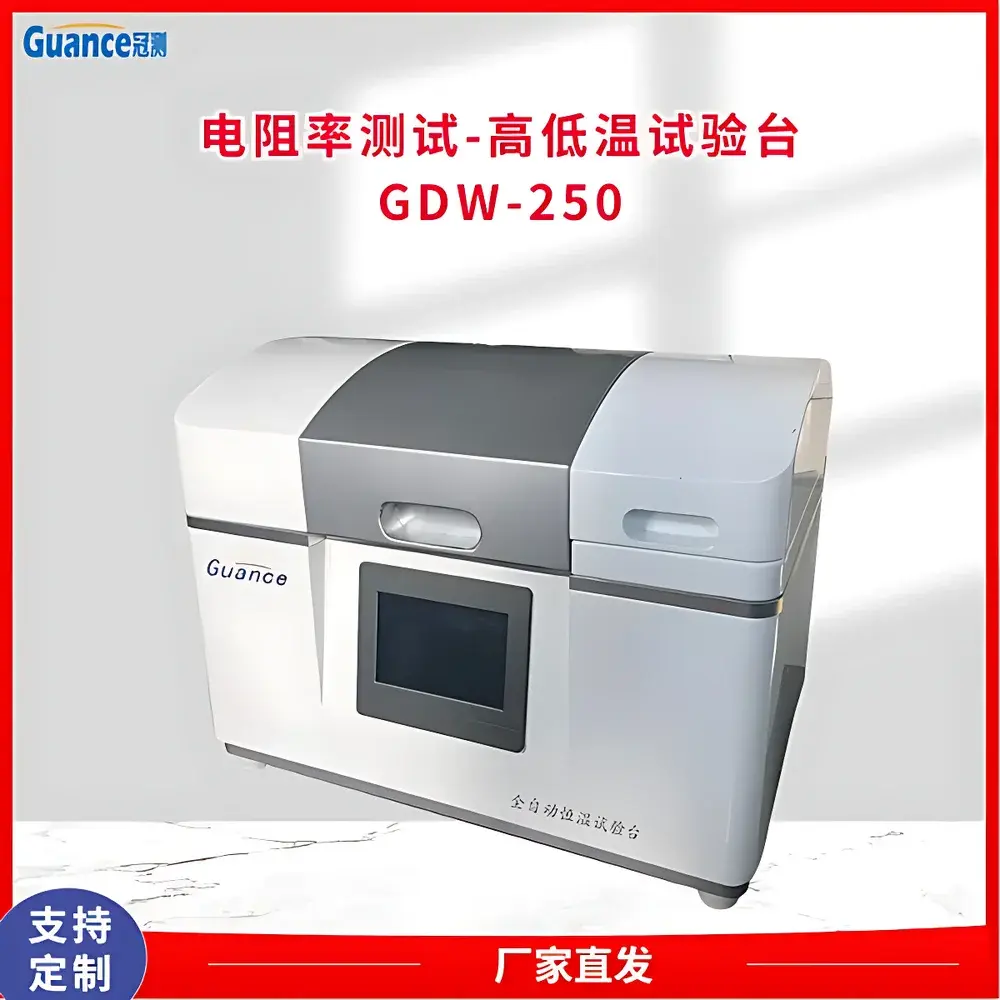
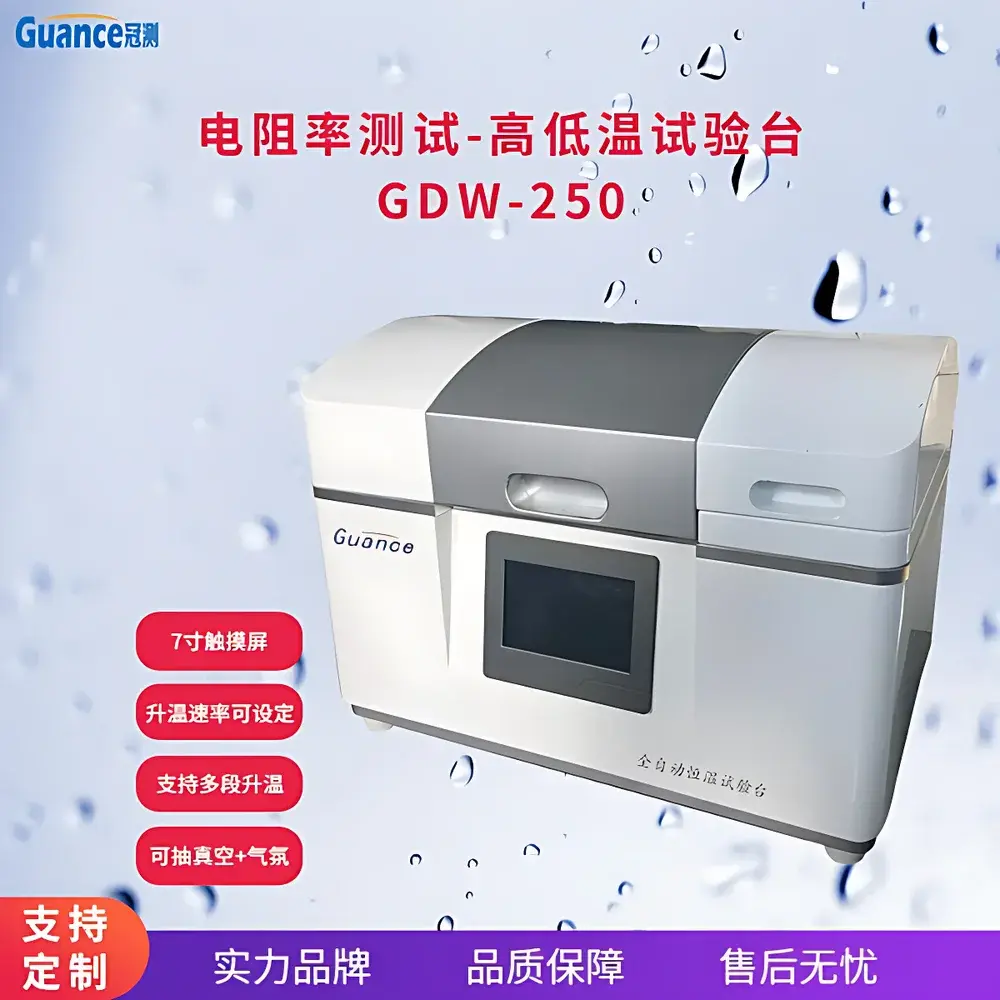
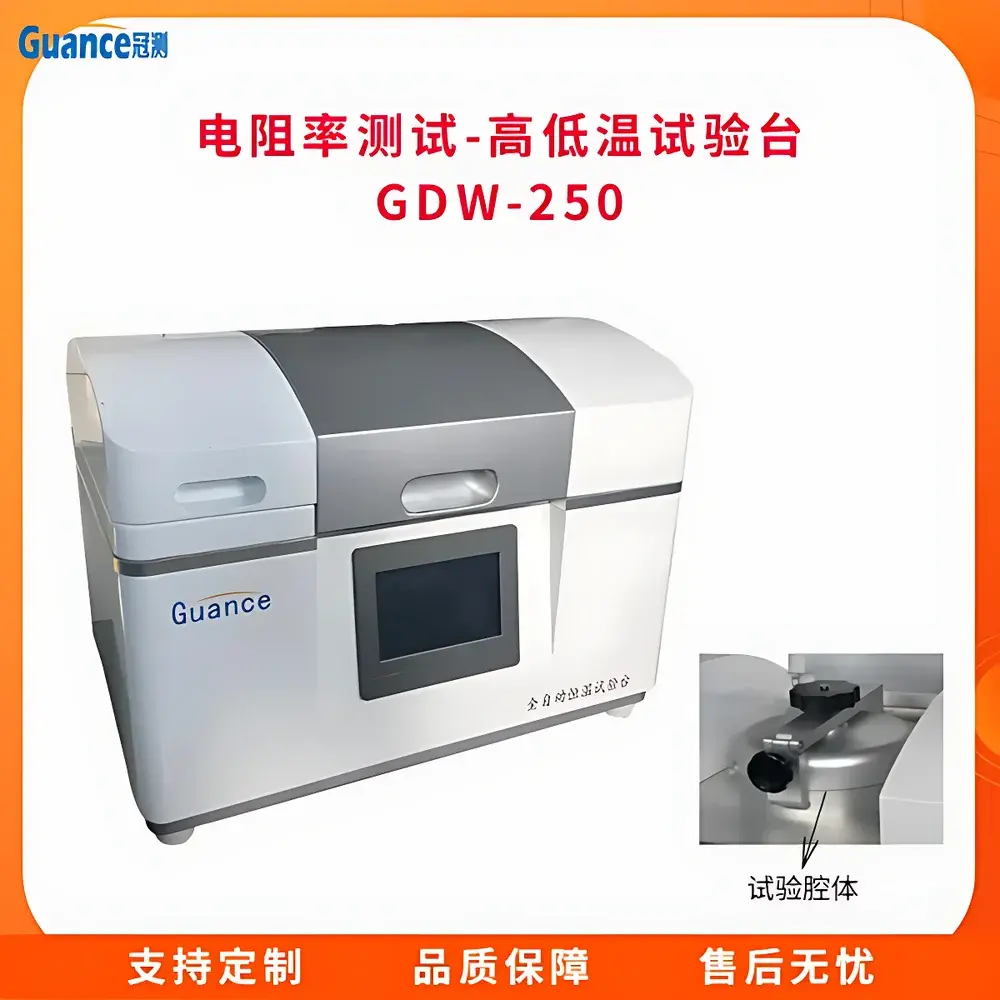
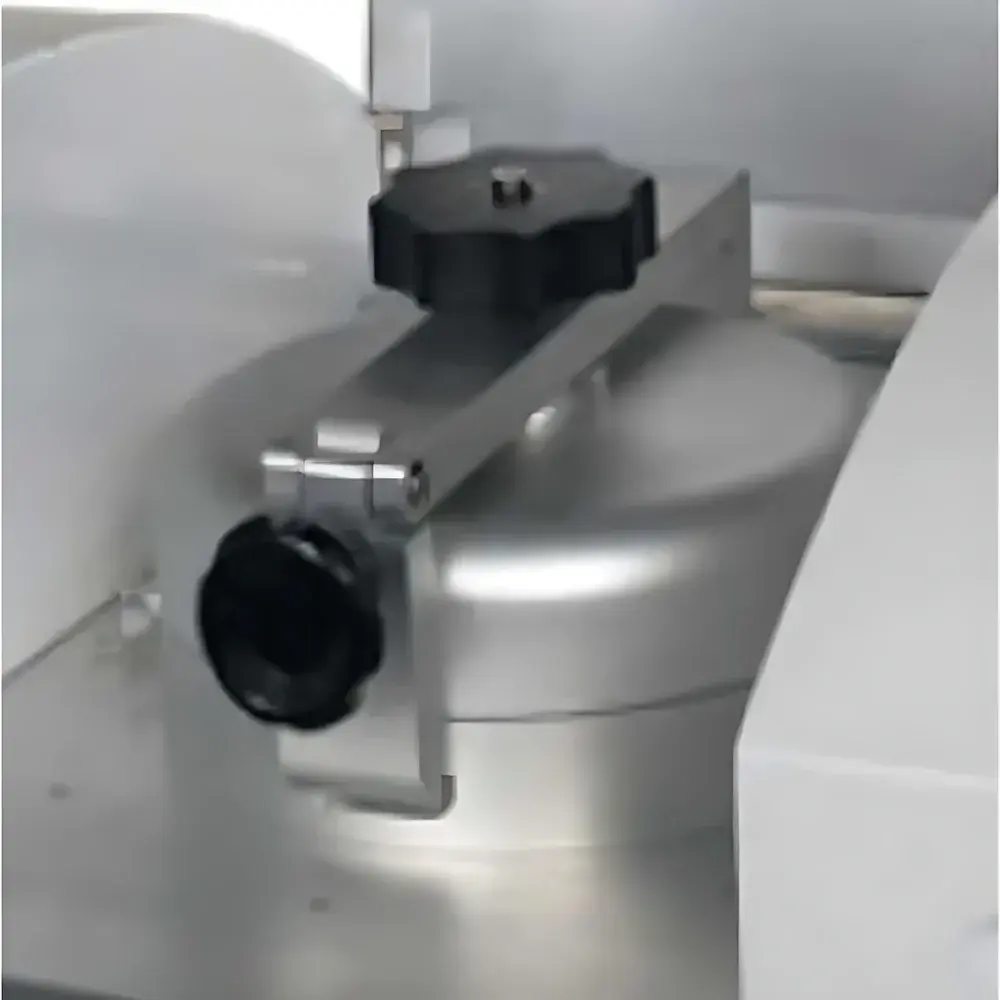
GuanCe Instruments GDW-250c High-Temperature Molten-State Dielectric Constant Analyzer
| Brand | GuanCe Instruments |
|---|---|
| Origin | Beijing, China |
| Manufacturer Type | Authorized Distributor |
| Country of Origin | China |
| Model | GDW-250c |
| Price | USD 410 (converted from ¥2888 at 1 USD = ¥7.0) |
Overview
The GuanCe Instruments GDW-250c High-Temperature Molten-State Dielectric Constant Analyzer is an engineered platform for precise dielectric characterization of insulating and semi-crystalline materials under controlled thermal conditions—from sub-ambient to +250 °C. Designed around a modular temperature-controlled test chamber with integrated electrode fixtures, the system operates on the principle of impedance spectroscopy in the frequency domain (typically 10 Hz–1 MHz), enabling measurement of complex permittivity (ε* = ε′ − jε″), loss tangent (tan δ), and AC resistivity of molten polymers, ceramic precursors, molten salts, and high-temperature resins. Unlike ambient-only dielectric analyzers, the GDW-250c incorporates active thermal stabilization via PID-controlled heating elements and forced-air cooling, supporting ramp-and-hold thermal protocols with programmable heating rates (0.1–10 °C/min). Its structural architecture—600 × 400 × 400 mm (L×W×H), powder-coated steel enclosure—ensures mechanical stability and electromagnetic shielding essential for low-noise capacitance and conductance measurements at elevated temperatures.
Key Features
- Thermal operating range: −40 °C to +250 °C (with optional cryo module; standard configuration covers ambient to 250 °C)
- Programmable heating/cooling rate control with real-time feedback via Pt100 sensor array
- Interchangeable electrode systems: parallel-plate, guarded-ring, and molten-bath immersion configurations compatible with ASTM D150 and IEC 60250 standards
- Variable test voltage selection: 10 V to 1000 V RMS (AC), adjustable in 10-V increments
- Dual-channel real-time plotting: resistivity vs. temperature and dielectric loss vs. frequency, synchronized with thermal profile
- Integrated data logging at user-defined intervals (1 s to 300 s), supporting CSV export and PDF report generation
- Robust mechanical design with vibration-dampened base mount and EMI-suppressed internal cabling
Sample Compatibility & Compliance
The GDW-250c accommodates solid, semi-solid, and fully molten samples with viscosities up to 10⁴ Pa·s, including thermoplastics (e.g., PET, PEEK), polymer melts, glass-forming oxides, and ionic liquid electrolytes. Electrode geometry can be adapted per sample form factor and ISO 2577 or ASTM D1531 guidelines. The system supports compliance workflows aligned with GLP and GMP environments: audit-trail-enabled software logs operator ID, timestamp, parameter changes, and calibration events. While not certified to UL or CE for hazardous-area use, its optional positive-pressure dry-air purge (0.05 MPa) enables operation in inert-atmosphere gloveboxes per ISO 8502-9 requirements. Electrical safety conforms to IEC 61010-1:2010 for laboratory equipment.
Software & Data Management
The proprietary GDW-Control Suite (v3.2) provides full instrument orchestration via USB 2.0 or Ethernet interface. It supports multi-step thermal-dielectric test sequences, including isothermal hold, dynamic ramp, and stepwise voltage sweeps. All acquired datasets embed metadata (sample ID, operator, ambient RH, chamber pressure), ensuring traceability per FDA 21 CFR Part 11 Annex 11 principles. Raw impedance spectra (Z*, θ) and derived parameters (ε′, ε″, σAC) are exportable in IEEE 488.2-compliant format for post-processing in MATLAB, Python (SciPy), or commercial analysis tools like Novocontrol WinDETA. Software includes built-in uncertainty estimation based on instrument repeatability (±0.5% for ε′ at 1 kHz, 120 °C) and thermal gradient compensation algorithms.
Applications
- Quality control of high-performance polymer melts during extrusion process development
- Dielectric relaxation mapping of epoxy curing kinetics under isothermal conditions
- Phase transition detection in ferroelectric ceramics (Curie point determination)
- Ion conduction mechanism analysis in solid-state battery electrolyte candidates
- Temperature-dependent polarization loss evaluation for aerospace-grade composites
- Validation of space-qualified material behavior per ECSS-Q-ST-70-02C
FAQ
What temperature uniformity is maintained across the sample chamber at 250 °C?
Typical axial/radial thermal deviation is ≤ ±1.2 °C over a 25 mm diameter sample zone under steady-state conditions.
Is the system compatible with third-party LCR meters or impedance analyzers?
Yes—GDW-250c features standardized BNC and triaxial output interfaces compliant with Keysight, Solartron, and Hioki instrumentation signal protocols.
Does the software support automated calibration routines?
It includes guided open/short/load compensation sequences traceable to NIST-traceable reference standards (100 pF–10 nF, 1 kΩ–10 MΩ).
Can humidity control be added as an option?
Not natively—but integration with external desiccant-based dry-air generators (dew point ≤ −40 °C) is supported via analog I/O triggers.
What maintenance intervals are recommended for long-term reliability?
Biannual verification of thermal sensor linearity and electrode surface integrity; annual recalibration of voltage/current sensing circuits by authorized service center.



