
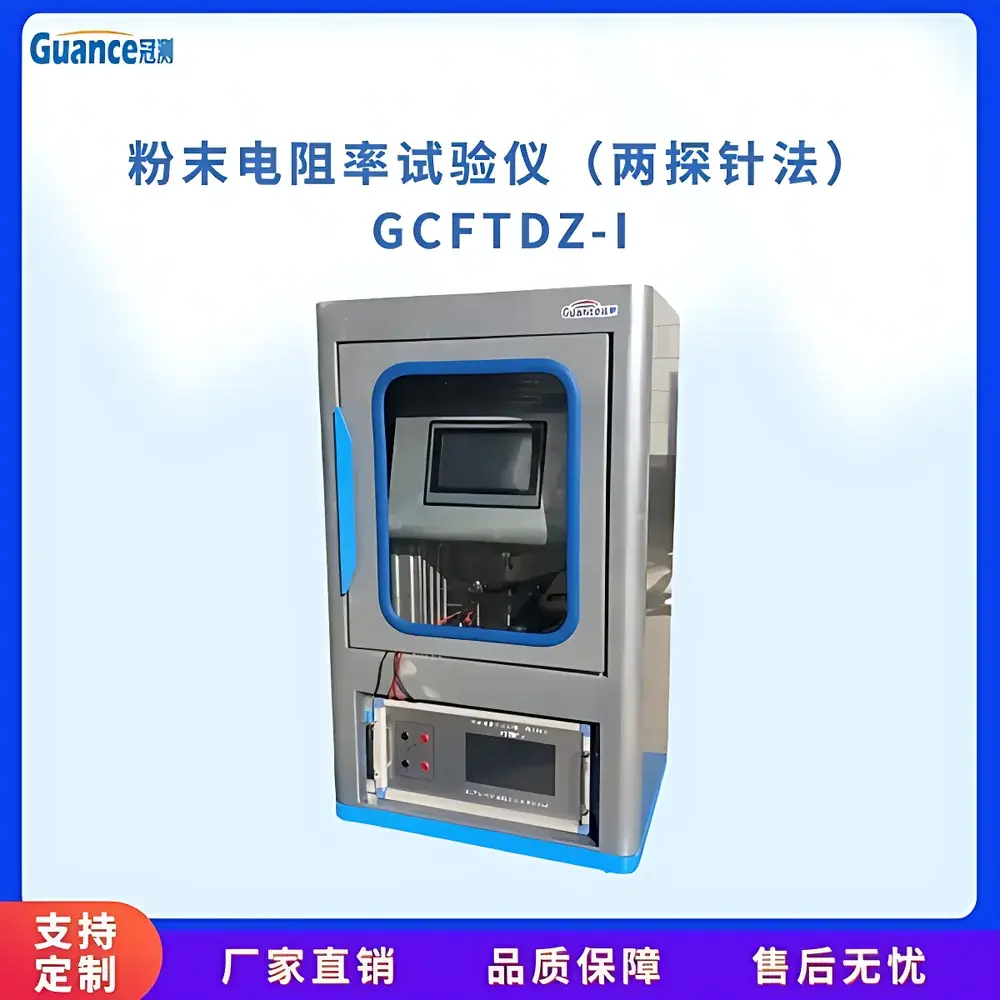
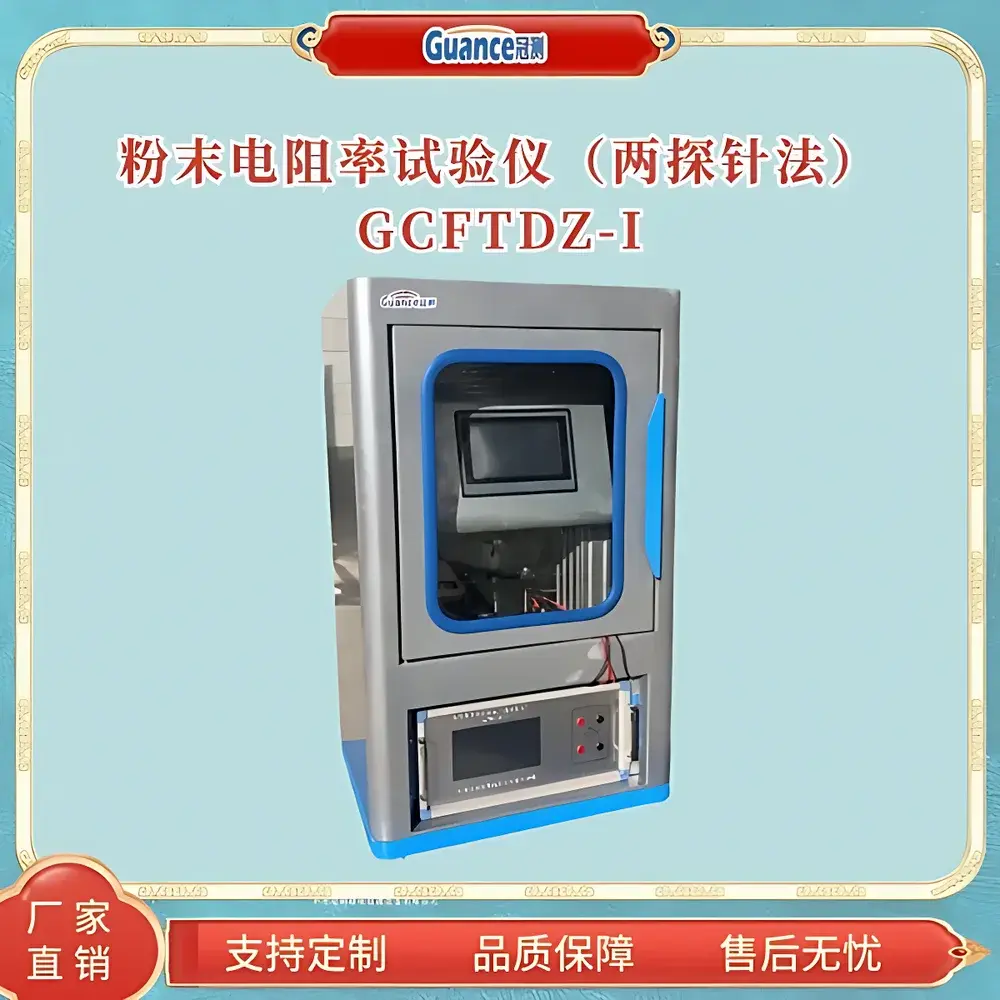
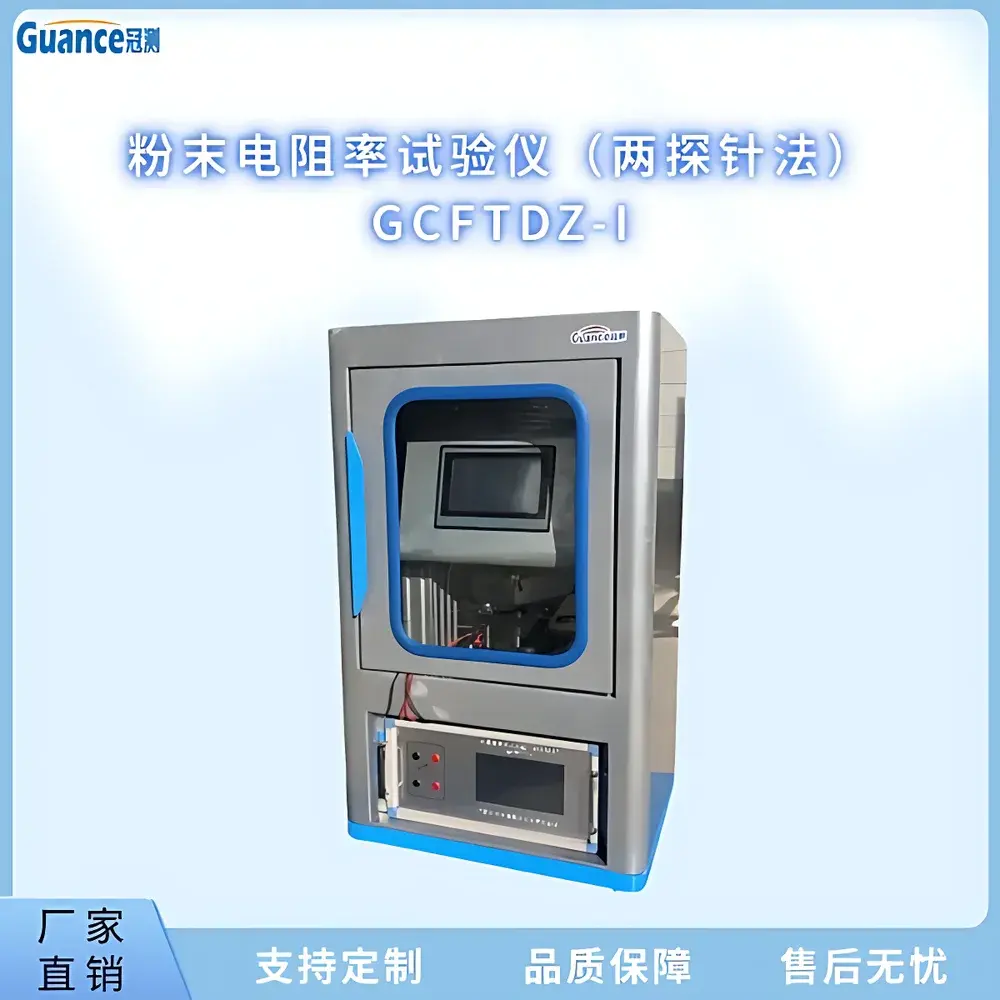
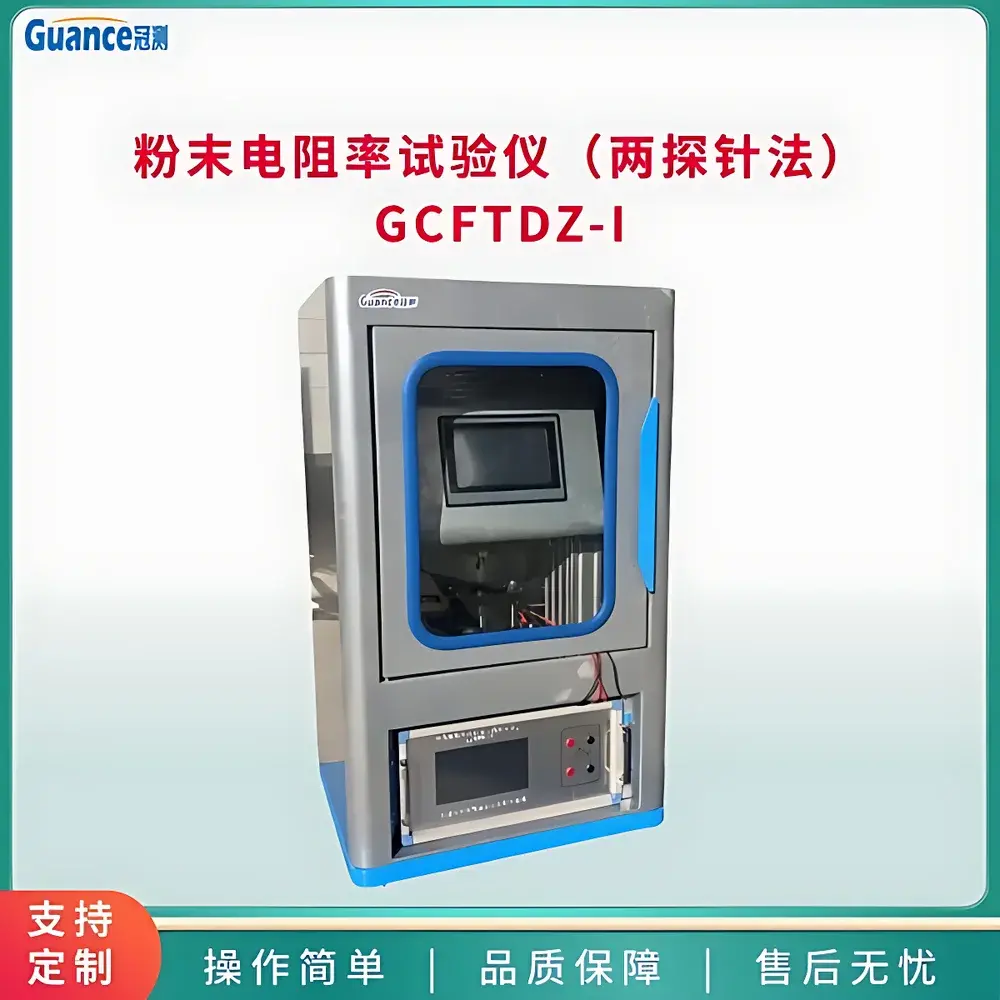
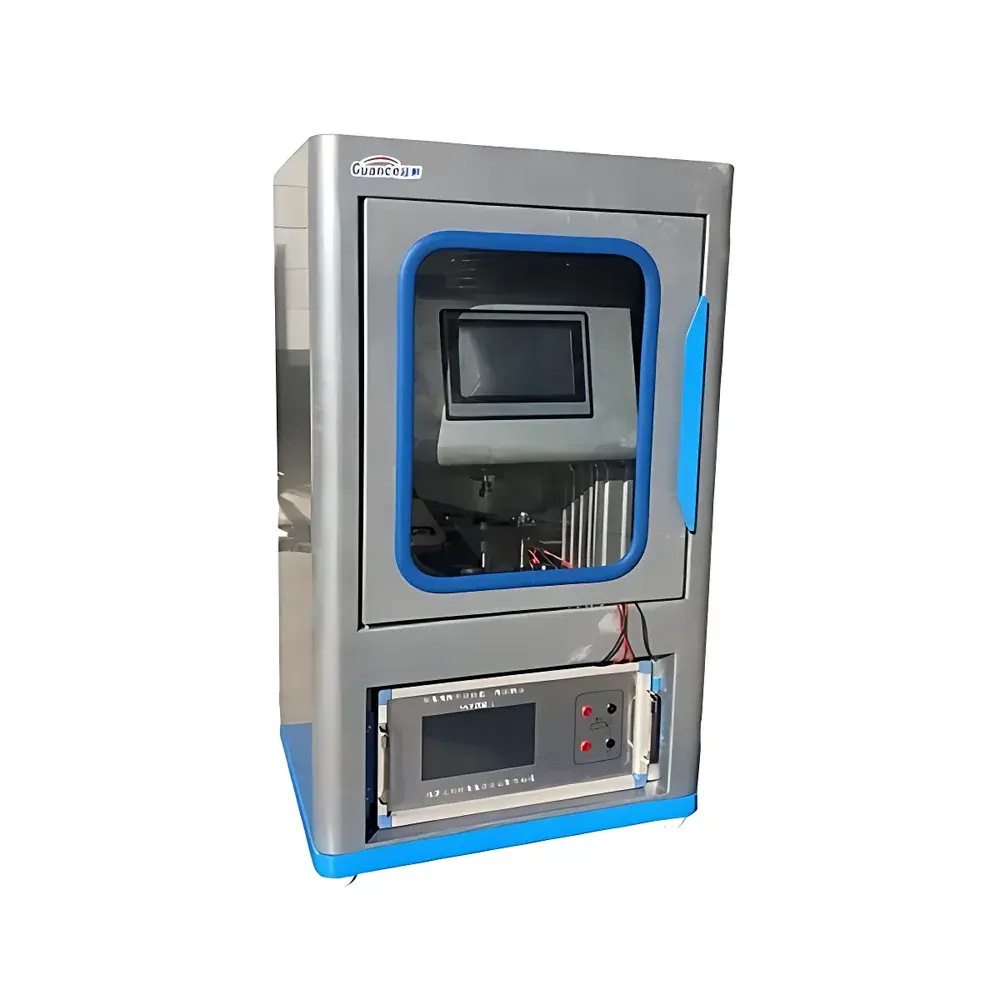
GCFTDZ-I Powder Two-Probe Resistivity Tester
| Brand | Guance Instruments |
|---|---|
| Origin | Beijing, China |
| Model | GCFTDZ-I |
| Pressure Range | 0–5 kN (up to 3.9 MPa) |
| Force Accuracy | ±0.5% FS |
| Resistivity Measurement Range | 10⁻⁶ – 10⁵ Ω·m |
| Current Sources | 10 μA – 10 A (8 ranges) |
| Voltage Resolution | 100 nV (2 mV range) |
| Electrode Diameters | φ16.0 mm & φ30.0 mm |
| Compression Thickness Resolution | ±1 μm |
| Data Output | USB export + thermal printer |
| Control Interface | 10-inch industrial touchscreen with Siemens PLC |
| Compliance | GB/T 24521–2018 |
Overview
The GCFTDZ-I Powder Two-Probe Resistivity Tester is an automated, standards-compliant instrument engineered for precise bulk resistivity characterization of granular carbonaceous materials under controlled compaction. It operates on the two-probe direct-current (DC) method—applying a known current between two coaxial cylindrical electrodes embedded in a confined powder column, then measuring the resulting voltage drop across the same electrode pair. Resistivity (ρ) is calculated using the geometric correction factor derived from electrode diameter and compressed sample height: ρ = R × (πd²/4h), where R is measured resistance, d is electrode diameter, and h is compacted thickness. Designed specifically to meet the requirements of GB/T 24521–2018 (“Test Method for Electrical Resistivity of Carbon Raw Materials and Coke”), the system ensures traceable, repeatable measurements for raw material qualification in carbon anode, graphite electrode, and metallurgical coke production.
Key Features
- Fully automated electromechanical compaction: servo-driven loading system delivers precise pressure control (0–5 kN, max 3.9 MPa) with programmable ramp rate, dwell time, and automatic return-to-zero positioning.
- Dual-electrode compatibility: interchangeable φ16.0 mm and φ30.0 mm stainless-steel electrodes—each calibrated for defined particle size ranges (0.315–0.5 mm and 0.5–1.0 mm, respectively)—ensuring optimal contact area and minimal edge effects.
- Multi-mode compression protocols: supports constant-force, constant-pressure, stepwise gradient pressure/pressure, and displacement-controlled (compression ratio) testing—enabling correlation of resistivity with density evolution.
- Real-time parameter monitoring: simultaneous display and logging of force, pressure, compacted height (±1 µm resolution), apparent density, applied current, measured voltage, resistance, resistivity, and conductivity—all with selectable units (e.g., Ω·m, S/m, mS/cm).
- High-fidelity DC resistance measurement: eight programmable current source ranges (10 µA to 10 A), four voltage ranges (2 mV to 2 V), ±0.5% current accuracy, ±0.1% voltage accuracy, and 10⁻⁸ Ω resolution ensure robust performance across insulating to moderately conductive powders.
- Integrated industrial control architecture: Siemens S7-1200 PLC coordinates motion, electrical measurement, and data acquisition; 10-inch HMI touchscreen provides intuitive workflow navigation, parameter configuration, and real-time curve plotting without external PC dependency.
Sample Compatibility & Compliance
The GCFTDZ-I is validated for use with dry, free-flowing carbonaceous powders conforming to GB/T 24521–2018 specifications—including calcined anthracite, petroleum coke (green and calcined), graphitized coke, needle coke, graphite powder, and carbon black. Sample preparation follows standardized sieving, drying, and mass-weighing procedures prior to loading into the precision-machined die cavity. The instrument’s mechanical and electrical calibration protocols align with ISO/IEC 17025 general requirements for competence of testing and calibration laboratories. While not certified to ASTM D3764 or IEC 62631-3-1, its measurement methodology is functionally equivalent to two-probe DC resistivity assessment per those standards when operated within specified dimensional and environmental constraints (23 ± 2 °C, RH < 60%). All test reports include timestamped metadata, operator ID, environmental conditions, and full audit trail for GLP-compliant documentation.
Software & Data Management
Data acquisition and reporting are managed entirely through the embedded HMI firmware. Each test generates a structured record containing raw sensor values (force, displacement, voltage, current), derived parameters (resistivity, density, conductivity), and user-defined metadata (sample ID, batch number, operator). Reports are exportable via USB to CSV format for downstream statistical analysis in MATLAB, Python (Pandas), or Excel. On-device thermal printing produces hard-copy certificates with instrument ID, calibration due date, and signature field. The system supports firmware updates over Ethernet or USB—enabling future protocol enhancements and regulatory alignment (e.g., optional 21 CFR Part 11-compliant electronic signatures via external authentication module).
Applications
- Quality control of carbon raw materials in aluminum smelting anode manufacturing.
- Process optimization of calcination and graphitization by correlating resistivity trends with thermal history.
- R&D evaluation of novel carbon composites, battery anode precursors, and conductive fillers.
- Supplier qualification audits requiring documented resistivity-density relationships under standardized compaction.
- Educational laboratories teaching fundamental principles of powder conductivity, contact resistance, and percolation theory.
FAQ
What standards does the GCFTDZ-I comply with?
It is designed and verified for GB/T 24521–2018. Its measurement principle is compatible with ASTM D3764 (for molded carbon products) and IEC 62631-3-1 (for dielectric materials), though formal certification requires third-party validation.
Can the instrument measure anisotropic resistivity?
No—it implements isotropic two-probe geometry. For directional (in-plane vs. through-thickness) resistivity, four-probe or van der Pauw configurations are required.
Is calibration traceable to national standards?
Yes—force transducers are calibrated against NIM-traceable deadweight standards; voltage and current channels are verified using Fluke 8508A metrology-grade calibrators.
What maintenance is required?
Annual verification of load cell linearity and electrode surface flatness; periodic cleaning of die cavity and electrode contacts with isopropyl alcohol; no lubrication of the servo drive mechanism is needed.
Does the system support remote monitoring?
The PLC supports Modbus TCP/IP communication; integration with SCADA or LIMS systems is possible via custom configuration—contact technical support for protocol documentation.



