
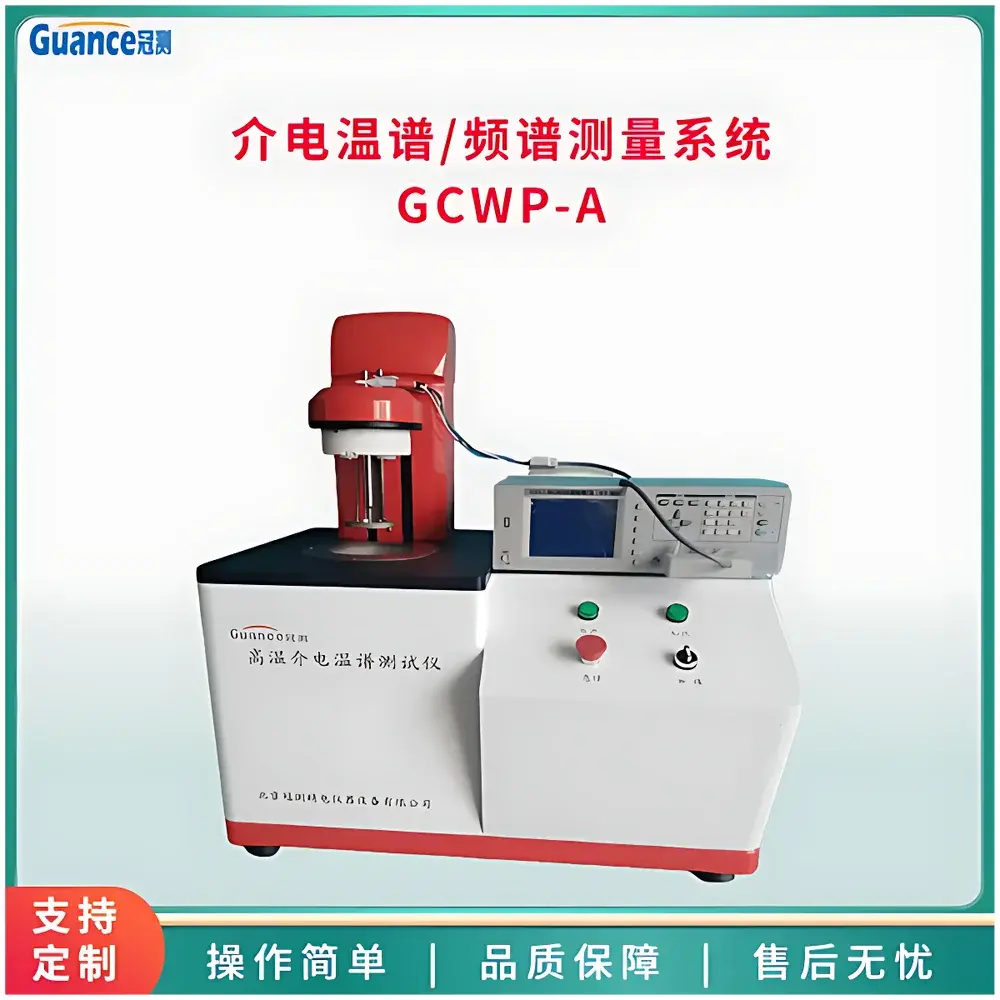
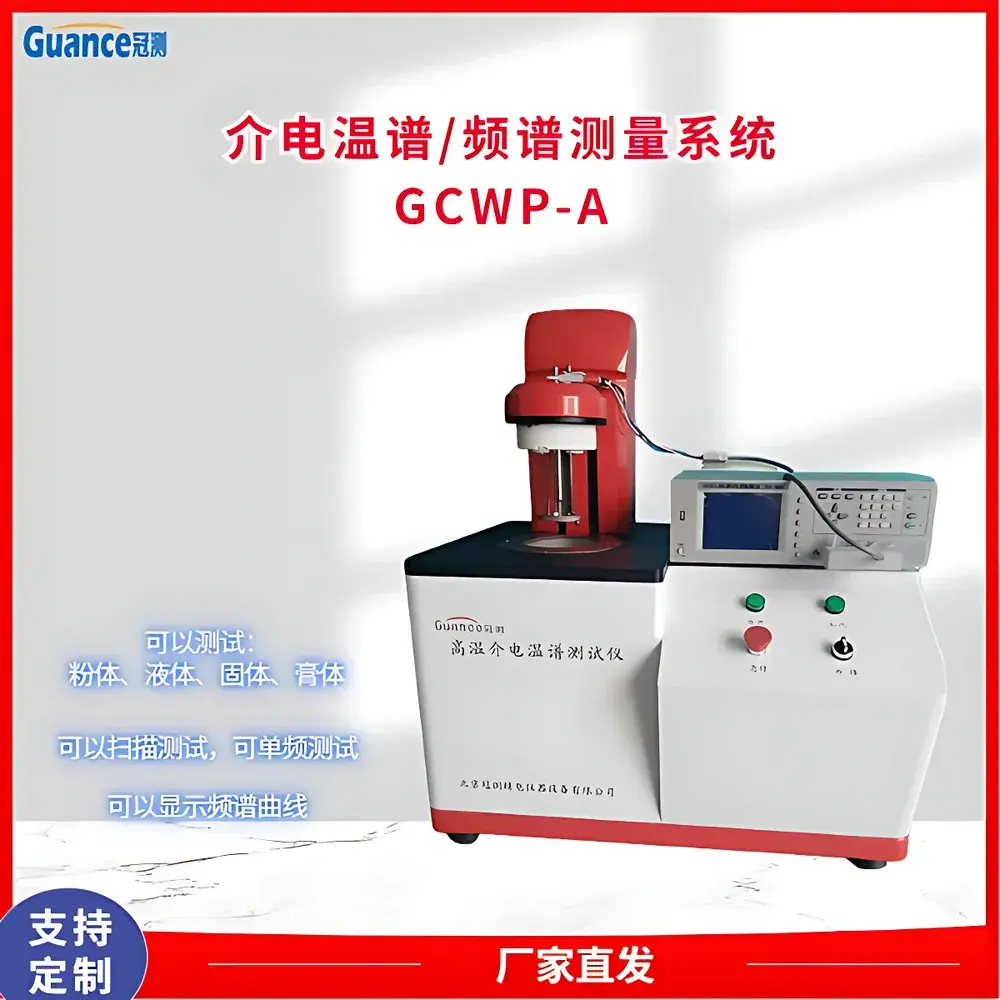
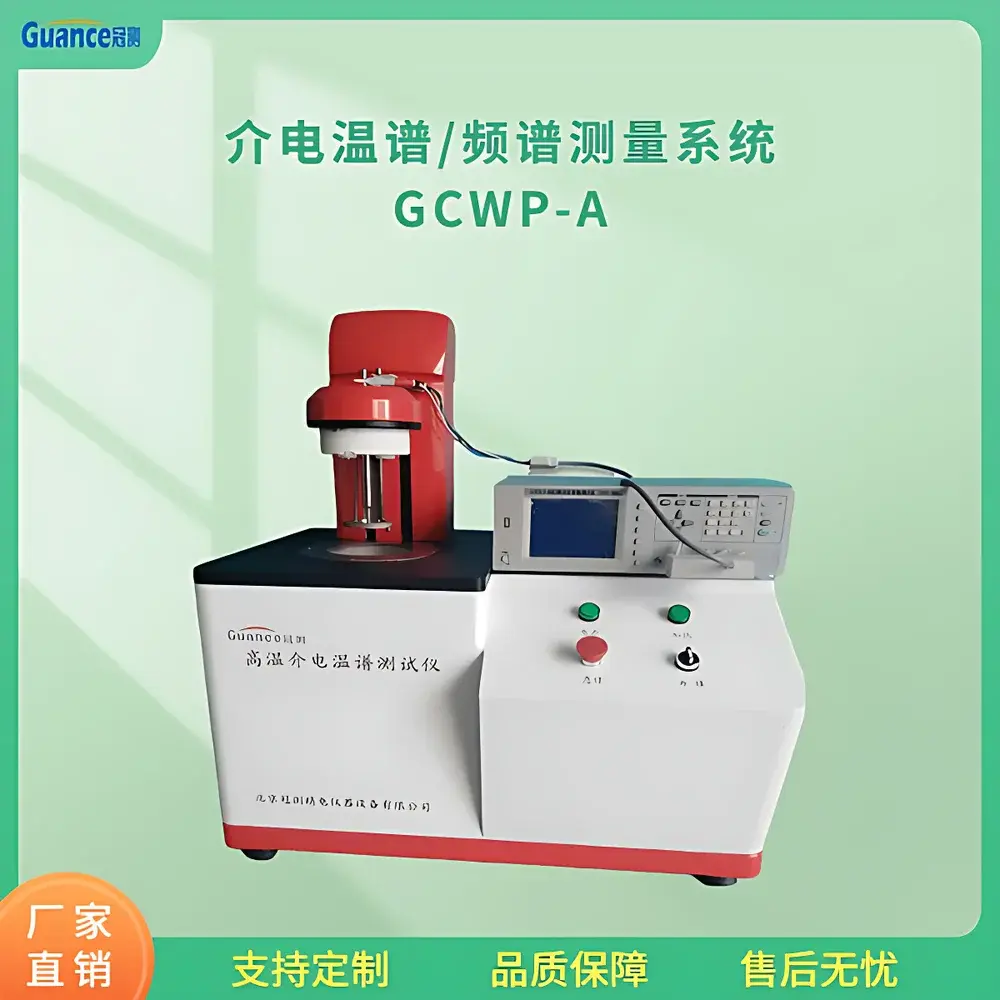
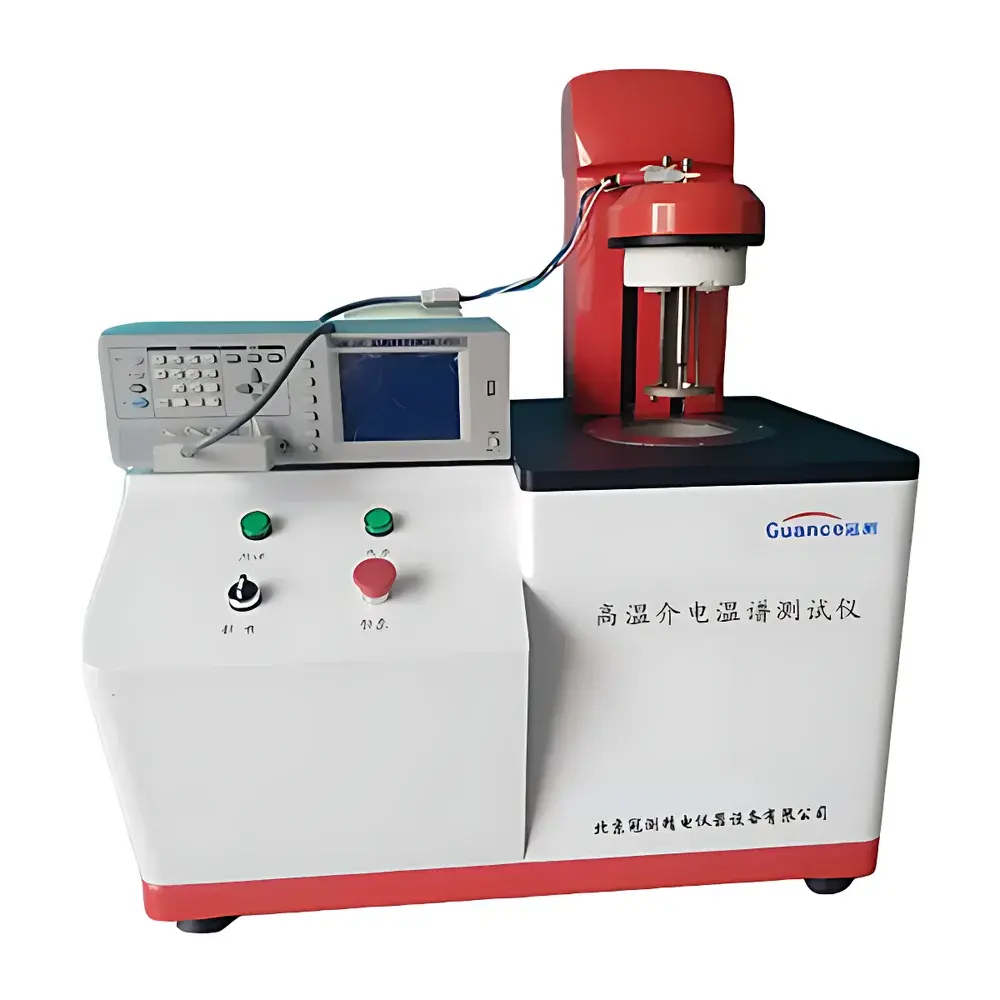
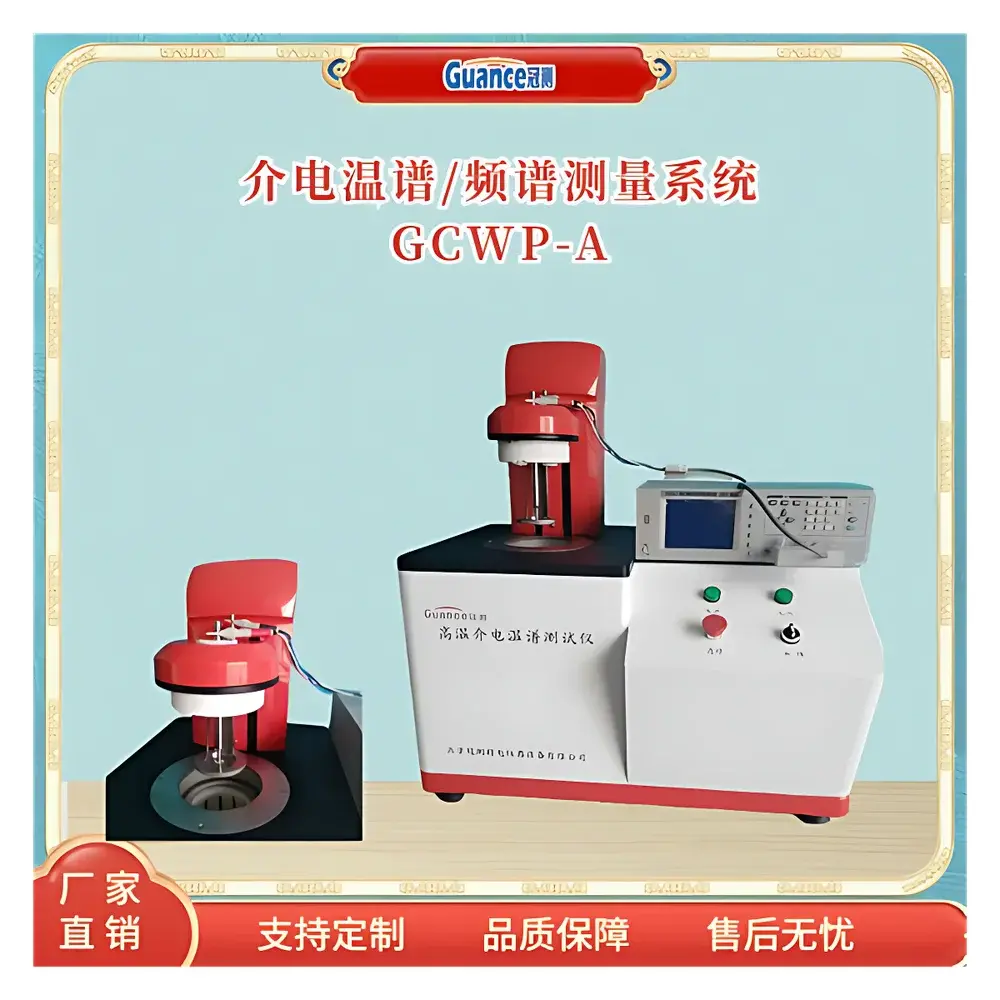
GuanCe Instruments GCWP-A3 Ferroelectric & Dielectric Property Characterization System
| Brand | GuanCe Instruments |
|---|---|
| Origin | Beijing, China |
| Manufacturer Type | Authorized Distributor |
| Country of Origin | China |
| Model | GCWP-A3 |
| Supply Voltage | AC 220 V, 50 Hz |
| Power Consumption | 2 kW |
| Electrode Diameter | 6 mm |
| Number of Electrodes | 4 (quad-channel) |
| Electrode Housing | Inner layer — 304 stainless steel |
| Temperature Range | −180 °C to +500 °C |
| Heating Rate | 0.5–2.5 °C/min |
| Measurement Frequency Range | As specified by integrated impedance analyzer |
| Impedance Analyzer | Keysight 4294A (or equivalent high-precision LCR bridge) |
| Data Cable | Silver-plated copper, cryogenic-grade shielded cable |
| Enclosure Material | Q235 carbon steel with high-temperature epoxy powder coating |
| Operating Environment | Low-dust, low-vibration, non-corrosive atmosphere |
| Data Output | Raw measurement files (CSV/ASCII), real-time Lissajous & Cole-Cole plots, printable test reports |
| Test Modes | Manual and programmable automated sequence |
| Sample Switching Interval | User-definable time-based channel selection |
Overview
The GuanCe Instruments GCWP-A3 Ferroelectric & Dielectric Property Characterization System is a fully integrated, temperature-controlled platform engineered for precision measurement of complex permittivity (ε′, ε″), loss tangent (tan δ), polarization hysteresis (P–E loops), and related ferroelectric parameters across extreme thermal conditions. Built upon the metrological foundation of a Keysight 4294A precision impedance analyzer (or functionally equivalent high-stability LCR bridge), the system employs guarded four-terminal sensing architecture and actively temperature-regulated quad-channel electrode modules to ensure traceable, reproducible dielectric response data from cryogenic (−180 °C) to high-temperature (500 °C) regimes. Its design adheres to fundamental principles of dielectric spectroscopy—namely, small-signal AC impedance analysis under controlled electric field bias—and supports both static (zero-frequency limit) and dynamic (frequency-swept) characterization protocols required for advanced functional materials R&D.
Key Features
- Quad-channel electrode module with four independent 6 mm diameter gold-plated brass electrodes, each housed in a dual-layer shield: inner 304 stainless steel cylinder for mechanical rigidity and thermal uniformity, outer PTFE sleeve for electrical insulation and low-loss dielectric isolation.
- Programmable sample switching logic enabling sequential or parallel acquisition across up to four specimens without manual reconfiguration—switching intervals configurable in 1-second increments via embedded controller.
- Cryogenic-compatible silver-plated copper coaxial cabling with triple-layer shielding (braided Cu + Al foil + Mu-metal) minimizes parasitic capacitance and EMI coupling, critical for sub-pF resolution at low temperatures.
- High-fidelity temperature control subsystem featuring liquid nitrogen-cooled cryostat integration (optional) and resistive heating elements with PID feedback loop, achieving ±0.3 °C stability over full −180 °C to +500 °C range and linear ramp rates adjustable between 0.5 and 2.5 °C/min.
- Ruggedized enclosure fabricated from Q235 structural steel with high-temperature epoxy powder coating (rated to 600 °C), providing electromagnetic shielding (≥60 dB attenuation at 1 MHz), mechanical robustness, and corrosion resistance in laboratory environments.
- Dual-mode operation: manual mode for exploratory testing and calibration verification; automated mode supporting user-defined temperature–frequency–bias sequences compliant with ASTM D150, IEC 60250, and ISO 257 standards.
Sample Compatibility & Compliance
The GCWP-A3 accommodates disk-shaped, pelletized, or thin-film specimens with diameters ≥6 mm and thicknesses between 0.1 mm and 5 mm. Electrode contact is ensured via spring-loaded, low-force pneumatic actuators to prevent cracking of brittle ceramics (e.g., BaTiO₃, PZT, BiFeO₃) or delamination of polymer films (e.g., PVDF-TrFE). All hardware and firmware comply with CE marking requirements for EMC Directive 2014/30/EU and Low Voltage Directive 2014/35/EU. Data acquisition workflows support audit-trail generation and electronic signature capability, aligning with GLP and GMP documentation expectations per FDA 21 CFR Part 11 when deployed in regulated QC laboratories.
Software & Data Management
The system ships with proprietary WinDielec v4.2 software (Windows 10/11 64-bit), offering real-time visualization of complex impedance spectra, Cole-Cole plots, Arrhenius activation energy fitting, and automatic extraction of Curie temperature (TC) from ε′(T) inflection points. Raw datasets are exported in ASCII-compliant CSV format with metadata headers (timestamp, channel ID, temperature, frequency, Vac, Vdc, Z, θ, ε′, ε″, tan δ), ensuring seamless import into MATLAB, Python (NumPy/Pandas), or OriginLab. Report generation includes customizable templates conforming to internal SOPs or external standards such as ASTM E112 or ISO 11357-4.
Applications
- Temperature-dependent dielectric spectroscopy of ferroelectric, relaxor, and antiferroelectric oxides for phase transition mapping and domain dynamics analysis.
- Characterization of polymer-ceramic composites used in embedded capacitors, where interfacial polarization and Maxwell-Wagner effects dominate at low frequencies.
- Quality assurance of thin-film ferroelectrics in MEMS actuators and non-volatile memory devices, including coercive field (Ec) and remnant polarization (Pr) quantification under bipolar drive.
- High-temperature stability assessment of gate dielectrics (e.g., HfO₂, Al₂O₃) in power electronics packaging under thermal cycling stress.
- Low-temperature dielectric relaxation studies in superconducting precursor materials and quantum paraelectrics (e.g., SrTiO₃).
FAQ
What impedance analyzers are compatible with the GCWP-A3 system?
The GCWP-A3 is factory-integrated with the Keysight 4294A LCR analyzer (40 Hz – 110 MHz); however, its analog/digital I/O interface supports third-party instruments meeting IEEE-488.2 (GPIB) or USB-TMC communication protocols, including Zurich Instruments MFIA and Solartron Modulab systems.
Can the system perform simultaneous multi-frequency measurements at fixed temperature?
Yes—user-defined frequency lists can be executed at each temperature step during automated sweeps, enabling construction of 3D ε*(f,T) datasets suitable for master curve analysis via time–temperature superposition.
Is vacuum or inert gas purging supported inside the chamber?
The chamber features dual 6 mm Swagelok ports for optional N₂ or Ar purge; vacuum compatibility up to 10⁻² mbar requires add-on turbomolecular pump kit (sold separately).
How is electrode calibration performed?
Open/short/load compensation routines follow IEC 60250 Annex B guidelines and are executed automatically prior to each test sequence using certified calibration standards traceable to NIST SRM 1828.
Does the software support scripting for custom test protocols?
Yes—WinDielec includes embedded Python 3.9 interpreter with full API access to instrument control, data streaming, and post-processing functions, enabling lab-specific automation beyond GUI presets.



