
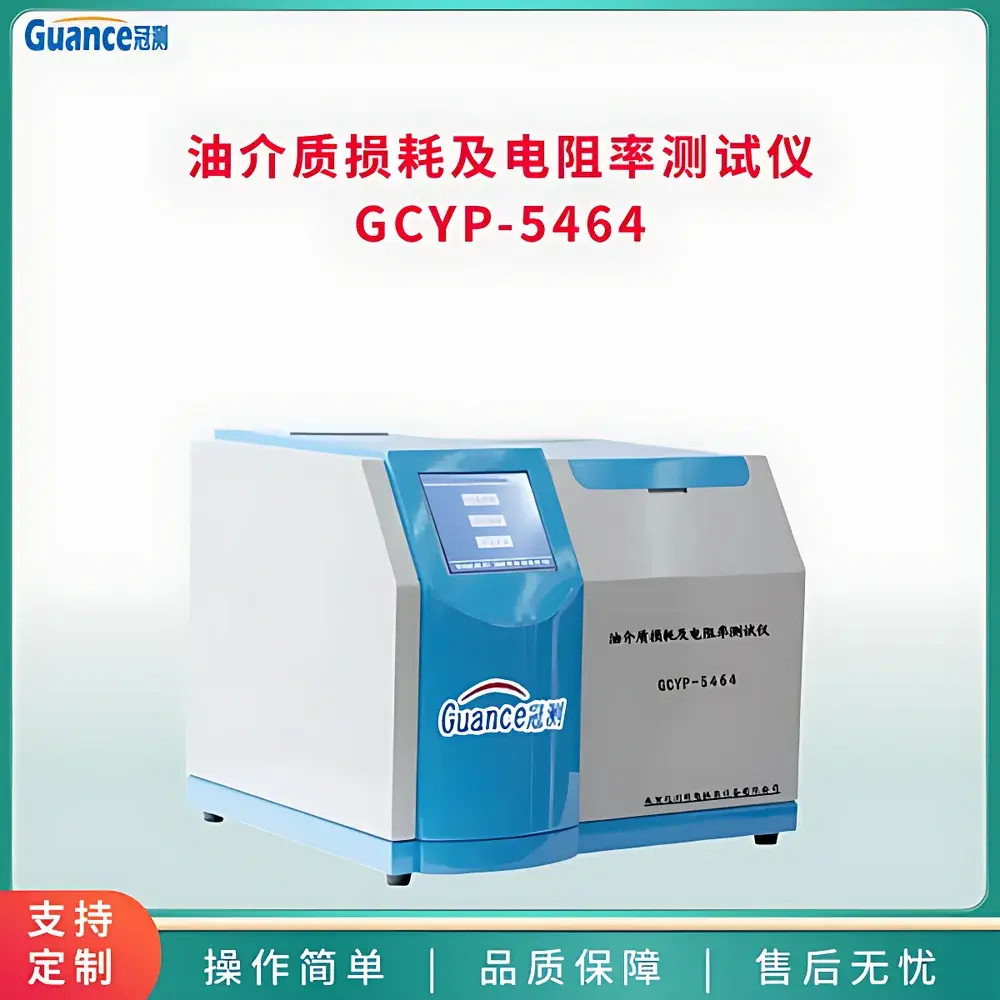
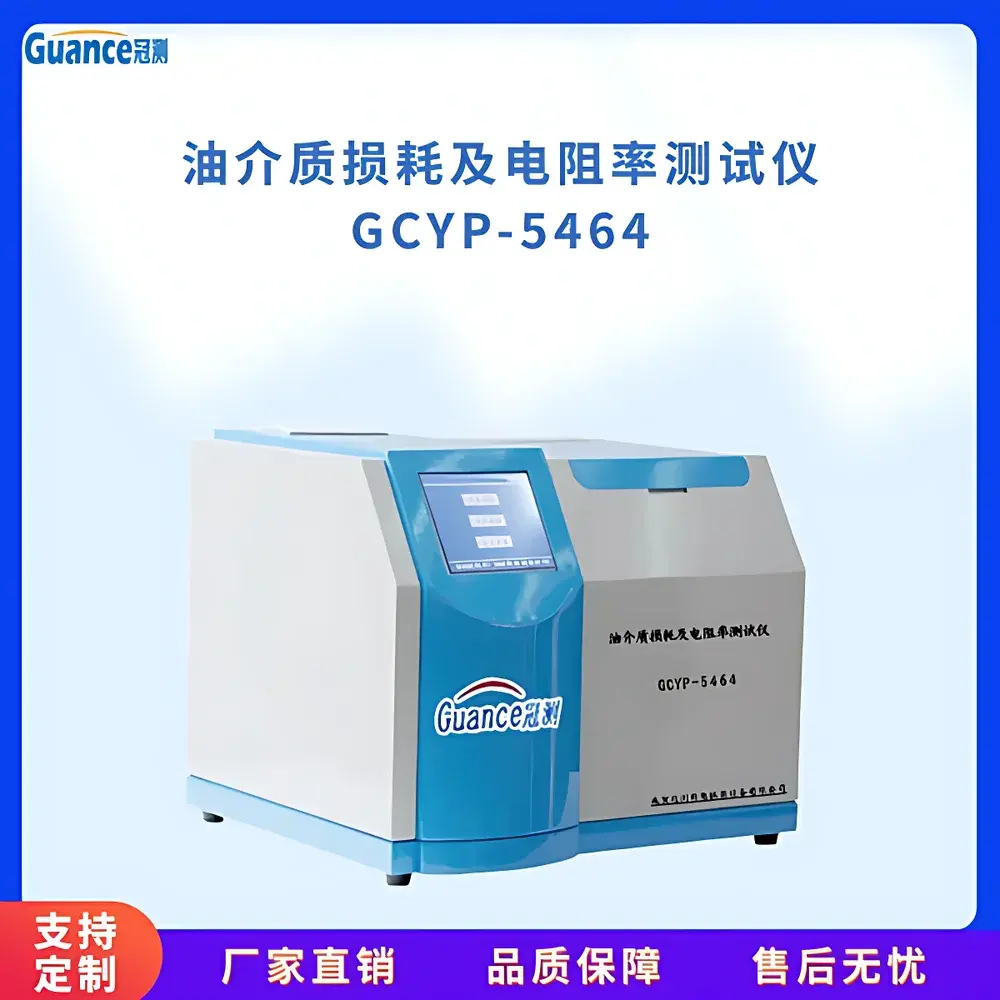
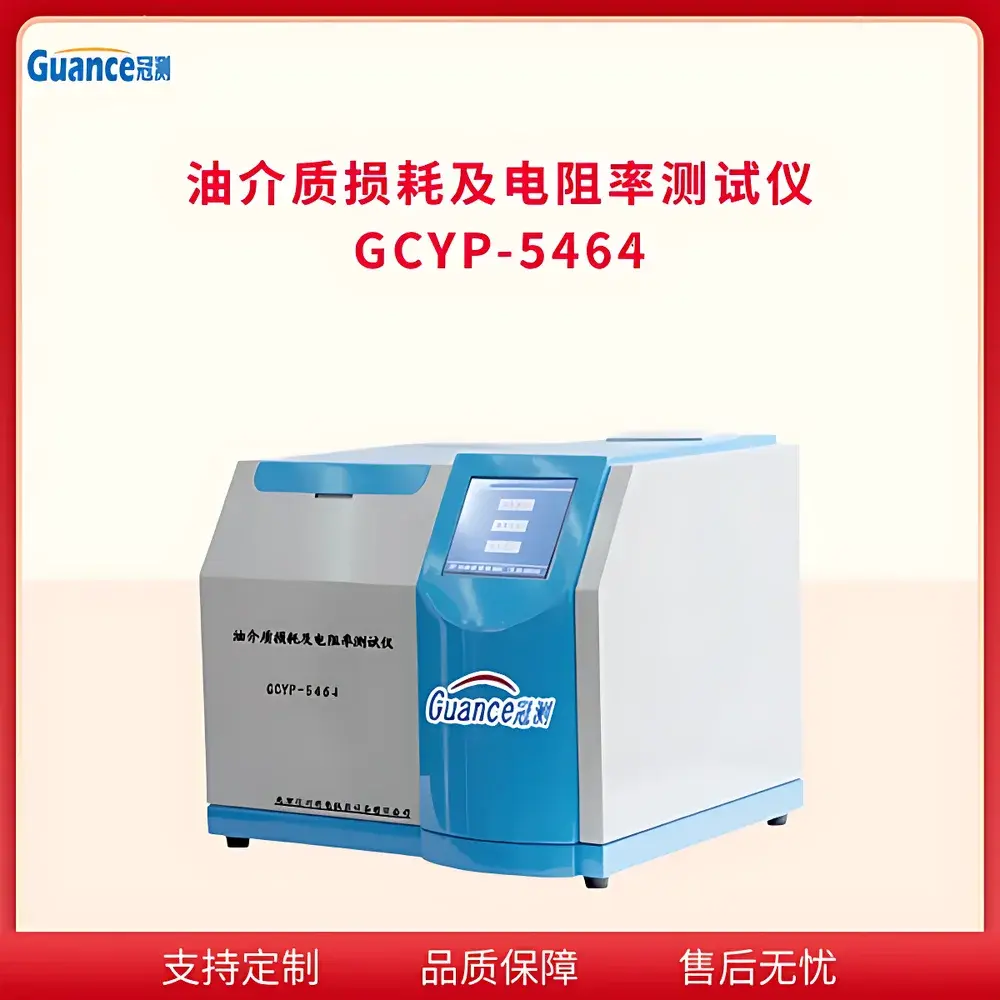
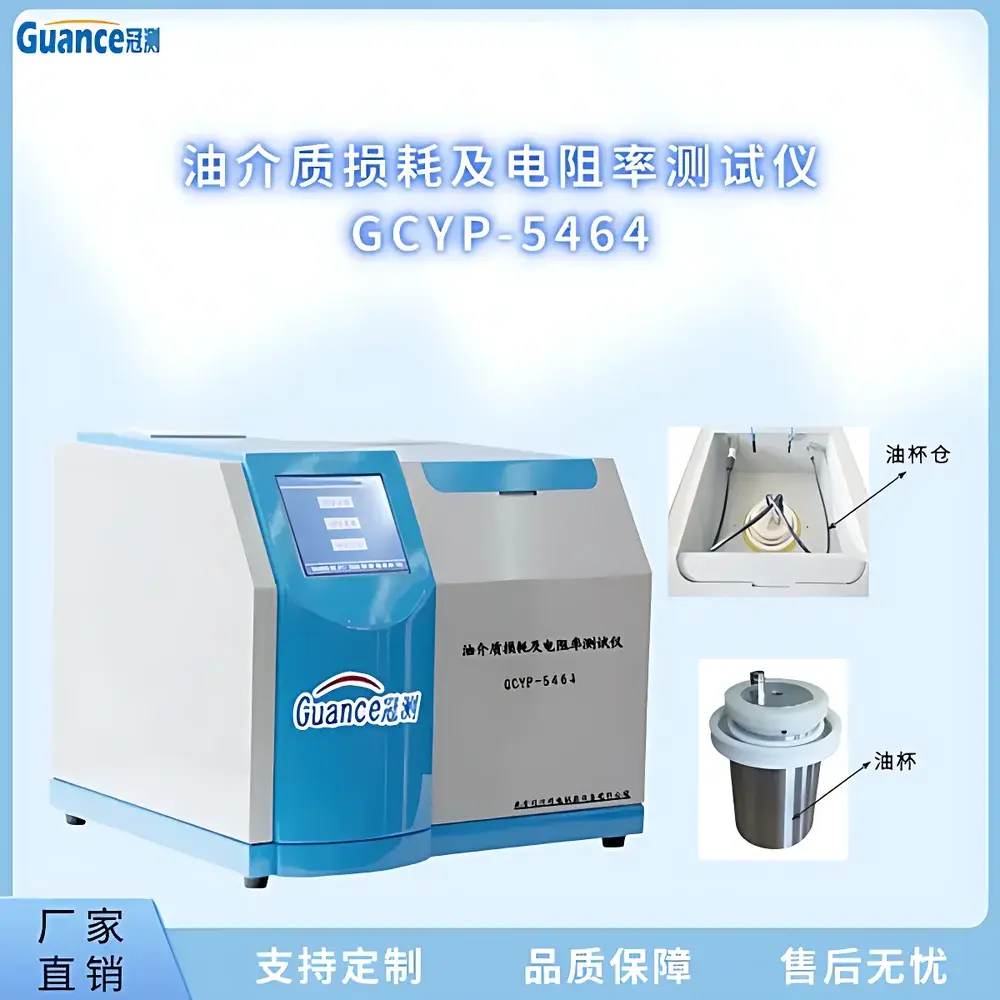
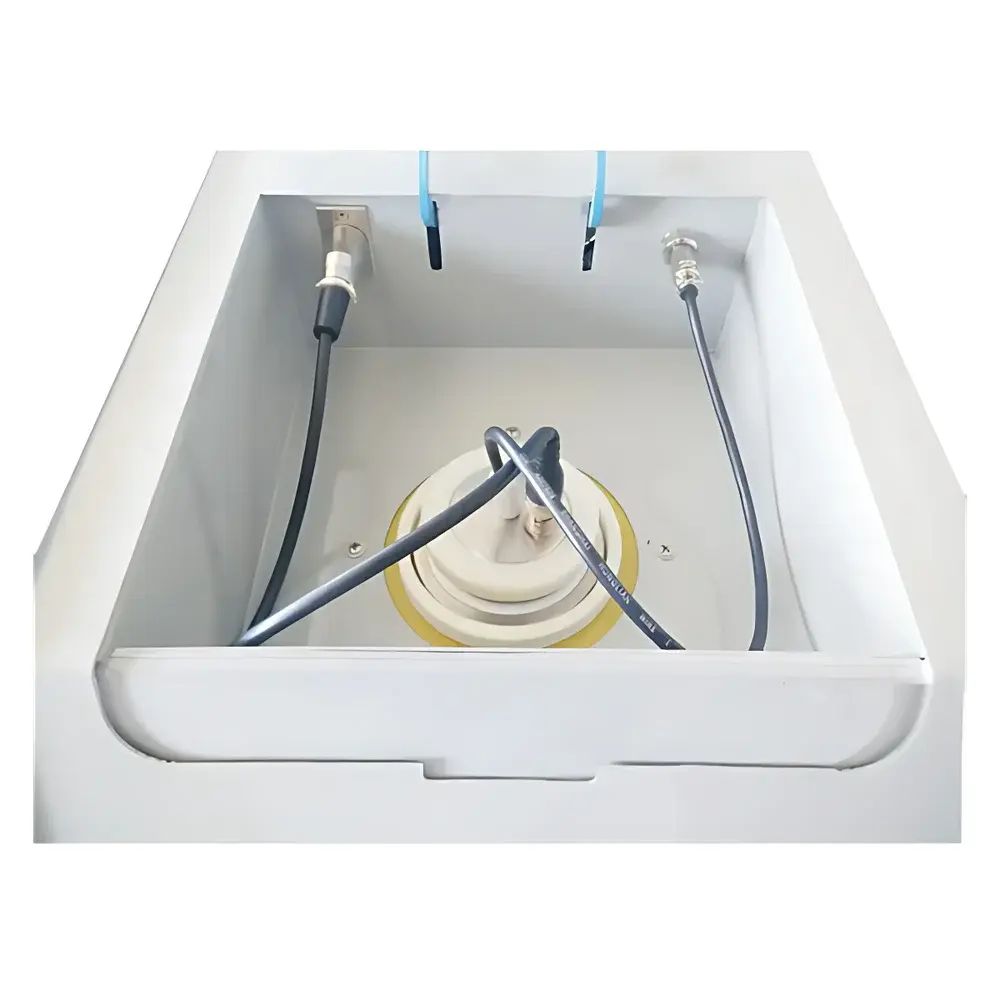
GuanCe GCYP-5464 Dielectric Loss and Resistivity Tester for Insulating Oil
| Brand | GuanCe Instruments |
|---|---|
| Origin | Beijing, China |
| Manufacturer Type | Authorized Distributor |
| Country of Origin | China |
| Model | GCYP-5464 |
| Price | USD 1,550 (FOB Beijing) |
| Power Supply | AC 220 V ±10%, 50/60 Hz ±1% |
| Capacitance Range | 5–200 pF |
| Relative Permittivity Range | 1.000–30.000 |
| Dissipation Factor (tan δ) Range | 1×10⁻⁵–100 |
| DC Resistivity Range | 2.5 MΩ·m – 20 TΩ·m |
| tan δ Accuracy | ±(5% of reading + 0.0002) |
| Permittivity Accuracy | ±(1–10)% of reading |
| Resistivity Accuracy | ±10% of reading |
| Temperature Control Range | 40–120 °C |
| Temp. Accuracy | ±0.5 °C |
| AC Test Voltage | 200–2200 V (50 Hz, continuously adjustable) |
| DC Test Voltage | 0–500 V (continuously adjustable) |
| Heating Method | Medium-frequency induction with PID control |
| Electrode Configuration | Three-terminal electrode cup per GB/T 5654–2007 (2 mm inter-electrode gap) |
| Display | 5.7″ TFT color touch LCD |
| Data Storage | Internal non-volatile memory with timestamp (RTC integrated) |
| Compliance | Designed to meet requirements of GB/T 5654–2007, ASTM D924, IEC 60247, and supports GLP-compliant reporting |
Overview
The GuanCe GCYP-5464 Dielectric Loss and Resistivity Tester is a fully integrated, microprocessor-controlled instrument engineered for precise measurement of dielectric dissipation factor (tan δ), relative permittivity (εr), and DC volume resistivity (ρ) of liquid insulating media—primarily mineral insulating oils used in power transformers, circuit breakers, and high-voltage apparatus. It operates on the principles of precision AC bridge measurement (Schering bridge topology) for tan δ and εr, combined with guarded electrode DC current measurement under controlled thermal conditions for resistivity determination. The system conforms to the core physical test methodology specified in GB/T 5654–2007, which aligns closely with international standards including IEC 60247 and ASTM D924. Its monolithic architecture integrates a temperature-regulated three-terminal test cell, medium-frequency induction heating module, digital AC/DC high-voltage sources, reference SF6-filled standard capacitor, and high-impedance electrometer—all calibrated and synchronized within a single embedded RAM9-based control platform.
Key Features
- Three-terminal oil test cell compliant with GB/T 5654–2007, featuring a fixed 2 mm electrode gap to minimize stray capacitance and surface leakage effects during tan δ measurement.
- Medium-frequency induction heating with closed-loop PID temperature control ensures uniform, contactless thermal equilibration across the oil sample; temperature stability maintained within ±0.5 °C over the full 40–120 °C operating range.
- Internally mounted SF6-filled three-electrode reference capacitor provides long-term stability of capacitance value and negligible dielectric loss, eliminating environmental drift in bridge calibration.
- Dual-mode high-voltage generation: programmable 200–2200 V AC (50 Hz) for dielectric response testing, and 0–500 V DC for resistivity evaluation—both continuously adjustable with real-time voltage monitoring.
- Integrated safety architecture includes overvoltage/overcurrent cutoff, HV short-circuit detection, open-sensor alarm for temperature probes, and hardware-limited thermal cutoff at 120 °C via fail-safe relay.
- 5.7″ full-color TFT capacitive touch display with intuitive Chinese-language GUI; all operations—including parameter setup, test initiation, result review, and print/export—are accessible without specialized training.
- Onboard real-time clock (RTC) stamps every measurement with date and time; results—including raw capacitance, tan δ, εr, ρ, and temperature—are stored in non-volatile memory and exportable via built-in thermal printer.
Sample Compatibility & Compliance
The GCYP-5464 is validated for use with hydrocarbon-based insulating oils (e.g., naphthenic and paraffinic mineral oils), synthetic esters, and silicone fluids meeting IEC 60296 or ASTM D3487 specifications. It supports routine quality assurance per transformer maintenance protocols (IEC 60429, IEEE C57.106) and laboratory accreditation requirements under ISO/IEC 17025. While designed primarily to GB/T 5654–2007, its measurement traceability extends to ASTM D924 (dielectric dissipation factor), ASTM D1169 (resistivity), and IEC 60247 (permittivity and tan δ). The instrument’s data logging structure—including operator ID fields, test condition metadata, and automatic calibration timestamps—enables compliance with GLP documentation practices and supports audit readiness for regulated environments.
Software & Data Management
The GCYP-5464 employs an embedded firmware environment with no external PC dependency. All measurement sequences are executed autonomously following user-defined test templates. Raw and derived parameters are stored in structured binary format with CRC integrity checks. Each record contains: test ID, timestamp, oil temperature, applied voltage(s), measured capacitance, tan δ, εr, ρ, and pass/fail flags against user-configurable limits. Internal thermal printing produces hard-copy reports with header information (model, serial number, calibration due date) and full metrological traceability. Although no USB or Ethernet interface is provided, printed outputs include QR-coded batch identifiers for manual entry into LIMS systems. Firmware updates are performed via SD card, and calibration coefficients are protected by write-lock EEPROM sectors.
Applications
- Routine acceptance testing of new insulating oil prior to transformer filling.
- Periodic condition monitoring of in-service transformer oil to assess oxidation, moisture ingress, and aging by tracking progressive increases in tan δ and reductions in resistivity.
- Diagnostic evaluation following electrical faults or thermal events—elevated tan δ at elevated temperatures often indicates sludge formation or polar contaminant accumulation.
- QC verification of reclaimed or reconditioned oil batches against specification thresholds (e.g., tan δ < 0.005 at 90 °C per IEC 60429).
- Research-grade characterization of alternative insulating fluids (e.g., natural/synthetic esters) where comparative dielectric performance under thermal stress is required.
FAQ
What standards does the GCYP-5464 directly support?
It is engineered to comply with GB/T 5654–2007 and functionally equivalent clauses in IEC 60247 and ASTM D924.
Can the instrument measure samples other than mineral oil?
Yes—it accommodates any low-conductivity liquid dielectric with viscosity ≤ 50 cSt and flash point > 100 °C, including silicone fluids and bio-based esters.
Is external calibration required between uses?
No. The internal SF6 reference capacitor and auto-zeroing electrometer eliminate daily recalibration; annual verification against NIST-traceable standards is recommended.
How is temperature uniformity ensured across the oil volume?
Medium-frequency induction heats the metallic cup wall directly, generating eddy currents that conduct heat radially inward—achieving ±0.3 °C gradient across typical 35 mL sample volumes.
Does the system support FDA 21 CFR Part 11 compliance?
Not natively—the instrument lacks electronic signature capability and audit trail encryption; however, printed reports with unique test IDs and timestamps satisfy basic ALCOA+ principles for non-GMP laboratories.



