
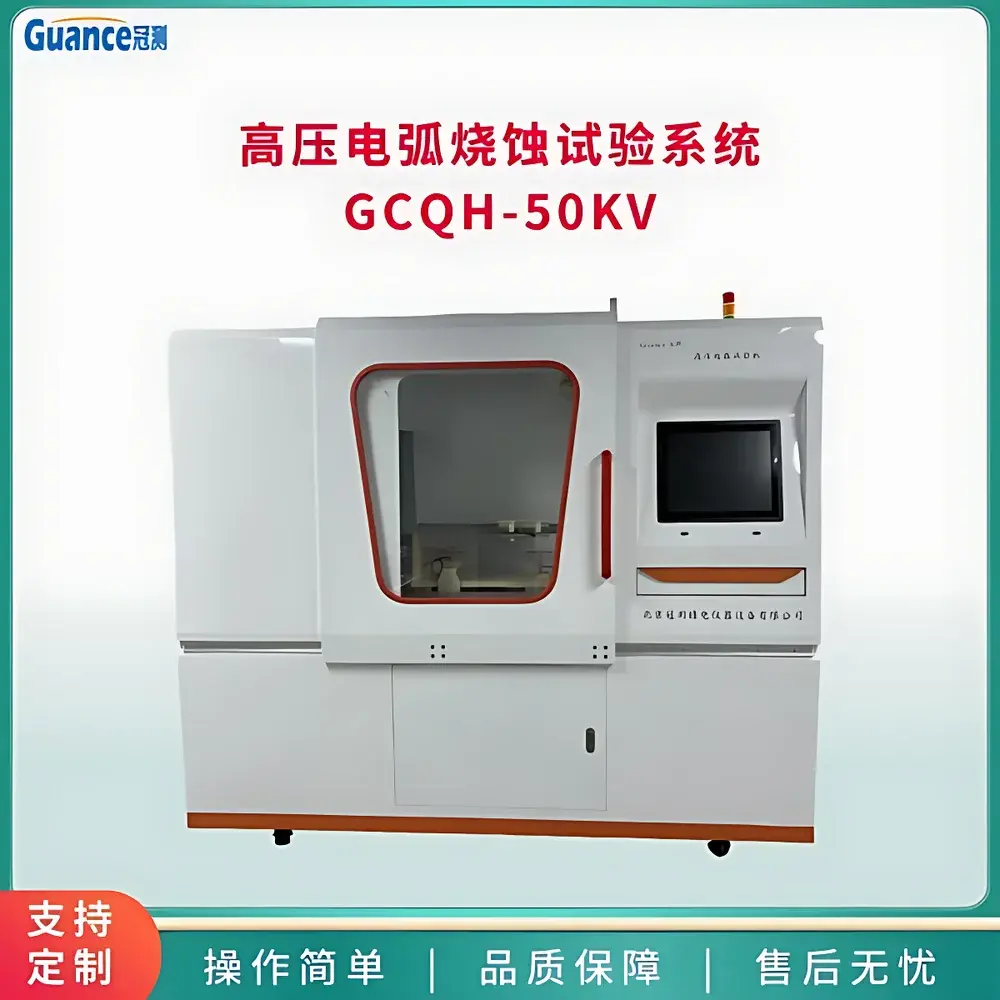
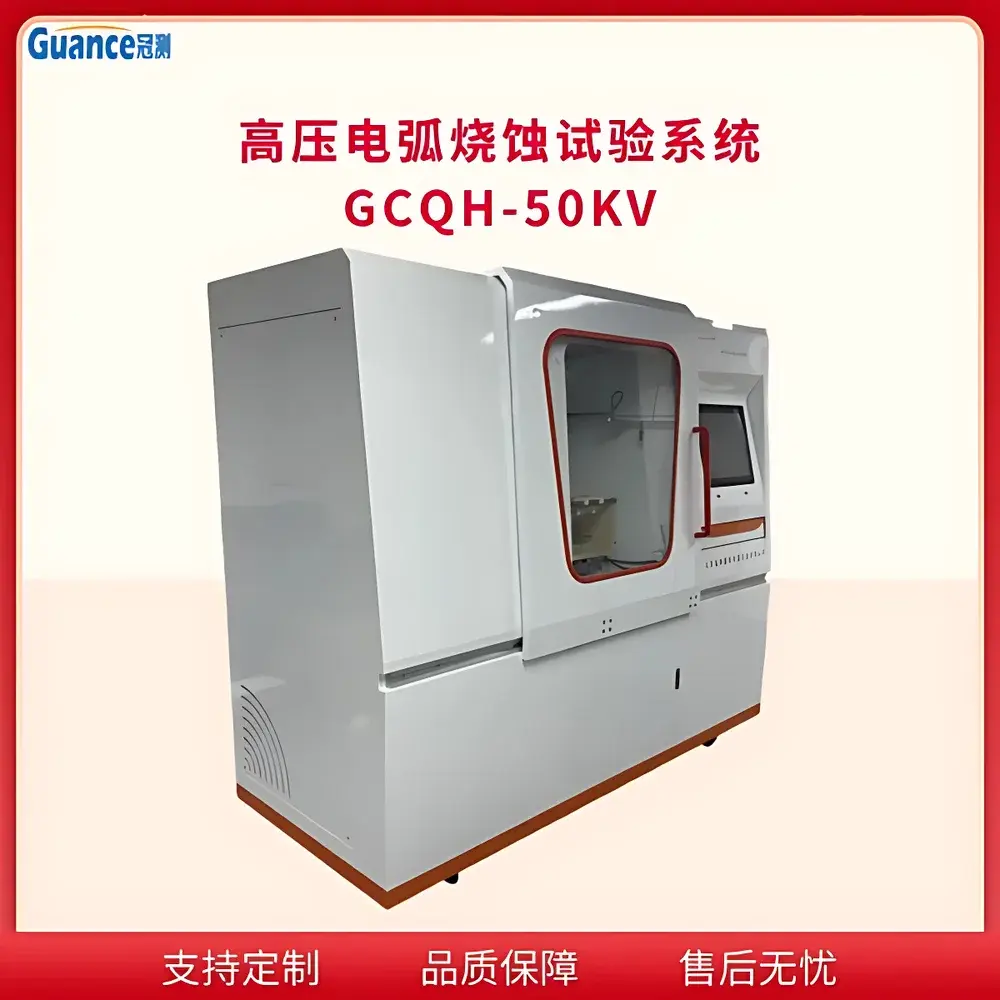
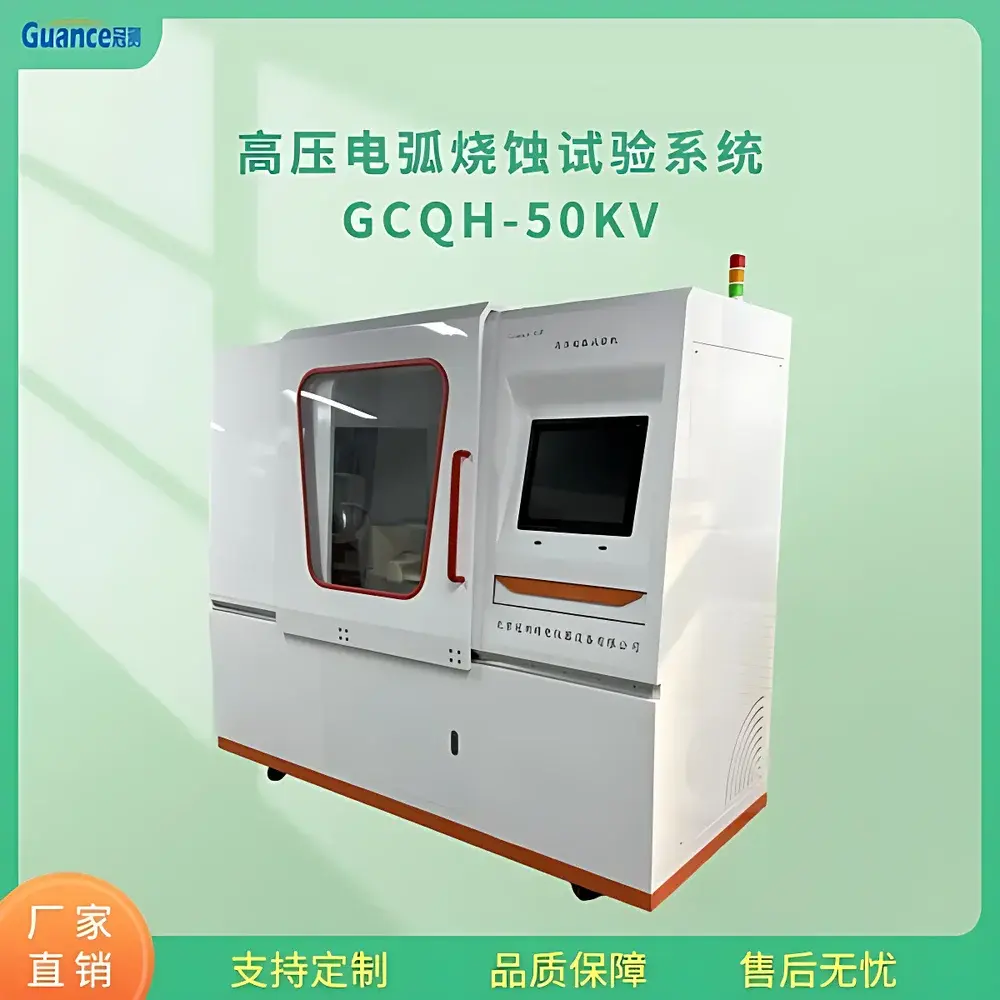
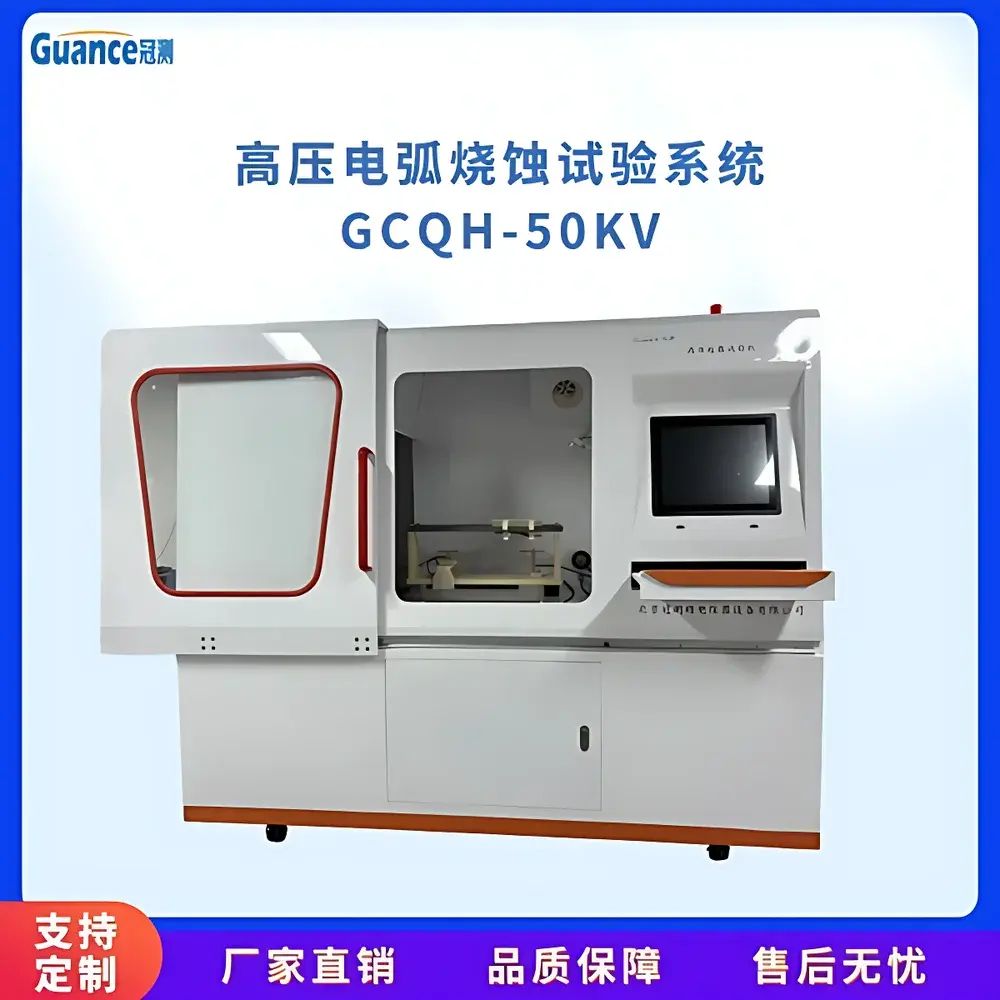
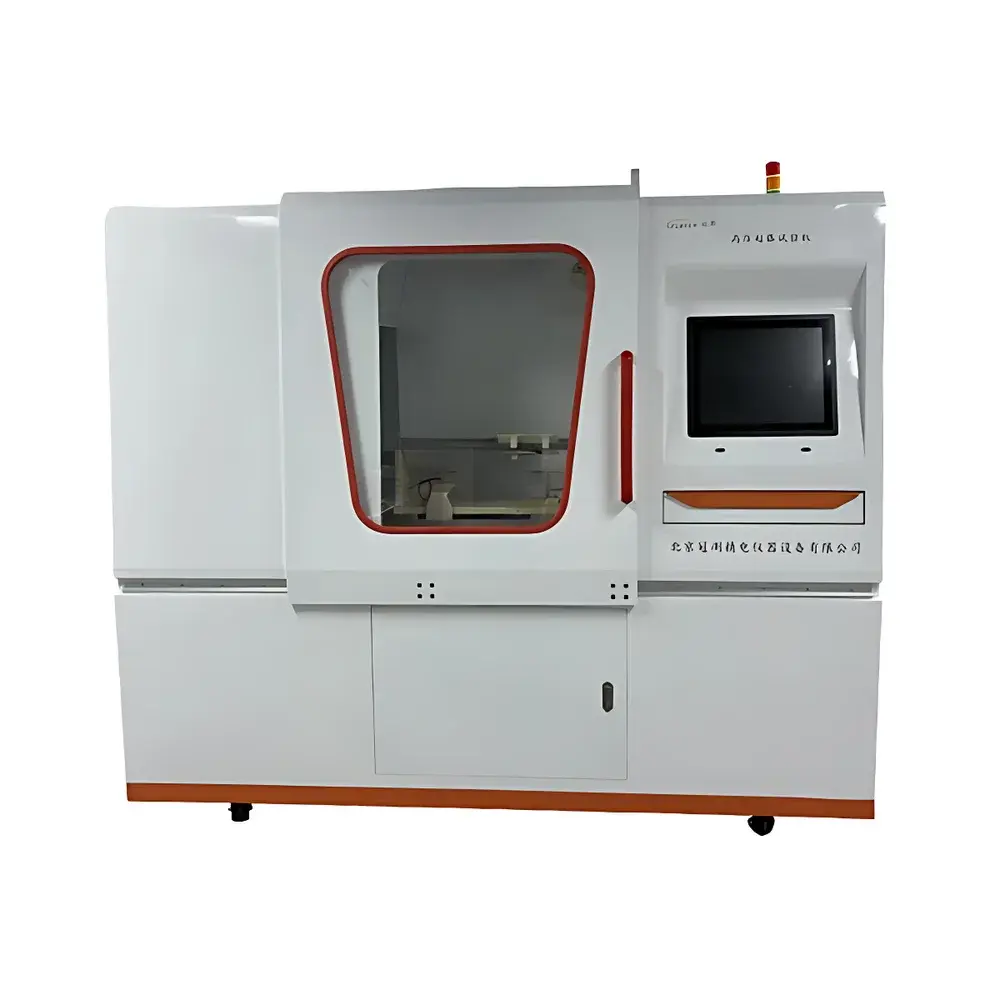
GuanCe GCQH-50KV High-Voltage Arc Erosion Test System
| Brand | GuanCe |
|---|---|
| Origin | Beijing, China |
| Manufacturer Type | Authorized Distributor |
| Country of Origin | China |
| Model | GCQH-50KV |
| Price | USD 2,250 (FOB Beijing) |
Overview
The GuanCe GCQH-50KV High-Voltage Arc Erosion Test System is an engineered platform designed for quantitative evaluation of arc resistance and erosion behavior in solid insulating materials under controlled high-voltage, high-current arcing conditions. It operates on the principle of sustained electric arc discharge between two standardized tungsten or copper electrodes, generating localized thermal energy densities exceeding 10⁴ W/mm²—sufficient to simulate fault-induced arcing events encountered in low-voltage switchgear, circuit breakers, terminal blocks, and insulation systems. The system integrates a 50 kV DC/AC adjustable high-voltage source with programmable current delivery (up to 100 A peak), enabling reproducible arc initiation, stabilization, and extinction cycles per IEC 60112 and ASTM D495 test protocols. Its architecture supports both single-pulse and repetitive arcing sequences, with real-time acquisition of arc voltage, current waveform, duration, and post-test mass loss—critical parameters for determining Comparative Tracking Index (CTI) and Proof Tracking Index (PTI) values.
Key Features
- Programmable high-voltage output: 0–50 kV DC or AC (50/60 Hz), with digital regulation and overvoltage protection
- Adjustable arc current range: 0.5–100 A (peak), with ramp-rate control and automatic current escalation per test step
- Automated arc cycling: Predefined number of arcs (1–999), inter-arc delay (0.1–99.9 s), and auto-return to home position post-test
- Electrode positioning system: Precision Z-axis motorized stage with ±0.01 mm repeatability; standard electrode geometry per IEC 60112 (φ2.0 mm tungsten rods, 30° tip angle)
- Integrated safety interlocks: Door-mounted microswitches, arc chamber grounding verification, emergency stop circuit compliant with EN 60204-1
- Real-time monitoring interface: 7-inch TFT touchscreen displaying synchronized voltage/current waveforms, arc count, elapsed time, and system status
Sample Compatibility & Compliance
The GCQH-50KV accommodates flat, rigid specimens measuring 100 × 100 × 3–10 mm (L × W × H), including thermoset resins, laminated phenolics, epoxy-glass composites, polyamide (PA6/PA66), polytetrafluoroethylene (PTFE), and silicone rubber sheets. Specimen mounting complies with IEC 60112 Annex A and ASTM D495 Section 7 requirements for surface conditioning and electrode contact pressure (1.0 ± 0.05 N). The system is validated for conformance with multiple international standards governing electrical safety and material arc resistance: IEC 60112:2020 (Method for Determining the Comparative Tracking Index), IEC 60950-1:2001/A2:2013 (Safety of Information Technology Equipment), IEC 60947-1:2020 (Low-Voltage Switchgear and Controlgear), GB/T 4207–2012 (Chinese equivalent of IEC 60112), and UL 746A (Polymeric Materials – Short Term Property Evaluations). All test reports generated include timestamped waveform data, operator ID, ambient temperature/humidity logging, and audit-ready metadata—supporting GLP-compliant documentation workflows.
Software & Data Management
The embedded firmware (v3.2+) provides standalone test sequencing without external PC dependency. Optional PC-based software (GCQH-Control Suite v2.1, Windows 10/11 compatible) enables advanced configuration, multi-parameter export (CSV, PDF), and statistical analysis of erosion depth, carbon tracking length, and time-to-failure. Data logs retain full waveform capture at ≥1 MS/s sampling rate, with configurable trigger thresholds for arc onset detection. Audit trail functionality records all parameter modifications, user logins, and calibration events—meeting FDA 21 CFR Part 11 requirements for electronic records and signatures when deployed in regulated manufacturing environments.
Applications
- Qualification testing of insulating housings and busbar supports in LV distribution panels
- Development and validation of arc-resistant thermoplastics for automotive EV battery enclosures
- Comparative assessment of tracking resistance in PCB substrate laminates (FR-4, polyimide)
- Research into plasma-erosion mechanisms in high-dielectric-strength ceramics (Al₂O₃, AlN)
- Third-party certification testing per UL, TÜV, and CNAS-accredited laboratories
- Root-cause analysis of field failures attributed to surface tracking or electrode erosion
FAQ
What is the maximum recommended continuous operating voltage for this system during routine testing?
Rated continuous output is 40 kV DC or 35 kV AC RMS; 50 kV is specified as short-term peak capability (≤5 s) under controlled environmental conditions (≤25 °C, ≤60 % RH).
Does the system support compliance with IEC 60112 Edition 4 (2020)?
Yes—the electrode geometry, current ramp profile, and timing logic fully align with Clause 8.2 and Annex B of IEC 60112:2020, including the 30-second dwell interval between arcs.
Can test data be exported in formats compatible with LIMS integration?
CSV and XML exports include ISO 8601 timestamps, instrument serial number, operator ID, and raw voltage/current arrays—enabling direct ingestion into LabWare LIMS or Thermo Fisher SampleManager.
Is periodic calibration traceable to national metrology institutes?
Calibration certificates are issued with NIST-traceable references for HV measurement (Fluke 8508A multimeter) and current shunt (ISO/IEC 17025 accredited lab); annual recalibration recommended.
What safety certifications does the enclosure hold?
The arc chamber meets IP2X finger-protection rating per IEC 61439-1 and incorporates Class II double-insulated construction with reinforced polycarbonate viewing window (EN 166 certified).



