
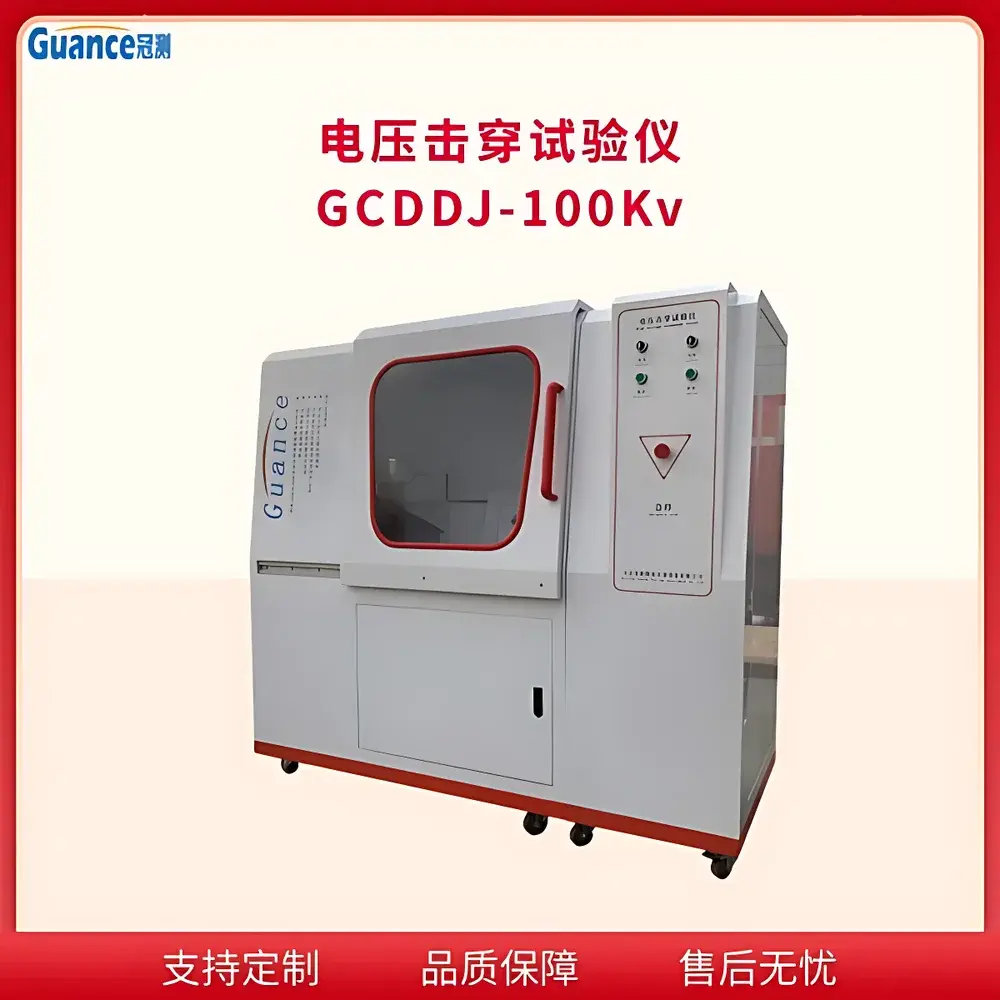
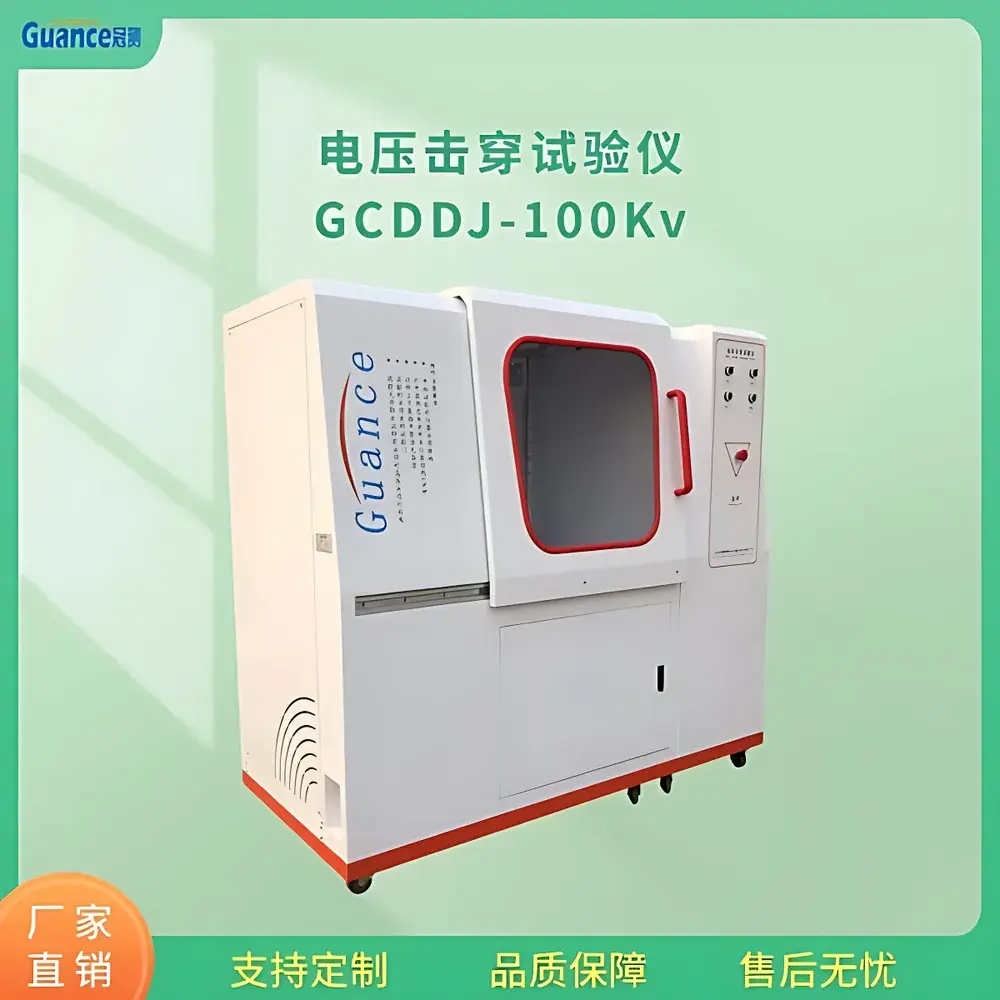
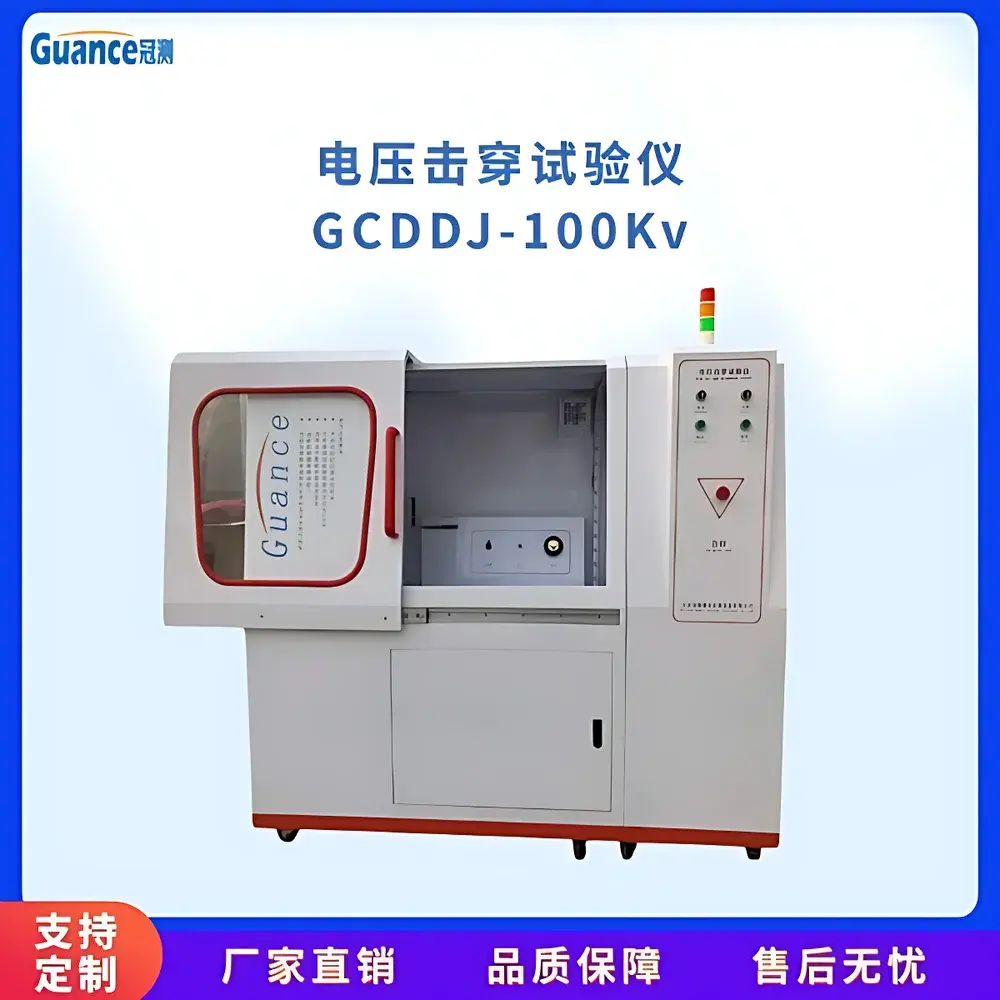
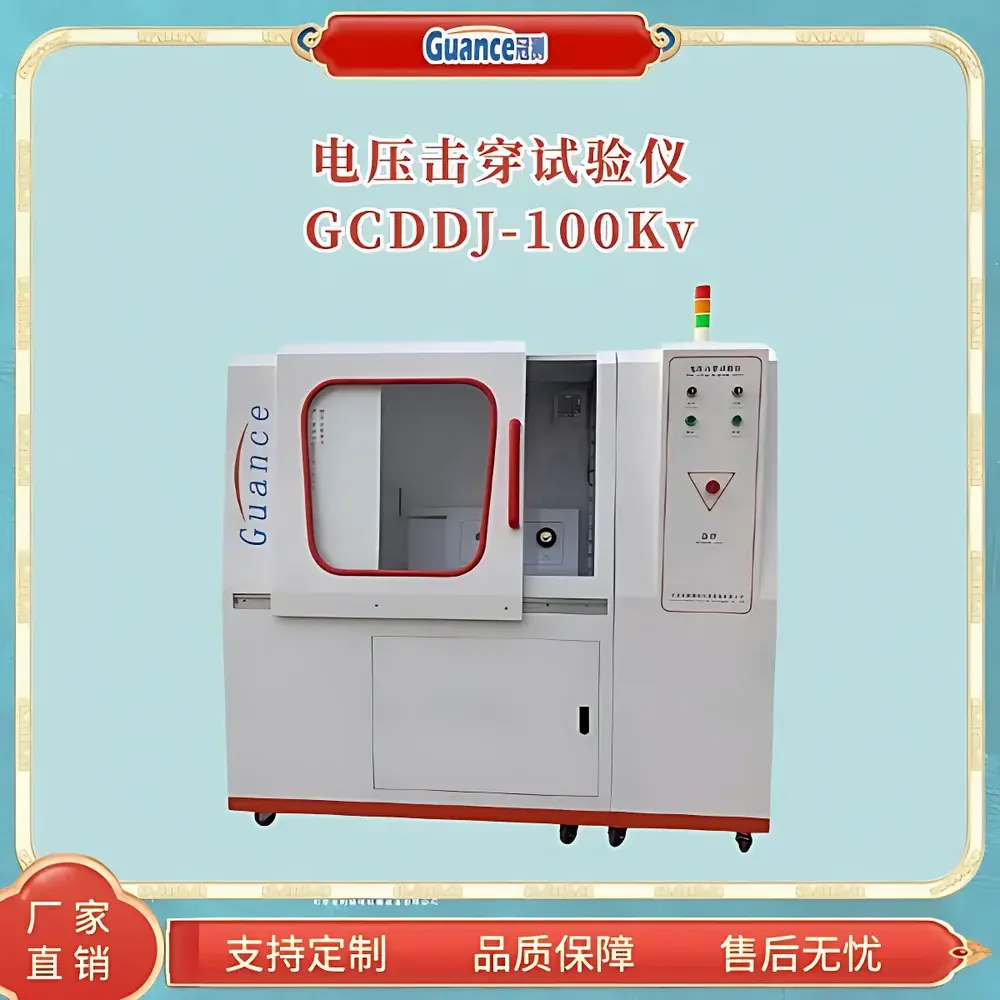
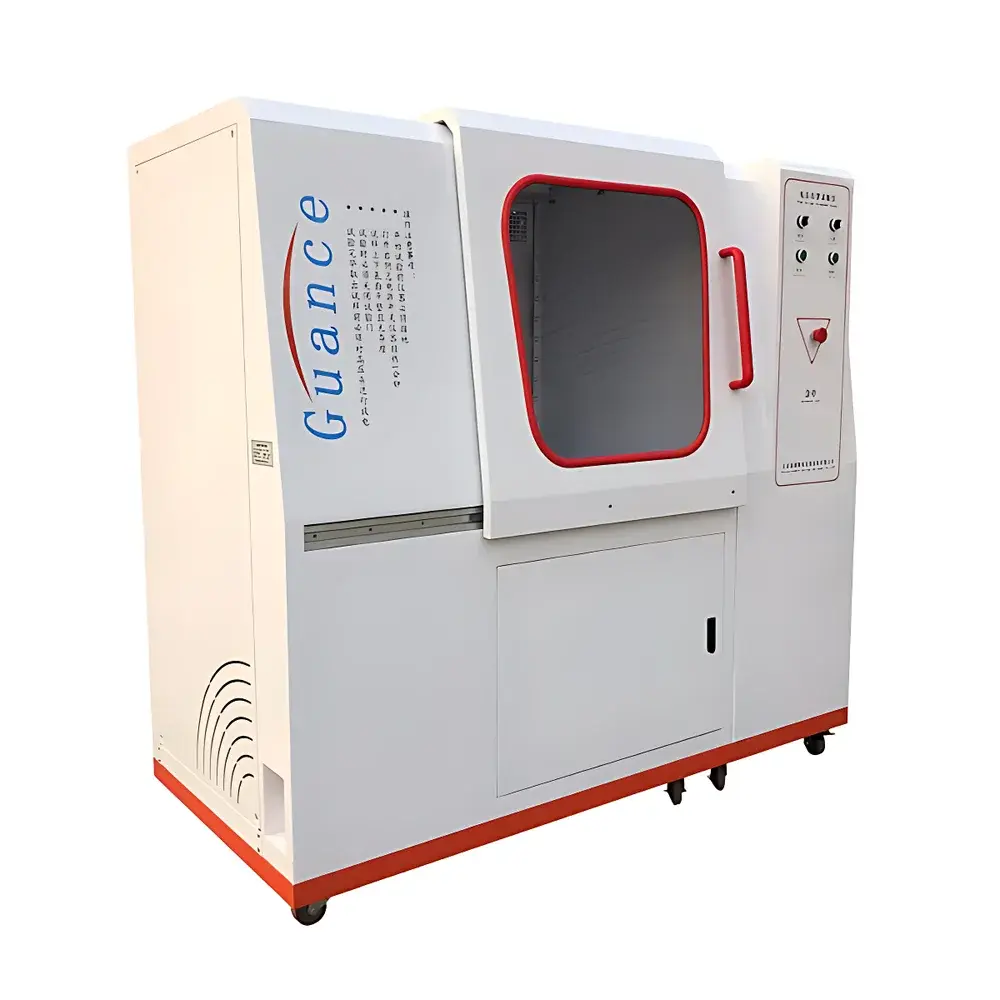
GuanCe Instruments GCDDJ-100kV3 High-Temperature Voltage Breakdown Tester
| Brand | GuanCe Instruments |
|---|---|
| Origin | Beijing, China |
| Model | GCDDJ-100kV3 |
| Breakdown Voltage | 100 kV AC/DC |
| Electrical Capacity | 5 kVA |
| Input Voltage | AC 220 V / 50 Hz |
| Ramp Rate | 0.1–5 kV/s (adjustable) |
| Voltage Accuracy | ≤ ±1.5% |
| Leakage Current Range | 0–100 mA |
| Voltage Sensor Range | 0–100 V |
| Electrode Options | φ25 mm (×2), φ75 mm (×1), customizable |
| Test Chamber Dimensions | 750 × 600 × 800 mm |
| Overall Dimensions | 1500 × 850 × 1700 mm |
| Weight | ~250 kg |
| Safety Protections | Overvoltage, overcurrent, short-circuit, and leakage current protection |
| Operating Environment | Ambient temperature, RH ≤ 65% |
Overview
The GuanCe Instruments GCDDJ-100kV3 High-Temperature Voltage Breakdown Tester is an engineered solution for determining the dielectric strength and voltage withstand capability of solid insulating materials under controlled AC or DC electric stress. Designed in accordance with fundamental principles of high-voltage insulation testing—namely, controlled ramped voltage application until electrical breakdown occurs—the system enables precise quantification of the critical electric field intensity at which a material transitions from insulator to conductor. This measurement, expressed as kilovolts per millimeter (kV/mm), serves as a core parameter in material qualification for power electronics, aerospace composites, medical device encapsulants, and high-voltage cable insulation systems. The GCDDJ-100kV3 supports standardized test configurations per IEC 60243-1 (Electric Strength of Insulating Materials – Part 1: Tests at Power Frequencies), ASTM D149 (Dielectric Breakdown Voltage of Solid Electrical Insulating Materials at Commercial Power Frequencies), and GB/T 1408.1 (Chinese national standard equivalent). Its integrated high-temperature test capability—via optional heated chamber integration—extends applicability to thermally aged samples or materials intended for elevated-temperature service environments.
Key Features
- Triple-redundant safety architecture: hardware-based overvoltage cutoff, programmable current-limiting thresholds, and real-time arc detection via isolated current sensing
- Siemens S7-1200 PLC core controller with optically isolated communication bus ensures electromagnetic immunity during high-dV/dt transients
- Digitally regulated ramp rate control (0.1–5 kV/s, resolution ≤ 0.05 kV/s) enabling compliance with both step-stress and slow-ramp test protocols
- Configurable test modes: dielectric breakdown voltage, dielectric withstand (hi-pot), and stepwise gradient testing with user-defined voltage hold intervals
- Motorized electrode positioning (optional) with precision vertical alignment for repeatable electrode-sample contact geometry
- Integrated oil bath test station (300 × 150 × 200 mm) with suspended sample rack, internal LED illumination, and forced-air exhaust for fume management
- Multi-level interlock system: pneumatic door lock, optical beam interruption monitoring, and tower-status lighting synchronized with test phase (standby, ramp, hold, fault)
- Automated post-breakdown discharge circuit with <100 ms residual energy dissipation time
Sample Compatibility & Compliance
The GCDDJ-100kV3 accommodates rigid and semi-rigid dielectrics up to 25 mm thickness—including polymer films, laminated composites, ceramic substrates, epoxy-molded components, and varnish-coated windings. Standard electrode sets conform to IEC 60243 geometry requirements: two 25 mm diameter disc electrodes for volume breakdown assessment and one 75 mm electrode for surface tracking evaluation. Custom electrode configurations (e.g., needle-plane, rod-rod) are supported upon request. All test sequences generate audit-ready metadata including timestamp, ramp rate, ambient temperature/humidity (via optional external sensor input), operator ID, and pass/fail status per test criterion. System firmware and software support traceable calibration logs compliant with ISO/IEC 17025 laboratory accreditation requirements and GLP documentation standards.
Software & Data Management
Control and analysis are executed via a native Windows-based application built on .NET Framework, featuring a deterministic real-time data acquisition loop (<10 ms sampling interval). The interface displays synchronized live plots of applied voltage, leakage current, and derivative dI/dt—enabling early arc precursor identification. Test parameters (voltage limit, ramp slope, dwell time, trip threshold) are stored in XML configuration files with version history. Export functionality includes CSV and Excel-compatible XLSX formats; reports embed digital signatures and comply with FDA 21 CFR Part 11 electronic record requirements when paired with domain-authenticated login and audit trail activation. Raw waveform data is retained in binary format for post-test reanalysis using third-party tools (MATLAB, Python SciPy).
Applications
- Qualification of polyimide and polyetherimide films for flexible printed circuit boards
- Comparative aging studies of silicone rubber insulators under thermal-electrical stress coupling
- Batch release testing of transformer board (pressboard) and epoxy-glass laminates per IEEE C57.104
- Development validation of nanocomposite dielectrics for medium-voltage cable insulation
- Failure analysis of potting compounds used in automotive power modules
- Research into space charge accumulation dynamics via controlled breakdown mapping
FAQ
Does the GCDDJ-100kV3 support both AC and DC breakdown testing?
Yes—it delivers sinusoidal 50 Hz AC output up to 100 kV RMS and ripple-free DC output up to ±100 kV, with independent calibration certificates provided for each mode.
Can test data be integrated into a LIMS environment?
Yes—the software exposes a COM interface and supports OPC UA connectivity for direct integration with laboratory information management systems.
Is high-temperature testing performed inside the main chamber or via external oven coupling?
High-temperature operation (up to 200 °C) is achieved using a factory-integrated heated test chamber with PID-controlled air circulation and thermocouple feedback—no external oven interfacing required.
What calibration standards does the voltage measurement subsystem reference?
Voltage sensors are traceably calibrated against NIST-traceable high-voltage dividers (±0.5% uncertainty at 100 kV) with annual recalibration recommended per ISO/IEC 17025 clause 6.5.
How is operator safety ensured during open-chamber testing?
The system enforces dual-channel safety shutdown: mechanical door interlock disables HV generation if the viewing window is unsealed, while continuous ground-fault monitoring halts operation within 20 ms of detecting >1 mA leakage to chassis.



