
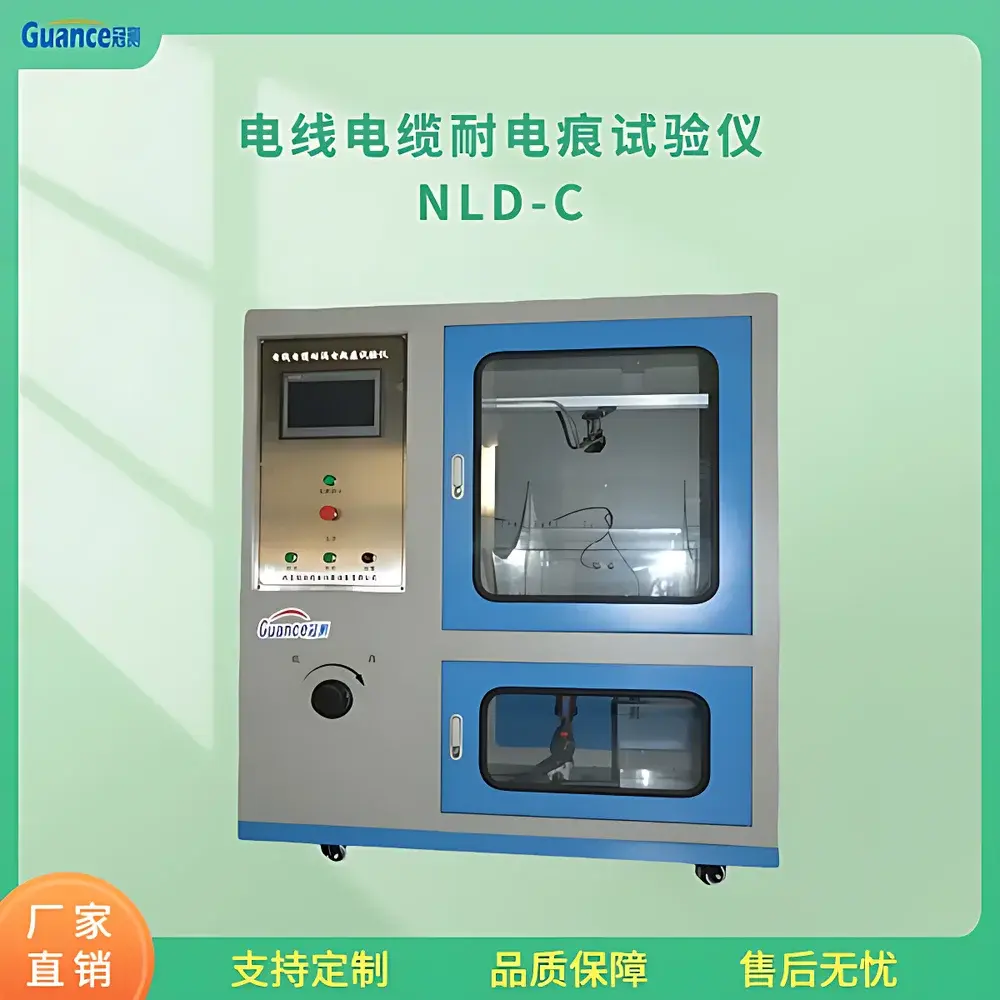
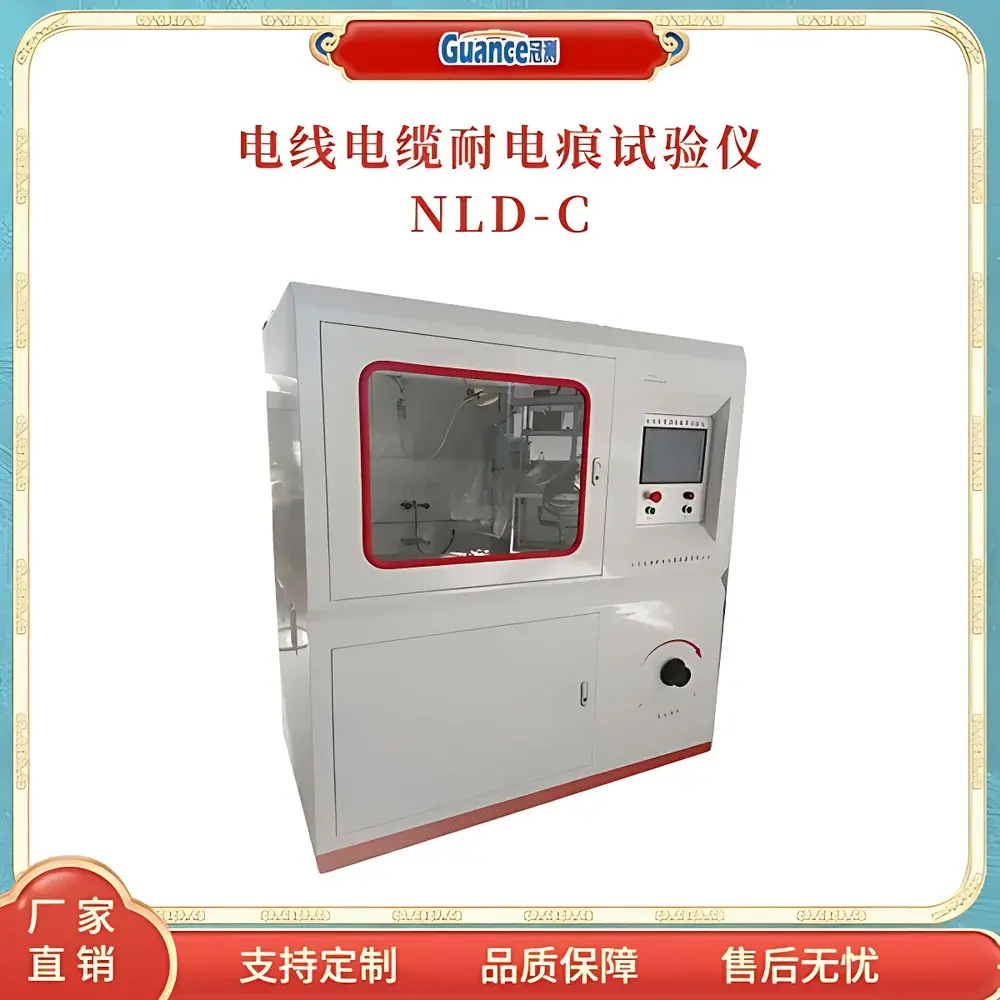
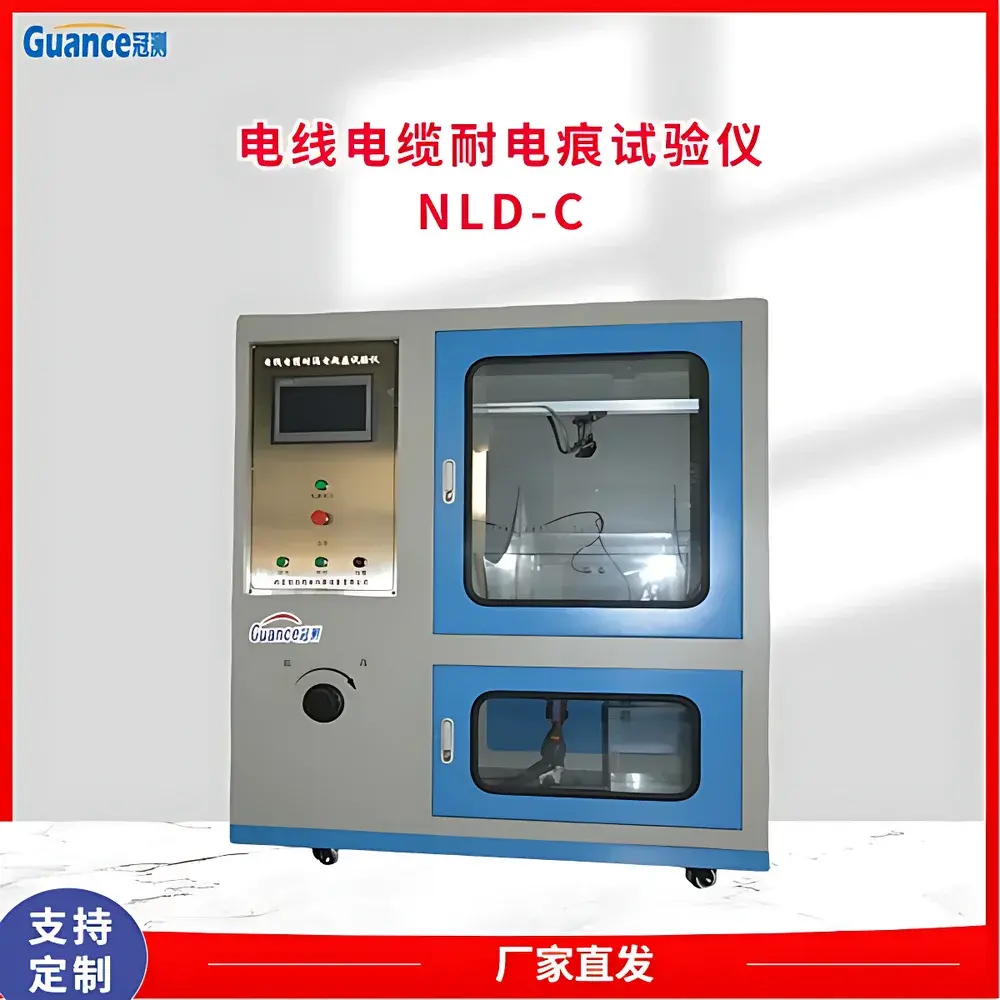
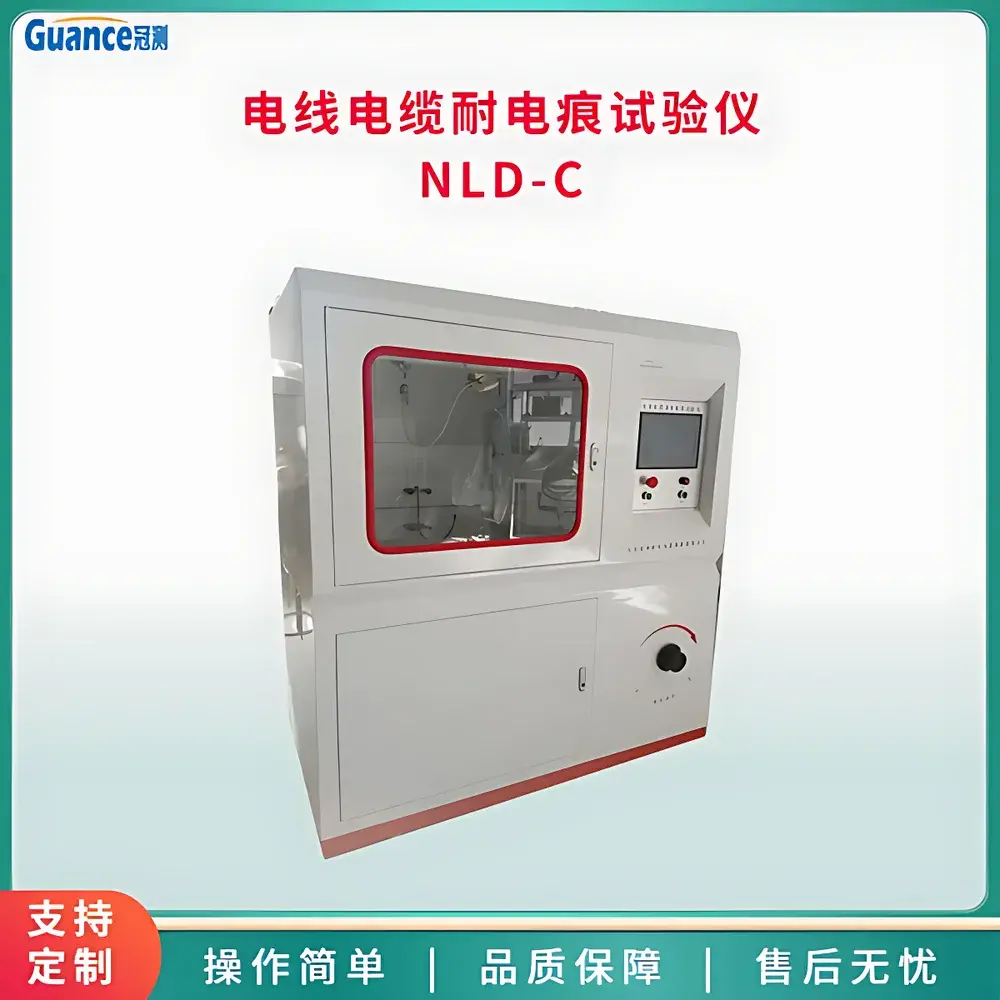
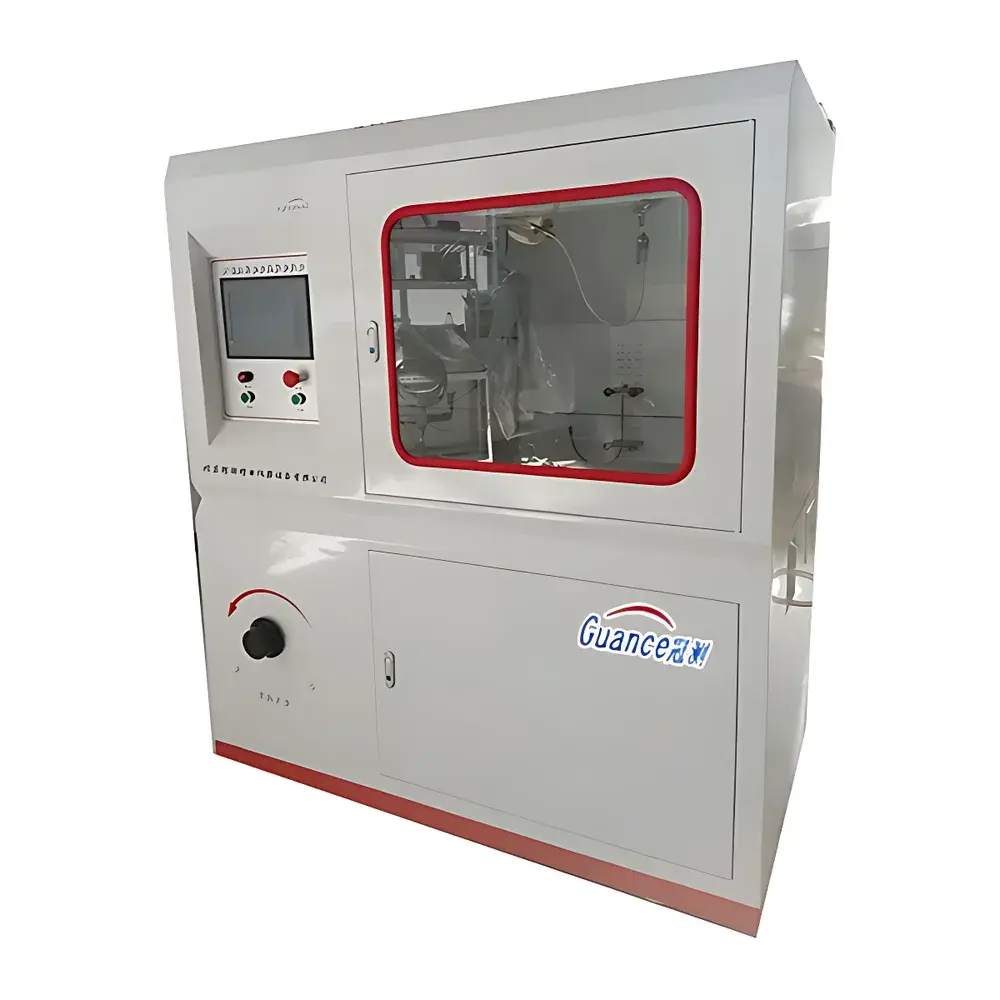
GuanCe NLD-C3 Touchscreen Tracking Resistance Tester
| Brand | GuanCe Instruments |
|---|---|
| Origin | Chongqing, China |
| Manufacturer Type | Authorized Distributor |
| Country of Origin | China |
| Model | NLD-C3 |
| Instrument Type | Electronic Universal Testing Machine |
| Input Voltage | AC 220 V |
| Output Voltage Range | 0–5 kV AC |
| Power Rating | 5 kVA |
| Voltage Accuracy | <2% |
| High-Voltage Output Current | >1 A |
| Current Measurement Accuracy | <1% |
| Spray Velocity at Specimen | 3 m/s |
| Spray Rate | 0.5 mm/min |
| Standard Spray Cycle | 10 s spray / 20 s pause |
| Nozzle-to-Specimen Distance | ≥500 mm |
| Nozzle Angle Relative to Specimen Axis | 45° |
| Spray Reach | >1 m |
| Nozzle Height Above Floor | ≥600 mm |
| Specimen Length | >150 mm |
| Electrode Configuration | Bare copper wire (1 mm Ø, 2–3 turns) wound 100 mm from cut end |
| Compliance Standard | GB/T 3048.7–2007 |
Overview
The GuanCe NLD-C3 Touchscreen Tracking Resistance Tester is a specialized high-voltage dielectric testing system engineered for evaluating the comparative tracking index (CTI) and resistance to electrical tracking of solid insulating materials—particularly polymer-based insulation used in wires, cables, connectors, and low-voltage electrical components. It operates on the principle of controlled electrochemical degradation under alternating high voltage and periodic electrolyte (typically ammonium chloride solution) exposure. In accordance with GB/T 3048.7–2007—the Chinese national standard aligned with IEC 60112 methodology—the instrument subjects conditioned specimens to repeated cycles of conductive liquid spraying and high-voltage stress. Electrical tracking initiates when localized surface carbonization forms conductive paths; failure is defined by sustained leakage current exceeding 1 A, arcing between electrodes, ignition, or dielectric breakdown. The NLD-C3 replicates real-world contamination and humidity-induced failure modes critical for safety certification and material qualification in power distribution, rail transport, and building wiring applications.
Key Features
- 10-inch industrial-grade resistive touchscreen interface with intuitive HMI navigation and real-time parameter monitoring.
- Siemens S7-1200 PLC-based control architecture ensuring electromagnetic compatibility (EMC), deterministic response timing, and long-term operational stability in laboratory environments.
- Optically isolated voltage and current acquisition channels minimize ground-loop interference and support repeatable sub-1% current measurement accuracy.
- Manual stepwise voltage ramping enables precise control over stress progression during pre-test calibration and qualification runs.
- Adjustable spray cycle configuration: user-defined duration (e.g., 10 s spray / 20 s pause) and total test cycle count, supporting both pass/fail screening and comparative CTI determination.
- Calibrated rotameter-based flow regulation ensures consistent electrolyte delivery at 0.5 mm/min ±5%, critical for inter-laboratory reproducibility.
- Dedicated drain port with quick-release valve facilitates safe, tool-free electrolyte replacement without disassembly or spill risk.
- Integrated axial exhaust fan with adjustable airflow rate mitigates accumulation of corrosive vapors or decomposition byproducts during extended tests.
- LED-dedicated specimen illumination with independent on/off control improves visual inspection of surface carbonization and tracking path formation.
- Audible alarm with programmable duration triggers upon either leakage current ≥1 A or completion of preset cycle count—both events logged with timestamps.
- 45° precision-machined nozzle alignment fixture maintains constant angular orientation relative to specimen axis, ensuring uniform droplet impact geometry per IEC/GB requirements.
- Integrated drip containment trough with sloped drainage directs all electrolyte runoff into sealed reservoir, preventing floor contamination and enabling closed-loop reuse where permitted.
Sample Compatibility & Compliance
The NLD-C3 accommodates flat or cylindrical solid insulators up to 150 mm in length, including extruded cable jackets, molded terminal blocks, PCB substrates, and insulating housings. Specimens are prepared per GB/T 3048.7–2007: one end stripped to expose conductor, bare copper wire wound 100 mm from cut edge as high-voltage electrode, and opposite end insulated to prevent flashover along untested surfaces. The system supports full compliance with GB/T 3048.7–2007 and is functionally equivalent to IEC 60112 test setups. While not certified to UL 746A or ASTM D3638 out-of-the-box, its voltage range (0–5 kV AC), current capacity (>1 A), and spray metrology meet the foundational hardware requirements for those standards when operated within defined procedural constraints. Data records—including voltage setpoint, current waveform snapshots, spray timing, and alarm events—are timestamped and exportable for GLP/GMP-aligned audit trails.
Software & Data Management
The embedded HMI firmware stores test configurations, runtime logs, and event-triggered alerts locally on industrial-grade flash memory. All parameters—including voltage ramp profile, spray cycle definition, alarm thresholds, and illumination state—are configurable via touchscreen and retained across power cycles. Test reports are exportable in CSV format via USB interface for integration into LIMS or QA documentation systems. Though no PC-based analysis software is bundled, the device outputs ASCII-formatted data streams compatible with third-party SCADA or LabVIEW acquisition modules. Audit trail functionality includes operator ID entry (optional), start/stop timestamps, and anomaly flags—sufficient for internal quality audits and preliminary FDA 21 CFR Part 11 readiness when paired with institutional electronic signature policies.
Applications
- Quality assurance of polymeric insulation materials for automotive wiring harnesses and EV battery interconnects.
- Comparative CTI ranking of halogen-free flame-retardant (HFFR) compounds during formulation development.
- Pre-certification screening of cable sheathing materials prior to IEC 60587 or UL 1581 Section 1090 testing.
- Root-cause analysis of field failures involving tracking-induced short circuits in outdoor junction boxes.
- Evaluation of surface contamination resistance in photovoltaic module backsheet films under damp heat conditions.
- Teaching laboratories demonstrating dielectric degradation mechanisms in electrical engineering curricula.
FAQ
What standards does the NLD-C3 directly support?
It is fully configured to execute GB/T 3048.7–2007 and aligns with the test methodology of IEC 60112. Users may adapt procedures for ASTM D3638 or UL 746A with appropriate validation.
Is the electrolyte delivery system calibrated and traceable?
Yes—the integrated rotameter is factory-calibrated for ammonium chloride solution (0.1% w/w) at 23 °C; calibration certificate is provided with each unit.
Can test data be exported for regulatory submission?
CSV exports include voltage, current, time, spray status, and alarm events—structured for inclusion in technical dossiers compliant with ISO/IEC 17025 or internal QA protocols.
What maintenance is required for long-term reliability?
Quarterly verification of high-voltage output accuracy using external calibrated meter, annual cleaning of nozzle orifices and drip trough, and biannual inspection of PLC firmware integrity.
Does the system support automated pass/fail decision logic?
Yes—the PLC executes real-time comparison of measured leakage current against user-defined threshold (default 1 A); automatic termination and logging occur upon breach.



