
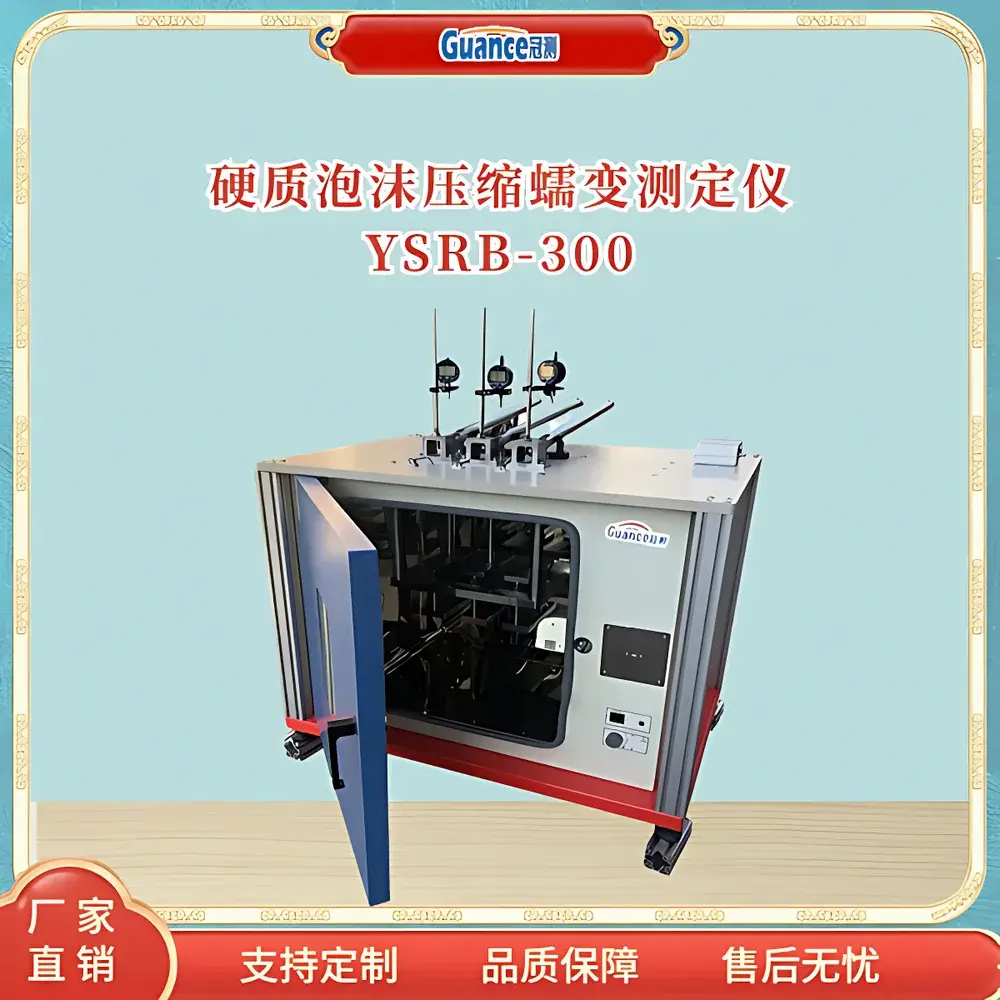
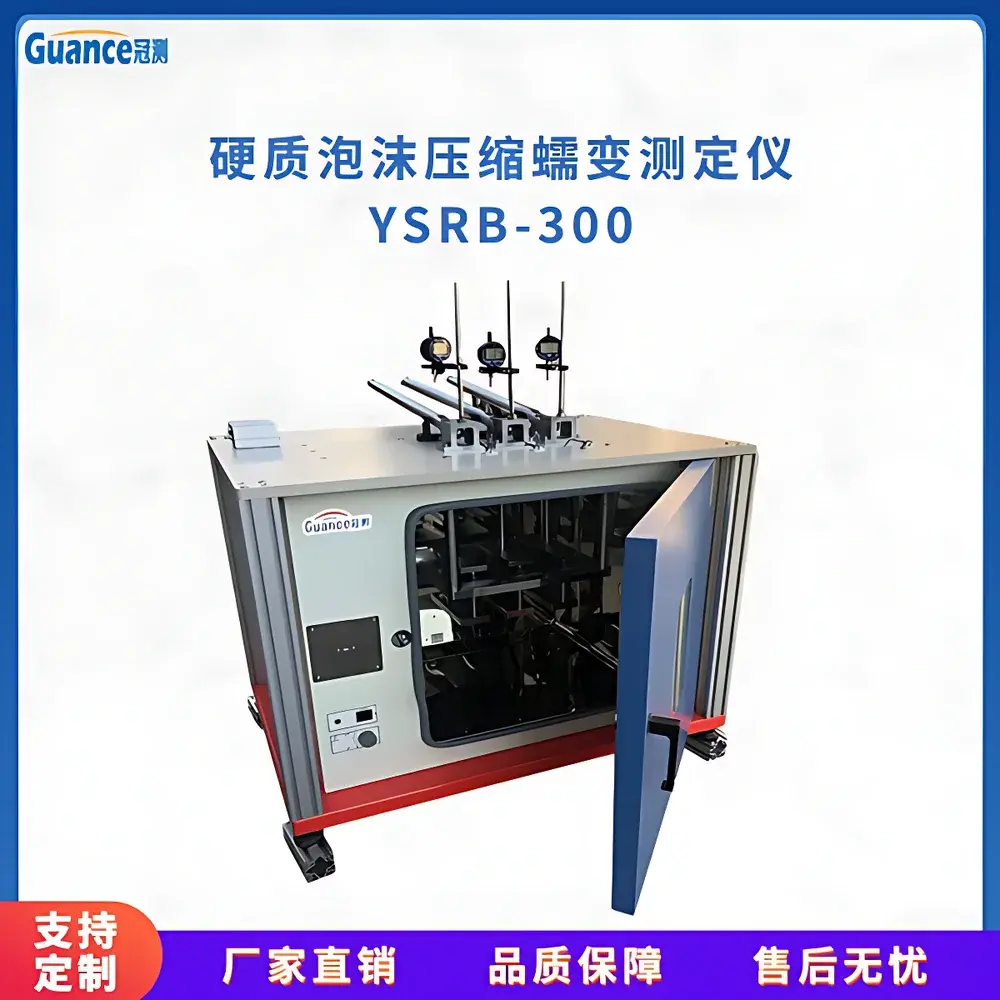
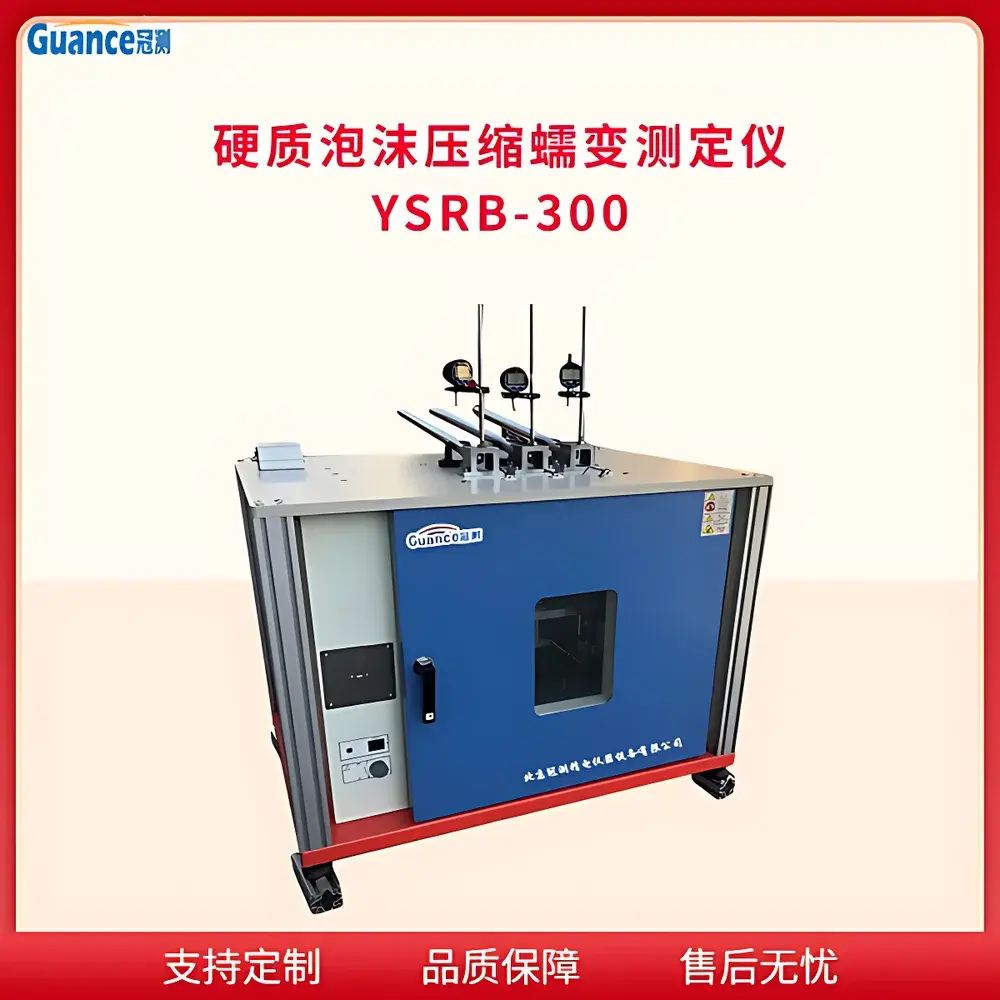
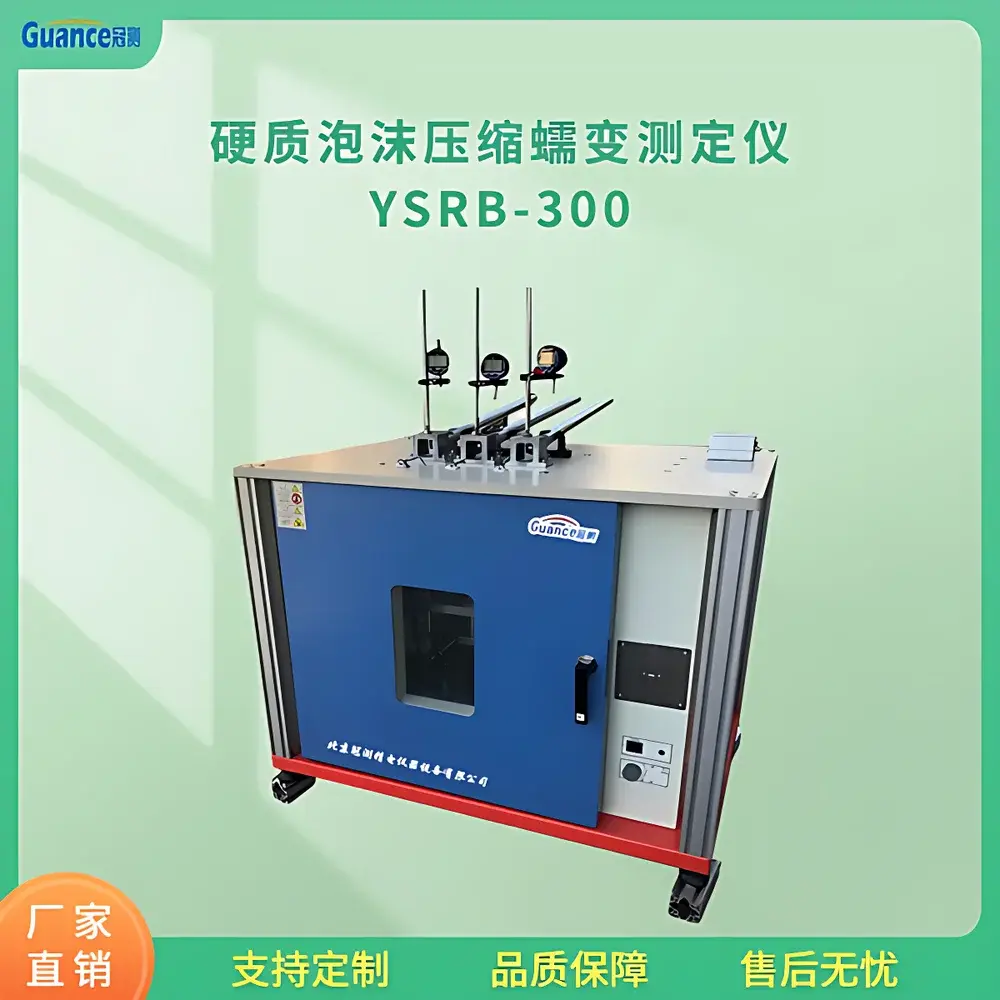
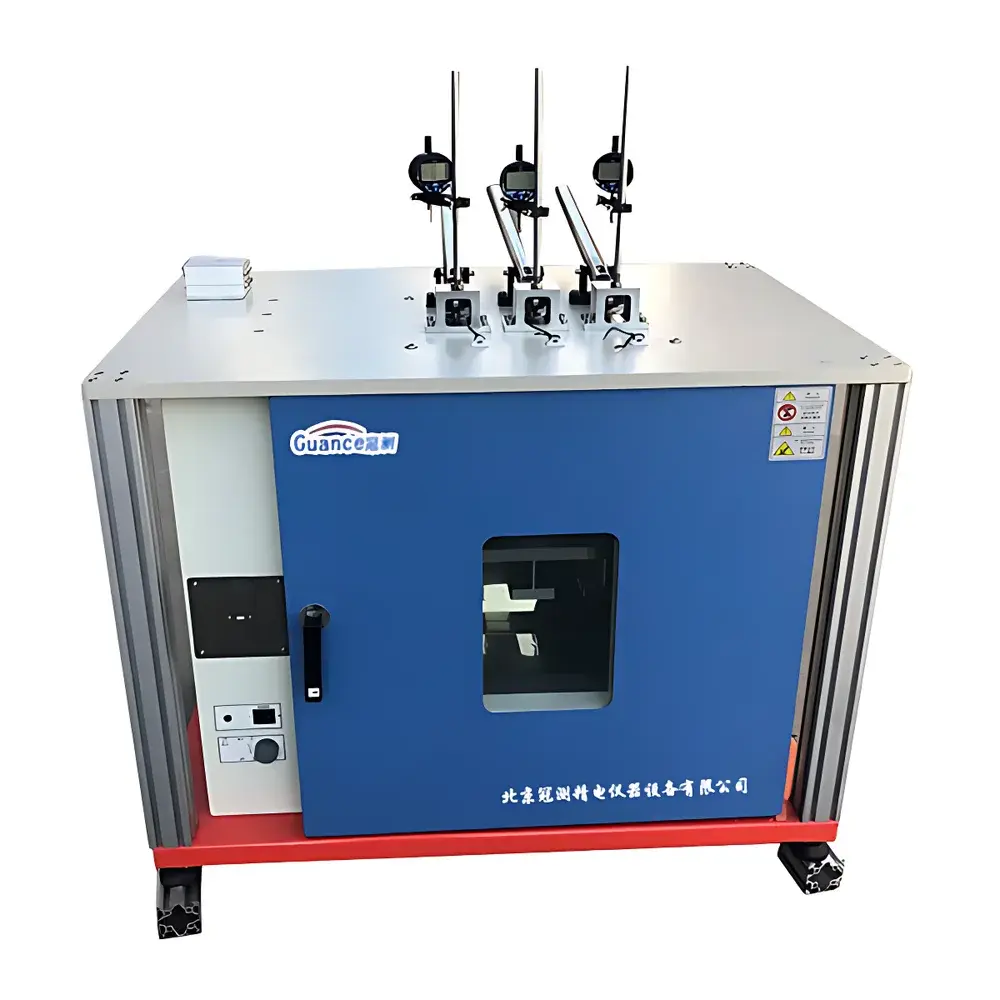
GuanCe Instruments YSRB-300.3 Foam Compression Creep Testing Machine
| Brand | GuanCe Instruments |
|---|---|
| Origin | Beijing, China |
| Manufacturer Type | Authorized Distributor |
| Country of Origin | China |
| Model | YSRB-300.3 |
| Instrument Type | Electromechanical |
| Max Test Load | 10 kN |
| Max Plunger Stroke | 180 mm |
| Dimensions (W×D×H) | 580 × 620 × 350 mm |
| Net Weight | 100 kg |
| Heating Method | Air-bath |
| Test Channels | 3 |
| Temperature Range | Ambient to 300 °C |
| Temp. Stability | ±2 °C |
| Heating Rate | 50 ± 3 °C/h or 10 ± 2 °C/12 min |
| Temp. Resolution | 0.1 °C |
| Deformation Resolution | 0.002 mm |
| Specimen Size | 50 × 50 × 50 mm or 40 × 40 × 20 mm |
| Loading Plate | Three 50 × 50 mm square platens |
| Recommended Stress Range | 0–1 MPa |
| Heating Chamber Volume | 350 × 400 × 400 mm |
| Lever Ratio | 1:32 |
| Loading Modes | Compression (lever-weighted), Bending (direct-weighted) |
| Standard Compliance | GB/T 20672–2006, DIN 53424 |
Overview
The GuanCe Instruments YSRB-300.3 Foam Compression Creep Testing Machine is a dedicated electromechanical testing system engineered for the standardized evaluation of time-dependent compressive and flexural deformation behavior in rigid cellular plastics under controlled thermal and mechanical loading conditions. It operates on the principle of sustained uniaxial compression and three-point bending under elevated temperature—enabling precise quantification of creep strain, creep rate, and stress relaxation characteristics per internationally recognized test protocols. Designed specifically for rigid polyurethane, phenolic, and melamine-formaldehyde foams, the system integrates air-bath heating with high-stability temperature control (±2 °C), lever-based mechanical load application, and optical-grating displacement transduction to deliver reproducible, traceable measurements essential for material qualification, formulation development, and quality assurance in insulation, aerospace core, and automotive component manufacturing.
Key Features
- Triple-channel independent test configuration supports simultaneous creep evaluation across three specimens—enhancing throughput and statistical robustness.
- Air-bath heating chamber (350 × 400 × 400 mm) enables uniform thermal exposure from ambient to 300 °C, with programmable ramp rates (50 ± 3 °C/h or 10 ± 2 °C/12 min) and real-time PID-controlled stabilization.
- High-resolution optical grating displacement sensors (0.002 mm resolution) provide traceable, low-drift deformation measurement across both compression and bending modes.
- Dual-loading architecture: compression tests employ a 1:32 mechanical lever system with calibrated dead-weight loading; bending tests use direct-weight application via precision-machined砝码 sets totaling 15 kg (including 2 g–5 kg increments).
- Three interchangeable 50 × 50 mm square loading platens ensure consistent contact geometry and minimize edge effects during compression testing.
- Integrated electronic control unit synchronizes temperature acquisition, load application, displacement sampling, and data logging at user-defined intervals—supporting full automation of multi-step thermal-mechanical profiles.
- Real-time color-coded curve visualization displays axial strain vs. time and temperature history, enabling immediate assessment of primary, secondary, and tertiary creep regimes.
Sample Compatibility & Compliance
The YSRB-300.3 accommodates standard specimen geometries defined in GB/T 20672–2006 (50 × 50 × 50 mm cubes) and DIN 53424 (40 × 40 × 20 mm prisms). Its design ensures compliance with ISO 178 (flexural properties), ISO 844 (rigid cellular plastics—determination of compression properties), and ASTM D3574 (flexible cellular materials—compression set and creep). While not certified to GLP or FDA 21 CFR Part 11 out-of-the-box, the system’s deterministic control logic, audit-ready timestamped data export (CSV, PDF), and hardware-level calibration traceability support integration into regulated environments when deployed with validated SOPs and periodic verification per ISO/IEC 17025 guidelines.
Software & Data Management
The embedded control software provides intuitive setup of multi-segment thermal ramps, load hold durations, and sampling frequencies. All raw sensor outputs—including temperature (Pt100), displacement (optical grating), and elapsed time—are logged at ≥1 Hz resolution and stored locally with metadata (operator ID, sample ID, test standard, environmental conditions). Export formats include CSV for post-processing in MATLAB or Python, and formatted PDF reports containing annotated creep curves, summary statistics (e.g., % strain at 1 h / 24 h / 168 h), and pass/fail flags against specified limits. Optional USB-to-PC connectivity enables remote monitoring and centralized database archiving in LIMS-compatible workflows.
Applications
- Creep resistance validation of structural foam cores used in sandwich panels for wind turbine blades and marine composites.
- Thermal-mechanical stability assessment of flame-retardant rigid foams in building insulation systems operating at elevated service temperatures.
- Accelerated aging studies correlating short-term creep compliance with long-term dimensional retention in automotive HVAC ducting.
- Formulation screening for polymeric foams where viscoelastic response under sustained load dictates end-use performance.
- Supporting ASTM E1356 and ISO 11357–3 for dynamic mechanical analysis (DMA) correlation studies by providing static reference data at discrete temperatures.
FAQ
What standards does the YSRB-300.3 directly support?
GB/T 20672–2006 and DIN 53424 are natively implemented in test templates; ISO 844 and ASTM D3574 procedures can be configured manually using custom parameter sets.
Is the system suitable for soft or flexible foams?
No—it is optimized for rigid cellular plastics (compressive strength >0.3 MPa); flexible foams require lower-force instrumentation and different fixture geometry.
Can deformation data be synchronized with thermal imaging?
Not natively—the system records bulk axial/bending displacement only; integration with external IR cameras requires third-party synchronization via TTL triggers and time-aligned post-processing.
How is calibration maintained over extended operation?
Temperature sensors are verified annually using NIST-traceable dry-block calibrators; displacement transducers are zero-checked before each test batch using gauge blocks certified to ISO 3650.
Does the machine support automatic load cycling or stress relaxation tests?
No—YSRB-300.3 is designed exclusively for constant-load creep and constant-temperature bending; dynamic loading sequences require servo-hydraulic or electromechanical universal testers.



