
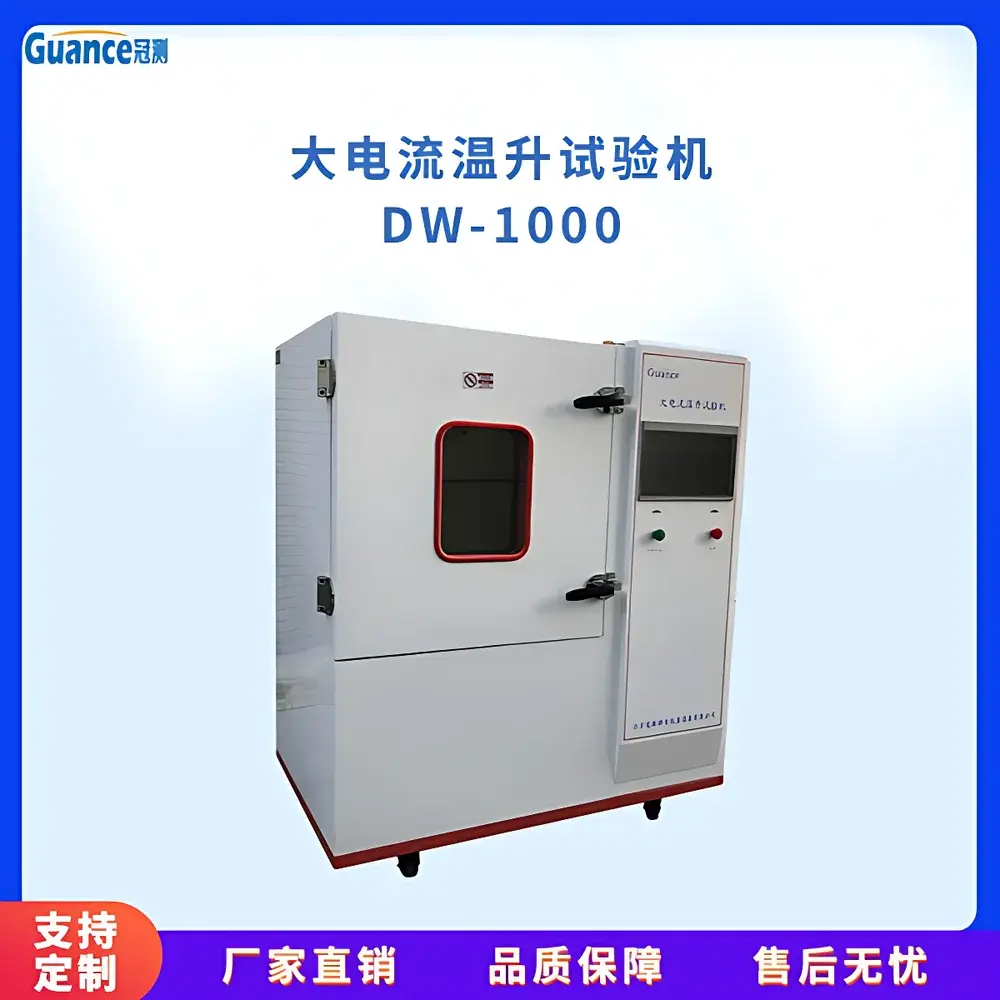
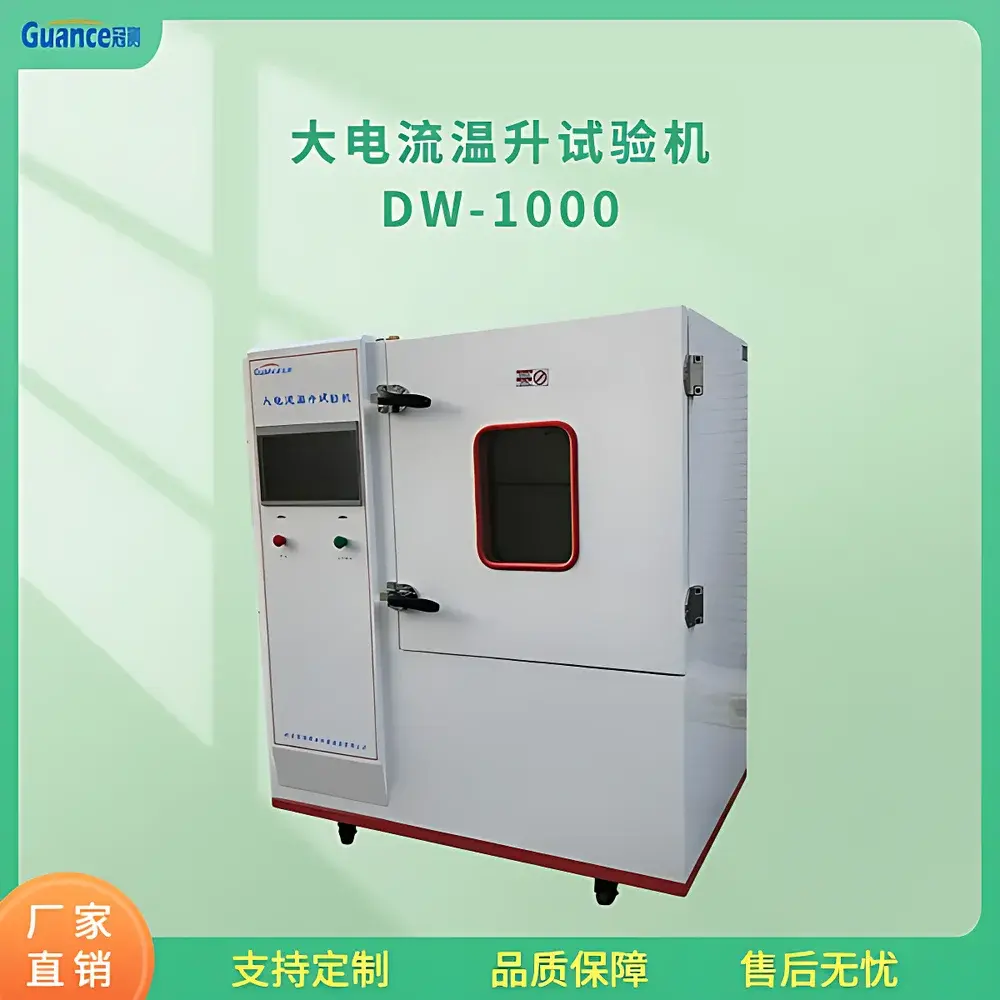
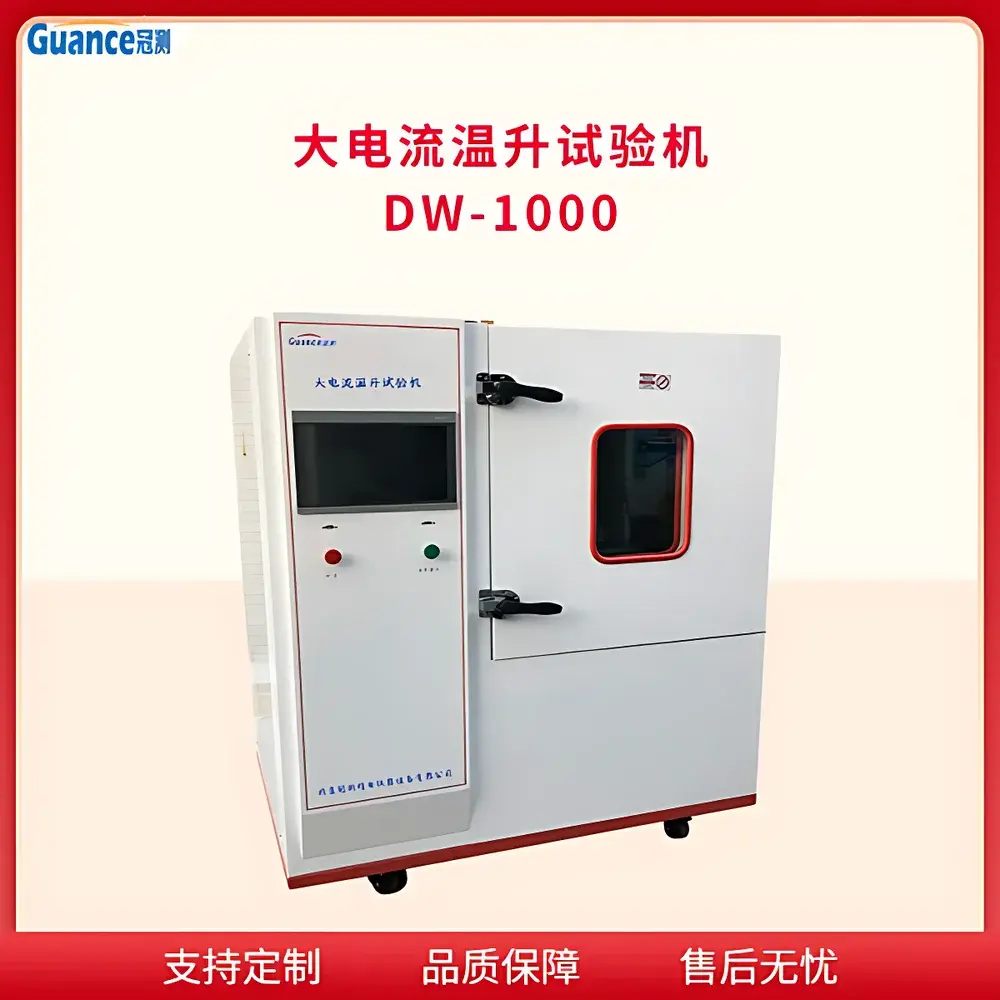
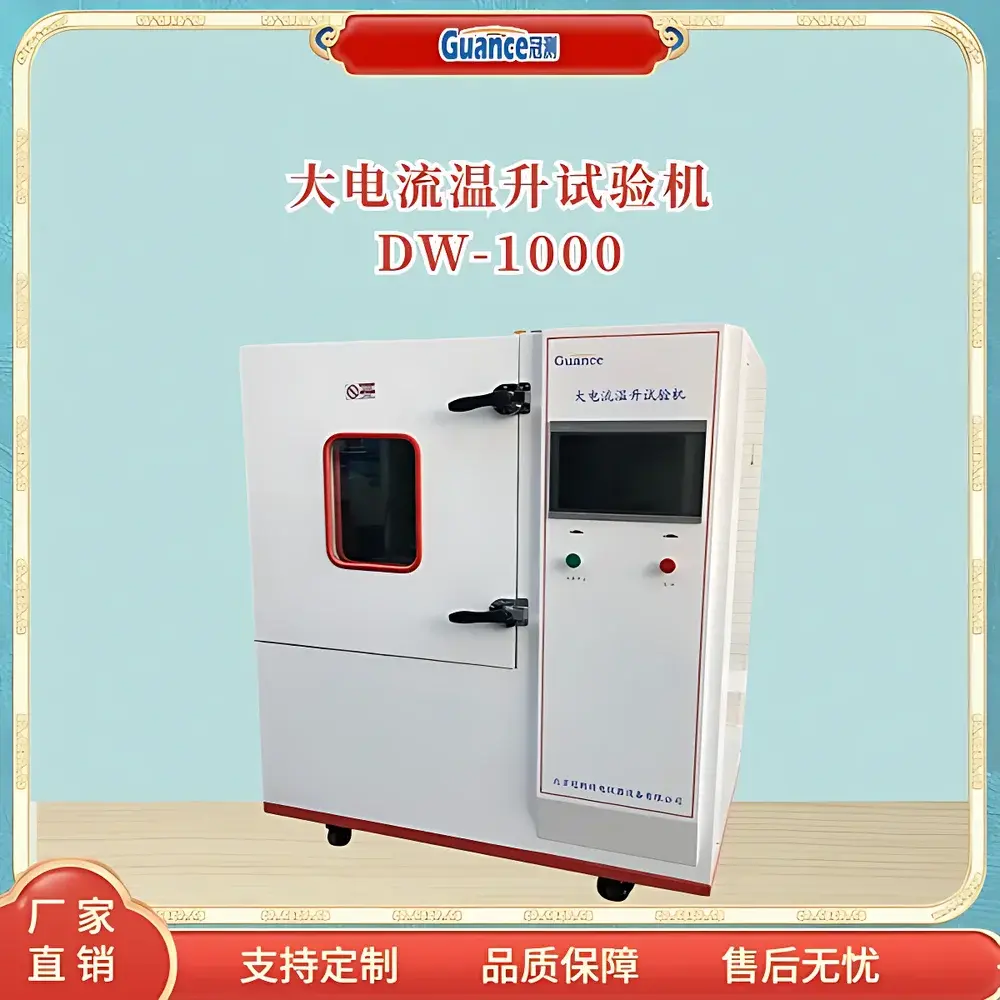
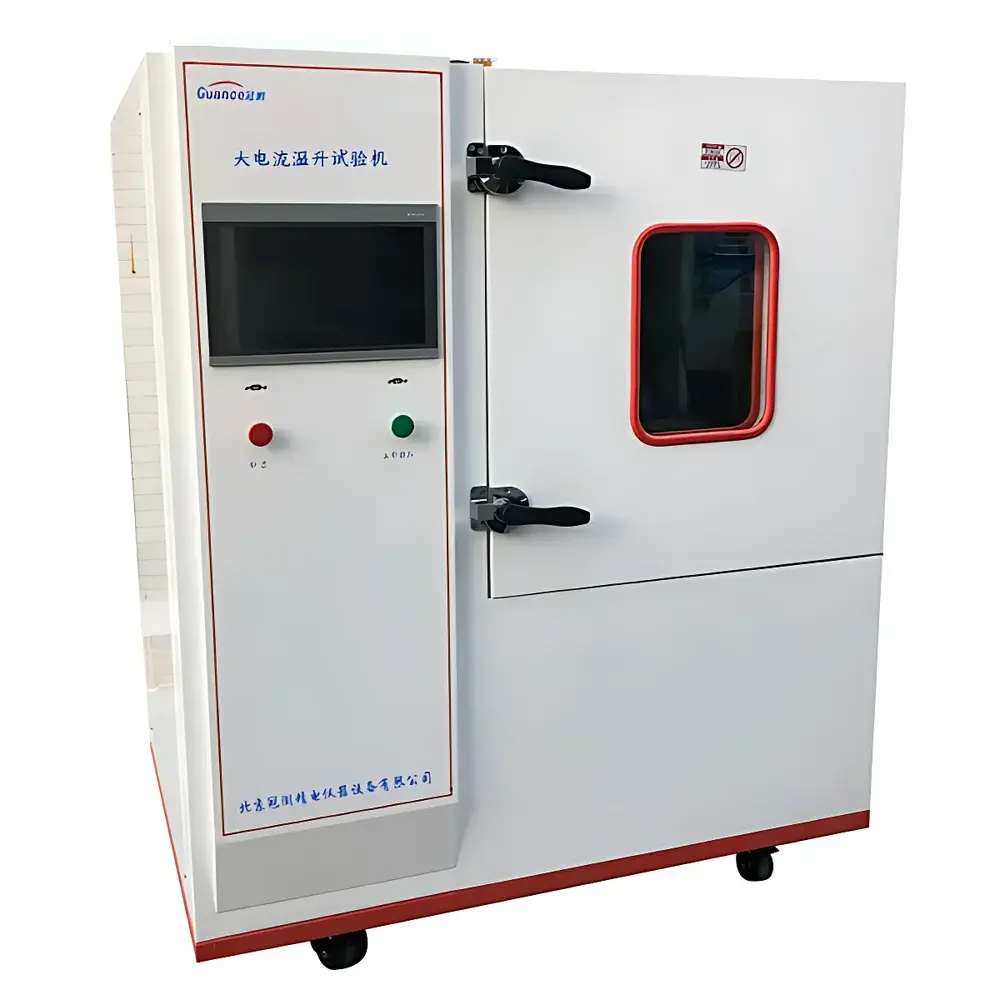
Guance Instruments DW-1000B High-Current Thermal Rise & Multi-Parameter Physical Property Tester
| Brand | Guance Instruments |
|---|---|
| Model | DW-1000B |
| Max Output Current | 1000 A AC |
| Temperature Acquisition Channels | 2 (ambient + sample) |
| Temperature Control | 1 loop |
| Current Accuracy | ±1% FS |
| Power Supply | 380 VAC ±10%, 50 Hz ±0.5 Hz, 20 kW |
| Operating Ambient | –30–40 °C, ≤85% RH, ≤1000 m altitude |
| Enclosure Dimensions (L×W×H) | 1400 × 1150 × 1700 mm |
| Weight | 500 kg |
| Protection | Overcurrent, overtemperature, grounding (≤4 Ω), seismic rating (horizontal 3 m/s² / vertical 1.5 m/s²) |
| Control System | Siemens PLC + 15″ HMI touchscreen |
| Compliance | Designed per IEC 60950-1, GB/T 20641–2014 (low-voltage switchgear thermal testing), and general industrial safety requirements for high-current test environments |
Overview
The Guance Instruments DW-1000B High-Current Thermal Rise & Multi-Parameter Physical Property Tester is an industrial-grade, PLC-controlled test system engineered for standardized evaluation of thermal behavior and electrical integrity under sustained high-current stress. It operates on the principle of Joule heating—applying precisely regulated alternating current (up to 1000 A RMS) to conductive components or assemblies while simultaneously monitoring temperature evolution at two independent points: ambient chamber conditions and direct contact with the test specimen. This dual-sensor architecture enables differential thermal analysis critical for verifying compliance with thermal stability limits defined in low-voltage equipment standards such as IEC 61439 and GB/T 20641. The system is not a general-purpose material analyzer but a dedicated verification platform for busbars, circuit breakers, contactors, fuse holders, and other power distribution elements subjected to continuous or overload current conditions.
Key Features
- Stable 1000 A AC output via internally rectified, voltage-controlled current source with ±1% full-scale accuracy across the operating range;
- Dual-channel temperature acquisition using calibrated PT100-class sensors—one mounted in the test chamber air stream, one in direct thermal contact with the DUT (Device Under Test);
- Integrated PID-based temperature regulation loop for active environmental stabilization during extended tests;
- Siemens S7-series PLC core with deterministic scan cycle, supporting real-time data logging, fault detection, and fail-safe shutdown logic;
- 15-inch industrial-grade capacitive touchscreen HMI with password-protected access levels (operator, engineer, calibration mode);
- Real-time graphical display of current vs. time and dual-temperature vs. time curves, with configurable sampling intervals (1–10 s);
- Comprehensive protection suite including overcurrent tripping, overtemperature cutoff, ground-fault monitoring (ground resistance ≤4 Ω verified), and seismic-rated mechanical mounting;
- Self-contained forced-air thermal uniformity system with axial circulation fans and tubular heating elements ensuring ±2.5 °C spatial gradient within the test volume.
Sample Compatibility & Compliance
The DW-1000B accommodates rigid or semi-rigid conductive specimens up to 300 mm in length and 80 mm in cross-sectional dimension, provided they can be securely terminated to the integrated 1000 A copper busbar interface. It supports both single-point and multi-point thermal attachment (e.g., thermocouple wires, surface-mount RTDs). While not certified to UL or CSA standards out-of-the-box, the system’s architecture aligns with test methodologies referenced in IEC 60947-1 Annex F (thermal endurance of switching devices), IEC 61439-1 Clause 10.10 (temperature rise verification), and GB/T 20641–2014 for low-voltage switchgear thermal validation. Users are responsible for configuring test protocols—including dwell time, ramp rate, and pass/fail thresholds—in accordance with their internal quality procedures or applicable regulatory frameworks (e.g., ISO/IEC 17025 accredited labs).
Software & Data Management
Data acquisition and visualization are handled natively by the embedded PLC runtime and HMI firmware—no external PC or proprietary software installation is required. All measured parameters (current, chamber temperature, DUT temperature, elapsed time) are timestamped and stored in non-volatile memory with 30-day rolling retention. Export is supported via USB 2.0 port in CSV format for post-processing in MATLAB, Excel, or LIMS-compatible tools. Audit trails include operator ID (via login), parameter change logs, alarm events, and calibration history. The system supports manual or automated periodic calibration routines for current transducers, voltage transmitters, and temperature input channels—each with traceable offset/gain adjustment and electronic signature capture. While not FDA 21 CFR Part 11 compliant by default, the architecture permits integration with third-party electronic signature and audit trail modules for GMP-regulated environments.
Applications
- Verification of temperature rise limits in LV switchgear and controlgear assemblies per IEC 61439 series;
- Endurance testing of busbar joints, cable lugs, and compression connectors under sustained 1000 A load;
- Thermal runaway assessment of high-current fuses and fusible links;
- Qualification of thermal management designs in EV charging infrastructure components (e.g., DC busbars, contactor housings);
- Root-cause analysis of premature failure in power distribution units exposed to harmonic-rich waveforms;
- Supporting GLP-compliant validation studies where thermal stability under rated current is a critical quality attribute.
FAQ
What standards does the DW-1000B directly comply with?
The DW-1000B is engineered to support test methods aligned with IEC 61439-1, IEC 60947-1, and GB/T 20641–2014. It is not pre-certified to any standard; final compliance depends on user-defined test execution, documentation, and metrological traceability.
Can the system perform ramp-and-hold current profiles?
Yes—the PLC program supports programmable current ramp rates (A/s), dwell durations, and step sequences up to three discrete phases, all configurable via the HMI.
Is remote monitoring or Ethernet connectivity available?
Standard configuration includes only local HMI and USB export. Optional PROFINET or Modbus TCP communication modules can be added for SCADA integration.
What maintenance is required for long-term accuracy?
Annual verification of current transducers and temperature inputs against NIST-traceable references is recommended. Fan filters should be cleaned quarterly; heating element resistance checked biannually.
Does the system include calibration certificates?
Factory calibration data is provided for all sensor inputs. Full ISO/IEC 17025-accredited calibration certificates require engagement with an authorized third-party lab.



