
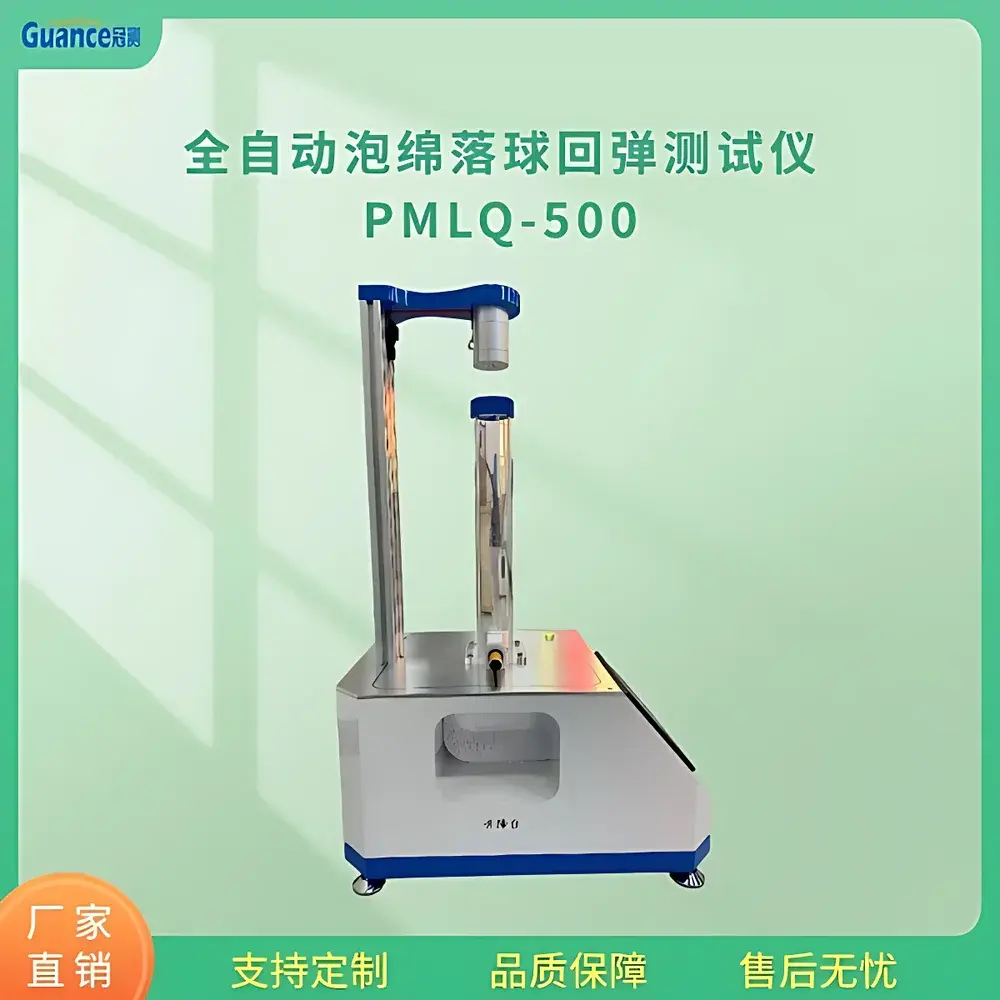
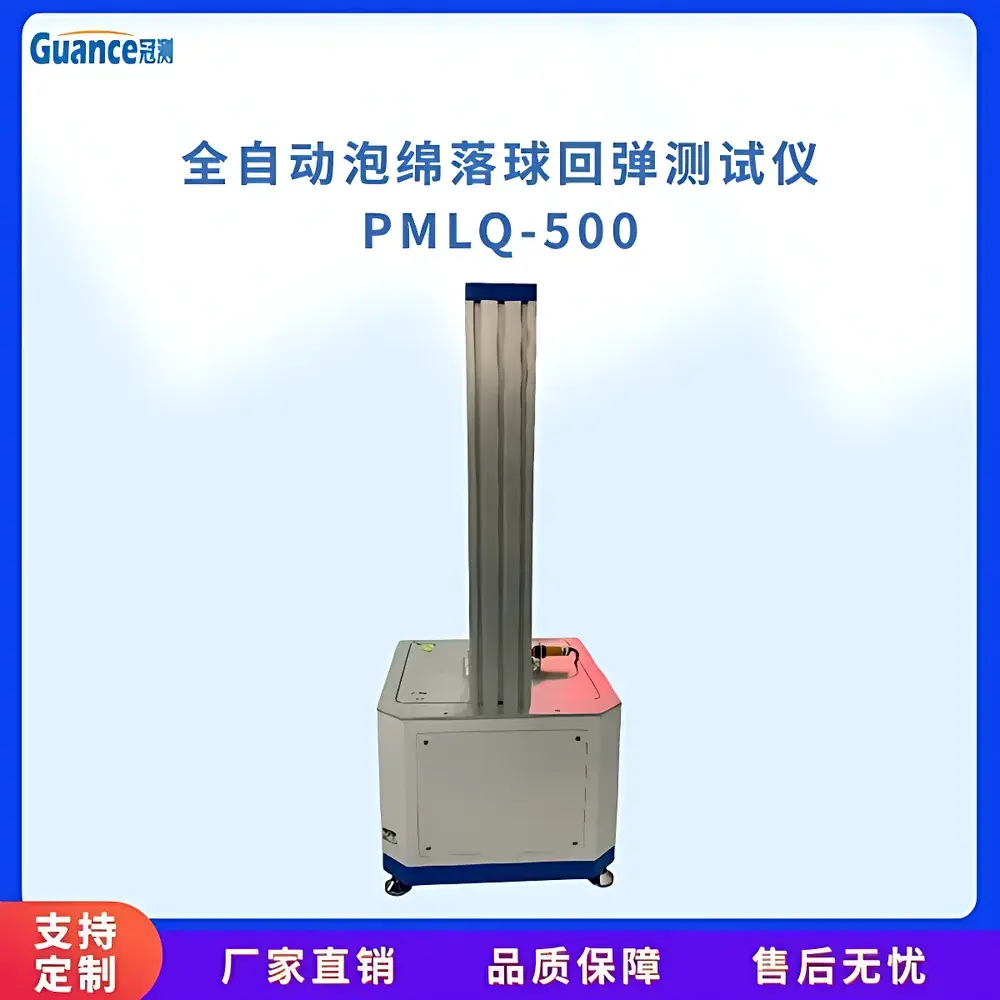
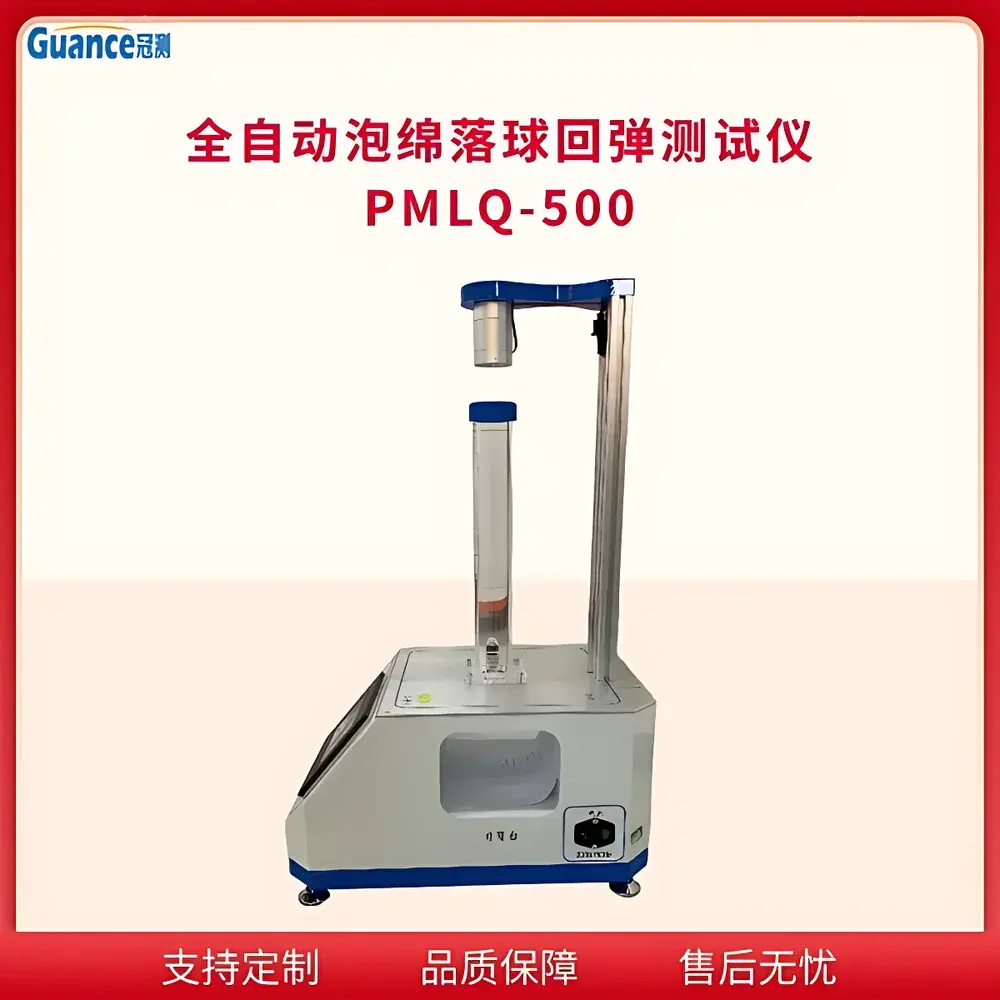
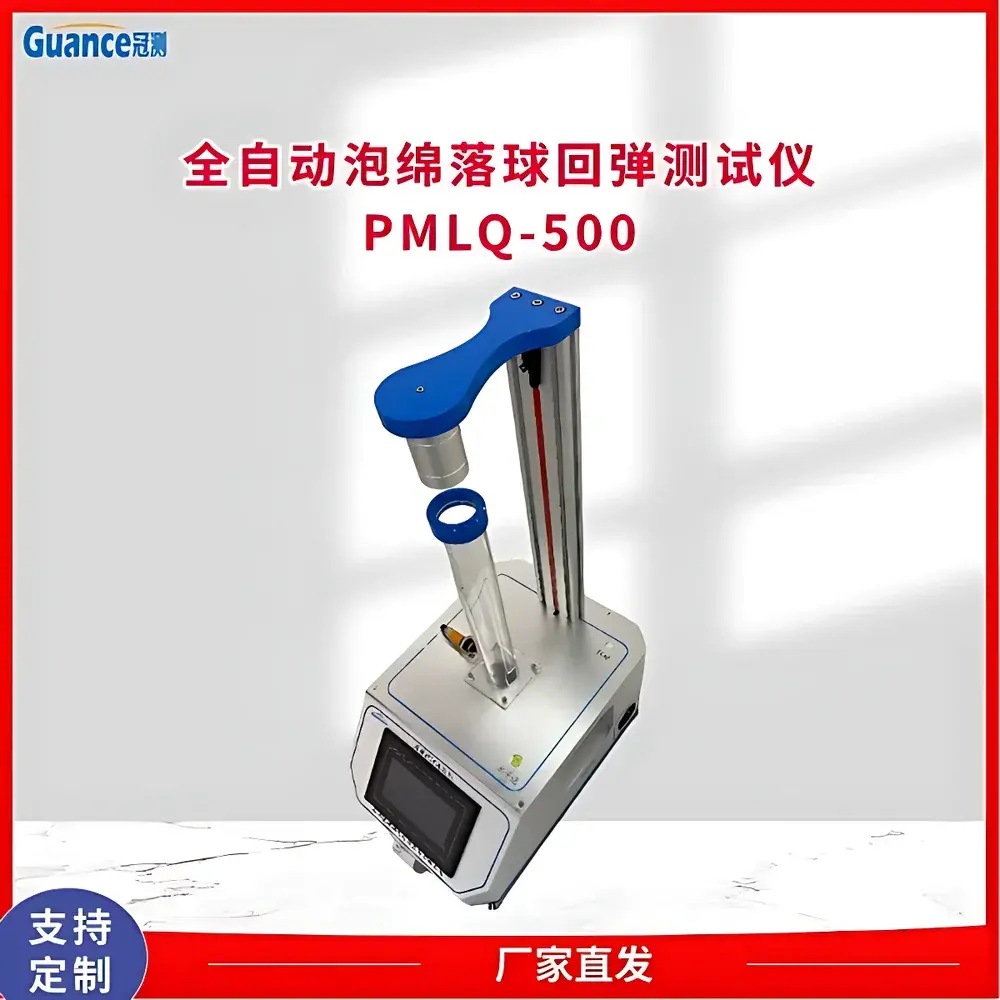
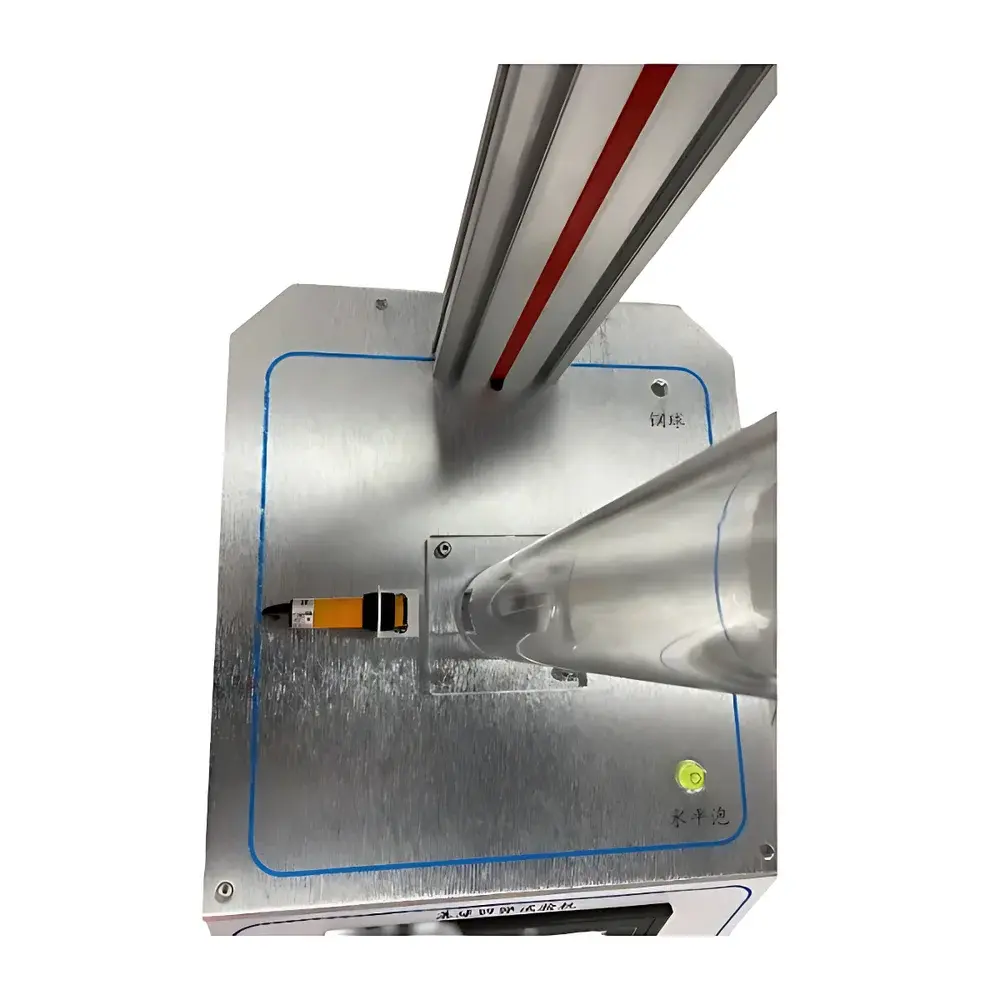
GuanCe Instruments PMLQ-500-1 Ball Rebound Tester for Flexible Polyurethane Foam
| Brand | GuanCe Instruments |
|---|---|
| Origin | Beijing, China |
| Model | PMLQ-500-1 |
| Drop Height | 460 mm (GB/ISO), 500 mm (ASTM) |
| Steel Ball Diameter | 16 mm |
| Guide Tube ID | 50 mm (transparent acrylic) |
| Sample Size | 100 × 100 × 50/100 mm |
| Test Replicates | 3 specimens × 3 drops each |
| Rebound Accuracy | <1% |
| Power Supply | 220 V / 50 Hz |
| Dimensions (L×W×H) | 560 × 360 × 860 mm |
| Weight | 25 kg |
| Control System | Siemens PLC with 7-inch HMI touchscreen |
Overview
The GuanCe Instruments PMLQ-500-1 Ball Rebound Tester is an engineered solution for the quantitative determination of elastic recovery performance in flexible polymeric foams—primarily soft polyurethane (PU) foam—according to internationally harmonized test standards. It operates on the principle of free-fall impact mechanics: a standardized steel ball of defined mass and diameter is released from a precisely controlled height onto a horizontally mounted foam specimen. The vertical rebound height is measured, and the rebound ratio—expressed as a percentage of the original drop height—is calculated to quantify the material’s resilience. This method is grounded in classical energy dissipation theory, where the ratio reflects the proportion of kinetic energy retained after impact, directly correlating with internal viscoelastic structure, cell wall integrity, and crosslink density. Designed for routine QC/QA laboratories and R&D centers, the instrument delivers traceable, repeatable measurements compliant with GB/T 6670–2008, ISO 8307, ASTM D3574 (Method A), and GB/T 10652–2001. Its mechanical architecture eliminates operator-induced variability through center-aligned electromagnetic release and optical height sensing—ensuring strict adherence to the standard requirement that the ball must fall freely without rotation or lateral deviation.
Key Features
- Electromagnetic ball release mechanism ensures axial alignment and zero rotational perturbation during free fall—critical for compliance with ASTM D3574 and ISO 8307 positional constraints.
- Integrated 7-inch industrial HMI touchscreen with Siemens PLC-based control logic enables intuitive parameter setup, real-time monitoring, and full audit trail of test sequences.
- Dual-mode height measurement: automatic optical detection of rebound height plus calibrated manual scale verification—supporting data cross-validation per GLP best practices.
- Automated statistical processing: computes individual rebound ratios, filters outliers per predefined validity criteria, and reports mean rebound height and mean rebound percentage across three specimens (each tested thrice).
- Specimen batch management system assigns unique IDs, timestamps, and operator tags to each test series—enabling traceability in regulated environments.
- Robust transparent acrylic guide tube (ID 50 mm) provides unobstructed visual access while maintaining consistent air resistance conditions across tests.
- Desktop footprint (560 × 360 × 860 mm) and 25 kg mass ensure stability during high-frequency testing without anchoring requirements.
Sample Compatibility & Compliance
The PMLQ-500-1 is validated for use with flexible open-cell polyurethane foams in slab, molded, or bonded forms, within dimensional limits of 100 mm × 100 mm × 50/100 mm. It supports both standard-compliant conditioning protocols (e.g., ISO 293, ASTM D3574 preconditioning at 23 ± 2°C and 50 ± 5% RH for 16 h) and post-test dimensional stability checks. Regulatory alignment includes full technical conformity with: GB/T 6670–2008 (equivalent to ISO 8307), ASTM D3574–22 Section 4 (Ball Rebound Method), and GB/T 10652–2001. While not certified to IEC 61000 or CE marking requirements out-of-box, its electrical design (220 V / 50 Hz, Class I insulation) meets baseline safety expectations for laboratory instrumentation under national metrological supervision in China. Documentation packages include calibration certificates for height sensors and traceable steel ball certification (material grade, hardness, sphericity < 0.5 µm).
Software & Data Management
Firmware embedded in the Siemens S7-1200 PLC handles all real-time acquisition, filtering, and arithmetic operations—eliminating external PC dependency and reducing software validation burden. Test records are stored locally in non-volatile memory with timestamp, operator ID, specimen ID, raw rebound heights (mm), computed ratios (%), and pass/fail flags based on user-defined acceptance thresholds. Export options include USB-stick CSV dumps compatible with LIMS integration (e.g., LabWare, Thermo Fisher SampleManager). Audit trails log all parameter changes, system resets, and calibration events—supporting FDA 21 CFR Part 11 readiness when deployed with supplementary electronic signature workflows. Firmware updates are delivered free-of-charge via secure download and retain all historical configuration settings.
Applications
This tester serves critical roles in polyurethane formulation development, incoming raw material screening, production line process control, and third-party certification testing. Typical use cases include: comparative evaluation of catalyst systems affecting network elasticity; assessment of filler dispersion homogeneity in flame-retardant foams; validation of aging effects (thermal, UV, compression set) on rebound retention; and supplier qualification against OEM specifications (e.g., automotive seating, mattress core layers). Its repeatability (<1% CV for homogeneous batches) makes it suitable for SPC charting and capability analysis (Cp/Cpk) in ISO 9001-certified facilities. Academic researchers also employ it for structure–property correlation studies linking foam morphology (cell size distribution, strut thickness) to macroscopic resilience behavior.
FAQ
What standards does the PMLQ-500-1 fully support?
It complies with GB/T 6670–2008, ISO 8307:2017, ASTM D3574–22 (Method A), and GB/T 10652–2001 for flexible polyurethane foam rebound testing.
Is electromagnetic release mandatory for standard compliance?
Yes—ASTM D3574 and ISO 8307 explicitly require the ball to fall “freely without rotation” and “centered within the guide tube.” Manual release introduces angular momentum and lateral drift, invalidating results.
Can the instrument store test data long-term without external software?
Yes—internal flash memory retains ≥10,000 test records with full metadata; USB export enables archival to network drives or LIMS.
Does the system support IQ/OQ/PQ documentation packages?
GuanCe provides standardized IQ/OQ templates upon request; PQ execution requires site-specific environmental verification and reference material testing.
What maintenance is required to sustain measurement accuracy?
Annual verification of guide tube verticality (±0.2°), steel ball surface finish (visual + profilometry), and optical sensor linearity using NIST-traceable height gauges is recommended.
Related Products



